The 7 Musical Modes: A Guide to Playing by Ear
Hear Music in Color: Your Guide to the 7 Musical Modes
Ever hear two songs built from almost the same notes, yet one feels bright and settled while the other feels restless, dark, or suspended? That difference is mode, and the fastest way to learn modes is to train your ear for their sound, not just memorize scale formulas.
The seven diatonic modes, Ionian, Dorian, Phrygian, Lydian, Mixolydian, Aeolian, and Locrian, all come from the same major-scale note set. What changes is the tonal center and the note that gives each mode its identity. On paper, that looks simple. In practice, hearing that identity inside real melodies, bass lines, and chord loops takes focused repetition.
That distinction matters for playing by ear because each mode leaves a reliable fingerprint. Dorian carries a minor sound with a brighter lift. Lydian opens up through its raised fourth. Mixolydian relaxes the major scale by lowering the seventh. Once you can hear those cues, you stop treating modes like a theory quiz and start using them as listening targets.
If your scale foundation still feels shaky, build that first with ear training for scales and tonal center.
I approach the seven modes as a practical ear training roadmap. Learn the home note. Isolate the characteristic tone. Sing it against a drone or chord. Then test it in an app until the sound becomes familiar enough to catch in actual music. That is how modes become usable. Not as labels to recite, but as flavors you can recognize, sing, and choose on purpose.
Table of Contents
- 1. Ionian Mode (Major Scale)
- 2. Dorian Mode
- 3. Phrygian Mode
- 4. Lydian Mode
- 5. Mixolydian Mode
- 6. Aeolian Mode (Natural Minor Scale)
- 7. Locrian Mode
- 7 Musical Modes Comparison
- Your 10-Minute Daily Plan to Master the Modes
1. Ionian Mode (Major Scale)
If you’re serious about the 7 musical modes, start with the one your ear already knows best. Ionian is the major scale. It’s the default sound of resolution for a lot of Western listening, which is why it’s the best reference point for beginners learning to play by ear.
The biggest mistake I see is students rushing past Ionian because it seems too basic. That usually backfires. If you can’t hear major clearly, you won’t hear how the other modes differ from it.
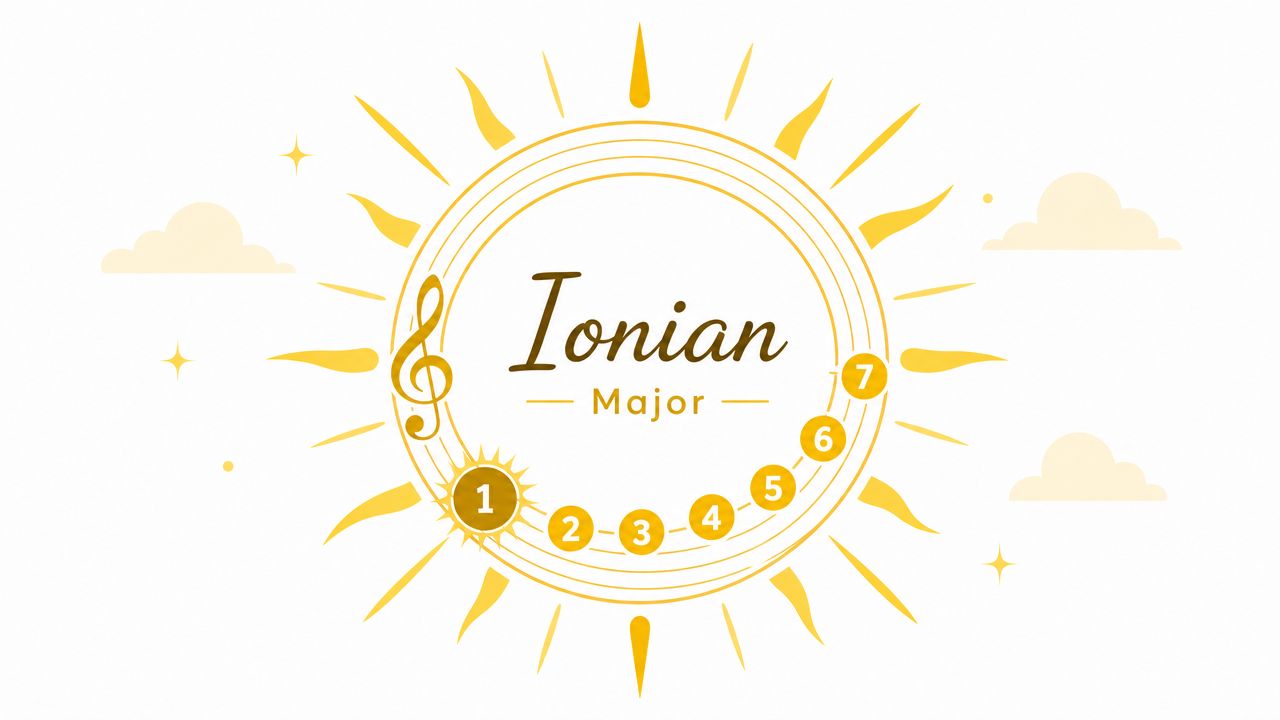
A familiar melody like “Twinkle, Twinkle Little Star” works well here. So does “Happy Birthday.” These aren’t childish examples. They’re useful because the tonal center is obvious, and obvious is exactly what your ear needs at first.
Hear home base first
Ionian sounds bright, settled, and complete. In practical listening, the notes that often help people lock in the sound are the major 3rd and major 7th. The 3rd gives the mode its clear major color. The 7th gives it that pull back to home.
A short practice routine works better than a long theory session:
- Sing the scale slowly: Ascend and descend on one instrument note at a time, then sing it without help.
- Play simple cadences: I-IV-V-I progressions make the “home” feeling unmistakable.
- Compare before labeling: Play Ionian, then switch to another mode built from the same notes and ask what changed in the sound.
- Use a visual tool after listening: A scale map helps, but only after your ear has made a guess.
For instrument support, a scale ear training guide for musicians can help connect what you’re hearing to what you’re playing.
Practical rule: Ionian isn’t just one of the modes. It’s your control group. Train it first, then measure every other mode against it.
2. Dorian Mode
Dorian is where many players first realize modes are useful. It sounds minor, but not fully dark. There’s lift in it. That’s why it shows up so often in jazz, funk, groove-based playing, and folk melodies that feel reflective without collapsing into sadness.
If Aeolian feels like a closed room, Dorian feels like someone opened a window.
Real music makes this clear fast. “So What” by Miles Davis is a classic entry point. “Impressions” by John Coltrane is another. “Scarborough Fair” is often a helpful folk example because the modal pull is easier to sing than a fast jazz line.
The note that gives Dorian away
The fastest way to hear Dorian is not “second mode of the major scale.” That description helps on paper, not in your ear. A key characteristic is this: Dorian is minor with a raised 6th.
That one note changes everything. It keeps the mode from sounding like natural minor.
Try this in practice:
- Alternate Aeolian and Dorian: Keep the same root and sing both back to back.
- Hold a minor chord underneath: A simple minor vamp makes the raised 6th easier to notice.
- Target the 6th in your melody: Don’t just run the scale. Land on that note and stay there long enough to hear the color.
- Train intervals separately: If your 6ths are fuzzy, mode recognition will stay fuzzy too.
For that reason, interval training for musicians matters more here than memorizing another fingering shape.
Dorian usually clicks when you stop asking, “What scale is this?” and start asking, “Does this minor sound have light in it?”
What doesn’t work is speed-drilling all seven names and hoping they’ll stick. What does work is repeating one minor vamp and training your ear to notice whether the 6th sounds natural minor or brighter than expected.
3. Phrygian Mode
Phrygian doesn’t hide. When it’s strong, you hear it almost immediately. The sound is dark, compressed, and tense because of the lowered 2nd. That half-step above the root creates friction right at the front door of the scale.
That’s why Phrygian often shows up in flamenco colors, heavy riffs, and music that wants an unsettled edge rather than a smooth minor mood.
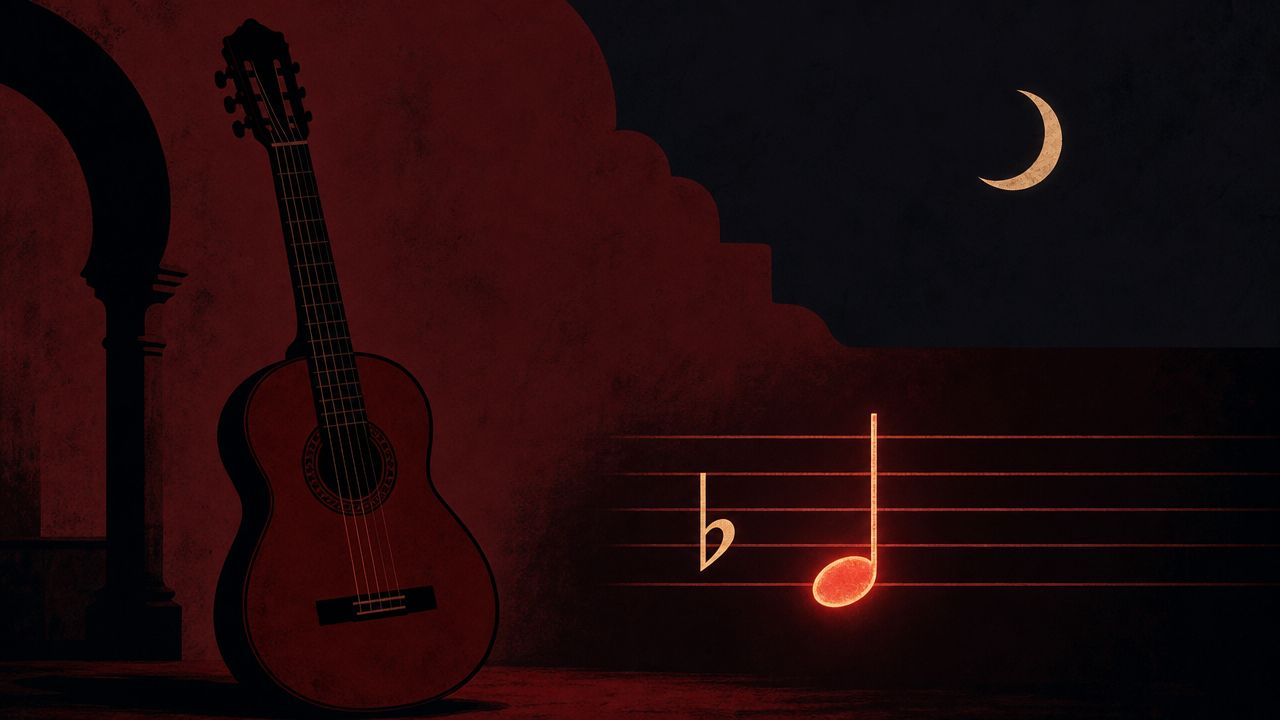
If you’re training by ear, don’t start by running all the notes. Start with the root and lowered 2nd only. That tiny movement carries most of the identity.
Train the half-step tension
Phrygian is minor-like, but it doesn’t feel like Aeolian or Dorian. The lowered 2nd is the clue. Sing root to flat 2, then back to root. Repeat until you can recognize the bite of that interval without looking at your instrument.
A few good practice moves:
- Isolate the first two notes: Root to flat 2 is more important than a full scale run at first.
- Compare with Aeolian: Same root, different 2nd. The contrast is easy to hear once you focus on it.
- Use slow singing: Fast playing hides bad hearing. Slow singing exposes it and fixes it.
- Listen in style: Flamenco guitar, metal riffs, and darker modal passages teach the color better than a worksheet does.
There’s also a mental shift here. Many players try to “understand” Phrygian before they can hear it. Reverse that process. Hear the tension first. Name it second.
When the note right above the tonic sounds uncomfortably close, you’re often in Phrygian territory.
This is one of the most useful modes for ear training because the signal is so strong. If you can identify Phrygian quickly, you’re learning to recognize function by sound, not by note spelling.
4. Lydian Mode
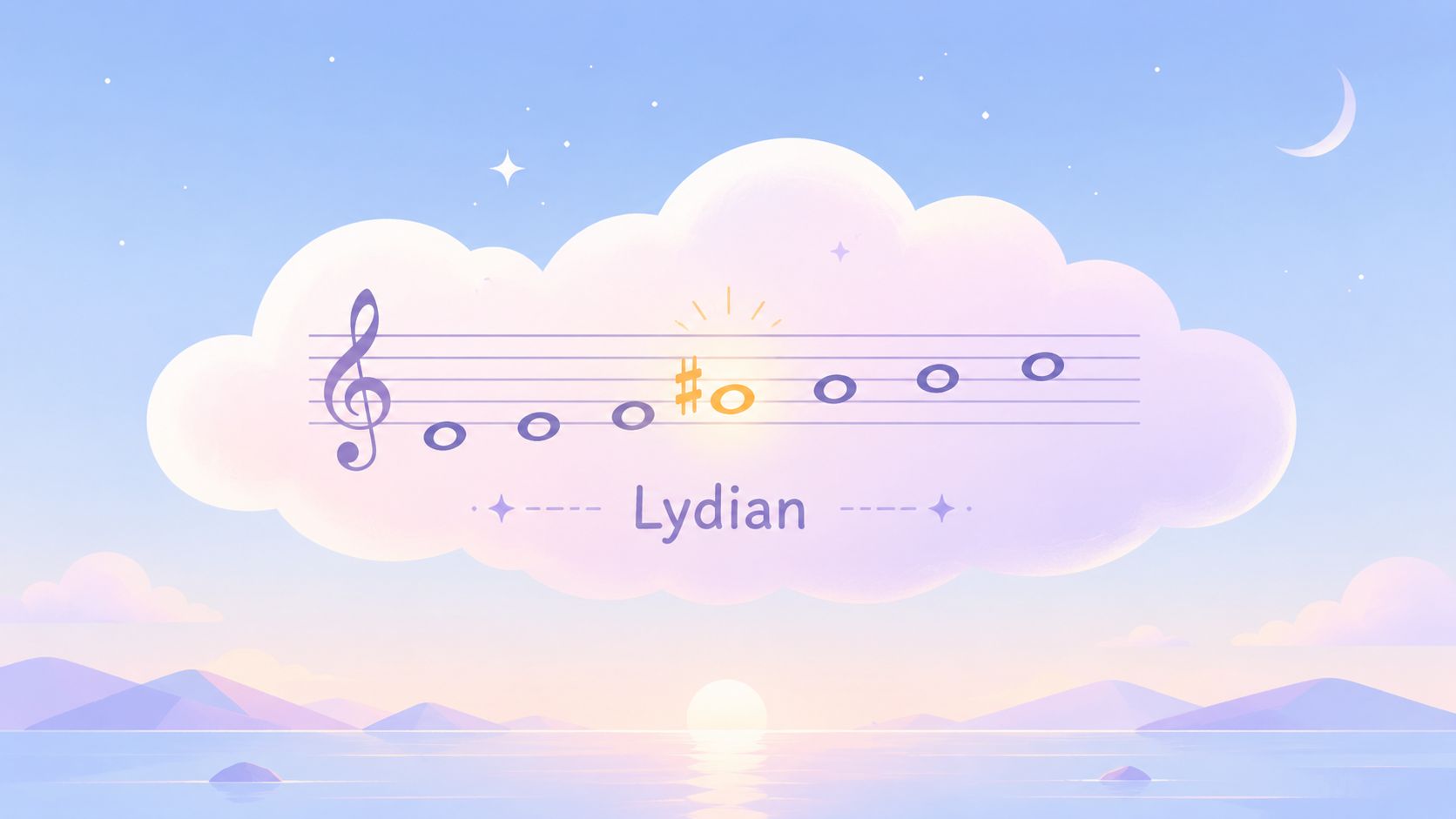
Lydian is one of the easiest modes to love and one of the easiest to mishear. At first glance it seems like plain major. Then one note changes the atmosphere completely.
That note is the raised 4th.
Lydian belongs to the major-like side of the modal family, and theorists often group the seven modes as three major-like modes, three minor-like modes, and one unusual mode, which is a useful way to hear the overall picture rather than memorize it mechanically. In that group, Lydian is the major sound that feels brightest and most floating because of that altered 4th, while the full set still remains part of the same seven-note rotational system described in this overview of modal rotation and color.
Listen for the raised fourth
The mistake here is hearing “bright major” and stopping there. Ionian is bright too. Lydian has a suspended, dreamy pull because the 4th is sharpened. If you want to train it by ear, spend less time on the whole scale and more time on the leap from the root to that raised 4th.
Try this approach:
- Play a major chord drone: Then sing the natural 4th and the raised 4th against it.
- Compare Ionian and Lydian directly: Same tonic, one changed note. That’s all your ear needs.
- Use film and modern jazz references: Long sustained harmony makes the color easier to catch.
- Pause on the sharp 4: Don’t rush past the defining note.
A lot of players confuse Lydian with “just major but prettier.” That’s too vague to help your ear. Train the exact note that creates the float.
5. Mixolydian Mode
What makes a major sound feel a little rougher, looser, and more conversational instead of polished and final? In Mixolydian, the answer is the lowered 7th.
This mode shows up in working musical situations all the time. Rock hooks, blues melodies, funk vamps, country turns, jam-band solos, and any groove that sits on a dominant chord for a while. Players often know the sound before they know the name.
The ear-training job is clear. Hear the contrast between Ionian and Mixolydian without changing the tonic. Both give you a major 3rd. Mixolydian changes the 7th, and that one note removes the strong pull back to home that you hear in plain major. The result is more open-ended. It keeps moving instead of sounding neatly resolved.
Train the sound in context
Start with a drone or vamp on a dominant chord, then sing 1, 3, 5, b7 until that color feels stable. After that, switch between the natural 7 and flat 7 on the same root. If you cannot hear that difference quickly, the full scale will not help much.
A practical routine:
- Use a dominant vamp: Mixolydian makes immediate sense when the harmony supports the b7.
- Alternate Ionian and Mixolydian on the same tonic: This is the fastest way to hear what changed.
- Steal phrases from blues and rock recordings: Short melodic fragments teach the sound better than running scale patterns.
- Sing the b7 before you play it: Ear first, fingers second.
- Practice chord and mode together: This guide to hearing chords and harmonic emotion helps connect the scale color to the harmony under it.
There is a trade-off here. If you only practice Mixolydian as a seven-note pattern, you may play it correctly and still fail to recognize it in real music. If you train the b7 against a major or dominant setting every day, recognition gets much faster.
Listening shortcut: If a groove sounds major but the melody favors the flat 7 and avoids a strong leading-tone finish, test for Mixolydian.
6. Aeolian Mode (Natural Minor Scale)
How do you train your ear to hear “minor” as a clear sound instead of a vague sad mood? Aeolian is the answer. It gives you a reliable minor reference, and without that reference, Dorian and Phrygian tend to blur together.
Aeolian is the natural minor scale. In practical ear training, it works as the baseline minor color you return to again and again. If Ionian teaches your ear what settled major sounds like, Aeolian does the same job for settled minor.
The key skill here is hearing minor as stable. Many players can identify that something sounds darker, but they cannot tell which kind of minor they are hearing. That slows everything down. Once Aeolian feels like home, the raised 6 in Dorian and the flat 2 in Phrygian stand out much faster.
Build a dependable minor sound
Use a drone, tonic pedal, or short vamp that keeps the root obvious. Aeolian gets easier to hear when the tonic is not in question.
A practical routine:
- Sing 1, b3, 5, b6, b7 over a minor tonic: Those tones define the color quickly.
- Alternate Ionian and Aeolian on the same root: This trains your ear to hear the shift from 3, 6, and 7 to b3, b6, and b7.
- Use common Aeolian harmony: Progressions like i, bVI, bVII help the sound settle into your ear.
- Transcribe short minor melodies: Two bars of a hook will teach the mode better than running the scale up and down.
- Check yourself with an ear training app or keyboard drone: Sing first, then play to confirm. Ear first, fingers second.
There is a trade-off. If you practice only the full scale shape, you may recognize “minor” in your hands but not in real music. If you train the tonic, b3, b6, and b7 as a sound family, recognition becomes much more reliable.
Ten focused minutes a day works better than occasional long sessions. Aeolian is not the most exotic mode, but it does more work than players expect. A strong Aeolian reference makes the rest of your mode training easier to hear, compare, and remember.
7. Locrian Mode
Locrian is the odd one, and it’s supposed to feel that way. Among the seven modes, it’s commonly treated as the unusual mode because its structure is unstable from the ground up. The most important detail is the flattened fifth, which creates tritone tension and makes the mode feel less settled than the others. If you’ve ever played a scale and felt like it resisted becoming a real home key, that’s the Locrian problem.
Don’t force this one too early. Locrian is useful, but it’s better as advanced ear training than as your starting point.
Why Locrian feels unstable
The two notes to focus on are the flat 2 and the flat 5. The flat 2 gives some of the same bite you hear in Phrygian. The flat 5 changes the core stability of the mode itself.
That flattened fifth is why Locrian is often described as the most dissonant of the seven in practical theory discussions. A stable tonic triad is hard to feel when the fifth above the root is diminished.

A better practice strategy:
- Study it last, not first: Build strong Ionian, Aeolian, Dorian, and Mixolydian hearing first.
- Sing small fragments: Root, flat 2, flat 5, then back to root.
- Use sparse harmony: Dense accompaniment can hide what’s distinctive.
- Treat it like tension training: It’s less about “playing songs in Locrian” and more about hearing instability clearly.
Existing mode lessons often stay theory-first and don’t answer the fundamental question musicians ask, which is how to hear a mode quickly when the tonic isn’t obvious. This practical overview of mode recognition by characteristic scale degree points toward the right idea. You hear the defining alteration against a tonal center, not just a scale formula on paper.
Locrian becomes useful when your ear stops asking whether it sounds “wrong” and starts hearing exactly why it sounds unstable.
7 Musical Modes Comparison
| Mode | Complexity 🔄 (implementation) | Resources ⚡ (requirements) | Expected outcomes 📊⭐ | Ideal use cases 💡 | Key advantages ⭐ |
|---|---|---|---|---|---|
| Ionian (Major Scale) | Low 🔄, basic scale structure, beginner-friendly | Minimal ⚡, basic instrument and theory practice | High 📊⭐, clear major tonality; strong ear‑training foundation | Ear training, pop, folk, basic harmony | Instantly recognizable; easy to sing and build progressions |
| Dorian | Medium 🔄, minor framework with raised 6th needs contrast | Low–Medium ⚡, modal vamps and jazz/funk examples | Medium–High 📊⭐, jazzy/minor-with-hope color, versatile for solos | Jazz, funk, soul, modal improvisation | Distinctive jazzy color; suits funk and modal grooves |
| Phrygian | Medium–High 🔄, lowered 2nd creates half‑step tension | Medium ⚡, exposure to flamenco/world styles helpful | Medium 📊, dark, exotic flavor; strong tension | Flamenco, metal, world music, dramatic atmospheres | Immediate exotic/dissonant character; dramatic effect |
| Lydian | Medium 🔄, raised 4th requires harmonic awareness | Medium ⚡, orchestral/jazz examples improve use | High 📊⭐, bright, ethereal, cinematic color | Film scoring, modern jazz, ambient textures | Dreamlike major variant; memorable melodic color |
| Mixolydian | Low–Medium 🔄, major with flat 7th, intuitive for players | Low ⚡, common in guitar/band settings | High 📊⭐, bluesy dominant feel; groove-oriented results | Blues, rock, funk, dominant‑7 improvisation | Strong blues character; easy for improvisation and riffs |
| Aeolian (Natural Minor) | Low 🔄, standard natural minor, widely taught | Minimal ⚡, standard minor-key practice | High 📊, reliable minor tonal reference for ear training | Minor‑key songwriting, rock/metal, classical minor passages | Principal minor scale; broad genre applicability |
| Locrian | High 🔄, diminished 5th and flat 2 complicate usage | High ⚡, advanced harmonic context and study required | Low–Medium 📊, very dissonant; niche expressive payoff | Horror scores, avant‑garde, diminished harmony studies | Unique, unforgettable dissonance; essential for diminished theory |
Your 10-Minute Daily Plan to Master the Modes
The fastest way to learn the 7 musical modes isn’t to memorize seven formulas in one sitting. It’s to build seven distinct sound memories. That’s an ear-training job, not a note-labeling job.
A good weekly cycle keeps things simple. Pick one mode and stay with it for several days. Sing it, play it, compare it to Ionian or Aeolian, and listen for the one note that gives it away. If you try to master all seven at once, most of them blur together.
Here’s a practical 10-minute session that works:
- Minute 1 to 2: Play the tonic and sing the mode slowly up and down.
- Minute 3 to 4: Isolate the characteristic note. Raised 6 for Dorian, flat 2 for Phrygian, raised 4 for Lydian, flat 7 for Mixolydian.
- Minute 5 to 6: Compare it to the closest familiar mode. Major-like against Ionian, minor-like against Aeolian.
- Minute 7 to 8: Improvise a short melody over a drone or simple vamp.
- Minute 9 to 10: Test yourself without looking. Sing first, then check on your instrument.
That kind of repetition matters because ear training is trainable. It isn’t some fixed gift you either have or don’t. Your brain learns recurring sound relationships the same way your hands learn chord shapes. Short, consistent exposure builds recognition much faster than occasional cramming.
What doesn’t work is passive listening with no task. What works is active listening with one target. Hear the mode, sing the mode, identify the note that creates the color, then apply it in real music.
If you want better improvisation, stronger chord recognition, cleaner transcription, and more confidence when you play by ear, modal training helps because it sharpens how you hear tonal center and scale behavior in context. It also helps with the broader goal many musicians care about when they talk about perfect pitch. Not magical note naming, but dependable listening skills that hold up in actual songs.
Train one mode at a time. Keep the sessions short. Stay consistent. Your ear will get better, and you won’t need to guess nearly as often.
If you want a daily system for ear training instead of scattered theory practice, Trill: Ear Training Daily is built for that. It helps musicians train intervals, chords, notes, and scales with short focused sessions that support playing by ear, chord recognition, improvisation, and even long-term perfect pitch development. If you’re ready to stop guessing and start hearing music more clearly, Trill gives you a practical 10-minute-a-day path.