Gospel Chord Progressions: Learn to Play by Ear
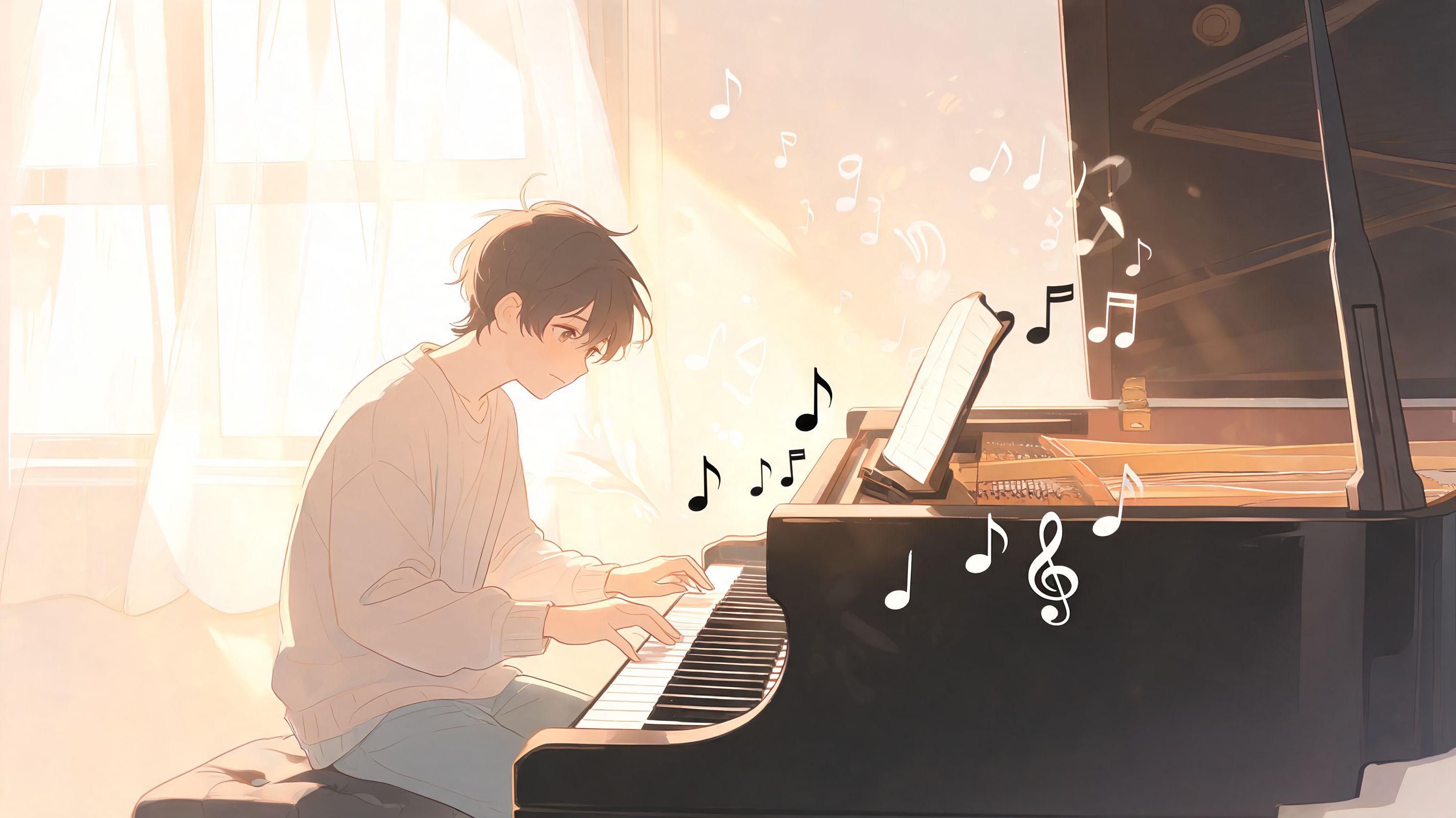
You sit at the piano, or pick up your guitar, and gospel music makes immediate sense to your heart. You can feel the lift before the chorus lands. You can feel the ache in a turnaround. You can hear when the band is about to resolve, even if you can’t name the chord.
Then you try to play it yourself.
Suddenly that clear feeling turns foggy. The sound feels familiar, but your hands don’t know where to go. You might know a few chord shapes. You might even recognize a key. But authentic gospel chord progressions still seem like a secret language other musicians somehow absorbed naturally.
They didn’t. They trained their ears.
That’s the shift that changes everything. If you want to play by ear, improvise, follow singers, and stop relying on charts, you need more than chord theory. You need to learn how gospel harmony feels and sounds in real time.
Table of Contents
- Why You Can Feel Gospel Music But Can’t Play It Yet
- What Makes Gospel Music Sound So Powerful
- The 3 Core Gospel Chord Progressions You Must Know
- Beyond the Basics Adding Richer Gospel Color
- How to Train Your Ear to Hear Gospel Progressions
- Your Daily 10 Minute Routine for Musical Freedom
Why You Can Feel Gospel Music But Can’t Play It Yet
A lot of beginners think they’re stuck because they don’t know enough theory. That’s usually not the actual problem. The actual problem is that they haven’t trained the ear to recognize movement fast enough.
You hear a singer hold a note, the pianist plays a rich turnaround, and you know something important just happened. But if someone asked you whether that sound was a 2-5-1, a plagal move, or a passing chord, you might freeze. That gap is normal.
Most online lessons don’t help much with this. They show hand positions, chord charts, and flashy voicings. One analysis found that 90% of tutorials demonstrate fingerings on piano, yet they don’t teach musicians to hear these sounds in real time, which leaves a major skill gap for anyone who wants to improvise or play live, as noted in this Pianote overview of gospel progressions.
The missing skill isn’t talent
If you’ve ever said, “I can’t do this because I don’t have perfect pitch,” stop there.
Perfect pitch isn’t the requirement for gospel playing. Strong relative hearing is. Gospel musicians survive by hearing relationships. They hear tension moving to release. They hear a bass note rising. They hear a dominant chord wanting to resolve. That skill is trainable.
Practical rule: If you can already tell when a song feels settled or unsettled, your ear is working. It just needs structure and repetition.
A church musician often has to react instantly. The singer extends a phrase. The preacher starts humming. The band vamps longer than expected. In those moments, nobody has time to search a chord chart. The player who can hear function stays calm.
Why charts alone keep you stuck
Charts can show you what happened after the fact. They rarely help you predict what’s about to happen.
That’s why so many musicians know chords on paper but still can’t play by ear. They memorize labels without connecting those labels to sound. Gospel chord progressions only become useful when your ear starts anticipating them before your hands play them.
You don’t need more random voicings. You need repeated listening, singing, and recognition.
What Makes Gospel Music Sound So Powerful
Gospel harmony moves people because it balances tension and release so well. One chord creates expectation. The next chord answers it. That emotional push and pull is what makes the music feel alive.
Visualize stretching a rubber band and letting it snap back. The stretch is tension. The release is home. Gospel uses that motion constantly, and great players learn to hear it before they try to explain it.
Rich chords are colors, not complications
A basic major or minor chord can do a lot. But gospel usually adds more color with tones like 7ths and 9ths. Those extra notes don’t exist to make music look advanced. They deepen the emotional shade of the chord.
If triads are primary colors, gospel harmony is a fuller palette. You still need the basic shape underneath, but the added notes make the sound warmer, brighter, heavier, or more urgent. If you want a simple foundation for hearing how chords create feeling, this guide on the chords foundation of musical emotion lays it out clearly.
Here’s a simple way to hear the difference:
| Chord type | What it often feels like | How to listen for it |
|---|---|---|
| Major triad | Stable, open | Feels plain and settled |
| Minor triad | Softer, sadder | Feels darker right away |
| Dominant 7 | Unfinished, pulling | Sounds like it needs to go somewhere |
| Major 7 or 9 | Full, warm, luminous | Feels more spacious than a plain major chord |
Gospel harmony speaks in motion
The power isn’t only in the chord itself. It’s in what that chord is doing.
A strong gospel player hears function. One chord prepares. One chord leans forward. One chord lands. Once you start hearing jobs instead of isolated shapes, gospel chord progressions become easier to recognize.
A chord matters less as an object than as a direction.
That’s why two songs in different keys can feel almost identical under your fingers once your ear catches the pattern. The key changes. The function doesn’t.
Where readers usually get confused
Many musicians try to identify every note in a voicing before they understand the chord’s role. That reverses the process.
Start with questions like these:
- Does this chord feel stable or unsettled?
- Does it sound like a setup or a landing?
- Did the bass move upward, downward, or by fifth?
- Does the next chord feel inevitable?
If you can answer those, you’re already doing real ear training.
And once your ear starts hearing these emotional jobs, the common gospel progressions stop sounding mysterious. They start sounding predictable in the best way.
The 3 Core Gospel Chord Progressions You Must Know
You are at the piano during a church service. The singer holds a note, the band swells, and you can feel where the music wants to go before you can name the chords. That instinct is the starting point. These three progressions matter because your ear will meet them again and again in intros, turnarounds, vamps, and endings.
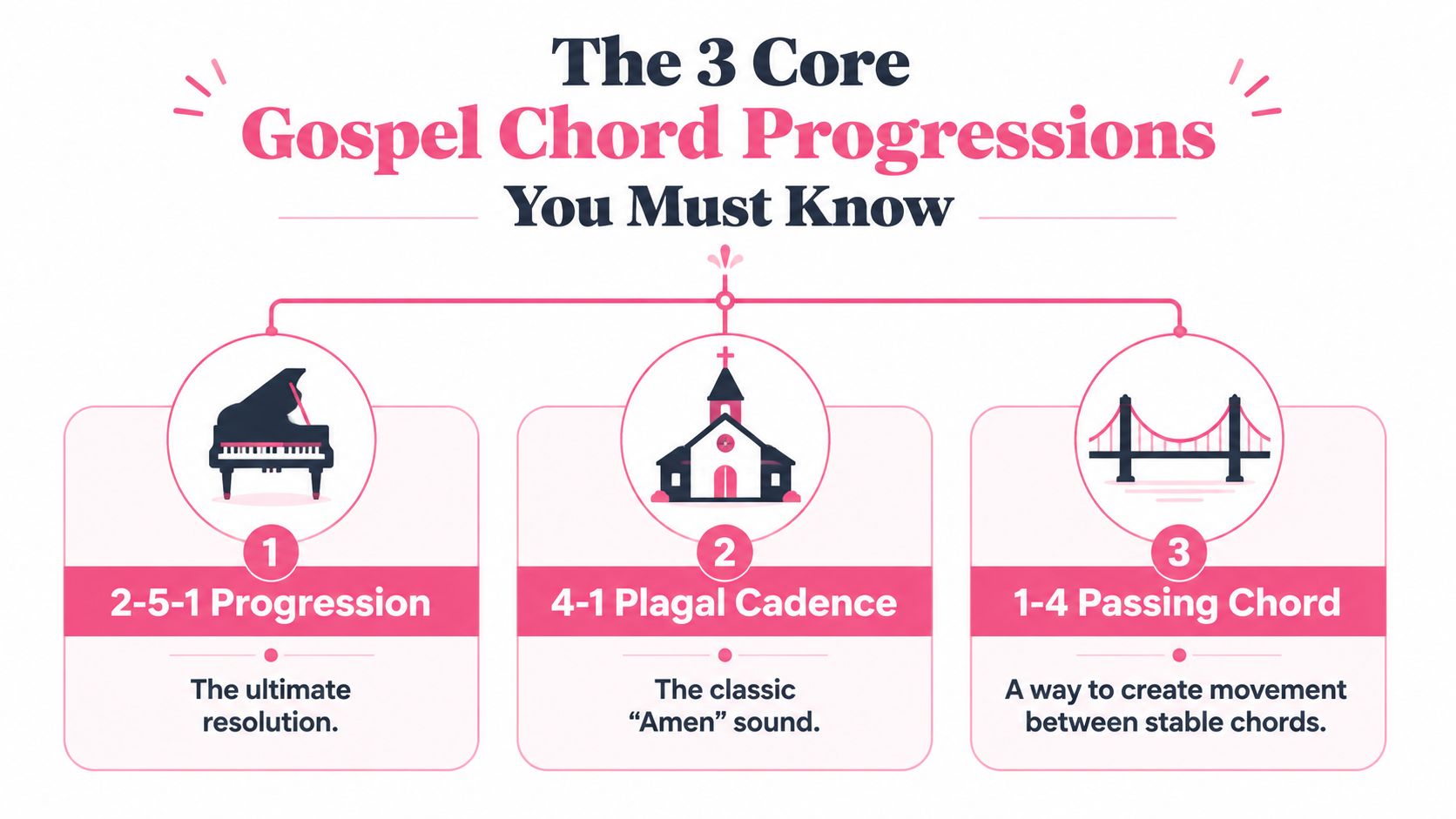
The goal here is not to memorize symbols on a page. The goal is to hear each progression like a familiar sentence so you can anticipate it in real time.
The 2 5 1 progression
This is the clearest gospel resolution your ear can learn.
In C major, it is Dm to G to C. With richer voicings, you may hear Dm7 to G7 to Cmaj7. The sound has a natural shape. It starts moving, gathers tension, then settles.
A Hear and Play article on common 2-5-1 gospel progressions describes how central this movement is in gospel playing. You do not need a percentage to prove the point. If you listen closely to gospel endings and transitions, your ear will start catching this pull everywhere.
Listen for the job of each chord:
- Chord 2 starts the trip.
- Chord 5 creates the strongest pull.
- Chord 1 feels settled and complete.
A simple ear exercise helps. Sing the roots out loud: “D, G, C.” Then play them. Then stop playing and try to hear that same shape in recordings. Over time, you stop guessing and start predicting.
Hear it as “departure, tension, home.”
The 4 5 1 praise movement
This progression carries more lift right from the start.
In C major, it is F to G to C. Compared with the 2-5-1, it sounds more open on the first chord and more direct in its push toward home. That is one reason it works so well in praise settings. It supports energy without sounding crowded.
Your ear can separate 4-5-1 from 2-5-1 by focusing on the first chord alone. The 2 chord usually feels softer and more inward. The 4 chord feels broader, almost like the room opened up.
| Progression | In C | Main feeling |
|---|---|---|
| 2-5-1 | Dm, G, C | Tension resolving home |
| 4-5-1 | F, G, C | Lift, push, arrival |
If those still blur together, that is normal early on. Sing the first bass note before you play the rest. That one note often tells your ear which road the harmony has taken.
The 1 4 5 with gospel flavor
In plain form, this is C, F, G in C major. On paper it looks simple. In actual gospel playing, it often arrives dressed in richer voicings, suspended notes, and moving bass lines.
That decoration can hide the skeleton.
This is a point where beginners can get tricked. They hear extra color tones and assume the progression itself has changed, when the main harmonic frame is still 1, 4, and 5.
Use this listening method:
- Reduce the sound in your mind. Ask what the basic chord under the decoration is.
- Track the bass first. If the bass moves C, then F, then G, that is your strongest clue.
- Treat upper notes as color until proven otherwise. The voicing may be rich while the function stays simple.
That habit matters because gospel players often speak in layers. The top notes add emotion, but the bass and function tell the story. Once you hear that clearly, the progression stops sounding like a blur of advanced chords and starts sounding like a familiar framework with beautiful clothing on it.
Beyond the Basics Adding Richer Gospel Color
You hear a gospel intro and feel the pull of it right away. By the time you reach for the first chord, the pianist has already slipped through three colors, a bass walk-up, and a turnaround that somehow still lands exactly where your ear hoped it would. That moment is where many players get stuck. They can enjoy the sound, but they cannot yet hear the path in real time.
Richer gospel harmony starts making sense when you stop asking, “What was that chord called?” and start asking, “Where is this line trying to go?”
The long way home sounds better
The classic example is the 3-6-2-5-1.
In C major, one common version is Em, Am, Dm, G, C. It works like a sentence that adds a few extra words before the final period. The destination is still home, but the setup creates more expectation, more motion, and more release when the 1 chord finally arrives.
The earlier PianoGroove lesson on gospel chord progressions connects this chain to gospel intros and turnarounds. That matches what your ear will notice in real songs. Players often stretch the journey before resolving because the preparation itself carries emotional weight.
Here is the listening logic:
- The 3 chord feels like the door opening.
- The 6 chord keeps the line moving instead of settling.
- The 2 and 5 create a stronger sense that a landing is close.
- The 1 chord gives release.
If 2-5-1 feels like one clear closing phrase, 3-6-2-5-1 feels like a fuller thought with more buildup.
Your ear can learn to expect the next stop before you can name every voicing. If you want extra practice hearing these chord relationships by function, this guide to ear training for chord progressions can help you connect sound to movement faster.
Passing chords and bass walk ups
What many listeners perceive as “gospel magic” is often just smooth connection.
A passing chord fills space between two stronger harmonic points. A bass walk-up does the same job from the bottom, often by moving step by step. Both give the music a sense of direction, the same way a staircase makes you feel the next floor before you get there.
That is why advanced gospel playing can sound busy while still feeling natural. The chords are not appearing at random. They are guiding your ear forward.
Listen for these clues:
- Bass walk-up. Follow the lowest note first. If it climbs steadily, your ear can often predict the destination before the right hand confirms it.
- Passing chord. It sounds brief but purposeful. You usually would not rest there.
- Diminished color. It sounds unstable in a useful way. That tension points ahead.
A strong exercise is to listen through one verse of a gospel song and ignore the upper voicing completely. Track only the bass. Many moments that first sounded advanced will begin to feel logical, almost inevitable.
Watch how players demonstrate that flow in performance:

Hear flavor as a clue
Richer voicings are easier to hear when you treat them like signals instead of trivia.
A bright altered dominant often means tension is rising. A diminished passing sound usually means the harmony is in motion. A walk-up in the bass tells your ear to expect arrival soon. You do not need to identify every note instantly. You need to hear what the color is doing.
That shift changes everything. Complex gospel progressions stop feeling like a pile of impressive chords and start sounding like spoken language. You hear setup, motion, tension, release. Once you hear those roles, your hands can begin to follow your ear instead of chasing chord names.
How to Train Your Ear to Hear Gospel Progressions
You are at the keyboard during service, the singer stretches a line, and the band turns toward a chord change you can feel coming before you can name it. That moment is the goal. Gospel playing by ear is less about storing chord labels in your head and more about hearing where the music wants to go early enough for your hands to follow.
Listen for the bass before the voicing
Beginners often focus on the top notes because they are easier to notice. In gospel, the lowest note usually gives away the direction first.
Treat the bass like the floor under the whole chord. If that floor shifts from 2 to 5, or from 6 toward 2, your ear can often sense the next stop before the upper notes fill in the color. That is why strong ear players can keep up with rich voicings they could not spell out on paper in the moment. They are hearing function first.
Try this with a real song:
- Hum the lowest note you hear.
- Pause the track.
- Find that note on your instrument.
- Ask yourself which chord family it suggests. Does it feel like motion, setup, or arrival?
That last question matters. Ear training gets easier when you stop asking only, “What chord is that?” and start asking, “What is this chord doing?”
Train the sound of the pull
A lot of gospel harmony lives on tension that points somewhere. The clearest example is the pull inside the V7 chord. You do not need advanced theory to hear it. You need to notice that one sound feels unfinished, like a sentence waiting for its last word.
A simple way to practice is to isolate the note inside the dominant chord that feels restless, then sing the note it wants to settle into. If you want a structured way to build that skill, this guide to ear training for chords gives you drills you can bring straight into gospel playing.
Sing the tension. Then sing the landing. Your ear learns resolution by feeling the distance between those two notes.
This is why gospel musicians can react so quickly in real time. They are not calculating every extension. They hear the pull, recognize the destination, and let the hands catch up.
A simple practice loop
Stay in one key at first. C major works well because it removes one layer of difficulty.
Repeat this loop for a few minutes:
- Play a 2-5-1 slowly. Sing the root of each chord while you play.
- Hold the 5 chord. Let the tension sit long enough for your ear to want the 1.
- Resolve to 1. Notice the physical sense of release.
- Close your eyes and repeat. Try to identify each moment by sound, not by finger shape.
After that feels clear, do the same with 4-5-1, then 3-6-2-5-1. Hear each progression as a path with landmarks. One chord sets up the next. Another increases pressure. Another gives rest.
Slow practice is not a beginner crutch. It is how your ear learns to predict instead of chase. Once that happens, gospel progressions stop sounding like a blur of impressive chords and start sounding like a conversation you can follow in real time.
Your Daily 10 Minute Routine for Musical Freedom
Long practice sessions feel productive, but short daily work changes the ear faster. Consistency matters because hearing is a pattern skill. Your brain needs regular exposure to the same sounds until they become familiar enough to name and use.
That’s especially true with gospel chord progressions. You don’t need to master twenty ideas at once. You need a small set of sounds repeated often enough that they stop sounding abstract.
A simple routine that actually fits real life
Use this routine every day for 10 minutes:
| Time | Focus | What to do |
|---|---|---|
| 3 minutes | 2-5-1 recognition | Play or hear it in one key, sing roots, identify the resolution |
| 3 minutes | 3-6-2-5-1 recognition | Listen for the chain and name each stop in the journey |
| 2 minutes | Bass movement | Hum low notes from a song and find them on your instrument |
| 2 minutes | Real music transfer | Put on a favorite gospel track and hunt for one progression by ear |
Keep it small enough that you’ll do it tomorrow.
A useful reason to stay consistent is that beta studies for ear training apps found that daily recognition drills on patterns like the 3-6-2-5-1 can improve progression transcription accuracy by as much as 300% within 30 days, as referenced earlier in the source used for richer gospel color. The practical point is simple. Daily repetition works.
What progress really looks like
At first, you’ll only catch the obvious landing points.
Then you’ll start hearing the setup before the landing. After that, you’ll notice bass motion, passing color, and repeated turnaround patterns. Eventually you stop feeling lost in church, rehearsal, or a jam session because your ear is already tracking the shape of the song.
That’s musical freedom.
Not perfect theory recall. Not flashy chord vocabulary. Freedom means you can hear movement, respond in time, and trust your hands to follow your ear. If you want a structured way to build that habit, Trill Ear Training Daily is built around short, repeatable sessions that fit this exact kind of practice.
Small daily ear work beats occasional marathon practice because it teaches recognition, not just repetition.
If you stay with this for a few weeks, gospel chord progressions won’t feel hidden anymore. You’ll hear them coming. And once you can hear them coming, you can play them.
If you want a daily system for learning to play by ear, recognize gospel chord progressions, strengthen chord recognition, and build the listening skills behind perfect pitch work, try Trill: Ear Training Daily. It’s designed to help musicians stop guessing and start hearing, with short sessions you can stick to every day.