How to Make Chords: A Guide to Playing by Ear
You hear a song, grab your guitar or sit at the piano, and try to find the chords. After a few seconds, it turns into guessing. You try one shape, then another. Sometimes you get close. Most of the time, you end up searching for tabs.
That’s where a lot of musicians get stuck. They learn chord shapes, chord formulas, even a bit of theory, but they never learn to hear what makes a chord a chord. That missing skill is why “how to make chords” can feel harder than it should.
The good news is that ear training is trainable. You don’t need perfect pitch to play by ear. You need a way to connect sound to structure, then repeat that process every day until your ear starts recognizing it on its own.
Table of Contents
- Stop Guessing Chords and Start Hearing Them
- Hear the Building Blocks Before You Build
- How to Build Any Major or Minor Chord in Seconds
- Unlock 70% of Songs by Hearing Common Progressions
- Add Your Signature Sound with Voicings and Extensions
- Your 10-Minute Daily Path to Musical Freedom
Stop Guessing Chords and Start Hearing Them
Most musicians don’t struggle because chords are too complicated. They struggle because they were taught to look at chords before they were taught to listen for them.
That creates a strange gap. You might know that a C major chord is C, E, and G. You might know the guitar shape or the piano keys. But when that same chord shows up in a song, your ear doesn’t recognize it quickly enough to use it in real time.
That’s why so many players stay dependent on charts, tabs, and tutorial videos. The information is there, but the sound hasn’t been internalized.
A lot of online content keeps reinforcing that problem. An analysis of top video guides found that less than 5% focus on aural identification, the skill of hearing a chord and knowing how to build it, as noted in this video analysis of chord-learning content.
Practical rule: If you only learn chords with your eyes, you’ll need your eyes every time you play.
Playing by ear starts when you reverse the order. First, you learn the sound. Then you attach the name, the formula, and the shape. That one shift makes theory useful instead of abstract.
Musical freedom doesn’t come from memorizing more diagrams. It comes from hearing a progression and knowing where your hands should go. It comes from recognizing tension and release. It comes from being able to improvise, accompany a singer, or work out a song without waiting for someone else to tell you the answer.
If you’ve ever thought, “Maybe I’m just not one of those naturally gifted people,” let that idea go. Ear training isn’t a talent test. It’s pattern training. Your ear learns the same way your fingers do, through short, steady repetition.
Hear the Building Blocks Before You Build
Every chord is made from smaller sound relationships called intervals. If chords feel confusing, this is usually where the confusion starts. People try to hear the whole chord before they can hear the distances inside it.
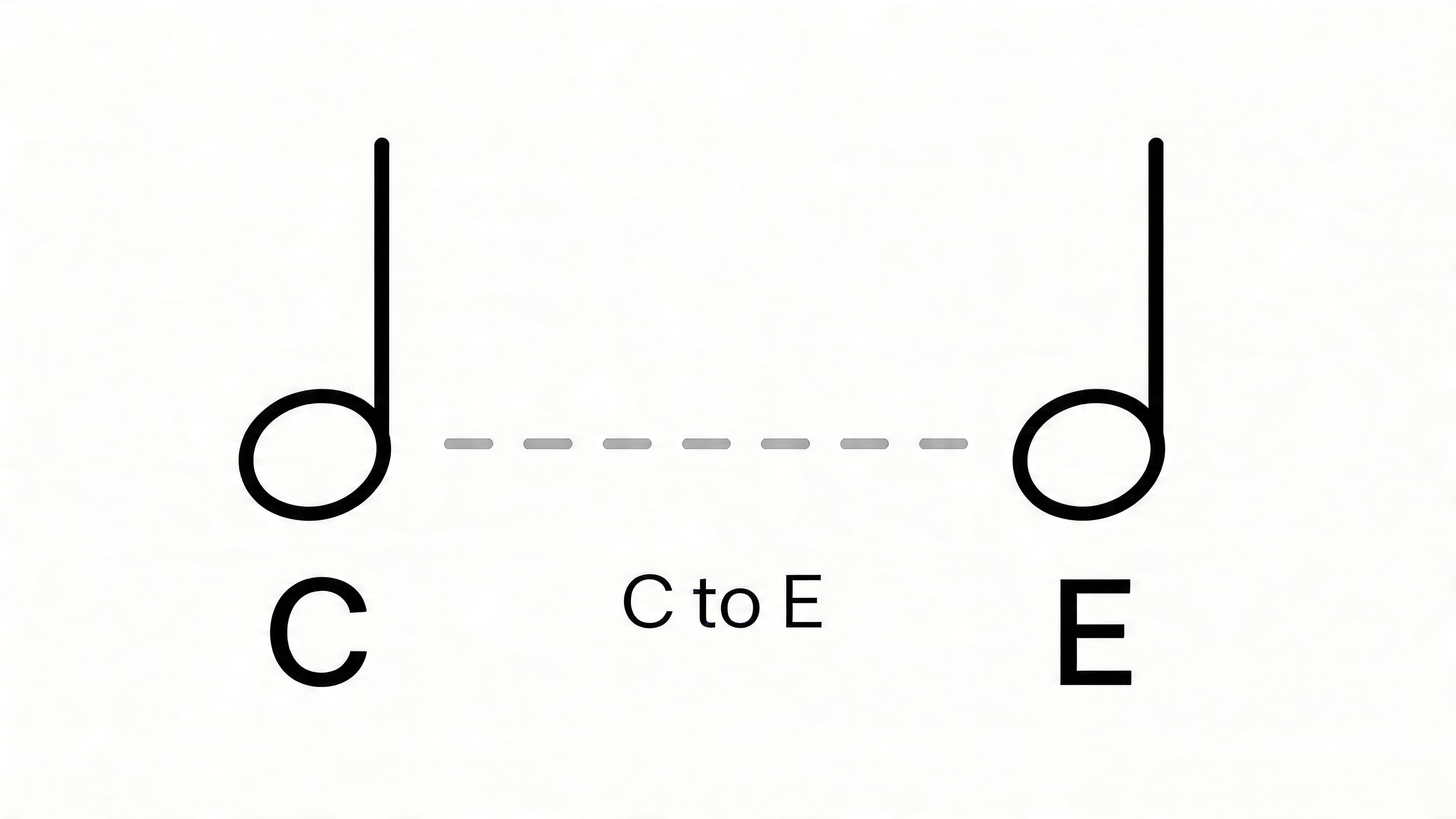
Why intervals matter first
Take a C major chord. It contains C, E, and G. If you strip away the theory terms, what you’re really hearing is a root note plus two interval colors above it.
The jump from C to E is a major third. The jump from C to G is a perfect fifth. Those two distances give the chord its stable, bright sound.
Change just one note and the feeling changes. Lower E to E-flat and you get C minor. Same root. Same fifth. Different third. That’s why the third is such a big deal for ear training. It often tells you whether a chord feels major or minor.
Here’s a useful perspective:
- Major third feels brighter and more open.
- Minor third feels darker or more inward.
- Perfect fifth feels steady and supportive.
If interval hearing is still fuzzy, this guide to intervals in music and how to hear them helps connect the theory to actual listening.
Hear the chord as stacked feelings, not just stacked notes.
A simple ear exercise you can do today
Use one root note and keep it fixed. C works well because it’s easy to picture, but any note is fine.
Then do this for 10 minutes a day:
- Play the root.
- Sing or play a major third above it.
- Go back to the root.
- Sing or play a minor third above it.
- Alternate until you can hear the difference before you play it.
Next, add the fifth. Hear how stable it sounds compared to the third. You’re teaching your ear to notice function, not just pitch.
A short routine like this works better than long, random practice. You’re building recognition. Over time, your ear stops treating a chord like one big mystery and starts hearing the parts inside it.
That’s the actual beginning of ear training, and it’s the first practical step toward learning how to make chords by sound instead of guesswork.
How to Build Any Major or Minor Chord in Seconds
Once your ear starts noticing thirds and fifths, chord building gets much simpler. You no longer need to memorize separate rules for every key. You can use one repeatable idea and apply it anywhere.
That idea is the add-skip method.
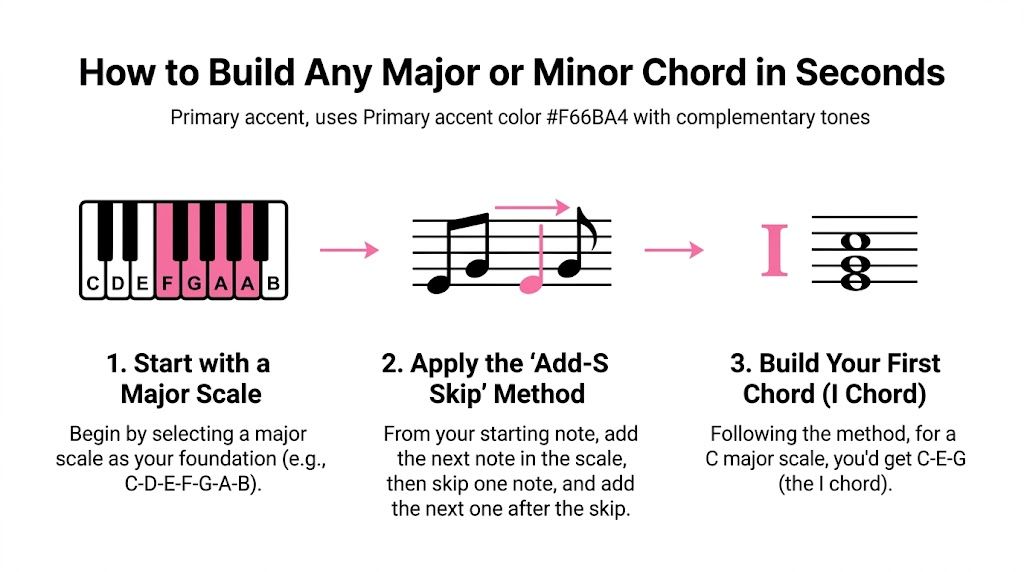
According to this acoustic guitar chord-building guide, you build diatonic chords from a major scale by starting on a root, skipping the next scale degree to add the third, then skipping another to add the fifth. Applied across the scale, this creates I, ii, iii, IV, V, vi, and vii°, which form the basis of 95% of Western pop and rock progressions.
The add-skip method in C major
Use the C major scale:
C - D - E - F - G - A - B
Start on C.
- Take C
- Skip D
- Add E
- Skip F
- Add G
You get C - E - G, which is C major.
Now start on D and stay inside the same scale:
- Take D
- Skip E
- Add F
- Skip G
- Add A
You get D - F - A, which is D minor.
Keep going and you get the full family of chords in the key:
| Scale degree | Chord |
|---|---|
| I | C major |
| ii | D minor |
| iii | E minor |
| IV | F major |
| V | G major |
| vi | A minor |
| vii° | B diminished |
This is one of the most useful shortcuts in music. You’re not learning random shapes. You’re learning how harmony grows out of a scale.
How to hear major and minor quality
The theory matters, but your ear still has to lead.
Try this exercise at your instrument:
- Play C-E-G, then listen for the brighter quality.
- Play C-E♭-G, then listen for the mood change.
- Keep the root and fifth the same so your ear locks onto the moving note.
- Sing the third if you can. That makes the sound stick much faster.
A lot of beginners get confused here because they think major and minor are huge, dramatic categories. Often the difference is just one note moving by a half step. Small change, big emotional effect.
Listening check: If two chords sound almost the same but one feels more settled and the other more shaded, listen to the third first.
You can also use this method on guitar without getting trapped in shape memorization. If you know the root and can hear whether the third should be major or minor, your fretboard starts making more sense. Chords stop feeling like separate objects and start feeling like variations of the same pattern.
That’s a big shift for anyone trying to play by ear. You stop asking, “What shape is this?” and start asking, “What sound am I hearing?”
Unlock 70% of Songs by Hearing Common Progressions
You don’t need to master every possible chord movement to start playing real music. Popular songs repeat the same harmonic ideas far more often than most beginners realize.
Why common chords matter so much
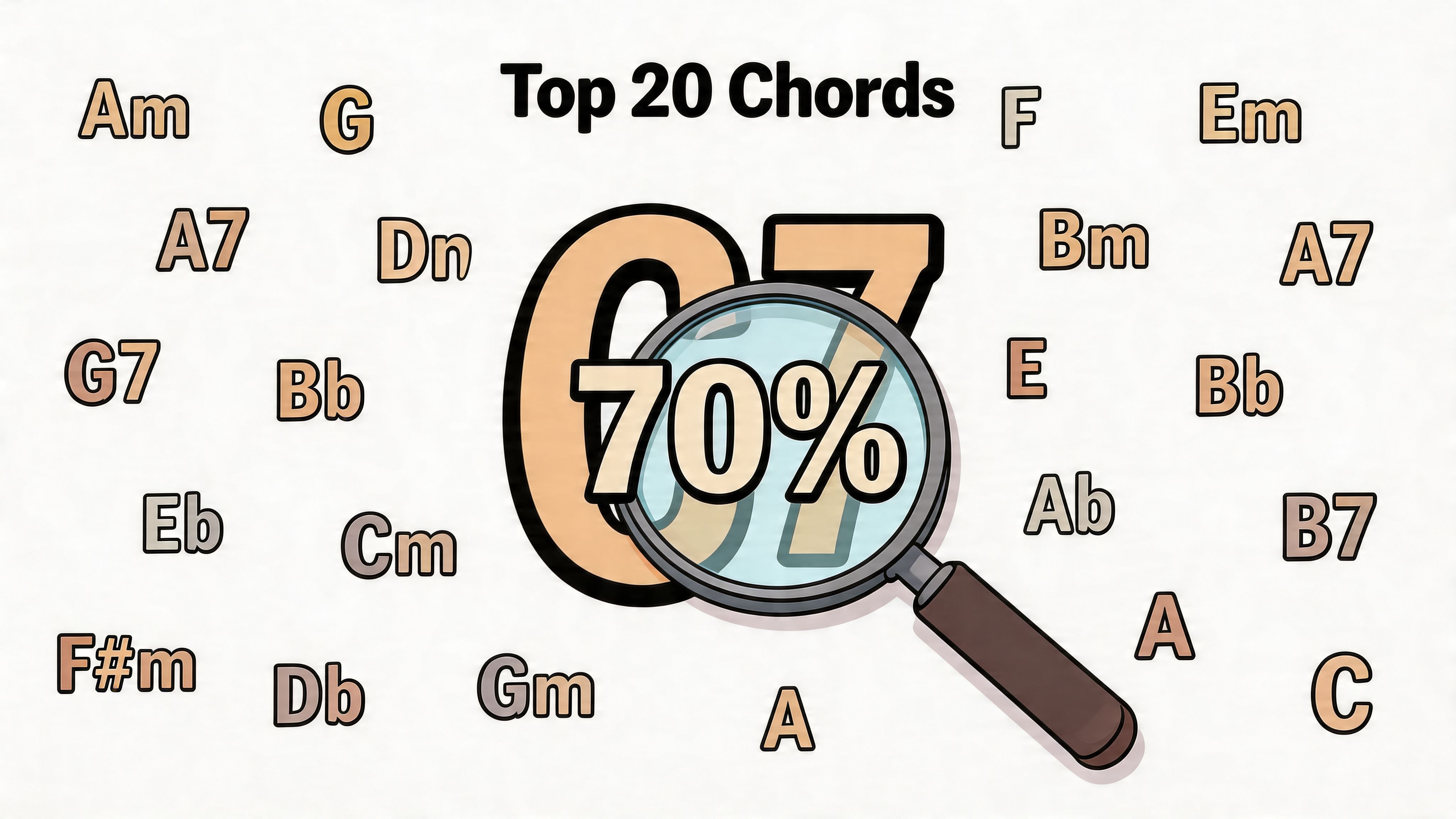
A large analysis of the Chordonomicon dataset found that the top 20 most common chords account for over 70% of all chord usage in popular music, across nearly 52 million chords in about 680,000 songs, as described in this analysis of chord progressions in popular music.
That matters for your ear because it means songs are not random. Harmony is patterned.
The same source notes that in major keys, the I major appears in about 25 to 30% of chord instances, vi minor around 15%, IV major at 12%, and V major at 10%. It also found that over 70% of all chord usage is concentrated in that small common set, and 80% of transitions follow predictable within-key patterns.
So when your ear learns to recognize the sound of I, IV, V, and vi, you’re not learning a niche trick. You’re learning the language many songs already speak.
One famous pattern is I - V - vi - IV. In C major, that’s:
C - G - A minor - F
When you hear it enough times, it stops sounding like four separate events. It starts sounding like one familiar sentence.
A listening drill for real songs
Use a song you like. Don’t look up the chords yet.
Start with this process:
- Find the home chord. The chord that feels most resolved is often I.
- Listen for lift or pull. V tends to create a strong urge to return home.
- Notice the emotional dip. vi often feels softer or more reflective than I.
- Catch the pre-return motion. IV often sets up movement without sounding as tense as V.
After you’ve guessed the progression by ear, check it against the instrument.
A visual example can help once you’ve tried to hear it first:

The key is to hear progressions as motion, not isolated chord labels. That’s how musicians start predicting what comes next. Your ear begins to recognize direction.
A progression is a pattern of expectation. Once you hear that pattern, songs get easier to follow and easier to play.
This is also where people start feeling real progress with chord recognition. Songs become less overwhelming because the possibilities narrow. Instead of searching the whole map, you’re listening for a few common roads.
Add Your Signature Sound with Voicings and Extensions
Basic triads get the job done. They help you hear function, identify key centers, and build songs quickly. But if you only play every chord in root position, your music can sound stiff.
That’s where voicings, inversions, and simple color tones come in.
Why the same chord can sound different
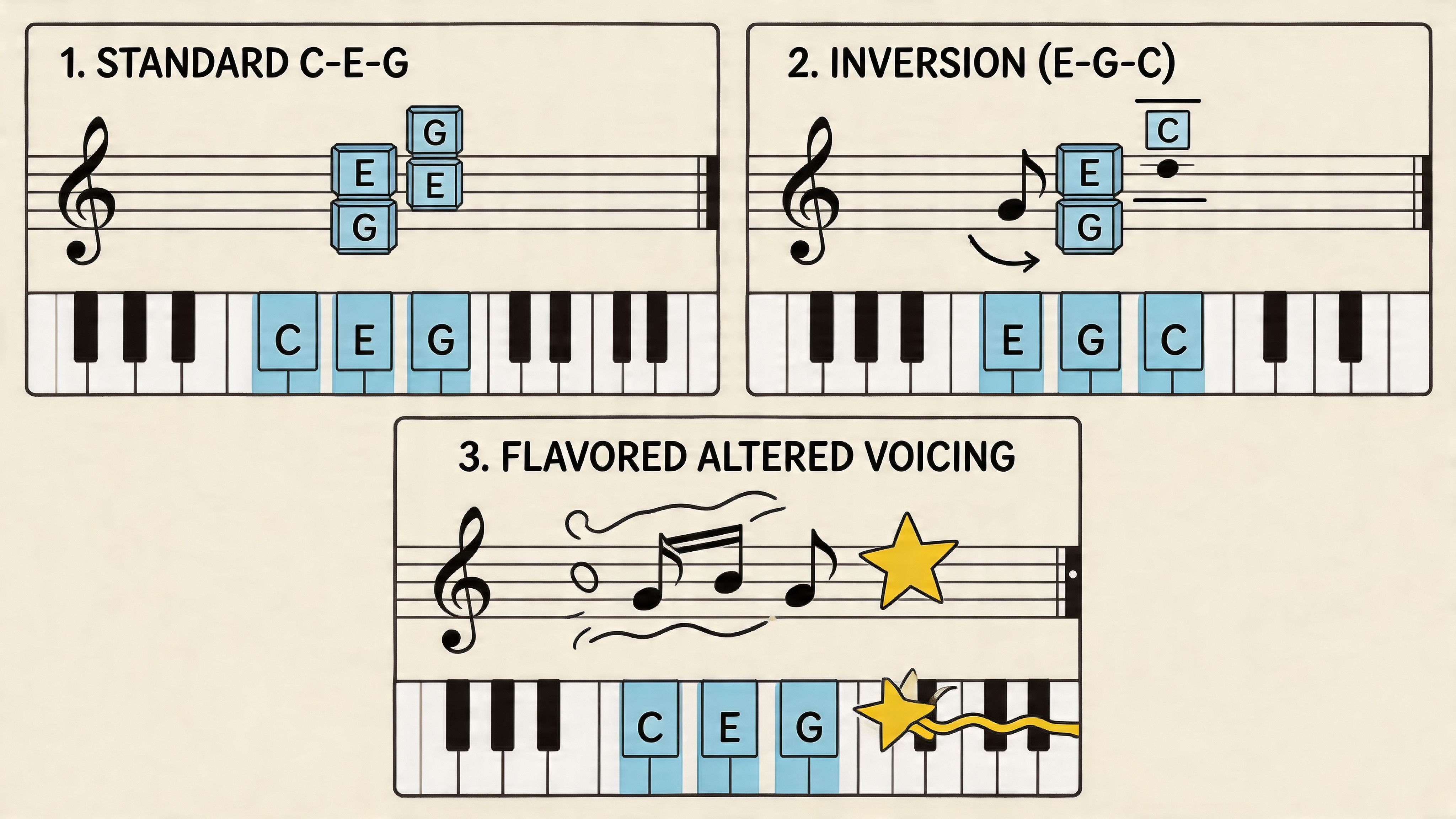
A C major chord doesn’t have to appear only as C-E-G with C in the bass. You can play E-G-C or G-C-E and still keep the same chord identity. Those are inversions.
The harmony stays recognizable, but the motion between chords becomes smoother. According to Production Music Live’s chord guide, using chord inversions and suspensions can create 20-30% smoother transitions. Pro musicians use them to avoid the “blocky” sound that often shows up when beginners rely only on root-position chords.
If you want a quick visual reference while you experiment, this interactive chord tool makes it easier to compare chord shapes and note layouts.
A suspension changes a different part of the chord. Instead of using the third, you temporarily replace it with another nearby scale note. That creates tension without changing the chord’s basic function too drastically.
What to listen for in richer chords
You don’t need to memorize advanced labels first. Listen for effect.
- Inversions sound smoother between chords because the notes move less.
- Suspensions sound unresolved, like the chord is holding its breath.
- Seventh chords add softness, warmth, or extra pull depending on the seventh.
- Wider voicings sound more open because the notes are spread out.
Here’s a practical test. Play a simple progression twice. First, use plain root-position triads. Then keep the same progression but move one or two notes to create inversions. Your ear will notice that the second version flows more naturally.
Ear cue: If the chord quality stays the same but the bass note changes, you’re probably hearing an inversion.
Now, “how to make chords” becomes personal. You’re no longer just constructing the correct chord. You’re choosing the version that says what you want emotionally.
Your 10-Minute Daily Path to Musical Freedom
Musicians who learn to play by ear usually don’t do it by cramming theory on weekends. They do it by training a little every day until sound recognition becomes automatic.
That’s why 10 minutes a day works so well. It’s short enough to repeat, and repetition is what turns hearing into instinct. A brief daily session on intervals, triads, and common progressions does more for chord recognition than occasional long practice full of guesswork.
A simple routine looks like this:
- Start with intervals and compare major and minor thirds.
- Build one chord family from a major scale using the add-skip method.
- Listen to one song section and identify the likely function of each chord.
- Test yourself without looking so your ear leads your hands.
If you stay consistent, your relationship with music changes. You stop waiting for sheet music. You stop depending on tabs. You start hearing structure inside songs, and that opens the door to improvisation, songwriting, and faster transcription.
If you’ve been chasing perfect pitch, don’t let that distract you from the skill that matters most right now. Relative hearing is enough to make real progress. You can learn to hear chord quality, movement, and function with practice.
The goal isn’t to become a theory machine. The goal is musical freedom.
For a focused system built around that habit, try daily ear training practice and make chord hearing part of your everyday routine.
If you want a simple way to stop guessing and start hearing music clearly, Trill: Ear Training Daily gives you short, structured practice for chord recognition, intervals, and playing by ear. It’s built for musicians who want real progress in just 10 minutes a day.