How to Play By Ear: A Musician's Daily Guide
You hear a song once, sit down at your instrument, and freeze.
You can sort of hear the melody in your head. You know there’s a pattern in the chords. But your hands start searching randomly, and within a few minutes it feels like you’re not making music at all. You’re guessing.
That’s where most players get stuck when they try to learn how to play by ear. Not because they lack talent. Because they never got a real process.
Playing by ear isn’t magic, and it isn’t reserved for people with perfect pitch. It’s a trainable ear training skill. When you learn what to listen for, and you practice it in short daily reps, your ears get clearer, your note choices get faster, and songs stop feeling like puzzles with no edges.
Table of Contents
- Stop Guessing and Start Hearing Music
- The Foundation Hearing Intervals and Scale Degrees
- Decoding Harmony Recognizing Chords and Progressions
- Your Daily Ear Training Workout Plan
- From Exercises to Playing Real Songs
- Common Mistakes and How to Stay Motivated
Stop Guessing and Start Hearing Music
Most musicians want the same moment. A song comes on, and instead of reaching for tabs, sheet music, or a chord chart, they can hear what’s happening and play along.
That skill doesn’t come from lucky guesses. It comes from training your ears to recognize sound before your fingers touch the instrument. The old method is familiar and painful. Randomly trying notes and chords can take about seven long, frustrating hours to pick out a single song, while consistent daily ear training for as little as 10 minutes can build musical perception through repetition, according to this ear training breakdown from Hear and Play.
That difference matters because random trial and error teaches panic. Structured ear training teaches recognition. One approach leaves you dependent on visual aids. The other builds the kind of listening that helps with improvisation, chord recognition, jamming, and learning songs faster.
Practical rule: Don’t play the first note you can find. Hear the note first, then test it.
A lot of players assume that if they can’t already do this, they’re just “not ear people.” I don’t buy that. Ears improve the same way rhythm improves or technique improves. Short reps. Clear targets. Daily work.
If you’ve been stuck in chord-hunting mode, this guide on tired of guessing chords gets at the core problem. Guessing feels active, but it usually hides the fact that you’re not yet hearing the function of the note or chord you’re reaching for.
The shift is simple. Stop asking, “Which key do I press next?” Start asking, “What sound am I hearing, and how does it relate to the last one?” That’s when ear training starts becoming real.
The Foundation Hearing Intervals and Scale Degrees
The first breakthrough in learning how to play by ear is understanding that you usually don’t need to identify isolated notes out of thin air. You need to hear relationships.
That’s why relative pitch matters so much more in daily playing than the myth of perfect pitch. If one note feels like home, every other note gets easier to identify because you hear its distance and role, not just its name.
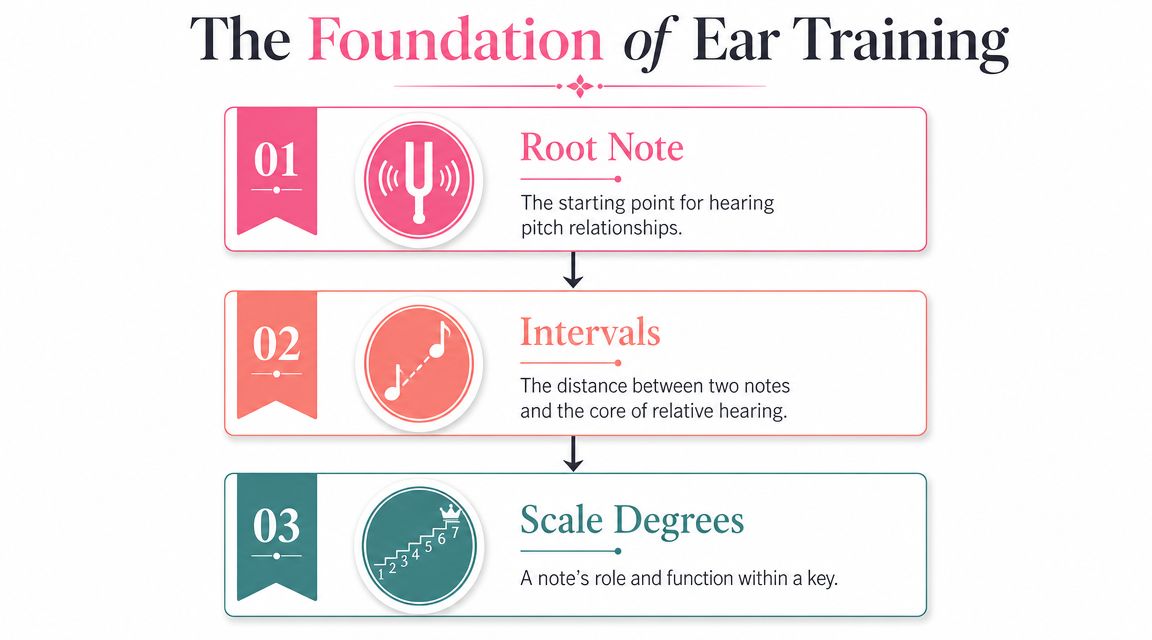
According to this lesson on playing by ear foundations, the core skill set requires mastering about 14 core sounds. The training starts with basic intervals like the perfect fifth and major third, and once you correctly identify the tonal center, your note accuracy increases by about 50% because the possible choices narrow down.
Relative pitch matters more than perfect pitch
Think of the key center as your home base. If you can hear where “home” is, the rest of the song stops sounding random.
A melody note might feel stable, bright, tense, or unresolved. Those feelings are useful. They tell you how the note behaves inside the key. That’s what scale degrees do. They describe a note by function.
A few sounds usually give beginners the fastest traction:
- Perfect fifth sounds open and stable. It often feels strong and familiar.
- Perfect fourth has a pull to it. It can feel suspended.
- Major third sounds bright and settled.
- Octave feels like the same note, just higher or lower.
If you want a deeper walkthrough of these building blocks, this intervals music guide is a useful companion while you practice.
Hear the distance first. Name it second. Theory helps most after the sound is already familiar.
A simple way to train the sounds
Don’t make this abstract. Put it into a real playing routine.
Try this at piano, guitar, or with a keyboard app:
- Play one home note and sing it back.
- Play a second note above it, such as a fifth or third.
- Describe the sound before you name it. Stable? Bright? Tense?
- Sing the interval back down to the home note.
- Repeat in a new key so your ear doesn’t depend on hand shape.
Then move to scale degree practice:
| Exercise | What you do | What you’re training |
|---|---|---|
| Home note reset | Play the tonic, pause, sing it again | Tonal center |
| Two note check | Hear tonic to another note, then identify the distance | Interval recognition |
| Melody mapping | Sing a short melody and find each note from the tonic | Scale degree awareness |
One warning matters here. Don’t rush to the instrument every time your ear feels unsure. Sing first. Hum first. Audiate first. Your hands should confirm what your ear already suspects.
Decoding Harmony Recognizing Chords and Progressions
Melody gets most of the attention, but harmony is where many players lose confidence. They can find a tune one note at a time, then the left hand or rhythm guitar enters and everything falls apart.
The fix is usually not to listen harder to the full chord. It’s to listen lower.
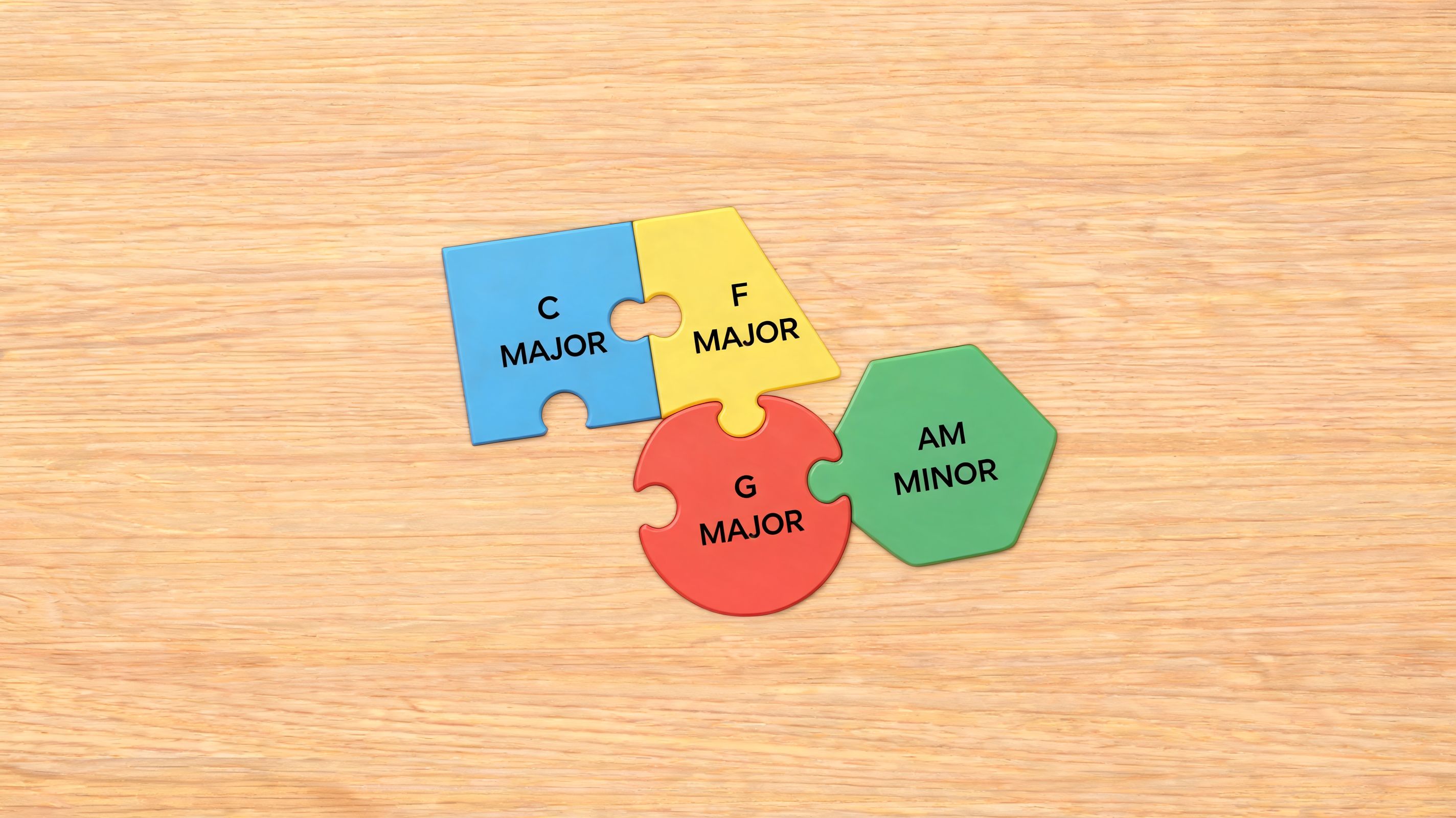
A strong chord transcription method focuses on three things: identifying the key, mapping the main diatonic chords in that key, and tracking the bass root. That approach reached 85% first-pass accuracy, and focusing on the bass root cut chord recognition errors by as much as 60%, according to this chord transcription analysis.
Start with the bass, not the full chord
When students tell me a progression feels too dense to hear, I usually ask them to ignore the keyboard pad, guitar voicing, or vocal stack and listen to the lowest moving note. The bass often tells you the harmonic skeleton.
If the song is in a clear key, your most likely chord family is already limited. In many pop, rock, and folk songs, the basic set is the familiar diatonic group: I, ii, iii, IV, V, vi. You don’t need to test every possible chord in the universe. You need to ask which chord in this key fits the bass and supports the melody.
Here’s a practical listening sequence:
- Find the key first by locating the note or chord that feels finished.
- List the likely chords in that key on paper or in your head.
- Track the bass movement from chord to chord.
- Test major or minor quality against the melody note.
- Check the pull of the chord. Does it sound settled, moving, or like it wants to resolve?
For more focused chord listening drills, this ear training chords guide connects chord quality practice to real song use.
Hear the job of each chord
Don’t treat chords as labels only. Hear what they do.
A major chord often sounds open or grounded. A minor chord tends to sound darker or more reflective. A dominant chord has tension. It sounds like it wants to go somewhere.
That “job” is easier to hear than the spelling at first. In real songs, this is often enough to sketch the progression before you know every inversion or added tone.
A useful exercise is to loop a short section of a familiar song and ask three questions:
| Question | What to listen for |
|---|---|
| Where does home feel like? | The tonic or resting chord |
| What is the bass doing? | Root movement between chords |
| Which chord has tension? | The dominant sound that wants resolution |
Once you can answer those, fill in the voicing later.
A short demonstration helps when this feels fuzzy:

If you can hear the bass and the pull of the harmony, you can usually sketch the progression before you know the fancy voicing.
That’s an important trade-off. Early on, don’t chase exact keyboard textures or guitar shapes. Chase function. A rough but correct harmonic map is far more useful than a beautiful wrong chord.
Your Daily Ear Training Workout Plan
Most players don’t need more information. They need a repeatable routine.
The biggest mistake I see is practicing ear training in bursts. One long session on a Sunday, then nothing for days. Your listening improves faster when it becomes a small daily habit, the same way technique improves when you touch it often.
A practical 10 minute routine
Keep the structure simple and repeatable. Five minutes should isolate a skill. The next five should apply it to actual music.
One option is to use a tool that organizes daily reps for you. Trill: Ear Training Daily provides short exercises for intervals, chords, notes, and scales, along with streaks, levels, instant feedback, and Focus Lock, which blocks distracting apps until the day’s training is done. The point isn’t the app itself. The point is having a system that makes ear training happen every day instead of only when motivation shows up.
A balanced workout usually includes these categories:
- Interval work for melodic distance
- Chord quality work for major, minor, and tension sounds
- Melodic recall for hearing then reproducing short phrases
- Song application for moving from drills into real music
Short practice wins because it keeps your ear fresh. Stop while your listening is still sharp.
Sample 10 minute daily ear training routine
| Day | Focus Skill (5 mins) | Application (5 mins) |
|---|---|---|
| Monday | Intervals. Sing and identify simple distances from a home note | Melody hunt. Find a short phrase from a familiar song |
| Tuesday | Chord quality. Compare major and minor sounds | Song chords. Test likely chords under a chorus |
| Wednesday | Scale degrees. Hear notes by function in one key | Call and response. Sing a note, then play it |
| Thursday | Bass listening. Follow the lowest note in a progression | Progression sketch. Write the root motion of one song section |
| Friday | Melodic dictation. Listen to a short phrase and repeat it | Transpose. Move that phrase to a different key |
| Saturday | Mixed review. Revisit weak spots from the week | Jam time. Play along with a simple track by ear |
| Sunday | Light reset. Easy ear drills only | Reflection. Note what sounds are getting easier |
Notice what’s missing here. No marathon practice. No trying to transcribe an entire dense song in one sitting. No scrolling for answers before your ear has had a chance to work.
The goal of a daily workout isn’t to prove what you know. It’s to build faster recognition. Over time, that shows up in rehearsal, on stage, in songwriting sessions, and in the way you react to sound in real time.
From Exercises to Playing Real Songs
A lot of musicians get stuck at the handoff point. They can do interval drills. They can identify a few chord types. Then a real song starts, and all that practice seems to disappear.
That gap gets smaller when you use a plain method. Start with the melody. Then add basic harmony.
An expert playing-by-ear framework teaches pianists to first isolate and copy a simple melody by ear, then test the primary triads I, IV, and V under each melody note. With 15 minutes of daily practice, users report 90% accuracy in choosing the correct chord within two weeks, according to Greg Howlett’s hymn-by-ear framework.
A simple song is the right first test
Use something easy and familiar. “Twinkle, Twinkle, Little Star” works well because you already know when a note is wrong.
Try the melody-first process like this:
- Sing the first phrase away from your instrument.
- Find the starting note.
- Move one note at a time. Don’t rush.
- If a note feels uncertain, sing the phrase again before touching the instrument.
- Repeat until the full melody feels stable.
Melody is easier to verify since you can hear if it matches the song. Chords are harder to judge if the melody itself is still shaky.
Sing the phrase before you play it. If you can’t sing it clearly, your hands are working without enough information.
Add harmony after the melody is secure
Once the melody is under your fingers, keep the harmony basic. Don’t jump to colorful voicings or advanced reharmonization. Test the primary chords under each melody note and listen for fit.
For a simple tune in a major key, that often means trying:
- I chord when the phrase sounds settled
- IV chord when the harmony opens up or lifts
- V chord when the phrase wants to return home
A practical way to work is to hold the melody note in your right hand or sing it, then try one chord at a time in the left hand. If one chord immediately sounds wrong, discard it and move on. Your ear learns from that contrast.
Here’s a simple decision view:
| Situation | First chord to test |
|---|---|
| Beginning or ending feels settled | I |
| Phrase feels like it opens outward | IV |
| Phrase sounds tense or unfinished | V |
This is also why simple songs are not childish practice. They expose the mechanics clearly. You hear function without too much noise.
When you can do this on easy material, start applying the same process to hymns, folk songs, pop choruses, and basic worship progressions. The method stays the same. The ear gets sharper. The songs get bigger.
Common Mistakes and How to Stay Motivated
Most players who struggle with ear training aren’t failing because they’re incapable. They’re failing because their process keeps breaking down.
Analysis of musician forums suggests up to 80% of players fail at transcribing songs by ear because they don’t have a systematic bridge from isolated exercises to full songs, and app surveys show a 60% dropout rate when ear training doesn’t connect to real song transcription, as noted in this analysis on the gap between exercises and real songs.
What slows most players down
The first trap is random guessing. A player hears a chord, misses it, then starts searching blindly. That feels productive, but it usually trains confusion.
The second trap is leaning too hard on visual aids. Tabs, chord charts, keyboard overlays, and AI tools can give quick answers, but they can also interrupt the listening process if you reach for them too early.
A few common problems show up again and again:
- Starting with songs that are too dense. Busy production hides the important parts.
- Playing before hearing. Fingers move faster than the ear can judge.
- Ignoring the bassline. The lowest note often gives away the harmony.
- Practicing drills with no song connection. Skills fade when they never reach real music.
How to keep going when progress feels slow
Stay close to songs you already know. Familiar music gives you an internal reference, which makes mistakes easier to catch.
Use small wins as proof that your ear is changing. The first time you hear a melody note before touching the instrument matters. The first time you predict a V chord correctly matters. Those moments are not luck. They are training effects.
Try these resets when you feel stuck:
- Loop one short phrase instead of the whole track.
- Sing the bassline if the chords feel blurry.
- Take a brief break when your listening gets tired.
- Write down your guesses before checking them, so you can see your ear improving.
The goal isn’t to become a human answer key overnight. The goal is to become the kind of musician who trusts what they hear.
If you want a simple way to make ear training daily instead of occasional, Trill: Ear Training Daily gives you short, focused listening exercises built around real musical skills like intervals, chord recognition, and playing by ear. Use it as part of a 10-minute routine, then apply what you hear to actual songs the same day.