
How to Practice Vocals: Your Ultimate Guide
You’re probably doing one of two things right now. Either you sing a lot and still don’t trust your pitch, or you practice carefully and still feel like your voice falls apart when the melody jumps, the key changes, or the chorus climbs.
That usually isn’t just a throat problem.
A lot of singers work on breath, posture, vowels, and range, but they never train the part that tells the voice where to go. They’re trying to produce sound without learning to hear sound clearly enough to guide it. That’s why vocal practice can feel inconsistent. One day you sound locked in. The next day you’re guessing.
How to practice vocals well comes down to two linked skills. You need a body that can produce the sound, and an ear that can recognize whether the sound is right. If one side is missing, progress stalls. If both sides train together, pitch gets cleaner, harmonies get easier, improvisation becomes less scary, and singing starts to feel musical instead of mechanical.
Table of Contents
- Why Your Vocal Practice Isn’t Working (And What to Do)
- Prepare Your Instrument: Posture and Breathing Essentials
- The 10-Minute Vocal Warm-Up That Actually Works
- Train Your Ear to Guide Your Voice
- Create Your Perfect Vocal Practice Schedule
- Common Vocal Problems and How to Fix Them
Why Your Vocal Practice Isn’t Working (And What to Do)
Most stalled singers share the same pattern. They practice songs more than skills, they push harder when something feels difficult, and they treat pitch as luck instead of something they can train.
That last part matters most.
If you can’t tell in real time whether you’re under the note, over the note, or centered on it, your practice turns into repetition without correction. You might sing the same chorus twenty times and teach yourself the same mistake twenty times. That’s why effort alone doesn’t fix pitchiness, unstable harmony, or a lack of confidence.
Practical rule: Your ear is the steering wheel. Your voice is the engine.
Most vocal advice stays on the biomechanical side. But a key gap in vocal training is that it often fails to teach singers how to train their ears for real-time self-correction, even though that ear-to-voice connection is what helps professionals sing with reliable pitch and musical control, as noted in this discussion of the missing link in vocal practice.
That’s good news, because ear training isn’t magic and it isn’t reserved for people with “natural talent.” You don’t need perfect pitch to sing well or play by ear. You need relative hearing. You need to recognize whether a note moved up or down, whether an interval feels wide or narrow, and whether your voice matched what you meant to sing.
A better routine fixes both halves of the problem:
- Prepare the body so the instrument works freely
- Warm up the voice so it responds without strain
- Train the ear so you stop guessing
- Apply both to songs so technique turns into music
That’s when practice starts paying off.
Prepare Your Instrument: Posture and Breathing Essentials
You open your mouth for the first line, and the note already feels heavy. The usual reaction is to blame range, breath support, or a weak warm-up. In practice, the problem often starts earlier. The body was set in the wrong position before the sound began.
That setup problem matters because your voice can only respond to what your body gives it. If the jaw is braced, the vowel narrows. If the neck is doing the work, pitch gets less stable. If the breath is high and shallow, the ear has less control over fine adjustments because the sound itself is inconsistent.
According to Cari Cole’s breakdown of vocal power and strain, strain shows up often in self-taught singers. She also describes a routine built around tension release and alignment work to improve vocal power over time.
Start with a tension scan
Before any scales or songs, check the parts that usually steal freedom from the voice.
Use a mirror and look at four places:
- Jaw. A clenched jaw stiffens vowels and makes it harder to center pitch cleanly.
- Neck. Extra work in the front of the neck usually shows up later as pushing on higher notes.
- Shoulders. Shoulders that lift on the inhale are a sign the breath is climbing upward instead of expanding low and wide.
- Tongue. A rigid tongue blocks resonance and can blur consonants and pitch accuracy.
Do one reset before you sing. I often use a quiet yawn feeling on the inhale, then an easy sigh on “ng.” The point is not tone quality yet. The point is removing effort that will interfere with tone quality later.
Then set alignment. Keep the feet under you, knees loose, ribcage stacked over the pelvis, and head balanced instead of reaching forward. Good posture does not feel stiff. It feels ready.
Build breathing that supports sound
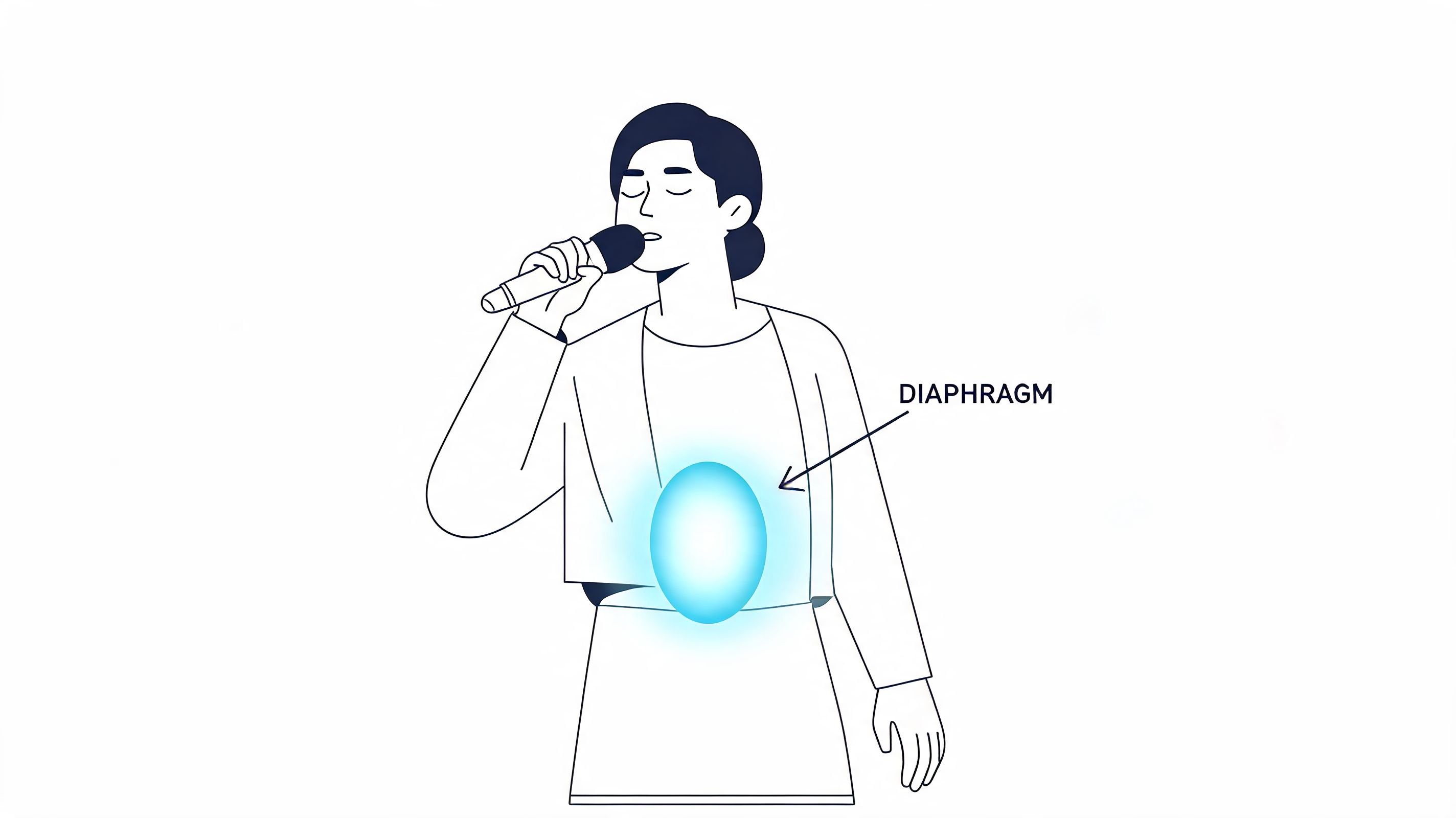
“Breathe from the diaphragm” confuses a lot of singers because it describes anatomy, not a usable sensation. What you want to feel is simpler. The inhale expands low. The exhale stays steady enough for the pitch to settle.
Try these drills:
-
Silent low inhale
Put your hands on the lower ribs and inhale without noise. Feel the ribs widen. If the upper chest jumps first, reduce the amount of air and try again. -
Long hiss
Inhale, then release on “sss.” Keep the airflow even. The goal is consistency, because a steady stream of air gives the vocal folds a cleaner job and gives your ear a more reliable sound to judge. -
Light panting
Use small, relaxed pants to feel the abdominal response. Stop if the shoulders start bouncing or the throat gets busy. -
Spoken pulse
Speak a light “ha-ha-ha” on one easy pitch. This connects breath pressure to sound without asking for full singing coordination yet.
These exercises are physical, but they also train perception. A stable breath makes the note easier to hear accurately. An unstable breath creates wobble, squeeze, or breathiness, and then singers misread the problem as “bad pitch” when the actual issue is setup.
That is why I treat body prep and ear training as one system. You free the mechanism first, then you check whether the sound matches what you intended to sing. If you want a few pitch-focused patterns to pair with this work, these vocal training tones and exercises fit well after breathing drills, especially if you use Trill to keep the ear involved from the start.
A clean setup saves time. It also gives your ear a signal it can trust.
The 10-Minute Vocal Warm-Up That Actually Works
A warm-up should do two jobs. It should prepare the voice, and it should tell you what kind of day your voice is having.
If the sound feels stiff, breathy, or uneven during warm-up, don’t ignore that and jump straight into songs. Use the warm-up as feedback. It’s your first diagnosis of the day.
Use warm-ups as a daily voice check
The biggest mistake I see is starting too big. Singers jump into full-volume choruses, dramatic vowels, or high-range belting before the voice has settled.
Start with sounds that make coordination easier. Semi-occluded sounds are useful because they encourage efficient airflow and cleaner vocal fold contact without forcing volume. That’s why lip trills, humming, and similar shapes show up in serious studios over and over.
If you want more examples of structured warm-up patterns, this guide on vocal training tones is a useful companion.
A simple 10-minute sequence
Use this sequence in order. Don’t rush it.
-
Minute 1 to 3: Lip trills
Glide gently from low to mid range, then back down. The trill should stay easy. If it collapses, your airflow is probably uneven or your face is tightening. -
Minute 3 to 5: Descending “ng” sirens
Start in a comfortable middle pitch and slide down. This helps release extra weight and smooth out the top of the sound. It should feel buzzy and easy, not swallowed. -
Minute 5 to 7: Five-tone scales on “oo”
Sing a simple five-note up-and-down pattern. Keep the vowel narrow and steady. The point isn’t volume. The point is consistent tone and centered pitch. -
Minute 7 to 10: Light vowel work on “ee” and “ah”
Alternate the vowels on short scale patterns. Listen for whether one vowel goes flat, spreads, or tightens. That tells you where your coordination needs attention.
A warm-up is working when you notice three things:
| Sign | What it means |
|---|---|
| Tone gets clearer | The folds are coordinating more efficiently |
| Pitch settles faster | Your ear and voice are syncing up |
| Range feels available | You’re releasing tension instead of forcing notes |
Don’t judge your voice by the first sound it makes. Judge it by whether it gets freer as you warm up.
If it doesn’t get freer, don’t sing louder. Go gentler. Reduce the range. Return to trills or humming and let the system organize itself.
Train Your Ear to Guide Your Voice
You sing the note you meant to sing. It still comes out a little sharp, or you drift into it and correct halfway through the phrase. In lessons, I see that problem blamed on support, tension, or lack of practice. Sometimes those are part of it. Just as often, the singer never heard the target clearly enough before making the sound.
Your ear is the guidance system for your voice. If it tracks pitch and harmony accurately, the body has something clear to organize around. If it does not, the throat starts guessing.

Pitch problems are often listening problems
Singers often treat ear training as optional theory work. That is a mistake. Clean intonation depends on two things working together. The voice has to coordinate the sound, and the ear has to identify what the sound should be.
If you slide around to find notes, need the piano or backing track to stay loud so you can stay centered, or lose your place when the chord changes, the weak point is often aural tracking. You are hearing pitch in a blurry way, so the voice arrives late.
That is why I put ear work inside vocal practice, not after it. Better hearing improves pitch accuracy, harmony singing, phrasing, improvisation, and song learning speed. It also makes physical exercises more useful, because you can tell whether the sound you produced matched the goal.
Trill: Ear Training Daily fits that job well. It gives singers short listening reps around intervals, note recognition, chords, and pitch memory. Used daily, it trains the part of musicianship that tells the voice where to go.
Relative pitch does most of the heavy lifting here. You do not need perfect pitch to sing well. You need to hear relationships. Which note feels higher. Which interval sounds tense. Which chord changed the color under your melody. That is what lets a singer enter confidently instead of fishing for the note.
What to practice for 10 minutes a day
Keep the work short enough that you will do it, and specific enough that your ear has a clear task.
-
Pitch matching
Play one note and sing it back immediately. Then check it. The goal is not volume or tone. The goal is fast, accurate targeting. This teaches your voice to respond to what you hear, not what you hope you heard. -
Interval recognition
Listen to two notes and identify the distance by sound. Start with seconds, thirds, fourths, and fifths. Then sing those intervals back. This sharpens melodic accuracy because songs are built from interval movement, not isolated notes. -
Direction training
Hear a short pattern and name whether it moved up, down, or stayed the same. It sounds simple. It is one of the fastest ways to improve reaction time and stop getting lost in phrases. -
Chord hearing
Listen for whether the harmony stayed put or changed, and what kind of change you heard. Singers who hear harmony phrase better, tune better, and recover faster if they miss an entrance.
For a practical bridge between drills and real music, this guide on ear training to play by ear lays out how listening skills transfer into actual songs.
Here’s a useful demonstration to pair with your routine:

How ear training changes real singing
The payoff shows up quickly in repertoire.
You hear the starting note of a phrase before you sing it. You stop scooping into entrances. Harmony parts feel less random because you can hear where they sit against the lead. Learning songs gets faster because you are tracking patterns, not memorizing one note at a time.
Good singers are not guessing less by accident. They are hearing more detail, earlier.
That is also why perfect pitch gets overhyped. Context hearing matters more for working singers. The useful skill is hearing notes in relation to the key, the chord, and the line before it. Once that improves, your voice follows with far less effort.
If your vocal practice trains the body but not the ear, you only trained half the instrument.
Create Your Perfect Vocal Practice Schedule
A workable vocal schedule solves a common problem. Singers either drift through unfocused sessions, or they overload one day and then avoid practice for the next three. Both habits slow progress because the voice improves from repeatable input, and the ear improves from frequent correction.
According to Forbrain’s vocal practice framework, singers tend to do better with a structured routine, several sessions across the week, and planned recovery days. That matches what shows up in real teaching. Consistency beats intensity, especially once you factor in fatigue, work, school, and the difference between a fresh voice and a used-up one.
A session that fits real life
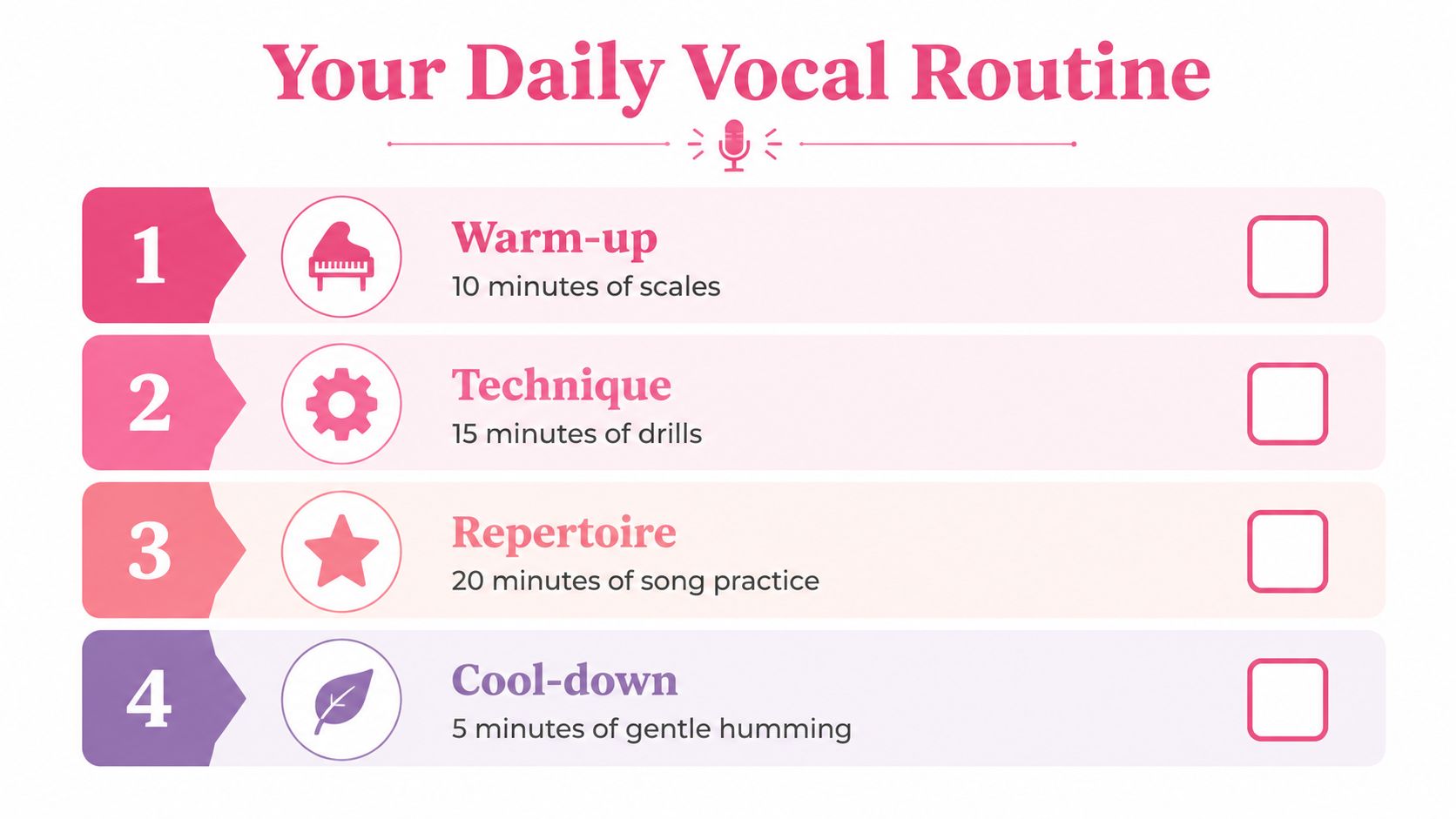
A good session has one job. Build coordination, then test it in music while your ears are still alert.
| Practice block | Time | What to do |
|---|---|---|
| Prep | 5 to 10 min | Tension scan, alignment, breathing reset |
| Warm-up | 10 min | Lip trills, sirens, easy scales |
| Ear training | 10 min | Pitch match, intervals, melodic direction |
| Song application | 10 to 15 min | Work one section of a real song slowly |
| Cool-down | 5 min | Gentle hums, easy descending sounds, quick notes |
That order matters. If you sing songs first, you usually reinforce whatever habits are already there. If you prepare the body first and train the ear before repertoire, you give the voice better instructions. The ear is the guidance system. The vocal tract follows.
Keep the song work narrow. One verse. One high entrance. One harmony line that keeps drifting flat. Record one take, fix one issue, sing it again. That is enough for a productive day.
Track what you practiced, what felt easy, and where pitch or coordination fell apart. A music practice tracker app for singers and musicians helps you spot patterns across the week, which matters because memory is unreliable after a long session.
A weekly plan you can actually follow
The best plan is one your voice can recover from and your schedule can repeat.
| Day | Focus |
|---|---|
| Monday | Full session with technique, ear training, and one song section |
| Tuesday | Shorter session with warm-up, ear training, and light repertoire |
| Wednesday | Complete vocal rest |
| Thursday | Full session with interval work and passaggio-focused song lines |
| Friday | Short session, mostly ear work and gentle singing |
| Saturday | Full session with repertoire and recording review |
| Sunday | Complete vocal rest |
The trade-offs are simple.
-
Short and repeatable beats occasional marathon sessions
Twenty-five solid minutes done often will help more than a heroic ninety-minute session that leaves you swollen and inconsistent. -
Rest preserves quality
A tired voice teaches bad coordination. Recovery days protect range, clarity, and confidence. -
Exercises need a musical target
Scales build control. Songs expose whether that control survives lyrics, rhythm, and emotion. -
Ear training stays in the plan even on lighter vocal days
If the voice needs less load, listening work can still sharpen pitch judgment, interval memory, and phrasing.
Beginners should start smaller than they think. Three focused sessions and a few short ear blocks are enough to build momentum. Add volume only after the voice is recovering well and the ears are catching mistakes earlier. That is the point of the whole schedule. Better singing starts with better hearing, then the physical work has somewhere accurate to go.
Common Vocal Problems and How to Fix Them
A recurring vocal problem is usually a coordination problem. The voice is giving feedback. Read it correctly, and practice gets faster.

Your voice cracks between registers
Register breaks usually show up when the voice changes gear faster than the singer can coordinate airflow, vowel shape, and pitch target. According to Singwise’s practical guide to vocal development, many untrained singers struggle in the passaggio, and Singwise recommends semi-occluded vocal tract work such as lip trills, followed by pure vowels on small scale patterns through the transition.
Use that advice in a strict order:
- Start with lip trills through the break area
- Slide lightly before you sing separate notes
- Use pure vowels like ee, eh, ah, oh, oo
- Move by half steps so the shift stays small and readable
Avoid the common mistake here. Singers often attack the problem phrase at full volume and hope repetition will solve it. It usually teaches the crack.
The ear matters as much as the larynx. If you cannot hear the note relationships clearly as you cross the register change, the body tends to grab and overshoot. Sing the pattern only after you can hear where the pitch is going.
You sound breathy or weak
Breathy tone often comes from poor vocal fold closure, but singers also create it by letting too much air escape before the pitch settles. The fix is not more force. The fix is cleaner setup.
Try this sequence:
- Start with an easy ng hum.
- Shift to a small oo vowel on a five-tone scale.
- Keep the sound focused and compact.
- Record one line, reset, and sing it again with less air.
Listen back for clarity, not size. If the second take sounds cleaner with less effort, keep that version. That is better coordination, and better coordination is what carries into songs.
A weak sound can also be an ear problem in disguise. Singers who do not hear the center of the pitch often leak air while searching for it. Short ear work on pitch matching and interval recognition helps the voice commit earlier instead of wandering into the note.
High notes feel strained
Strain on high notes usually means the singer is trying to lift pitch by pushing harder. That trade-off feels powerful for a second and falls apart fast. Intonation gets unstable, the jaw joins in, and the neck starts doing work it should not do.
Use this check:
- If the neck tightens, lower the volume
- If the vowel spreads, modify it to a narrower shape
- If the pitch gets unstable, hear the interval first, then sing it
- If the note only comes out once, the coordination is not repeatable yet
I see this constantly with singers who practice scales faithfully but skip listening work. They can produce the note once by effort, but they cannot return to it on command because the ear never got specific enough. High notes improve faster when the body and the ear are trained together.
As noted earlier, Trill: Ear Training Daily fits well on lighter practice days or before song work. A few minutes of interval and pitch recognition gives the voice a clearer target, which reduces guessing and cuts down the strain that comes from chasing notes mid-phrase.



