How to Transcribe Music by Ear: A Musician's Guide
You know the feeling. A song comes on, you grab your instrument, and within seconds you’re poking around for notes that might fit. You try a few chords, land on something close, then lose the thread when the verse changes or the melody jumps. After a while, it starts to feel like some musicians can just hear music and everyone else is faking it.
They aren’t faking it, but they usually aren’t guessing either.
Transcribing music by ear is the skill of turning sound into something you can sing, play, name, and remember. It’s one of the fastest ways to build real musical freedom. You stop depending on tabs, weak chord charts, and somebody else’s explanation of the song. You start hearing shape, function, and movement for yourself.
That shift matters whether you’re a guitarist trying to play by ear, a singer working on pitch, a producer pulling chords out of a track, or a student trying to survive aural skills class. The big insight is simple. This is trainable. Ear training works the same way any other musical skill works. Small, focused practice repeated daily changes what you notice.
Table of Contents
- Stop Guessing and Start Hearing Your Favorite Songs
- First Train Your Brain to Hear Music Clearly
- A Practical Workflow for Transcribing Any Song
- Your Daily Transcription Practice Routine
- Common Transcription Hurdles and How to Jump Over Them
- Frequently Asked Questions About Transcribing by Ear
Stop Guessing and Start Hearing Your Favorite Songs
Most players who say they want to learn how to transcribe music by ear are really describing a deeper frustration. They want to stop feeling dependent. They want to hear a song at rehearsal and join in. They want to catch a chord progression without waiting for someone to spell it out. They want to improvise without sounding like they’re searching in the dark.
That ability doesn’t come from perfect pitch. It comes from trained listening.
A good transcriber doesn’t hear music as a blur. They hear roles. They notice which note feels like home, which note creates tension, where the bass moves, and where the phrase resolves. That sounds advanced when you first read it, but in practice it’s built from very basic habits. You sing what you hear. You compare one note to another. You test your answer against the recording. Then you repeat that process until your ear stops panicking.
Practical rule: If you’re hunting for notes with your fingers before you can sing the phrase, you’re probably training your hands to guess instead of training your ear to hear.
This is why tabs and chord charts can become a trap. They can be useful references, but they don’t teach you how the music sounds. They give answers without building perception. If your goal is to play by ear, you need the opposite. You need a way to connect sound, voice, and instrument.
Three outcomes show up when this clicks:
- You hear progressions sooner: Common chord motion starts sounding familiar instead of mysterious.
- You learn songs faster: Not because the songs got easier, but because your ear starts grouping sounds into patterns.
- You improvise with more intention: You stop throwing notes at the track and start reacting to what the harmony is doing.
The first big breakthrough is realizing that hearing music is not magic. It’s pattern recognition under pressure. The second is realizing pressure drops when you follow a system.
First Train Your Brain to Hear Music Clearly
Before you transcribe a full song, you need to clean up the way you listen. Most beginners don’t have a note problem. They have an attention problem. They’re trying to hear melody, chords, rhythm, bass, and texture all at once, then wondering why everything feels muddy.
Why random guessing keeps you stuck
Ear training starts with relationships, not isolated facts. You don’t need to recognize every note as a floating label. You need to hear whether a melody moved up or down, whether a chord sounds bright or dark, and whether the phrase settled or stayed open.
That approach gets much easier once you realize how much music reuses the same materials. Approximately 95% of music is diatonic, meaning it uses notes and chords from a single key. This makes transcription feasible because by mastering the sound of one key, you can recognize recurring patterns across hundreds of songs, as explained in this breakdown of transcribing in the same key.
That’s a huge relief for most musicians. You don’t need to prepare for every possible sound on day one. You need to get very good at hearing a manageable set of sounds repeatedly.
A solid early practice stack looks like this:
- Intervals: Hear the distance between two notes by singing them back.
- Chord quality: Learn the sound of major, minor, and unstable colors instead of treating chords like abstract symbols.
- Melodic direction: Track contour first. Is the phrase climbing, falling, or circling one tone?
- Tonal center: Notice which note sounds settled, even before you know its name.
For a deeper foundation on this process, this ear training guide on how to play by ear connects the listening side directly to real playing.
Build a small library of reliable sounds
A trained ear isn’t a gift. It’s a memory bank.
Every day you spend singing intervals, identifying simple chord movement, and matching short melodies, you add one more reference to that bank. Over time, the sounds stop feeling separate. You hear a melody note against the bass and think, “I’ve heard that pull before.” That’s the moment theory turns into hearing.
Hearing improves fastest when you stop asking, “What note is that?” and start asking, “What is that note doing?”
Keep the exercises short. Stay with simple songs. Repeat familiar progressions in one key until they feel obvious. That kind of repetition isn’t boring. It’s what makes later transcription feel possible.
A Practical Workflow for Transcribing Any Song
Good transcription is methodical. Bad transcription feels like wrestling. If you jump straight into note hunting, hard songs feel impossible and easy songs take longer than they should.
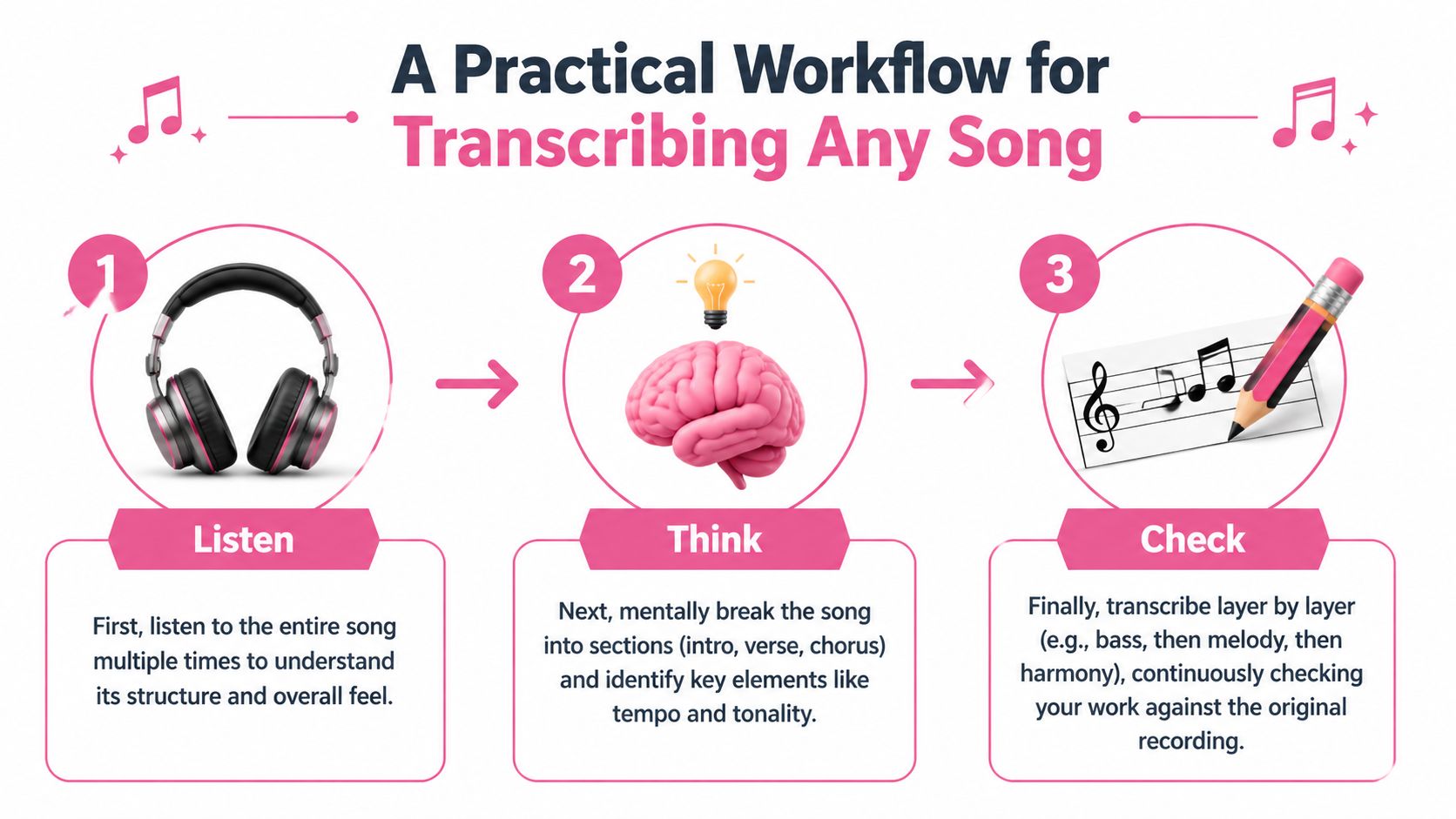
The workflow that holds up best is Listen, Think, Check. In this explanation of the Listen-Think-Check process, the method is defined as three steps: listen to map the song’s form and key, think by mentally analyzing melody and bass lines without an instrument, and check your work against the recording. That’s what keeps you from confusing guessing with hearing.
Listen before you touch the instrument
Start away from your instrument if you can.
Play the song several times and answer a few basic questions first. Where does the verse begin and end? Does the chorus repeat exactly? Does the groove feel square or syncopated? What note or chord feels like home?
If you have slowdown software like Audacity or Transcribe!, use it early. Loop a short section. Slow it enough that details separate, but not so much that the phrase loses its shape.
Focus on structure before details:
- Form: Intro, verse, chorus, bridge
- Pulse: Where the beat lands
- Center: The tonal home base
- Repeated material: Hooks, turnarounds, recurring fills
A lot of musicians skip this because they want instant answers. But if you don’t know where you are in the song, every note feels harder to place.
Think in layers instead of chasing everything at once
Transcribe one layer at a time. This is the part that makes the whole process manageable.
Start with the melody. Sing it before you play it. If you can’t sing the phrase, you probably haven’t heard it clearly enough yet. Once the melody is stable, move to the bass. The bass often tells you more about the harmony than the upper parts do, especially in pop, rock, folk, and a lot of singer-songwriter material.
This guide to musical intervals helps with the exact skill that matters here. Hearing how one note relates to the previous note or to the tonal center.
Work in this order:
- Melody first: Short phrase, sung out loud, then found on your instrument.
- Bass second: Listen for root motion and where the harmony changes.
- Harmony third: Fill in chord quality and any color tones after melody and bass make sense.
Start with what is clearest, not with what seems most important. In many songs, that means melody first. In others, the bass gives away the whole progression.
A common mistake is trying to identify full chords before hearing the bass. That usually leads to vague labels and wrong roots. Another is trying to transcribe the entire arrangement in one pass. Don’t. Build from the ground up.
Check against the recording, not your ego
Once you think you have the phrase, test it.
Play or sing along with the track. If it locks, keep going. If it rubs against the recording, don’t defend your answer. Fix it. Good transcribers get fast because they correct quickly, not because they’re never wrong.
Use these checks:
- Sing with the track: If your voice drifts, the pitch or rhythm is off.
- Loop the problem spot: One beat is enough if the phrase is dense.
- Mute your instrument and listen again: This clears away finger memory.
- Write it down if needed: Notation or simple note names can expose fuzzy hearing.
The trade-off is simple. Working this way feels slower at first because you’re not letting your hands bluff their way through. But that slower start builds the exact ear skills that make future songs much easier.
Your Daily Transcription Practice Routine
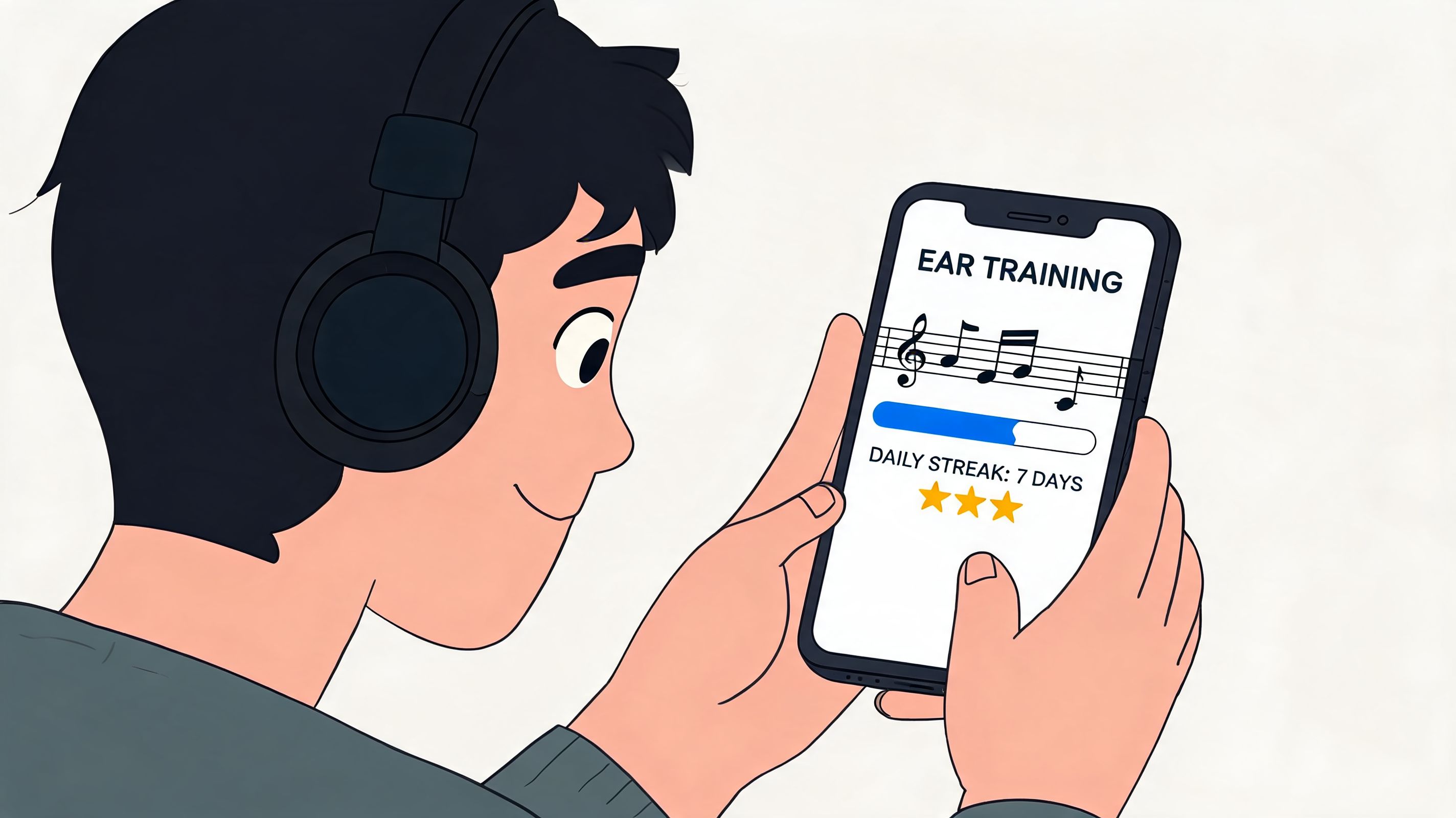
Long sessions feel serious, but short sessions are what most musicians sustain. If you want to get better at ear training and play by ear more confidently, daily contact matters more than heroic effort once in a while.
A short routine you can actually keep
A practical daily routine has two parts. First, do focused ear work. Then apply it to real music.
One verified benchmark is worth keeping in mind. Musicians who follow a daily 10-15 minute ear training regimen see proficiency gains up to 4x faster, with some able to transcribe a full pop song in one hour versus a four-hour baseline after several months of consistent practice, according to this ear training methodology video.
That doesn’t mean every session should be long or dramatic. It means consistency works.
A clean routine looks like this:
- Ear training block: Spend 10 minutes on interval recognition, chord quality, and tonal center work with a daily ear training app.
- Transcription block: Take 15 to 20 minutes on a single small excerpt.
- Review block: Sing back what you learned without the recording.
Keep the excerpt tiny. One or two bars is enough. If you finish that cleanly, you’ve had a productive session.
What to practice when time is tight
Use simple material on purpose. A nursery-rhyme-level melody, a pop chorus, or a bass line with obvious roots will teach you more than a dense arrangement you can’t yet parse.
Useful tools include Audacity for slowing and looping, Transcribe! for marker-based playback, your voice for singing phrases, and your instrument only after the sound is already in your head.
This quick video pairs well with that kind of session:

When time is short, rotate your focus across days instead of forcing everything into one sitting:
- Day one: Melody only
- Day two: Same bars, bass only
- Day three: Chord quality and rhythm cleanup
- Day four: Sing and play the full phrase from memory
Small-session advantage: Stopping with one phrase done correctly builds momentum. Stopping after a messy hour usually builds avoidance.
This is also where people discover that ear training doesn’t live apart from real musicianship. The same work that helps you transcribe also improves improvisation, chord recognition, accompaniment, and writing.
Common Transcription Hurdles and How to Jump Over Them
Everyone runs into the same few problems. The difference between progress and burnout is knowing which lever to pull when you get stuck.
Troubleshooting Your Transcription
| The Problem | The Fix |
|---|---|
| You can’t find the key | Listen for the last note or chord that feels resolved, then sing that tone and test nearby notes against it. |
| All the chords sound the same | Ignore the full chord for a moment and follow the bass line only. Root movement usually narrows the choices fast. |
| The rhythm feels slippery | Stop chasing pitches. Clap or tap the rhythm until it sits in your body, then return to the notes. |
| You keep grabbing notes on your instrument without hearing them first | Sing the phrase away from the instrument, then find it. If you can’t sing it, loop a smaller chunk. |
| You hear the melody but not the harmony | Write down or memorize the melody first, then add bass underneath it. Melody plus bass reveals more harmony than upper textures do. |
| Fast passages turn into blur | Slow the audio and shorten the loop. One beat or even two notes can be enough. |
| You get the notes but they still sound wrong | Check articulation and rhythm placement. A correct pitch played in the wrong spot will still feel off. |
| You lose your place in the song | Mark the form first. Label sections in plain language such as intro, verse, chorus, and bridge. |
| You feel overwhelmed by dense arrangements | Choose one line and stay with it. Horizontal listening is often clearer than trying to hear the full stack at once. |
A lot of these problems come from the same source. The ear is being asked to process too much at once.
Two habits solve more than people expect:
- Shrink the task: One phrase, one line, one beat.
- Change the question: Not “what is everything happening here?” but “what is the bass doing right now?” or “did that melody move by step or leap?”
Frustration usually means the chunk is too big, not that you lack talent.
If you treat transcription like a hearing exercise instead of an intelligence test, it gets much easier to recover when you hit a wall.
Frequently Asked Questions About Transcribing by Ear
Do I need perfect pitch to transcribe?
No. Most musicians who learn to transcribe well rely on relative hearing, not perfect pitch. They learn how notes relate to a key center, a bass note, or the previous note in the phrase.
Should I use my instrument while transcribing?
Yes, but not first. Listen and sing before you play. The instrument should verify what you heard, not replace hearing.
What’s the best kind of song to start with?
Start with music that has a clear melody, steady rhythm, and obvious bass movement. Simple pop, folk, children’s songs, and spacious vocal lines are all good choices.
Is writing it down necessary?
Not always. If your goal is to play by ear, you can memorize and perform the phrase without notation. But writing can reveal fuzzy rhythm and pitch decisions.
How long before this starts to feel natural?
It varies, but the first change is often noticed when songs stop sounding like a wall of sound and start revealing separate parts with distinct jobs.
What’s the biggest mistake beginners make?
Trying to transcribe whole songs too soon. Small excerpts build skill. Huge projects usually build frustration.
If you want a simple way to make ear training a daily habit, Trill: Ear Training Daily is built for exactly that. It helps musicians train intervals, chords, notes, and scales through short sessions designed to improve real listening, chord recognition, and the ability to play by ear with confidence.