Mastering Intervals of Major Scale by Ear
You hear a melody clearly in your head. You sit down with your guitar, piano, or voice. Then the guessing starts.
You try one note, then another. You get close, lose it, and start over. A lot of musicians think this means they’re “not naturally good” at ear training.
It usually means something simpler. You can hear the song, but you haven’t trained yourself to hear the distance between notes yet.
That distance is an interval. If you can hear intervals of major scale patterns as actual sounds, not just theory terms, melodies stop feeling random. You start to recognize motion, tension, stability, and where a phrase wants to go next. That’s the moment playing by ear starts to feel real.
Table of Contents
- Why You Can’t Play That Melody By Ear Yet
- The Seven Essential Sounds of the Major Scale
- Hearing the Feeling Behind Each Interval
- Daily Exercises to Train Your Interval Instincts
- How Interval Skills Unlock Musical Freedom
- Your 10-Minute Daily Path to Playing By Ear
Why You Can’t Play That Melody By Ear Yet
A beginner pianist once told me, “I know the tune. I can sing it. But when I touch the keys, I lose it.”
That’s one of the most common ear training problems there is. The issue isn’t hearing the melody. The issue is translating what you hear into note-to-note movement.
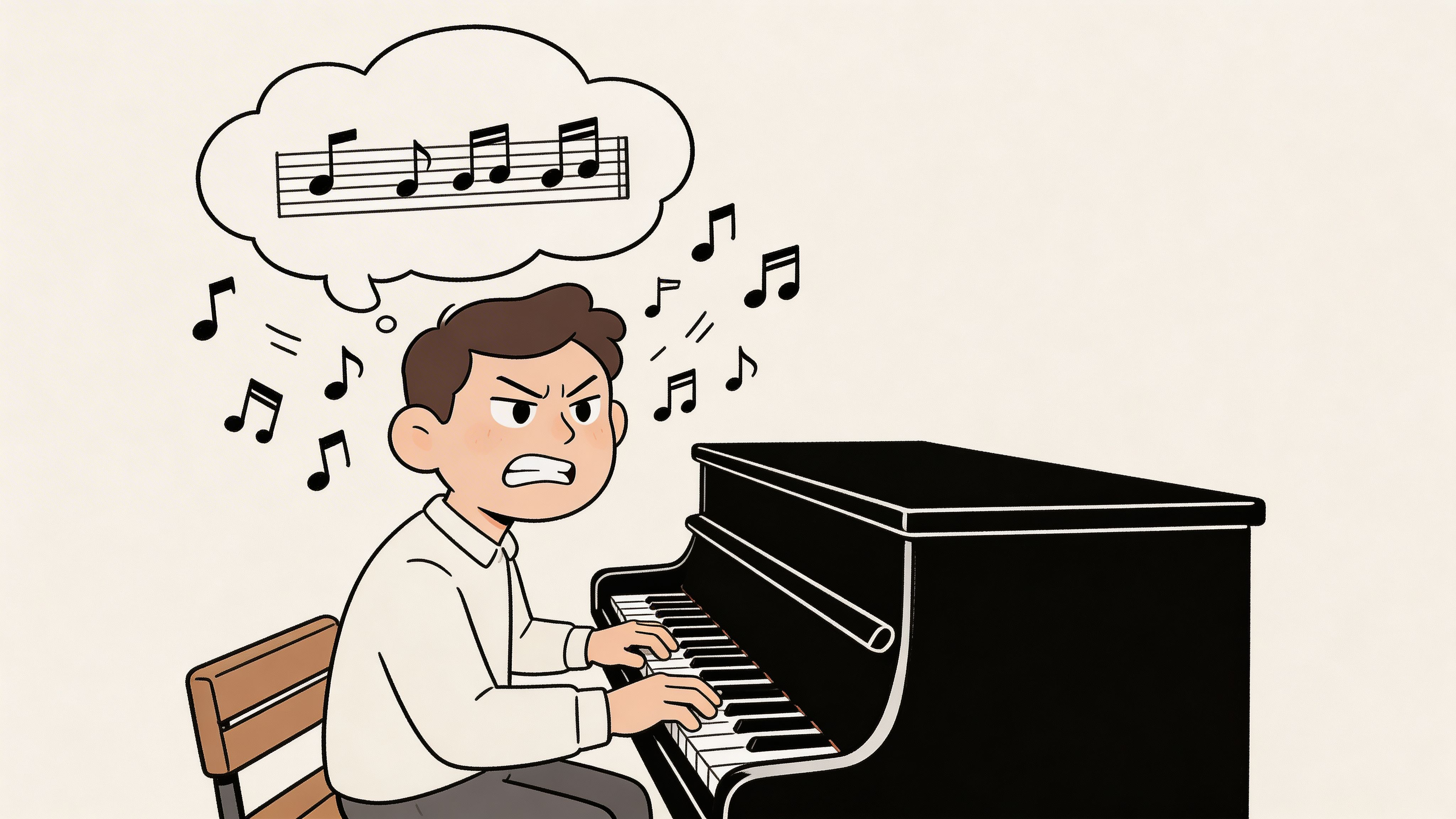
If your ear hasn’t learned intervals yet, every melody feels like a search. You’re not really listening for shape. You’re hunting for isolated notes.
That’s why some players can hum a tune perfectly but still struggle to find it on their instrument. They hear the song as one big blur instead of hearing, “that note moved up a step,” or “that leap sounded wide and stable,” or “that last note wanted to resolve.”
The missing skill is distance
Every melody is built from intervals. A melody doesn’t move by random magic. It moves by small and large distances that your ear can learn to recognize.
When you train intervals of major scale sounds, you stop treating melodies like puzzles with infinite choices. You start hearing a smaller set of familiar moves.
- Step motion often feels close and connected.
- Larger skips feel more dramatic.
- Stable intervals sound settled.
- Tense intervals sound like they want to go somewhere.
Practical rule: If you can sing the distance between notes, you’re already on the way to playing it by ear.
Guessing feels musical. Hearing is better
A lot of musicians rely on trial and error for years. They call it “working it out by ear,” but most of the time they’re guessing, then correcting.
Real ear training is different. You learn to identify what your ear is already sensing. That’s trainable. It’s not reserved for people with perfect pitch.
When you understand intervals of major scale sounds, you build a reference system. Then a melody doesn’t feel invisible anymore. It has a shape, a pull, and a logic your ear can follow.
The Seven Essential Sounds of the Major Scale
The major scale is one of the best places to build your ear because it has a clear sound world. From the tonic, its intervals are only perfect and major intervals, and they follow the fixed pattern whole-whole-half-whole-whole-whole-half according to Music Crash Courses on major and minor intervals.
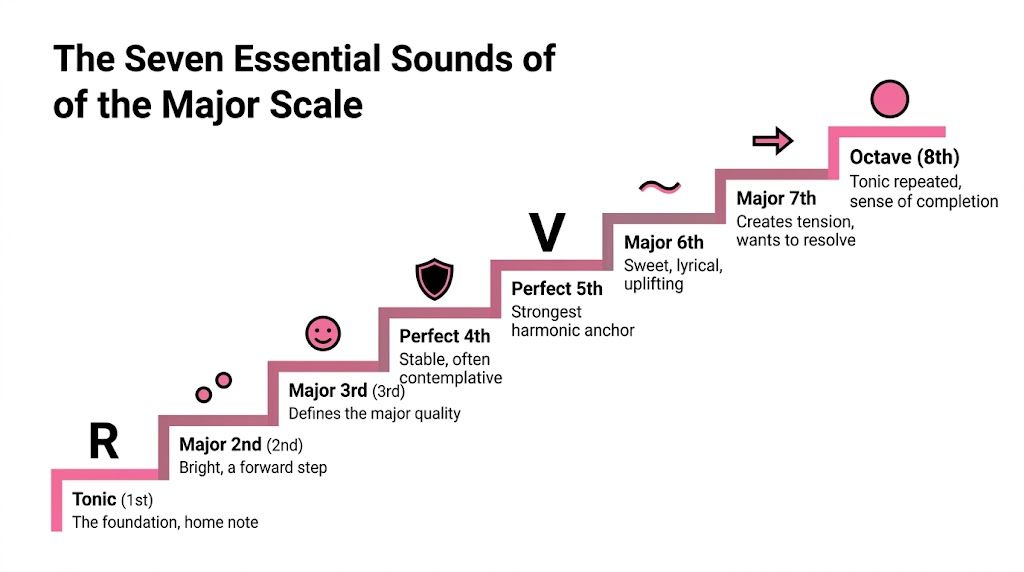
Think of the scale as a ladder. The tonic is home. Each note above it has its own flavor and function.
Why the major scale sounds so familiar
In a major scale, the tonic gives you a sense of rest. Then each higher note creates a different kind of motion away from home.
Here are the sounds you want to learn from the tonic upward:
- Unison feels like staying put.
- Major 2nd feels like the first bright step away.
- Major 3rd gives the scale its major color.
- Perfect 4th feels stable, but not fully finished.
- Perfect 5th sounds strong and grounded.
- Major 6th feels open and lyrical.
- Major 7th feels tense and eager to resolve.
- Octave feels like home again, higher.
If you want a quick visual reference while practicing, the scale tools at Trill Studio can help you see these note relationships on screen.
A simple map in C major
Using C as the tonic makes this easy to picture:
| Interval Name | Scale Degree | Example Notes (in C) | Semitones from Tonic |
|---|---|---|---|
| Unison | 1 | C to C | 0 |
| Major 2nd | 2 | C to D | 2 |
| Major 3rd | 3 | C to E | 4 |
| Perfect 4th | 4 | C to F | 5 |
| Perfect 5th | 5 | C to G | 7 |
| Major 6th | 6 | C to A | 9 |
| Major 7th | 7 | C to B | 11 |
| Octave | 8 | C to C | 12 |
This table matters because it gives your ear a map. But don’t stop at reading it. Sing it.
Play C, then sing D. Back to C. Then sing E. Then F. Keep returning to the tonic so your ear learns each interval as a relationship, not as an isolated note.
Don’t memorize intervals as facts only. Memorize how each one feels against home.
That’s how intervals of major scale sounds become useful when you want to play by ear.
Hearing the Feeling Behind Each Interval
Most musicians start by trying to label intervals. That helps, but it’s only half the job.
The better skill is hearing what an interval does. Does it feel settled? Does it lean forward? Does it sound open, sweet, sharp, or unresolved?
Stable sounds and restless sounds
The major scale gets its familiar bright character from its stack of major and perfect intervals, and that sound is reinforced by the harmonic series, as described in Puget Sound’s interval introduction.
You don’t need to think about acoustics while playing. You just need to notice the result.
A perfect 5th usually feels solid. If you play C up to G, the sound has weight and balance. That’s one reason power-chord based music feels so grounded.
A major 3rd gives the scale its sunny identity. C up to E is the sound that says, “this is major.”
A major 6th often feels smooth and singing. It has a lyrical quality that works beautifully in melodies.
Then there’s the major 7th. C up to B doesn’t feel finished. It leans hard toward the octave. Your ear often wants B to rise to C.
That contrast matters. Both notes belong to the major scale, but they don’t behave the same way.
A trained ear doesn’t just identify “major 7th.” It hears “tension that wants release.”
Why this matters when you play by ear
When you’re learning songs by ear, the emotional function of an interval helps you predict what comes next.
If a melody lands on the 5th, it may rest there for a moment. If it lands on the 7th, your ear often expects a return to tonic. That expectation helps you find notes faster.
This is also where many players get confused. They assume every note in a major scale should feel equally stable because all of them are “in key.” That isn’t how hearing works.
Try this on your instrument:
- Play C to G. Notice the calm.
- Play C to B. Notice the pull.
- Sing both back to back. Feel how different the endings are.
- Return both to C. Hear which one already sounded settled and which one needed help.
This is a big shift for ear training. You stop hearing intervals as dry measurements and start hearing them as musical behavior.
That’s the difference between knowing theory and being able to play by ear.
Daily Exercises to Train Your Interval Instincts
Reading about intervals won’t change your ear. Listening, singing, checking, and repeating will.
A short daily routine works better than occasional long sessions because your ear learns through frequent contact with the same sounds.
A short routine that builds real hearing
Use one tonic for a few minutes. C works well, but any comfortable pitch is fine.
Then do this:
-
Anchor home first
Play the tonic several times. Sing it until it feels stable in your body, not just in your instrument. -
Add one interval only
Start with the major 2nd. Play C to D. Sing it back. Then return to C alone and try to sing D before checking yourself. -
Contrast two close sounds
Compare major 2nd and major 3rd. C to D, then C to E. Don’t ask only, “Which one is which?” Ask, “Which one feels closer? Which one sounds more settled?” -
Test downward too
Sing from E down to C, or from D down to C. Descending hearing often exposes weak spots. -
Close your eyes when possible
Visual habits can hide listening weaknesses. Give your ear more of the workload.
One useful option is the interval training tool at Trill Studio, which presents interval listening exercises in a structured format for short daily practice.
Move from naming to feeling
A lot of players get stuck because they only practice identification. That can turn into a quiz game instead of a musical skill.
Musicians learning to play by ear need to recognize an interval’s quality of consonance, meaning the tension it creates and whether it needs resolution, as discussed in this ear training lesson on hearing tension signatures.
Here’s a stronger approach:
-
Ask where it wants to go
After hearing a major 7th, sing the octave it wants to resolve to. -
Group by function
Practice the more stable sounds together, then compare them with the more active ones. -
Use real melodic fragments
Don’t stay with flashcards forever. Build short phrases from scale tones and hear how they move around the tonic. -
Sing before you play
This is one of the fastest ways to stop guessing and start hearing.
A short demonstration helps. Watch this, then try to imitate the sounds with your own voice.

A practical 10 minute session
Here’s a simple daily plan:
-
Minute 1 to 2
Sing the tonic and octave. Get centered. -
Minute 3 to 4
Practice major 2nd and major 3rd. Alternate them. -
Minute 5 to 6
Add perfect 4th and perfect 5th. Listen for stability. -
Minute 7 to 8
Add major 6th and major 7th. Focus on sweetness versus tension. -
Minute 9 to 10
Improvise tiny melodies using only major scale notes, then try to name the interval of each jump.
Try this tonight: End every exercise by singing the tonic again. Your ear learns intervals faster when every sound is tied back to home.
Keep the session short enough that you’ll repeat it tomorrow. Consistency builds instinct. That’s how ear training starts to show up in real playing.
How Interval Skills Unlock Musical Freedom
Learning intervals of major scale sounds pays off when music gets messy. A band counts in. A singer changes the melody slightly. A chord chart is wrong. You still need to function.
That’s where ear training becomes practical, not academic.
For guitarists singers and songwriters
If you’re a guitarist, interval hearing helps you stop relying on tab for every melody. You hear that a phrase rises by step, then leaps to a stable tone. Your hands can search with purpose instead of panic.
If you’re a singer, intervals help with pitch accuracy and recovery. When you drift off pitch, you don’t just hope to land back in tune. You hear where the note sits relative to home and adjust.
If you write songs, interval awareness gives you control over emotional shape. A line built around the 5th feels different from one that leans on the 7th. You start choosing that effect instead of stumbling into it.
What changes in real music situations
Here are a few musical outcomes that matter:
- Melody transcription gets faster because you hear relationships between notes, not just individual pitches.
- Improvisation feels less random because stable intervals give you landing points.
- Chord recognition improves because melody notes often reveal harmonic function.
- Ensemble playing gets easier because you can react to what others played.
There’s also a confidence shift that’s hard to overstate. When your ear knows what a note feels like before your fingers find it, you play with less hesitation.
That doesn’t require perfect pitch. It requires repeated listening, singing, and checking. In other words, the kind of ear training anybody can practice.
The player who can hear function has more freedom than the player who only remembers shapes.
This is why interval practice belongs in everyday musicianship. It helps you improvise, follow melodies, hear resolutions, and make better choices on the spot. That’s what people usually mean when they say they want to play by ear.
Your 10-Minute Daily Path to Playing By Ear
If you can’t play melodies by ear yet, that isn’t a verdict on your talent. It’s a training issue.
Your ear gets stronger when you work with the same core sounds again and again. The intervals of major scale notes give you one of the clearest places to start because each one has a distinct role, feeling, and pull.
Keep it simple. Sing the tonic. Compare one or two intervals. Notice which sounds feel stable and which ones want resolution. Then repeat tomorrow.
Ten focused minutes a day can do more than occasional marathon practice because it teaches your brain to recognize sound patterns as normal, familiar musical events.
If you want a deeper daily framework for this skill, this guide on ear training and how to play by ear is a strong next step.
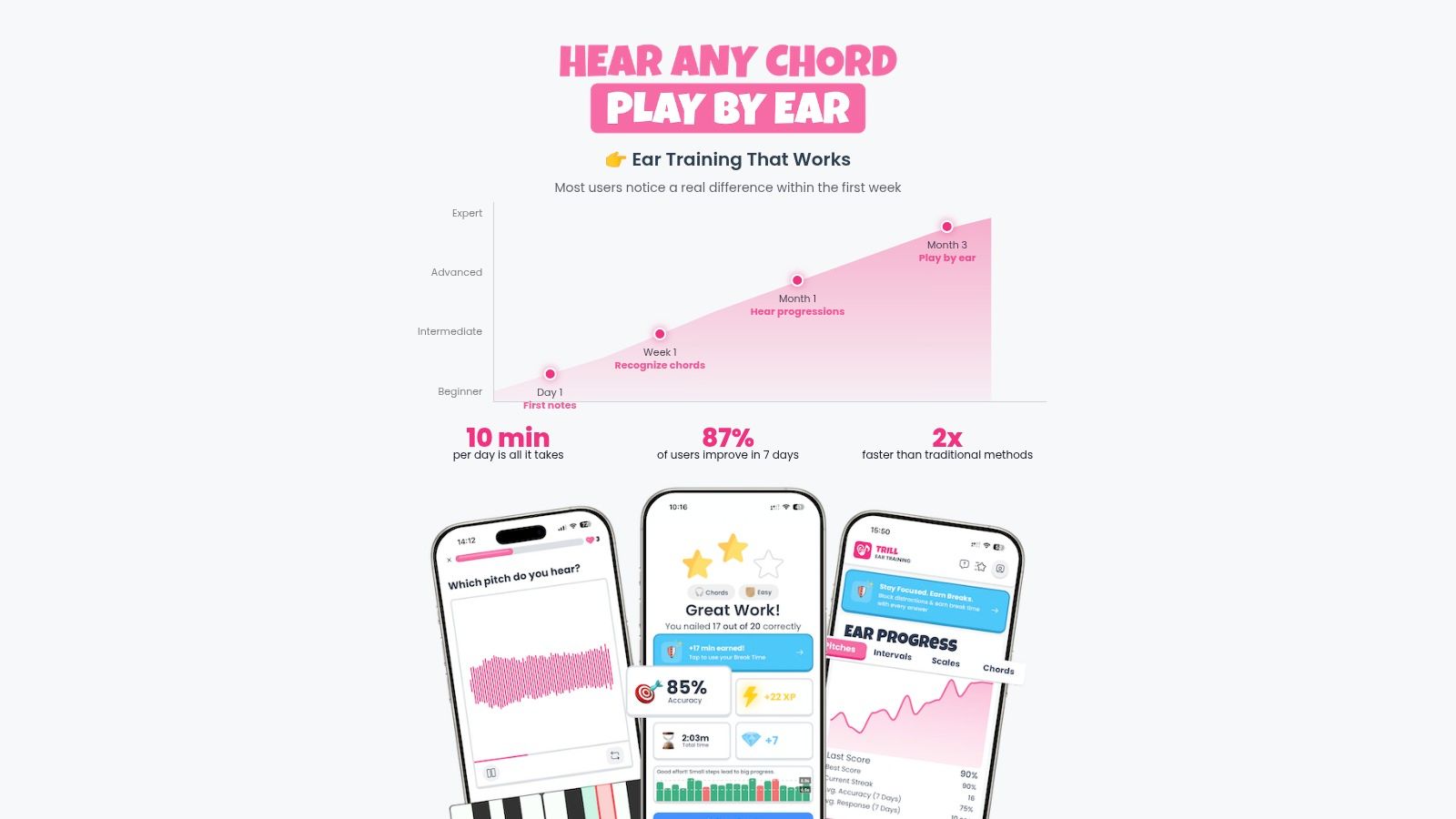
If you want a simple daily system for ear training, Trill: Ear Training Daily offers short exercises for intervals, chords, notes, and scales so you can spend 10 minutes a day building the listening skills behind improvisation, chord recognition, and real confidence when you play by ear.