Music Learning App: Unlock Your Musical Potential

You sit down with your instrument, pull up a tutorial, pause every few seconds, copy the shape, and hope it sounds right. You can get through the song, but if someone takes away the tab, the chord chart, or the video, you’re stuck.
That frustration is more common than most musicians admit. I see it in beginners, in singers with strong voices, and in guitarists who can play dozens of songs but still can’t play by ear. They don’t lack passion. They haven’t trained the skill that matters most for musical freedom, which is hearing what’s happening and connecting it to their hands or voice.
A good music learning app can help, but only if you use it as a daily training system, not as background entertainment. That’s why so many families and students are turning toward digital music tools. The market for children’s music learning apps is projected to reach USD 737.9 million by 2032, and apps for ages 5 to 12 saw a 150% increase in downloads over the last two years, according to Astute Analytica reporting via GlobeNewswire. People want music learning that fits real life.
If your goal is ear training, that’s good news. You don’t need longer lectures. You need a simple path that teaches you to hear music instead of guess it.
Table of Contents
- Tired of Tabs and Tutorials Start Hearing the Music
- What Real Music Learning Apps Actually Teach
- Why Your Ear Is a Muscle Not a Gift
- How to Choose an App That Builds Real Skills
- The 10-Minute Daily Routine for Playing by Ear
- The Real-World Payoff Musical Freedom
Tired of Tabs and Tutorials Start Hearing the Music
A student once told me, “I can learn songs, but I can’t find them.” That sentence gets right to the point.
He wasn’t lazy. He practiced. He could follow a video, copy fingerings, and memorize patterns. But if I played a simple progression and asked him to find it by ear, he froze. He had trained his fingers to copy, not his ears to recognize.
The moment most musicians realize what’s missing
This usually shows up in ordinary situations:
- At a jam session: Someone says, “It’s just a simple progression.” You know the style, but you can’t hear the chord movement fast enough to join in.
- While learning songs: You replay the same section over and over because you don’t trust what you’re hearing.
- When improvising: Your hands know scales, but your phrases sound random because your ear isn’t leading.
Practical rule: If you can only play music after someone explains it visually, your ear training needs more attention than your technique.
That’s where a music learning app becomes useful. Not as a game. Not as a collection of badges. As a repeatable system that gives your ear a daily job.
Playing by ear starts smaller than people think
Many musicians think “play by ear” means instantly naming every chord in a jazz standard or developing perfect pitch overnight. It doesn’t.
At first, playing by ear means hearing that a melody moved up instead of down. It means noticing that one chord sounds settled and another sounds tense. It means recognizing that a chorus repeats the same shape as the first one.
Those are trainable listening habits.
Here’s the encouraging part. You don’t need to become a theory expert before you begin. You need short, focused repetition. If you can learn to hear intervals, chord quality, and simple melodic patterns, you stop relying on visual crutches and start building musical independence.
That shift is a primary objective for those searching for a music learning app. They don’t just want more content. They want the freedom to hear a song and respond musically.
What Real Music Learning Apps Actually Teach
The strongest apps don’t treat musical skills as separate boxes. They connect everything back to hearing.
Hearing is the thread that connects everything
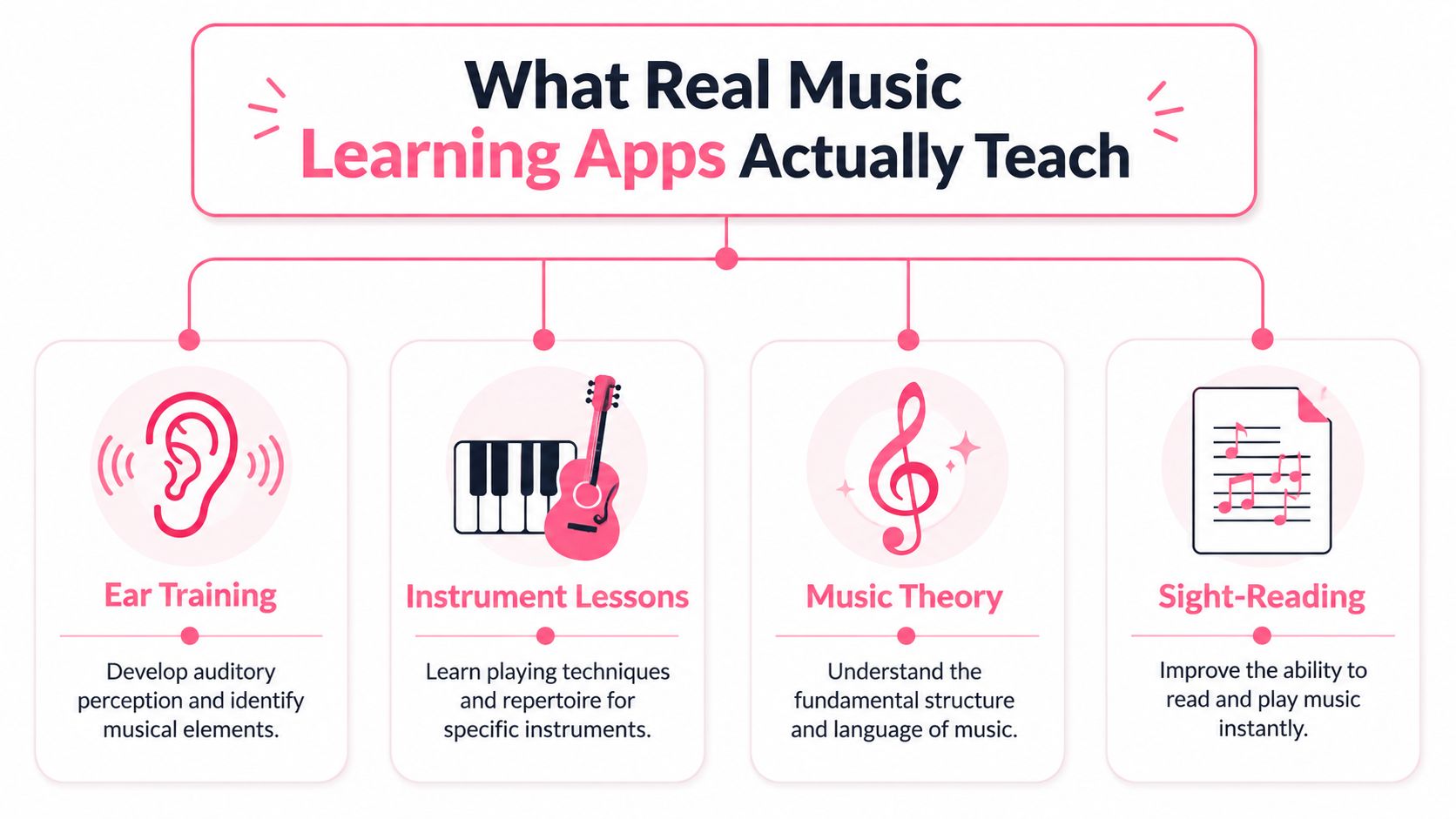
Most music apps fall into four broad areas. The mistake is thinking only one of them matters for ear training.
| App area | What people think it teaches | What it should teach you to hear |
|---|---|---|
| Ear training | Intervals, chords, notes | Sound relationships you can recognize in real songs |
| Instrument lessons | Technique and songs | How your movements create the sounds you’re aiming for |
| Music theory | Rules and terms | Why certain sounds feel stable, bright, dark, tense, or resolved |
| Sight-reading | Faster reading | How notation maps to sounds in your inner ear |
If an app teaches theory without sound, students memorize labels and stay disconnected. If it teaches instrument technique without listening, students develop fast fingers and weak ears.
A real training system brings those pieces together. If you’re learning a major chord, you shouldn’t just identify the name. You should hear its character. If you’re practicing a scale, you shouldn’t only run it up and down. You should learn what that pattern sounds like in melodies.
The difference between drills and musical understanding
Music learning offers benefits extending beyond musical proficiency. One cited summary of music education research notes that after 20 days of computerized music training, 90% of children showed gains in verbal IQ, and students in music programs scored an average of 63 points higher on verbal SATs, as described in this music education overview. The exact mechanism may be discussed in different ways, but the big idea is clear. Focused musical listening builds broader mental skills.
For musicians, the practical takeaway is simpler. The app should train your brain to notice patterns, not just react to quizzes.
When you compare tools, ask one question first. Does this app help me hear music more clearly?
A focused option such as Trill’s ear training app is built around that question. The relevant point isn’t the branding. It’s the structure. Chords, intervals, notes, and scales should all lead back to one outcome, which is the ability to play by ear in real situations.
The best music learning app doesn’t just ask, “Can you get this answer right?” It asks, “Will you hear this in an actual song?”
Why Your Ear Is a Muscle Not a Gift
You sit down with your instrument, put on a song you love, and try to find the first chord. A friend hears it in seconds. You miss it three times and start telling yourself the same story many adult learners tell. “They have the ear. I don’t.”
That story blocks progress.
Why some apps don’t transfer to real playing
Many learners can score well in an app and still freeze when a real song starts. The reason is simple. Some apps train recognition inside a narrow exercise, but playing by ear asks you to recognize sounds inside moving, messy, emotional music.
That gap feels personal, but it usually comes from the training format.
If your practice only uses isolated sounds with no key center, no rhythm, and no musical context, your brain learns the quiz more than the language. It is similar to memorizing flash cards in a new language but struggling to follow a conversation. You may know the right answer when the choices are neat and slow. Songs do not arrive that way.
A good musician ear training system for daily practice closes that gap by connecting drills to real listening. The goal is not collecting correct answers. The goal is hearing a chord change, a melodic pull, or a scale flavor fast enough to use it on your instrument.
Train hearing like you train technique
Your ear improves through repeated exposure, correction, and recall. The process is less mysterious than many students expect.
A pianist does not build hand independence in one long weekend. A singer does not develop breath control by reading about support. Ear training follows the same pattern. Short sessions, repeated often, teach your brain what to notice and how to label it.
Over time, three things begin to happen:
- Familiar sounds stop feeling random. The minor seventh or the IV chord starts to feel recognizable, not foggy.
- Differences become clearer. Major and minor chords stop sounding like theory vocabulary and start sounding like distinct moods.
- Reaction time gets faster. You spend less energy guessing because your ear starts grouping patterns on contact.
Your musical ear is a trained response, not a fixed trait.
This is also why perfect pitch gets too much attention. For playing by ear, relative hearing matters more. You need to hear how one note relates to another, how a chord behaves in a key, and where a melody wants to go next. Those are the skills that help you improvise, transcribe, and play with other musicians with confidence.
So if you’ve been saying, “I’m not naturally good at ear training,” try a more accurate sentence. “I haven’t trained this consistently yet.”
That shift matters because it gives you something to do tomorrow. Ten focused minutes can start changing what you hear.
How to Choose an App That Builds Real Skills
A flashy interface doesn’t train your ear. A streak by itself doesn’t help you hear a chord progression. What matters is whether the app creates useful repetition and immediate correction.
Look for a training system not a toy
One useful study on the ChordIQ app found that amateur musicians who practiced for 10 minutes daily improved interval and chord recognition, according to the ChordIQ study on consistent ear training practice. That finding lines up with what teachers see every day. Short, structured work sticks when learners can sustain it.
When you’re comparing apps, look past the feature list and ask whether the tool does these jobs well:
- It gives structured progression. You shouldn’t be dropped into random drills. Good ear training starts simple and gets harder when your hearing improves.
- It corrects you right away. Fast feedback matters because your brain needs to compare what you heard with what was played.
- It uses real musical sound. Synthetic beeps can be useful early on, but real instrument tone helps skills transfer to songs and rehearsals.
- It keeps sessions short enough to repeat. Ten focused minutes is easier to sustain than occasional marathon practice.
- It supports habit formation. If you’re forgetful or distracted, the app should help you return daily.
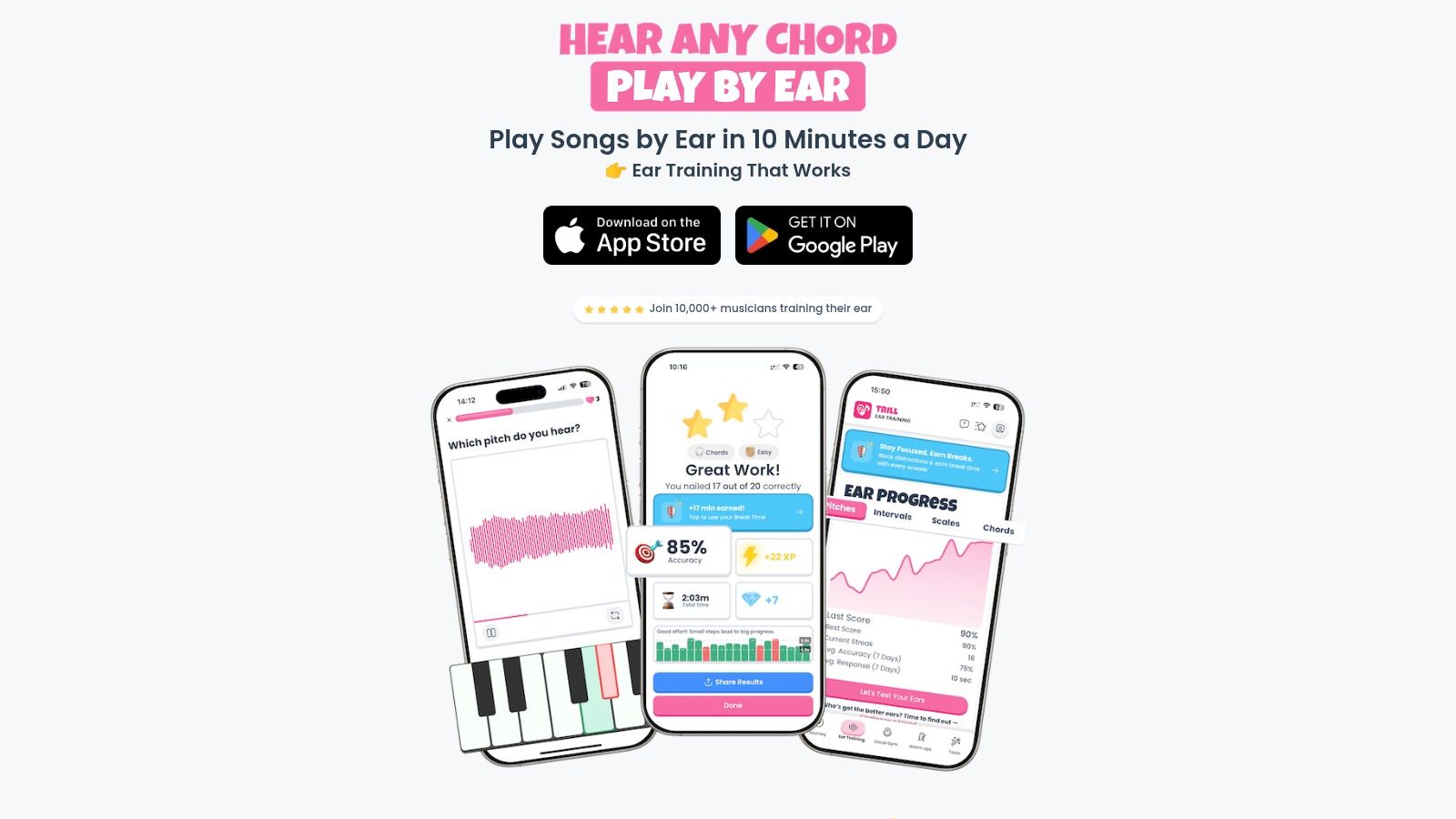
One example is Trill’s musician toolkit app, which combines ear training with tools musicians already use, such as a tuner, metronome, and visualizers. That’s relevant because practice is more likely to happen when the listening work sits close to the rest of your daily routine.
A quick checklist before you commit
Before you subscribe to any music learning app, test it against real outcomes.
- Can it help you hear chord quality? Major, minor, dominant. These sounds show up everywhere.
- Does it train intervals in both isolation and short musical phrases? That bridge matters.
- Can you sing back what you hear? If the app never asks for that connection, your ear may stay passive.
- Does it make daily practice easy to restart after a missed day? Rigid systems often fail ordinary people.
- Will the exercises help outside the app? That’s the only result that counts.
A short demo can also reveal a lot. If the app feels like endless tapping with no link to actual songs, move on.
This walkthrough gives a useful example of the kind of listening-first training many musicians need:

Coach’s check: After one week, you should notice clearer listening, not just a higher score.
The right app won’t make you musical by itself. It will make it easier to do the kind of daily work that builds musical hearing.
The 10-Minute Daily Routine for Playing by Ear
You sit down with your instrument, hear a song you love, and still reach for tabs because the notes feel hidden. That stuck feeling usually does not mean you lack talent. It usually means your ear work has been too vague, too long, or too easy to skip.
A short routine solves that problem better than an ambitious one. Give your ear one clear job each day, repeat it, and the fog starts to lift. Ten focused minutes is enough to train the hearing skills that lead to playing by ear, especially when your app guides you from listening to singing to playing.
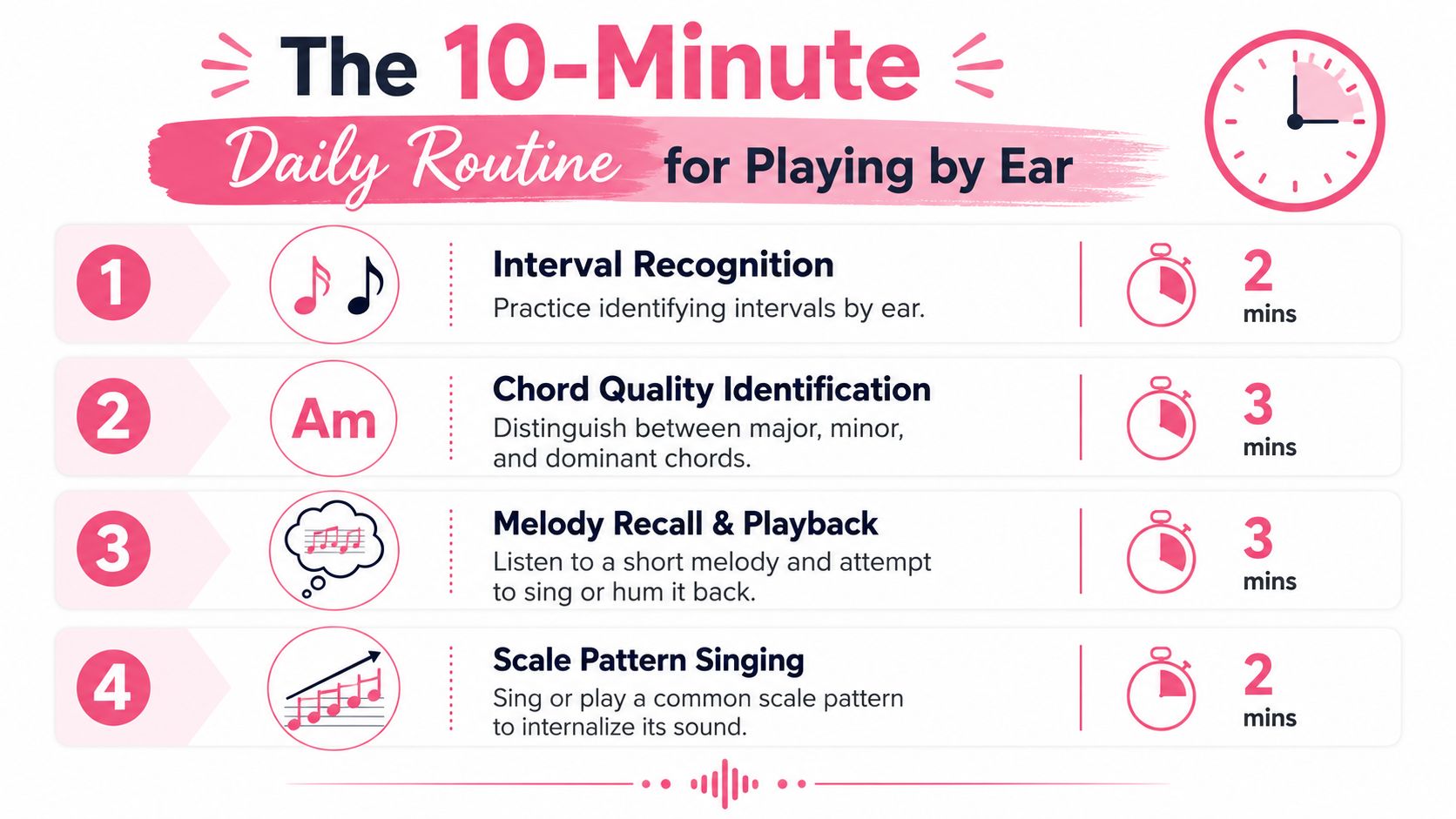
Your daily ear training workout
Try this routine for the next two weeks. Keep it simple. The goal is not to finish more exercises. The goal is to hear more clearly.
-
Start with interval recognition for 2 minutes
Listen to two notes and judge the distance before naming it. Small, medium, or wide is enough at first. This works like learning to recognize steps versus leaps before worrying about street names. Once your ear can sense the size of the move, melodies become easier to track. -
Move to chord quality for 3 minutes
Practice hearing major, minor, and dominant chords. Start with the feeling of each sound before the label. Bright, darker, unsettled. That extra step matters because your ear remembers sound character faster than abstract terms. -
Do melody recall and playback for 3 minutes
Hear a short phrase, then sing, hum, or play it back. Singing is the bridge here. It slows you down just enough to prove whether you heard the shape or guessed from finger habits. If singing feels awkward, that is fine. Awkward often means useful. -
Finish with a scale pattern for 2 minutes
Sing or play a small pattern such as up, down, skip, return. These are the building blocks inside real melodies. Practicing them is like learning common words before trying to speak in full paragraphs.
How to make the habit stick
This routine works because it reduces decisions. You open the app, follow the same sequence, and train the same ear to hand connection every day. Good ear training apps help by giving fast, clear feedback, so you can correct mistakes while the sound is still fresh in your memory.
A few habits make that daily loop much easier:
- Attach it to an existing cue. Practice after coffee, after school, or before you check your phone.
- End with one clean response. Give your ear a correct example to remember before you stop.
- Keep notes short. Write one line, such as “minor chords clearer today” or “still confusing fourths and fifths.”
- Use a repeatable practice system. If you want a tool built around short listening sessions, a daily ear training app built for this kind of routine is one example.
Sing first if you’re unsure. Your voice often reveals whether you heard the pattern or only hoped you did.
If a day feels messy, resist the urge to turn ten minutes into thirty. Start again tomorrow and run the same routine. Ear training improves the same way physical training does. Small sessions done often beat heroic sessions done rarely.
The Real-World Payoff Musical Freedom
The payoff isn’t a prettier practice graph. It’s freedom.
What changes when you stop guessing
When ear training begins to work, the first signs are subtle. You hear a melody once and can find the opening notes faster. You notice when a chord change feels familiar. You stop waiting for someone else to explain what’s happening.
Then bigger shifts arrive.
- Improvisation gets more musical. Your phrases start following what you hear inside, not just shapes under your fingers.
- Chord recognition speeds up. Songs become easier to learn because harmony feels less hidden.
- Playing with others gets less stressful. You can listen, adapt, and recover instead of panicking when the chart changes.
- Songwriting opens up. Ideas come out with less friction because your ear can guide your choices.
That’s what people mean by musical freedom. Not perfection. Not constant accuracy. Freedom from total dependence on tabs, charts, and tutorials.
Start before you feel ready
Many musicians wait until they “know more theory” before they train their ear seriously. I wouldn’t wait.
Hearing improves through use. The more often you compare sound, name it, sing it, and play it back, the more natural it becomes. That’s true whether you’re a beginner working on your first progression or an experienced player trying to sharpen chord recognition.
If you’re stuck, don’t ask for more motivation. Build the habit instead. Give your ear ten honest minutes a day and let repetition do its work.
The goal isn’t to become impressive inside an app. The goal is to sit down with music and understand what you’re hearing.
If you want a simple place to begin, Trill: Ear Training Daily is built around that exact goal. It focuses on daily ear training for chord recognition, intervals, notes, and scales so you can hear music more clearly and play by ear with more confidence.