Music Neuroplasticity: Rewire Your Brain to Play by Ear
You hear a song you love. The chorus hits, and your brain immediately asks the same question it always asks.
What are those chords?
Maybe you grab your guitar and hunt for notes. Maybe you sit at the piano and test one shape after another. Maybe you get close, then second-guess yourself and open a tab. You’re not lazy. You’re not untalented. Your ear just hasn’t been trained yet.
That’s where music neuroplasticity changes the conversation. It’s the reason ear training works. Your brain can adapt to sound, organize it better, and connect what you hear to what you play. In plain language, that means learning to play by ear isn’t some mysterious gift. It’s a skill your brain can build through repeated, focused listening.
If you’ve ever thought, “Some people just have it,” this article is for you. A fundamental shift happens when you stop treating listening like guessing and start treating it like training.
Table of Contents
- From Listener to Musician The Dream of Playing by Ear
- What Is Music Neuroplasticity Really
- How Music Rewires Your Auditory Brain
- The Real-World Skills You Can Build Through Ear Training
- Your Daily Plan to Train Your Musical Brain
- Conclusion Stop Guessing and Start Hearing
From Listener to Musician The Dream of Playing by Ear
A lot of musicians live in a frustrating middle ground. You can enjoy music deeply, maybe even play songs you’ve practiced, but the moment you try to work something out by ear, everything slows down. You test random notes. You hope one fits. You call it “having a bad ear.”
I see this with students all the time. They’ll sing along to a melody perfectly in the car, then tell me they “can’t hear” intervals or chords. What they really mean is that they can hear music emotionally, but they haven’t yet trained their brain to organize that sound into usable musical information.
That difference matters.
Playing by ear isn’t about magic. It’s about learning to notice patterns. A rising melody. A chord that sounds stable. A note that creates tension and wants to move. Once your brain starts sorting those patterns more clearly, you stop making blind guesses and start making musical decisions.
You don’t need a rare gift to hear music better. You need repeated contact with the right sounds and the habit of paying attention.
That’s why the idea of music neuroplasticity is so hopeful. Your brain isn’t fixed. It can learn. It can get better at hearing a major chord as major, a minor chord as minor, and a familiar progression as something recognizable instead of vague.
If your goal is ear training, play by ear confidence, or even long-term work toward perfect pitch skills, the starting point is the same. Train the ear you already have. Then let your brain adapt.
What Is Music Neuroplasticity Really
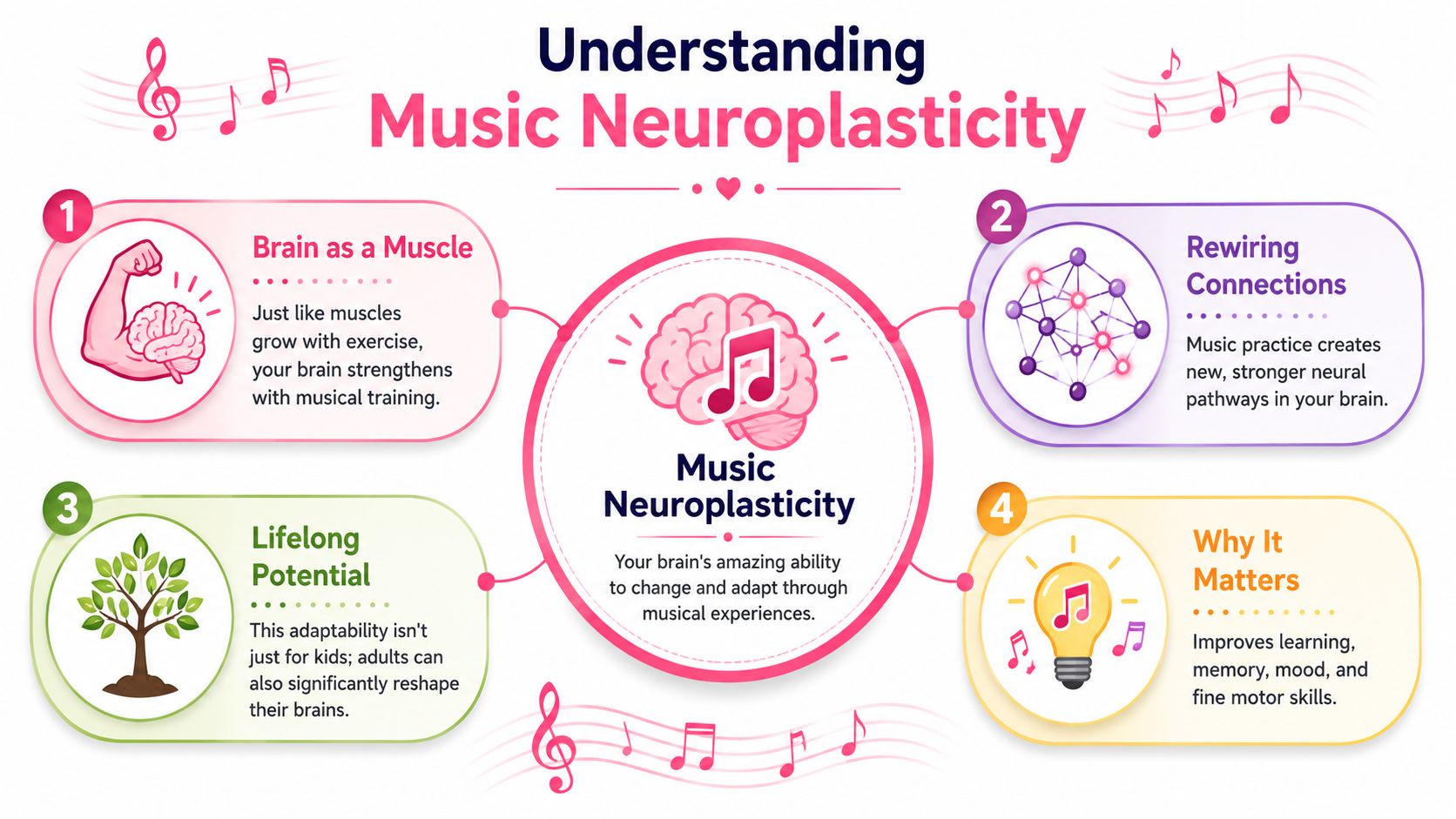
Music neuroplasticity means your brain changes in response to musical experience. These changes are real, not just metaphorical. With practice, the systems involved in hearing, attention, memory, and movement become more organized around musical tasks.
The easiest way to think about it is this. Your brain is like a trail through tall grass. The first time you walk it, the path is faint. Walk it every day, and the route gets clearer. Ear training works the same way. Every time you identify an interval, sing back a note, or match a chord by ear, you strengthen a path your brain can use again.
Your brain changes when your listening changes
This isn’t just a nice idea. Structural research comparing professional musicians with non-musicians reported significant increases in gray matter volume and cortical thickness across multiple brain regions, including the superior temporal region and hippocampus. The same review found that functional and structural connectivity in auditory-motor networks is positively correlated with practice time, as described in this Frontiers review on music training and brain structure.
In simple terms, more practice is linked with stronger brain networks for hearing and doing music.
That’s why the old debate about talent versus training often misses the point. Some people may start with advantages, but the brain still responds to use. If you repeatedly ask it to hear intervals, track bass motion, and connect sounds to your instrument, it adapts to those demands.
Why that matters for ear training
This is especially important if you’ve been confused by terms like relative pitch and absolute pitch. Most real-world musicians don’t need mystical powers. They need reliable sound recognition. They need to hear relationships. If you want a clearer picture of that difference, this guide to relative pitch vs absolute pitch helps put the goal in practical terms.
A trained ear doesn’t hear “some note.” It starts hearing function.
- Intervals become familiar shapes instead of abstract labels.
- Chords sound distinct rather than blended together.
- Melodies become trackable because your brain starts predicting where notes want to go.
Practical rule: If you repeat a listening task often enough, your brain stops treating it like noise and starts treating it like useful structure.
That’s the meaning of music neuroplasticity for a musician. Training your ear is training your brain to notice music more accurately and respond to it more quickly.
How Music Rewires Your Auditory Brain
When people say “I want to hear better,” they often mean something very specific. They want a C sharp to feel different from a D. They want to recognize a chord quality before touching the instrument. They want to sing or play the next note because they hear it internally, not because they guessed.
That shift happens because practice changes how the auditory parts of the brain respond to sound.
Your brain gives more attention to sound
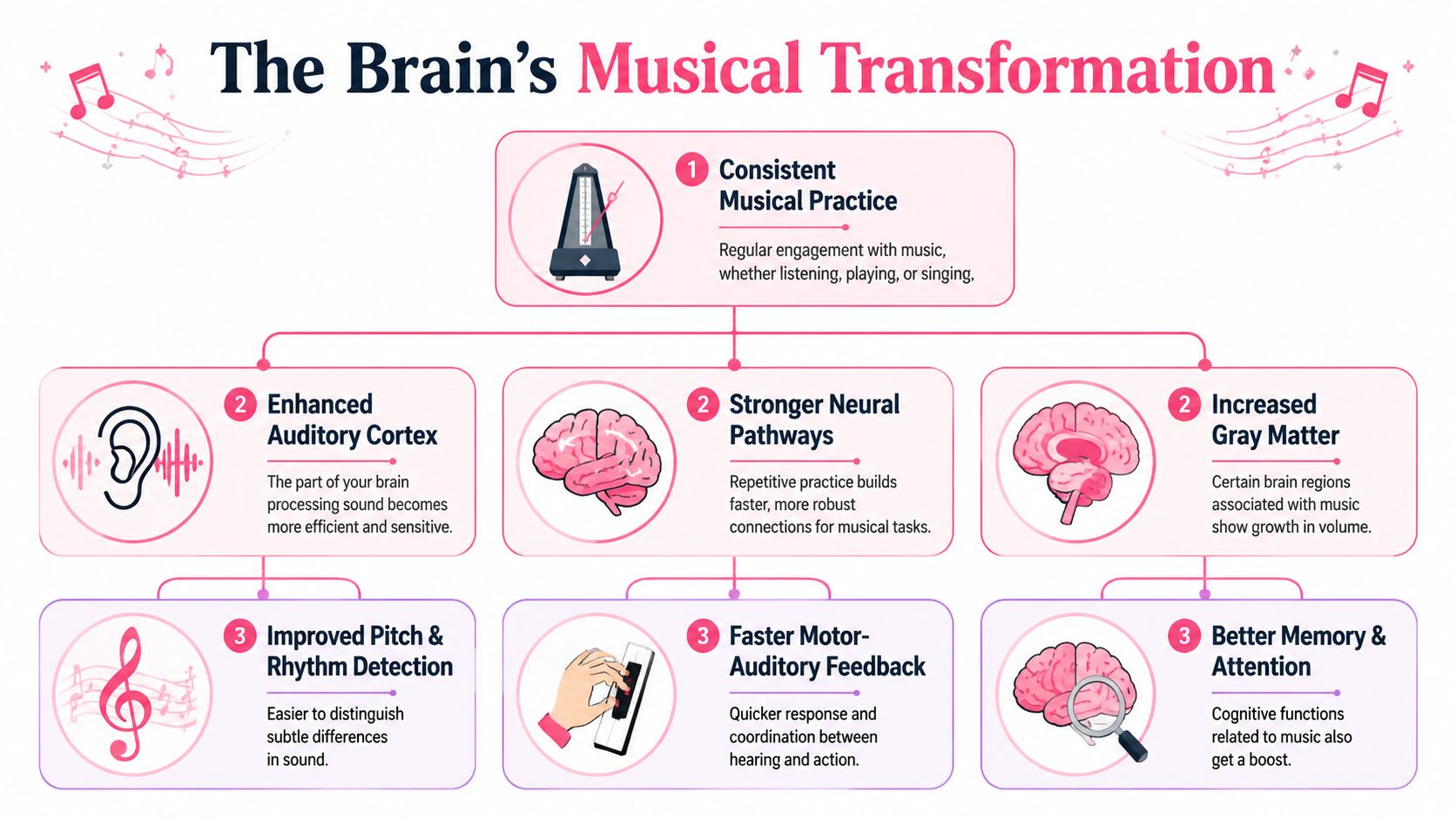
A major finding in music research is that musicians show about 25% greater cortical activation for piano tones than non-musicians, which points to stronger auditory cortical engagement during sound processing. Research also shows that one year of music training can produce measurable structural changes in the brain’s primary auditory areas, linking practice to physical neural development, as reviewed in this summary of music-related neuroplasticity findings.
That’s a big deal for ear training. It means musical listening isn’t passive. The brain can devote more processing power to sound when it has been trained to care about sound.
Think about two people hearing the same chord. One person hears “nice.” The other hears “major, root position, likely moving to the four chord.” The sound entering the ears is the same. The internal processing is not.
Practice builds faster hearing to playing links
There’s another part of the puzzle. Music isn’t only hearing. It’s hearing plus action. You hear a note, your voice matches it. You hear a bass movement, your hand finds the chord. You hear tension, you improvise a line that resolves it.
A controlled MRI study of adult beginners found that after just one 45-minute piano training session, mean diffusivity fell by 2–3% in the left premotor cortex, left middle temporal gyrus, and bilateral superior cerebellum. A second 40-minute session produced an additional reduction in the lingual gyrus. The study interpreted this as rapid short-term neuroplasticity in motor, auditory-language, and cerebellar networks.
You don’t need to memorize the brain regions. The useful takeaway is simpler. Focused musical practice can quickly begin changing the networks that connect listening with movement.
That’s exactly what aural training is designed to improve. If you want a structured way to practice that hearing-to-action loop, these aural training exercises at Trill are built around recognizing notes, chords, and patterns through sound rather than theory-only drills.
Here’s how this rewiring shows up in everyday musicianship:
| Brain change | Musical result |
|---|---|
| Stronger attention to tone | You notice when a note is slightly off |
| Clearer sound categories | Major and minor stop sounding interchangeable |
| Better hearing to movement connection | Your hands find what your ear already recognized |
The goal isn’t to become a human tuner. The goal is to hear musical meaning faster.
That’s why daily ear training matters so much. Every short session teaches your auditory brain to sort sound with more precision. Over time, hearing becomes less fuzzy and more immediate.
The Real-World Skills You Can Build Through Ear Training
Science matters because it leads somewhere. In music, that “somewhere” is freedom.
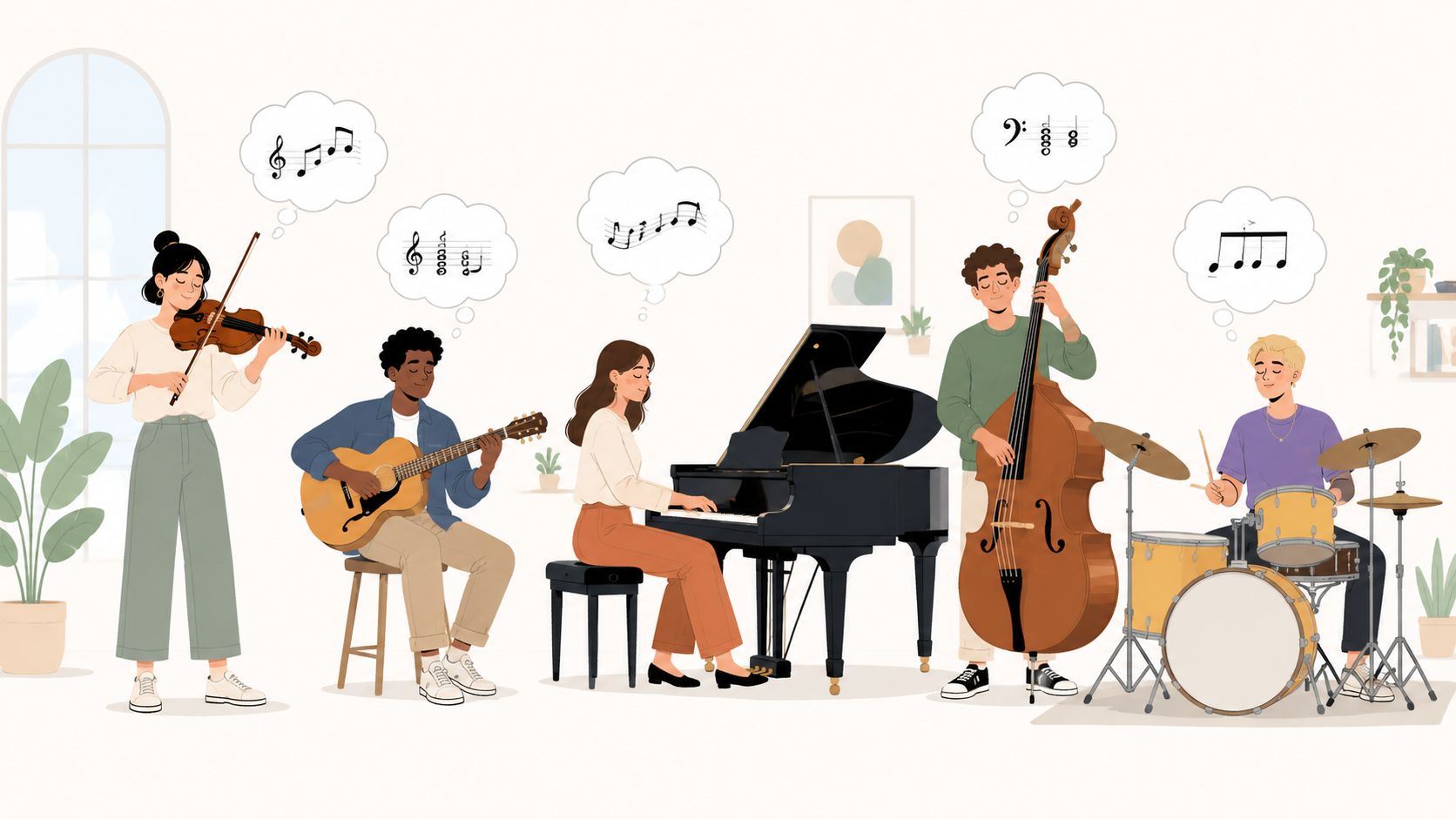
When your brain gets better at organizing sound, you don’t just score better on exercises. You become more capable in real musical situations. Rehearsals get easier. Improvisation feels less random. Songs become easier to learn without waiting for sheet music.
What changes in actual playing
Here’s what trained listening often enables:
- Chord recognition in real time helps you hear the difference between stable, tense, bright, and darker harmony. On an instrument, that means fewer random shape searches.
- Melody pickup by ear lets you hear a phrase, sing it back, then find it on your instrument without relying on notation.
- Improvisation with intention becomes easier because you’re reacting to what you hear in the harmony, not just running scale patterns.
- Better ensemble playing comes from noticing pitch, timing, and harmonic movement faster when other musicians are playing.
These are not separate superpowers. They grow from the same root skill. Your ear gets better at identifying patterns, and your playing follows.
Why this feels like musical freedom
A musician who depends entirely on tabs or chord charts often feels stuck. If the paper disappears, the confidence goes with it. Ear training changes that relationship. You start trusting your hearing as a usable guide.
That trust has a practical effect.
When you can hear what’s happening, you can join in faster, recover from mistakes sooner, and communicate more musically with the people around you.
This is also where a lot of confusion about perfect pitch clears up. Many players assume they need perfect pitch to function at a high level. Most don’t. They need strong relative hearing, dependable chord recognition, pitch matching, and the habit of listening actively.
Music neuroplasticity makes those outcomes trainable. Not overnight. But absolutely through repetition.
Your Daily Plan to Train Your Musical Brain
If the brain changes through repeated use, then your strategy matters. Long, occasional practice sessions can help, but for ear training, short daily contact is often easier to sustain and easier for the brain to absorb. That’s why 10 minutes a day is such a useful rule.
A controlled MRI study found that after just one 45-minute piano training session, adult beginners showed a measurable increase in white-matter organization in motor and auditory brain networks, demonstrating that even brief practice can induce rapid neuroplastic changes. You don’t need marathon sessions to start building the hearing system. You need consistency.
A simple 10 minute routine
Try this for the next two weeks.
-
Start with one note. Play a note on your instrument, sing it, then check whether your voice matched it. This builds pitch connection between ear and body.
-
Do a small interval drill. Choose just two or three intervals at first. Hear them, sing them, and identify them. Keep it narrow so your brain learns clear categories.
-
Work on chord quality. Alternate major and minor chords. Don’t rush. Listen for the emotional color and the internal shape of the sound.
-
End with a real song. Pick a simple melody or bass line from music you know well. Find it by ear before you look anything up.
This kind of plan keeps theory tied to sound. You’re not memorizing labels in isolation. You’re teaching your brain what music feels like when it enters the ear.
How to make consistency easier
The hardest part of ear training usually isn’t the exercise. It’s doing it again tomorrow.
A few things help:
- Reduce the setup by keeping one instrument ready and one routine repeated.
- Train at the same time each day so the habit becomes automatic.
- Use immediate feedback so wrong answers become useful, not discouraging.
- Keep sessions short enough that you’ll still do them on busy days.
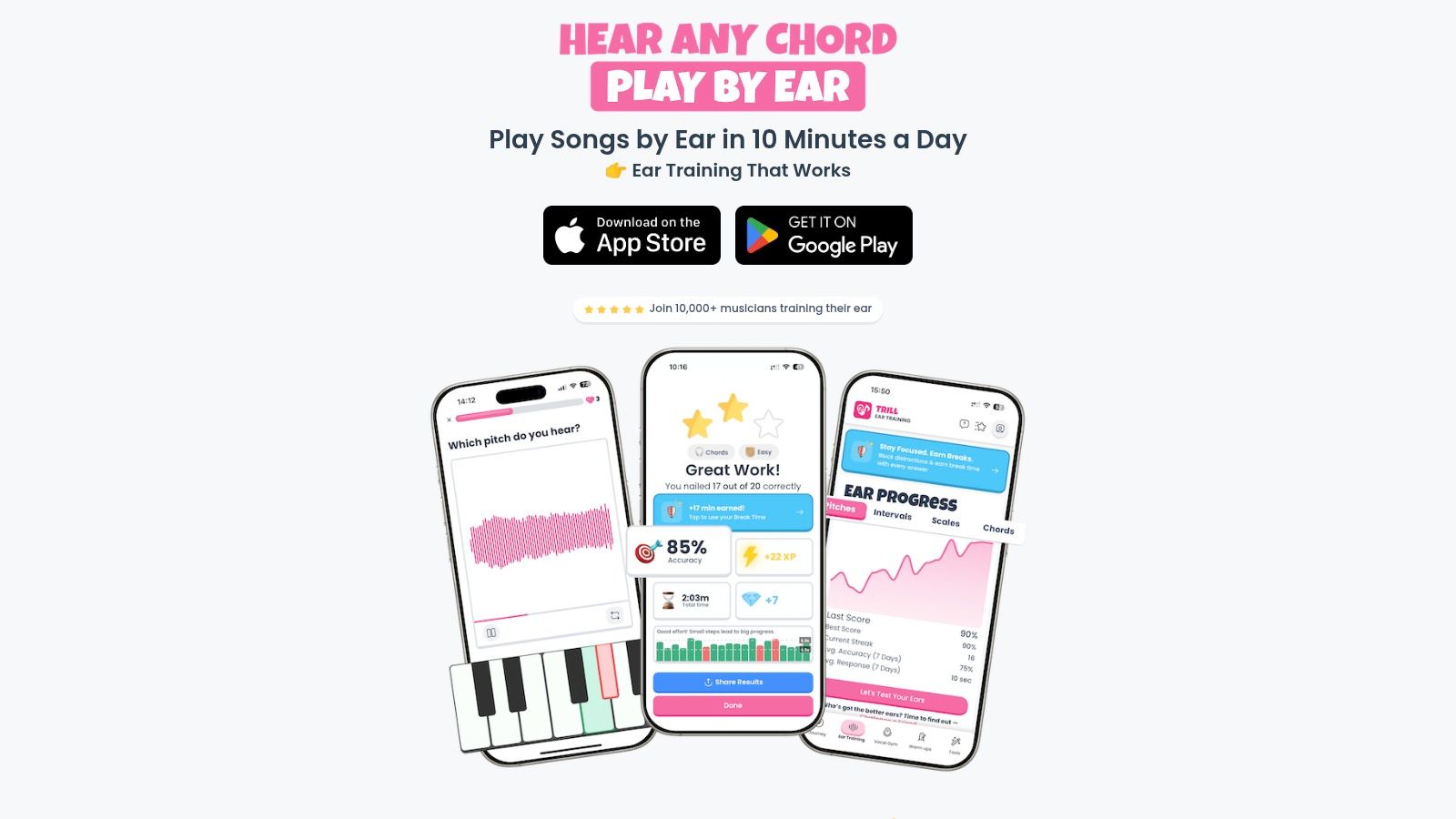
One tool built around that idea is Trill: Ear Training Daily. It offers short, structured ear training sessions focused on recognizing chords, intervals, notes, and scales through audio, along with features like daily streaks and Focus Lock to support consistency. Used this way, an app isn’t magic. It’s a system for repeating the right listening tasks often enough that the brain starts adapting.
A good daily routine should feel small enough to start and specific enough to repeat.
If you stick with that, something important changes. You stop asking, “Do I have the talent?” and start noticing, “I hear more than I used to.” That’s the sign the training is working.
Conclusion Stop Guessing and Start Hearing
The most useful thing to know about music neuroplasticity is also the most encouraging. Your musical ear is not fixed.
Your brain can learn to process pitch, harmony, and pattern more clearly. It can strengthen the connection between hearing and playing. It can turn ear training from a frustrating mystery into a practical skill-building process.
That matters whether your goal is to play by ear, recognize chord progressions faster, improvise with more confidence, or move closer to the kind of note awareness people associate with perfect pitch. The path isn’t guessing harder. It’s listening better, every day.
Keep the process simple. Sing notes back. Compare intervals. Hear chord quality. Work out real songs by ear. Do it consistently, even if it’s only for 10 minutes.
Small sessions add up. Your ear gets sharper. Your choices get faster. Music starts to feel less like a code you’re trying to crack and more like a language you can hear.
If you want a simple way to make daily ear training stick, Trill: Ear Training Daily gives you short, structured practice built around hearing chords, intervals, notes, and scales through real audio, so you can spend less time guessing and more time learning to hear music.