Note Recognition Game: A Guide to Play by Ear
You probably know this feeling. A song comes on, you can hum the hook, and your hands still freeze when you try to find the notes on your instrument.
That gap is where most musicians get stuck.
They know some theory. They may even read a bit of music. But they still can’t play by ear with confidence, because hearing and naming notes in real time is a different skill from recognizing symbols on a page.
A note recognition game can help, but only if you use it for the right job. Used badly, it’s just fast tapping. Used well, it becomes a daily ear training system that teaches you to hear music instead of guess at it.
Musical freedom isn’t about getting a better score in an app. It’s about hearing a melody, finding it quickly, recognizing chord movement, and feeling less dependent on tabs, sheet music, or trial and error. Ear training is trainable. It isn’t reserved for the few people who seem born with perfect pitch.
Table of Contents
- Turn Your Ear Into Your Best Instrument
- Why Most Note Games Fail to Build Your Ear
- Your First 10 Minutes From Guessing to Hearing
- Progressive Drills From Single Notes to Melodies
- How to Build a Daily Ear Training Routine
- Assessing Your Progress and Hearing Real Results
- From Game to Musical Instinct
Turn Your Ear Into Your Best Instrument
The fastest musicians in a room usually aren’t the ones with the most theory memorized. They’re the ones who can hear what’s happening and react.
That’s why I care so much about note recognition. Not as a school exercise, but as the base layer of ear training, improvisation, transcription, and confident playing. When your ear gets sharper, everything else gets easier. Chords stop sounding random. Melodies stop feeling hidden. You stop poking around your instrument and start moving with purpose.
Many players chase perfect pitch because it sounds impressive. In practice, musicians typically need something more useful first. They need reliable pitch awareness, strong relative hearing, and a habit of checking sound before fingers.
Practical rule: If an exercise doesn’t improve what you can hear away from the screen, it isn’t doing enough.
That’s where a note recognition game becomes useful. Not because it’s a game, but because it gives you quick reps, immediate feedback, and a repeatable routine. Those three things matter when you’re trying to train a listening skill.
The shift is simple. Stop treating the app like a quiz. Start treating it like a gym for your ear. Short sessions, focused material, and steady progression will do more for your playing than another week of random guessing.
Why Most Note Games Fail to Build Your Ear
Most note games feel productive because they give you a clean task and a fast reward. You see a note, tap an answer, hear a sound effect, move on.
That loop isn’t useless. It can help with music reading. But it often misses the skill that players want, which is hearing a note and finding it in real music.
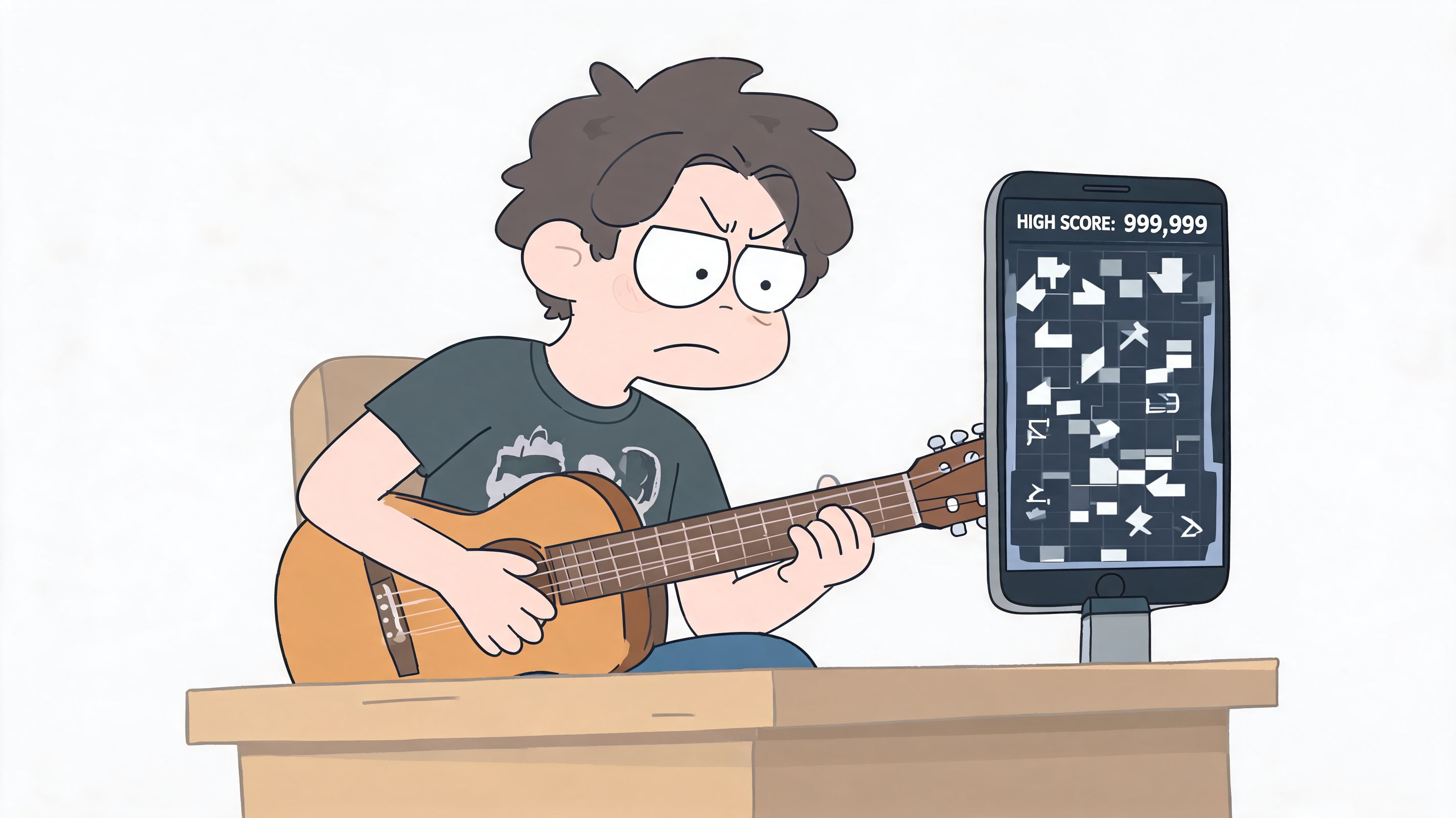
The visual trap
Many tools train visual note identification first. That’s useful for staff reading, especially if you’re preparing for lessons, school, or ensemble work. But it doesn’t automatically transfer to hearing by ear.
According to Toy Theater’s note quiz reference, 6 out of 7 top note recognition game results focus solely on reading note names from staves, and a cited 2025 music education study found that this approach improves reading by 40% while aural note identification lags by 25% without dedicated audio drills.
That gap explains why so many players can pass a quiz and still struggle to catch a melody from a recording.
Here’s the practical issue. When the eye leads every repetition, the brain learns to associate a symbol with a label. Real playing by ear asks for a different chain:
- You hear a sound
- You compare it to a reference
- You predict where it lives
- You confirm it on your instrument
That process is slower at first. It also leads to real skill.
What your ear actually needs
Your ear needs contrast, repetition, and context.
Contrast means hearing one sound against another, not facing all twelve notes in a blur. Repetition means enough clean reps that your brain stops treating pitch as random. Context means connecting a note to a home base, a chord, or a melodic shape.
A note only becomes useful when you can recognize it as sound, not just as information.
This is why many beginners think they’re bad at ear training. They aren’t bad. They’re doing the wrong kind of practice. They’ve spent weeks naming notes on a screen and almost no time singing them back, comparing them, or locating them by ear on their instrument.
If you want a note recognition game to build musicianship, use it as an aural drill first. If the sound is optional, the exercise is incomplete.
Your First 10 Minutes From Guessing to Hearing
The first mistake beginners make is trying to learn every note at once. That’s usually where guessing starts.
A better start is tiny. Two notes. Clear contrast. Repeated daily.
Start with only two notes
Pick C and G. They sound distinct, they’re easy to locate on most instruments, and they give your ear a strong sense of low versus high and home versus lift. If you’re using an app, choose one that lets you narrow the pool and repeat the same material enough times to build recognition. That’s one reason habit-focused systems matter. This overview of playing by ear with short daily drills matches the way beginners improve, through small repeatable reps instead of endless variety.
A cited trend summary at Notebusters on Note Dash says no recent mobile-first, gamified note recognition apps with daily streaks and progression systems appear in top search results, and it also cites Q1 2026 App Annie data saying Duolingo-style gamification boosts retention 2.5x. The practical takeaway is simple. Consistency usually beats intensity, and most static browser quizzes don’t help people stay consistent.
What to do during each rep
Use this sequence for the full ten minutes:
-
Listen first
Play one of the two notes. Don’t answer immediately. Let the sound settle for a second. -
Hum it back
Your voice forces active listening. Even if your singing is rough, this step matters. -
Name it
Say C or G out loud before you touch your instrument. -
Find it
Play the note on guitar, piano, bass, or whatever you use. -
Check the feeling
Ask what you heard. Was it lower, higher, more settled, more open?
That last step is where the training happens. You’re not trying to become a faster guesser. You’re building a stable internal reference.
If you can’t sing a note back, you probably didn’t hear it clearly enough yet.
Keep the pace slow enough that every answer feels deliberate. Fast reps are useful later. Early on, speed hides weak listening.
If C and G become easy, don’t celebrate by jumping to twelve notes. Add one note and protect the quality of hearing. That’s how relative pitch grows. It’s also the most realistic path toward the kind of pitch memory people often associate with perfect pitch.
Progressive Drills From Single Notes to Melodies
Once two-note contrast feels solid, your training needs more musical depth, not more chaos. The right progression builds hearing in layers.
Start with the visual map below, then use it as a ladder instead of a checklist.
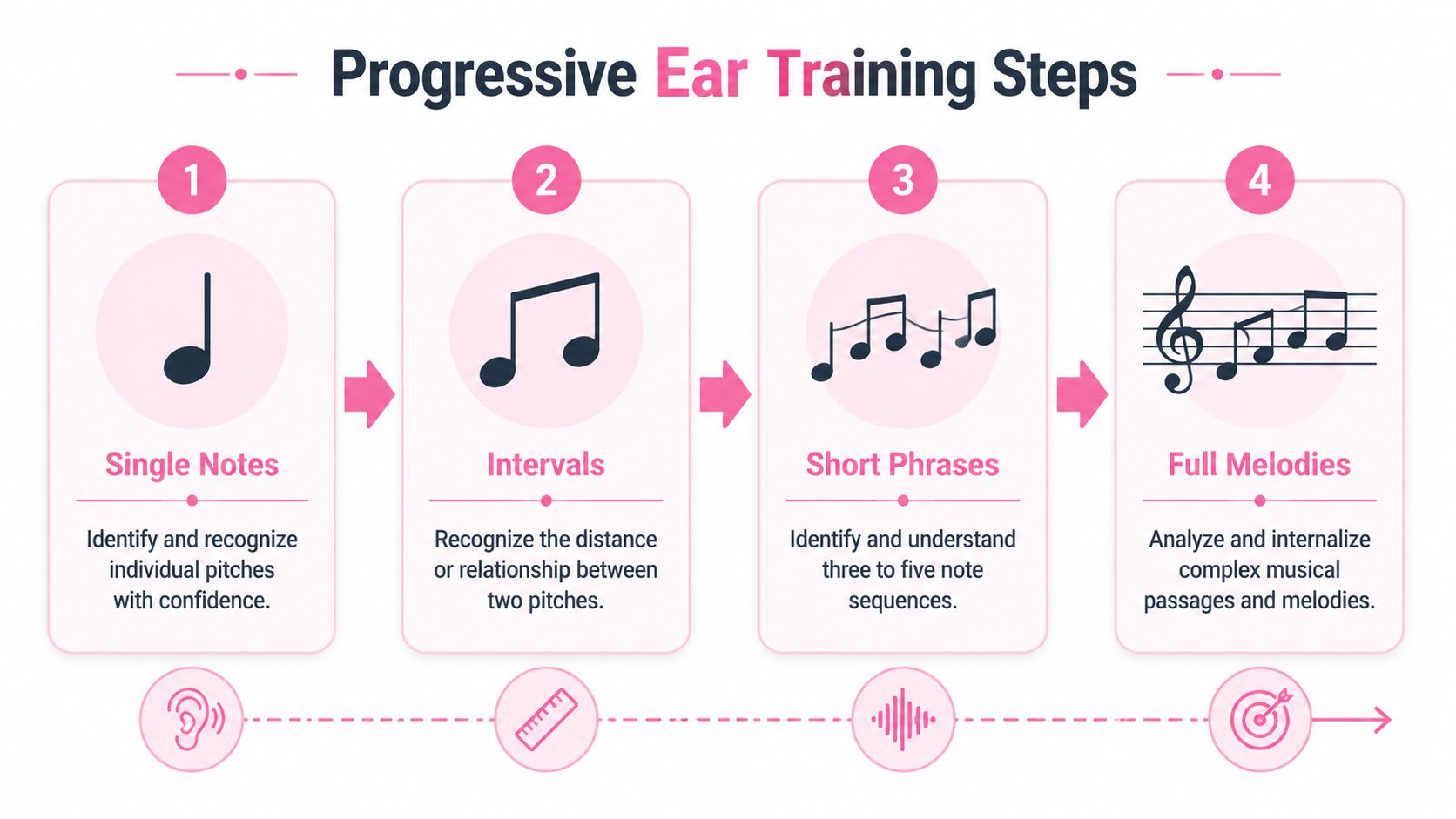
Build one layer at a time
Single notes come first. Keep comparing notes to a tonal center so they don’t feel isolated.
Then add intervals. Through these, ear training starts connecting directly to real playing. A major third has a different emotional color from a perfect fifth. A minor third pulls differently from a major third. If you’re working on interval hearing, Trill’s interval training tool is one example of a focused drill that uses audio identification instead of visual guessing.
A practical sequence looks like this:
-
Two-note contrast
C and G, then C and E, then C, E, and G. -
Scale awareness
Stay inside C major and learn how each note feels against C as home. -
Interval recognition
Hear the distance, not just the note label. -
Short phrases
Three-note patterns first. Then four or five.
A strong reason to progress this way comes from a gamified notation study summarized in the Bournemouth University paper. 92% of players improved note recognition speed by 25% over 4 sessions, and the paper’s expert insight suggests adaptive gamification can help transfer skill to aural tasks like chord identification by up to 35% compared to traditional methods.
That doesn’t mean every game creates ear training automatically. It means structured progression and adaptive difficulty matter.
Here’s a short demonstration to pair with your drills:

When to move up
Don’t move up because you’re bored. Move up when the current task feels stable.
Use these signs:
- Your answers feel calm instead of rushed.
- You can sing before you play without fishing for the pitch.
- You can recognize the sound on another instrument and not just the app voice.
- You recover after mistakes because the sounds have started to mean something.
Working standard: Add difficulty only when you can still listen carefully inside the harder drill.
If melody work feels impossible, step back to intervals. If intervals feel muddy, return to a smaller note pool. Good ear training isn’t linear. It’s a staircase with repeats.
How to Build a Daily Ear Training Routine
Long sessions feel serious. Short sessions change musicians.
Your ear learns best when you train it often enough that the sounds stay familiar from one day to the next. That’s why a 10 minute a day approach works so well for beginners and busy players. It lowers resistance. It also makes it easier to stay sharp without turning practice into a second job.
A simple 10 minute structure
Use the same three-part format every day.
First 2 minutes: wake up your ear with single-note contrast.
Stay with a very small pool. Two or three notes is enough.
Next 5 minutes: do your current main drill.
This might be interval recognition, major versus minor chord color, or three-note melodic patterns.
Last 3 minutes: apply the skill to actual music.
Take a simple song and find the first melody note, the bass note, or the root motion of the chords.
That final step is important because it stops ear training from becoming abstract. You’re teaching your brain to carry the skill outside the exercise.
Sample 1 week beginner ear training schedule
| Day | Focus Exercise (5 Mins) | Application (3 Mins) |
|---|---|---|
| Monday | C vs G note recognition | Find those two notes on your instrument by ear |
| Tuesday | C, E, G note pool | Hum each note, then match it on your instrument |
| Wednesday | Major third vs perfect fifth | Listen to a simple song and identify a stable note in the melody |
| Thursday | Three-note ascending patterns | Copy short patterns by ear |
| Friday | Three-note descending patterns | Find the first note of a familiar tune |
| Saturday | Major vs minor chord color | Listen for whether a chord sounds bright or darker |
| Sunday | Mixed review | Play along with a simple recording and locate bass roots |
A habit system helps here because failure often stems not from a lack of information, but from inconsistency. Trill’s daily ear training page shows this habit-first model clearly, with short sessions, daily challenges, and routine support aimed at regular practice rather than occasional cramming.
A few trade-offs matter in real life:
- Morning practice sticks better for many players because the ear is fresh and distractions are lower.
- Late-night practice can work if that’s when you’re consistent, but fatigue makes close listening harder.
- Random drills feel fun but often slow down progress because your references never settle.
- Repeating familiar material feels less exciting and usually produces better results.
The routine shouldn’t feel heroic. It should feel easy enough that you can keep doing it when motivation is low.
Assessing Your Progress and Hearing Real Results
Players often check progress in the wrong place. They stare at the in-app score.
A better question is this: what can you hear now that you couldn’t hear a few weeks ago?
Use musical tests, not app scores
Try these real-world checks:
- Hum a bassline from a simple pop song and locate those notes on your instrument.
- Listen to a basic chord change and decide whether the color stayed major or shifted darker.
- Pause after a short melody and pick out the first few notes without touching random keys.
- Improvise slowly and notice whether you’re choosing notes because you hear them, not because your fingers know a pattern.
Those are meaningful signs of growth because they show transfer. The game is practice. Music is the test.
That transfer matters at a bigger scale too. The Notebusters overview of music note learning tools states that the global music education technology market reached about $2.3 billion in 2023 and reports that interactive note recognition exercises improve student retention by about 35% over traditional methods. The useful part for everyday musicians isn’t the market size. It’s the retention point. People improve when the practice format keeps them coming back.
Progress in ear training sounds like this: less guessing, faster locating, and more confidence joining real music.
If your playing feels less dependent on luck, the method is working.
From Game to Musical Instinct
A note recognition game becomes powerful when it trains hearing first and speed second.
That’s the difference between tapping answers and building instinct. The first gives you a score. The second helps you catch melodies, hear chord movement, sing more accurately, and play by ear with less hesitation. It also makes theory more useful, because theory starts attaching to sounds you’ve already learned to recognize.
The deeper point is simple. Ear training is trainable. Musical instinct isn’t magic, and perfect pitch isn’t the only path to musical freedom. Daily listening, careful repetition, and progressive drills build the kind of ear that works in real songs.
Keep it short. Keep it daily. Keep it musical.
The players who stop guessing aren’t always the most naturally gifted. They’re usually the ones who spent enough days hearing the same patterns until those patterns became familiar.
If you want a structured way to practice this every day, Trill: Ear Training Daily is built around short audio-based drills for notes, intervals, chords, and scales, with a routine designed to help musicians hear music more clearly and play by ear with confidence.