Transposing Chart Instruments: A Guide to Playing by Ear
You’re in rehearsal. The pianist says the tune is in C. The guitarist nods. The alto player reads the chart, counts off, and the first chord lands sideways.
Nothing is wrong with anyone’s ears. The group is just speaking in two pitch languages at once.
That’s the point of transposing chart instruments. A saxophone, trumpet, clarinet, or horn may read one note name while sounding another. If you only treat that as paper math, you’ll survive rehearsal. If you learn to hear the offset, you’ll stop guessing, start reacting faster, and get much better at playing by ear.
Most players first meet transposition as a chart problem. It becomes a music problem only when the band starts. The chart says one thing, the room says another, and you need to connect them in real time. That’s why ear training matters here. Not because you need rare talent or instant perfect pitch, but because your ear can learn the relationship until it feels normal.
Table of Contents
- Why Your Saxophone’s ‘C’ Isn’t a Piano’s ‘C’
- The Simple Rules for Common Transposing Instruments
- A Worked Example From Concert Pitch to Your Horn
- Train Your Ear to Hear the Transposition
- Common Mistakes and How to Avoid Them by Listening
- From Charts and Confusion to Musical Freedom
Why Your Saxophone’s ‘C’ Isn’t a Piano’s ‘C’
If you play sax, clarinet, trumpet, or horn, you already know the feeling. You finger what looks like C, but the piano in the room doesn’t agree. That mismatch feels strange only until you understand that your instrument isn’t broken. It’s transposing.
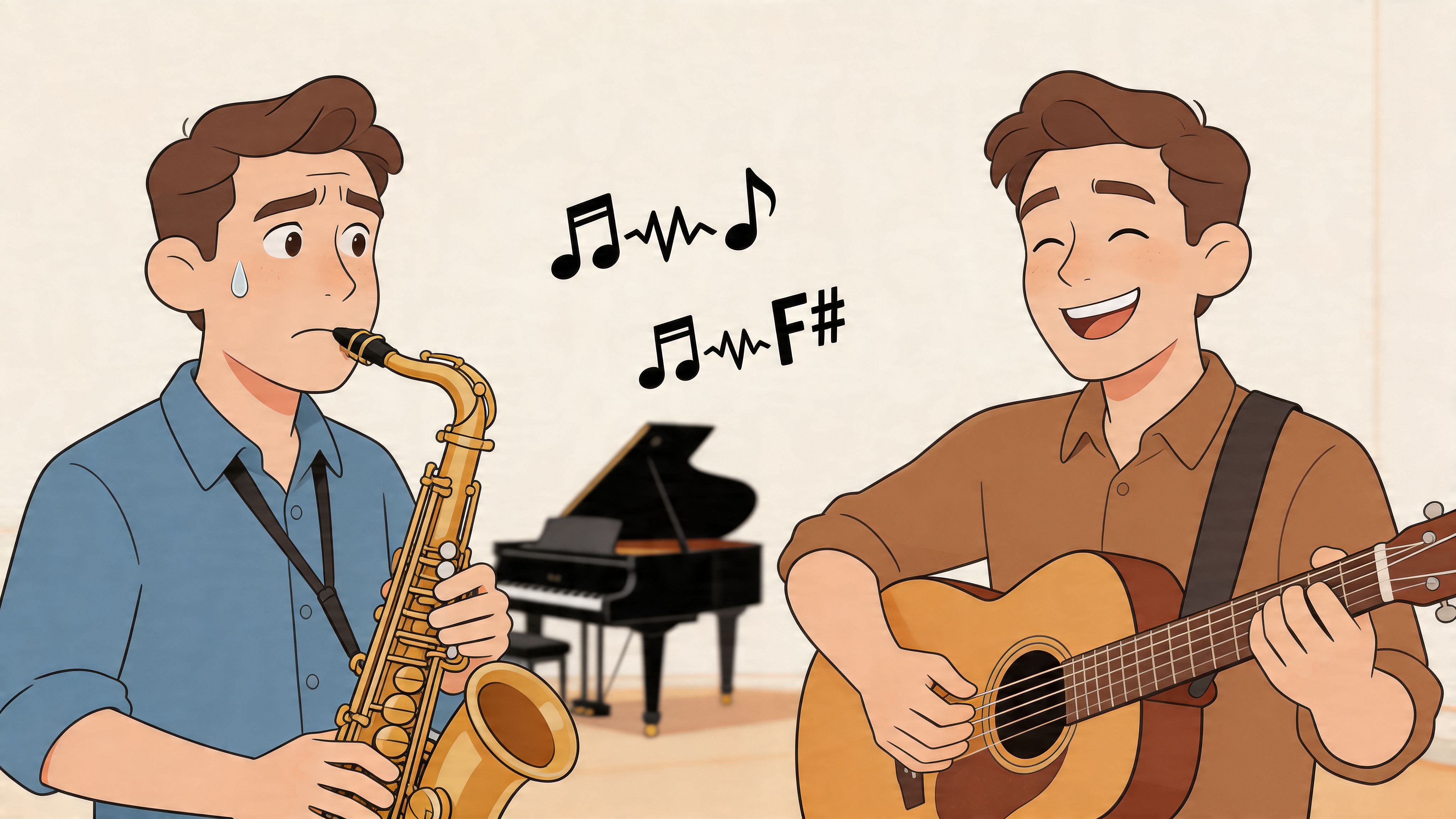
Historically, this didn’t start as a theory trick. According to this history of transposing instruments, the practice grew out of Baroque Germany, where ensembles used different pitch standards. That convention stuck, and instruments like the B♭ clarinet still transpose down a major second, so written C sounds as B♭. The practical payoff was huge. Players could move around an instrument family without relearning all their fingerings.
The real issue isn’t notation
For working musicians, the problem usually isn’t “How do I calculate this?” It’s “How do I hear this fast enough to play with everyone else?”
That’s why I teach transposition as a listening skill first. The page matters, but the page is not the gig. In the gig, you’re hearing harmony, matching the band, and reacting before your brain has time to run a little spreadsheet.
Practical rule: Treat transposition like a dialect, not a mistake. Your horn reads one language and sounds another.
If you want the pitch side of this to feel less abstract, it helps to understand how tuning and instrument frequencies relate in real playing. Once you connect note names to actual sounding pitch, transposition stops feeling like a trap.
Why this matters for playing by ear
A lot of beginners think they need perfect pitch to handle this. They don’t. They need relative pitch that’s steady enough to hear, “What I read is not what the band hears.”
That difference becomes musical freedom once your ear owns it. Then “concert B♭” isn’t a panic moment. It’s just the sound you already know how to find on your horn.
The Simple Rules for Common Transposing Instruments
Most of the fear around transposing chart instruments comes from too many words. The usable version is much simpler.
According to Britannica’s overview of transposing instruments, over 50% of wind instruments in professional orchestras are transposing, including clarinet, saxophone, and horn. That system lets players keep one fingering logic across instrument families, and it matters in music education too, where approximately 12 million students participate in school bands.
The rule that keeps players sane
Think in concert pitch to written pitch.
- For B♭ instruments, write up a major second
- For E♭ instruments, write up a major sixth
- For F instruments, write up a perfect fourth
That’s the version you use when the bandleader or pianist gives you concert chords and you need your part.
If you’re shaky on intervals, spend time with a plain-language guide to musical intervals. This is one of those spots where interval hearing saves far more time than memorizing isolated note pairs.
Quick transposition chart
| Concert Pitch | B♭ Instrument Note | E♭ Instrument Note | F Instrument Note |
|---|---|---|---|
| C | D | A | F |
| F | G | D | B♭ |
| G | A | E | C |
| B♭ | C | G | F |
| E♭ | F | C | B♭ |
| A | B | F♯ | E |
This chart is enough to get through a lot of rehearsals. Screenshot it if you need to.
What works and what doesn’t
What works is learning one clean rule for each family and applying it the same way every time.
What doesn’t work is trying to memorize every chord in every key as a separate fact. That approach falls apart under pressure because you’re not hearing the relationship. You’re trying to retrieve isolated answers.
A better way is to connect each instrument family to a sound:
- B♭ horns feel like the written part sits a whole step above concert
- E♭ horns feel farther away, which is why they often confuse beginners at first
- F horns reward careful hearing because fourths are easy to sing once they’re internalized
The chart gets you started. Your ear keeps you from freezing when the chart isn’t there.
Another practical trade-off matters here too. Written transposition keeps music readable on the page and preserves familiar fingerings, but it also asks you to maintain two realities at once. That’s why good players don’t stop at notation. They train the ear until the offset feels normal.
A Worked Example From Concert Pitch to Your Horn
Let’s use a progression that shows up everywhere: C - G - Am - F.
In practice, transposition becomes useful instead of theoretical. You’re not solving a worksheet. You’re trying to survive a rehearsal, catch the harmony, and maybe improvise over it.
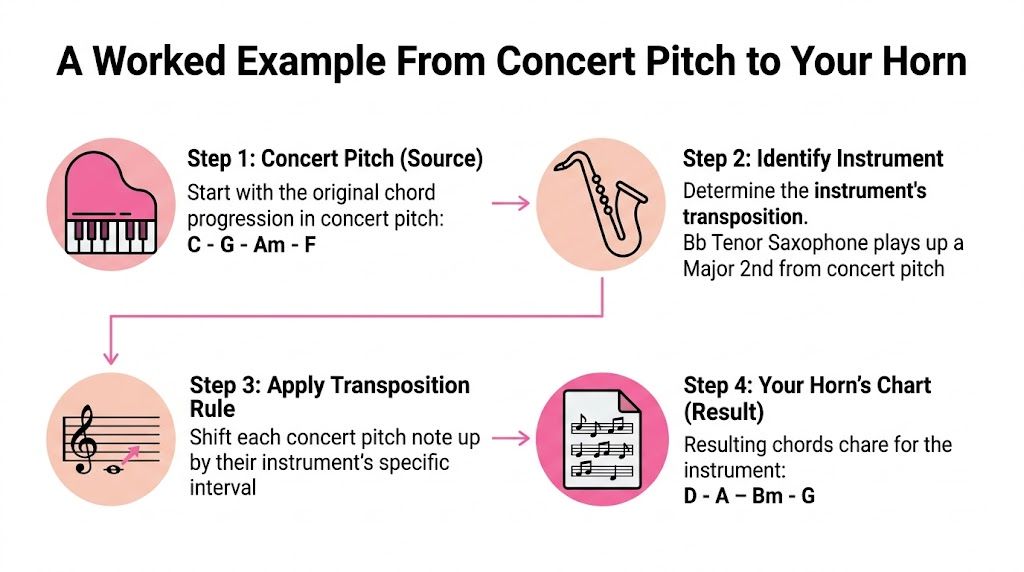
A good method keeps you from flipping direction halfway through. The Tunable explanation of transposition makes the key point clearly: for a B♭ clarinet, converting concert pitch to written pitch means moving up a major second, and 70% of novice arrangers transpose in the wrong direction.
For a B flat instrument
Say the band calls the progression in concert pitch:
- C
- G
- Am
- F
For a B♭ trumpet, tenor sax, or B♭ clarinet, move each chord up a major second for the written chart:
- Concert C becomes written D
- Concert G becomes written A
- Concert Am becomes written Bm
- Concert F becomes written G
So your horn’s chart is:
| Concert chord | Written chord for B♭ instrument |
|---|---|
| C | D |
| G | A |
| Am | Bm |
| F | G |
The same shift applies to the key. If the concert key is C major, the written key for the B♭ player becomes D major.
The useful listening check is simple. If the band is sounding C and your written chart starts on D, your ear should learn to accept that D shape as “the thing that produces concert C in this setting.”
Don’t ask only, “What do I write?” Also ask, “What will the room hear when I play this shape?”
For an E flat instrument
Now take the same concert progression for alto sax.
For an E♭ instrument, move the concert pitch up a major sixth to get the written part:
- Concert C becomes written A
- Concert G becomes written E
- Concert Am becomes written F♯m
- Concert F becomes written D
So the alto chart reads:
| Concert chord | Written chord for E♭ instrument |
|---|---|
| C | A |
| G | E |
| Am | F♯m |
| F | D |
For many players, hesitation arises because the written chords can look far removed from the band’s language. But once you hear the relationship, it stops being weird. You stop translating one note at a time and start hearing the chord function underneath.
That’s the turning point. You’re no longer doing clerical work. You’re hearing harmony through your instrument’s version of the page.
Train Your Ear to Hear the Transposition
Most musicians learn transposition visually first. That’s useful, but incomplete. A lot of players can move notes on paper and still get lost when the rhythm section starts playing.
That gap matters. According to this transposition cheat sheet discussion, 65% of student musicians struggle with mental transposition in ensembles, especially when they need to hear concert pitch from a transposed part rather than just read a chart.
If you want to get better at this, focus on ear training that leads directly to real playing. This kind of play by ear practice builds the skill much faster than memorizing charts alone.
Exercise one sing the offset
Take your instrument’s transposition and sing it before you play it.
For a B♭ instrument, hear concert C, then sing the written note D. Do that in both directions. Hear D, then sing the concert result B♭ if your horn plays it.
Use a tuner, piano app, or keyboard drone. Keep it slow.
- Start with one note: Concert C to written D for B♭, concert C to written A for E♭
- Then use pairs: Concert G to written A, concert F to written G
- Then do triads: Hear a concert major chord, then sing the chord tones your chart would show
This isn’t about showing off perfect pitch. It’s about building reliable relative hearing.
Exercise two call and response without the page
Have a friend, keyboard, or app play a concert note. Don’t look at paper first. Find the note on your horn by ear based on your instrument’s transposition.
That moment matters. You’re teaching your ear to convert sound into action.
After a few rounds, switch roles:
- Hear the concert note
- Mentally name the written note
- Play it
- Check it after
That order is important. If you check first, your ear stays passive.
Here’s a good short demo to pair with this kind of practice:

Exercise three melody transfer
Pick a melody you already know by sound. “Twinkle, Twinkle, Little Star” works because your ear already owns it.
Now do this for 10 minutes a day:
- Sing the concert melody first
- Play it on your transposing instrument without writing it down
- Say the concert chord underneath if you know it
- Repeat in another starting key
If you can sing it and then find it, you’re building the skill that leads to improvisation, chord recognition, and real musical freedom.
The big shift is this. Stop asking, “What note name should I guess?” Start asking, “What sound am I trying to produce with this horn in this ensemble?” That question trains the ear. The page only supports it.
Common Mistakes and How to Avoid Them by Listening
The classic mistake is going the wrong way. A player sees “B♭ instrument” and moves everything down because the horn sounds lower than written. But when you’re creating the written chart from concert pitch, that move is often backward.
Another common miss is the octave. Guitarists, pianists, and other non-transposing players often understand the chord name but mis-hear the register where the line belongs.
According to this practical transposition lesson, 60% of non-transposing players misjudge by an octave, and using aural cues like hearing whether the part should sound “higher or lower” can reduce those errors.
The ear first fixes what the eye misses
When players rely only on symbols, they tend to make the same mistakes repeatedly:
- Wrong direction: They transpose by logic they half-remember instead of hearing the interval
- Right notes, wrong key feel: They move chord roots but forget the new key center
- Octave drift: The line is technically correct but sits in the wrong register for the ensemble
The fix is more musical than theoretical.
Sing the line before you play it. If the written answer feels too low or too high against what the band is sounding, stop there. Your ear is warning you before the rehearsal does.
A good transposition doesn’t just look correct. It sounds inevitable when it lands in the band.
One more useful habit helps a lot. When someone calls a concert chord, label your own instrument’s version, then hear both at once. That tiny pause builds the bridge between chart reading and playing by ear. Over time, that bridge becomes automatic.
From Charts and Confusion to Musical Freedom
The point of learning transposing chart instruments isn’t to become faster at paperwork. It’s to become harder to shake in real music.
Once your ear starts hearing the offset, rehearsals get simpler. Chord recognition improves. Improvisation gets less tense. You stop waiting for someone to explain what key you’re “really” in and start hearing where you fit.
That skill is trainable. It isn’t reserved for people with natural perfect pitch. Most working musicians build it the same way they build time feel or intonation. Short sessions. Repetition. Real sound. Daily contact.
Keep the practice small and consistent. Ten minutes a day is enough if you do it. Sing the interval. Find concert notes on your horn by ear. Transfer simple melodies without writing them first. Then bring that habit into rehearsal.
Charts still matter. But charts are only the starting point. The better goal is hearing harmony clearly enough that your instrument’s transposition no longer feels like a barrier. It just feels like home.
If you want a daily system for building that kind of ear, Trill: Ear Training Daily is built for exactly that. It helps musicians train chord recognition, intervals, note hearing, and play-by-ear skills through short daily practice, so transposition feels less like guessing and more like hearing.