Absolute vs Relative Pitch: Which Should You Train?
You hear a song once. Then you reach for your instrument and freeze.
You can tell the music feels simple. You can hum part of the melody. But when you try to find the chords, everything turns into trial and error. You guess. You restart. You wonder if other musicians are hearing something you aren’t.
They are hearing something. But it isn’t magic, and it isn’t reserved for people born with “gifted ears.”
It’s trained listening.
That’s why the debate around absolute vs relative pitch matters so much for anyone doing ear training. If your real goal is to play by ear, improvise, recognize chords, and stop depending on tabs or sheet music, you need to know which skill moves you forward.
A lot of musicians get pulled toward perfect pitch because it sounds like the highest level. But the skill that usually creates musical freedom is the one many people overlook.
Before we go deeper, here’s the quick comparison.
| Skill | What it does | Best use in real music | Can you train it? |
|---|---|---|---|
| Absolute pitch | Identifies a note without a reference tone | Naming pitches, recalling exact notes, starting on a target note | Some aspects of pitch perception can improve, but developing true absolute pitch is strongly tied to early childhood exposure |
| Relative pitch | Hears relationships between notes, chords, and melodies | Playing by ear, transposing, improvising, chord recognition | Yes. It’s trainable through consistent practice |
| Both together | Combines note awareness with musical context | Helpful when balanced well | Relative pitch should still be the foundation for most musicians |
Table of Contents
- The Two Paths to Playing by Ear
- What Is Absolute Pitch Perfect Pitch
- What Is Relative Pitch
- Absolute vs Relative Pitch in the Real World
- Which Skill Should You Actually Train
- Your Daily Ear Training Plan
- Common Questions About Ear Training
The Two Paths to Playing by Ear
A beginner sits at the piano trying to copy a melody from a video. They find the first note, lose the second, then hunt around for the rest. An experienced player hears the same line and finds it almost immediately. The difference usually isn’t faster fingers. It’s a better ear.
When musicians talk about learning to play by ear, they often end up facing two paths. One path is absolute pitch, often called perfect pitch. The other is relative pitch. They sound similar, but they solve different problems.
One way to understand it is to borrow a simple idea from data. A 5% increase can sound small, but on a $20 trillion budget it represents an absolute change of $1 trillion, as shown in Data School’s explanation of absolute vs relative change. In other words, the label can hide what really matters.
Music works the same way. A note by itself is one kind of information. A note in relation to another note is a different kind. Many learners confuse the two.
Two listening habits
Absolute listening means hearing a sound and identifying the exact note.
Relative listening means hearing how one sound connects to another. Higher or lower. Tense or settled. Major or minor. Home chord or dominant pull.
If your dream is to learn how to play by ear, relative listening is usually the skill doing the heavy lifting.
Practical rule: If you can name notes but can’t hear movement, you’ll still struggle to play songs by ear.
Where readers usually get stuck
Many people think ear training means memorizing isolated notes until they become automatic. That can help in narrow situations. But most real musical moments aren’t isolated.
You’re hearing:
- Melodies in motion that rise, fall, and repeat
- Chords in context that create tension and release
- Progressions that tell you where the song is going
- Patterns that your ear can learn to recognize faster over time
That’s why this topic matters. You’re not choosing between a fancy skill and a basic one. You’re choosing between two different ways of hearing music.
What Is Absolute Pitch Perfect Pitch
Absolute pitch is the ability to identify or produce a note without hearing a reference first. Someone with this skill hears a tone and knows, “That’s F sharp,” the same way someone might look at a color and say, “That’s blue.”
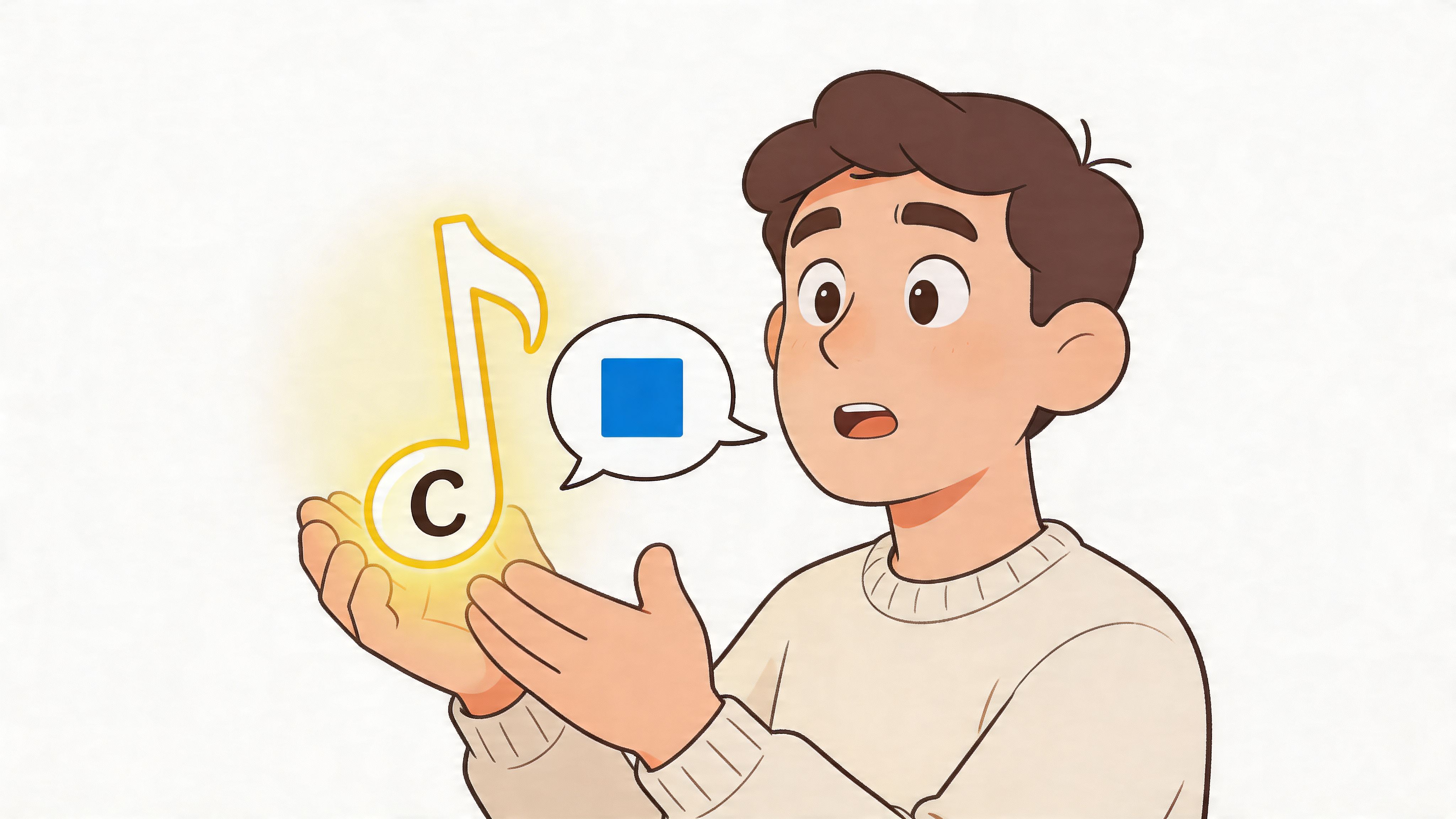
This is why perfect pitch sounds so impressive. It feels direct. Instant. Almost supernatural.
But it helps to strip away the mythology.
What perfect pitch actually is
Absolute pitch is an automatic note-labeling system. A person hears a tone and their brain attaches a name to it quickly.
That can be useful in a few real situations:
- Starting on a target note without checking an instrument first
- Identifying single tones in daily life, such as a piano key or ringtone
- Writing down music from memory when exact pitch recall is strong
Those are real strengths. But they are not the same thing as deep musical understanding.
A person can name a note and still struggle to hear the function of a chord in a progression. They can identify pitches and still find improvisation hard.
Why people overrate it
People often hear a dramatic percentage and assume the practical impact must also be dramatic. In medicine, a 50% relative risk reduction can sound huge, even if the actual change is tiny, such as going from 1 in 1,000,000 to 1 in 2,000,000, as discussed in this review on relative and absolute risk. That same confusion shows up in music.
Perfect pitch gets treated like a magical dividing line between ordinary musicians and elite ones. But the aura around it is often bigger than its practical role.
A musician doesn’t become expressive just because they can label tones quickly.
What it feels like and what it doesn’t guarantee
If you have absolute pitch, hearing notes can feel more specific and immediate. But that doesn’t automatically give you:
| Absolute pitch does not automatically give you | Why |
|---|---|
| Strong improvisation | Improvisation depends on hearing movement and tension in context |
| Chord progression recognition | Progressions are about relationships, not isolated labels |
| Easy transposition | Transposition asks you to think in patterns across keys |
| Musical freedom | Freedom comes from hearing function, shape, and direction |
That’s the key idea. Perfect pitch is a note-identification skill. It isn’t the same as hearing music structurally.
For ear training, that distinction matters a lot.
What Is Relative Pitch
Relative pitch is the ability to hear how notes relate to each other. Instead of asking, “What exact note is that?” you ask, “How far did it move?” “What kind of chord is this?” “Does this sound stable or unresolved?”
That’s the listening skill behind most real-world musicianship.
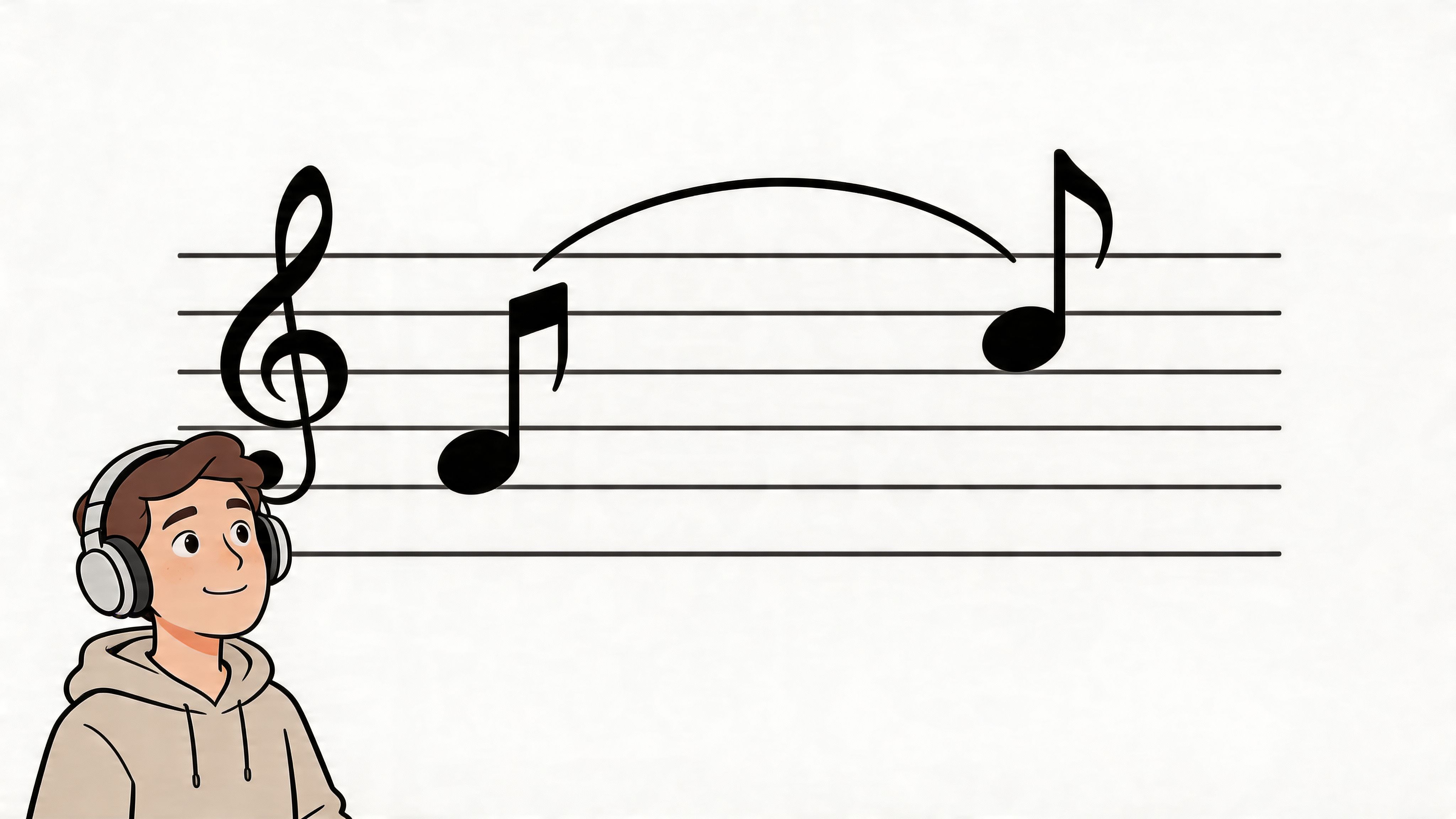
If absolute pitch is like identifying one house by its address, relative pitch is like understanding the whole neighborhood. You hear where you are, where you’re going, and how everything connects.
Why relative pitch matters more for playing by ear
Songs don’t arrive as disconnected notes. They arrive as patterns.
You hear a melody leap upward. You hear a chord change create tension. You hear a chorus land back home. Relative pitch helps you make sense of all of that in real time.
This is why relative pitch supports skills that musicians use every day:
- Interval recognition so you can track melodic movement
- Chord quality recognition so you can hear major, minor, and other sonorities
- Progression hearing so you can follow harmonic direction
- Transposition so you can move a song into another key without panic
- Improvisation so your phrases respond to the harmony instead of floating randomly
A flexible skill for changing musical situations
In business, relative performance measures are useful in unstable conditions because they compare outcomes in context rather than in isolation. Compensation Standards makes that point in its discussion of absolute vs relative performance metrics. Music is similar.
Keys change. Singers need new starting notes. Bands speed up live. Melodies get transposed. Chords get reharmonized. Relative pitch handles this better because it follows relationships, not fixed labels.
When you play by ear, you rarely need to know “This is E flat” first. You need to hear “this melody moved up,” “the chord turned minor,” or “we just went to the five.”
Why it’s the foundation for most musicians
A guitarist figuring out a pop song by ear uses relative pitch.
A vocalist finding harmonies uses relative pitch.
A producer hearing whether a chorus lifts enough uses relative pitch.
A pianist reharmonizing a melody uses relative pitch.
That doesn’t make it a lesser skill. It makes it the working language of music.
What relative pitch practice sounds like
Here are a few examples of relative listening in action:
- You hear two notes and identify the interval by sound, not by guessing keys on an instrument.
- You hear a chord progression and notice when the song moves away from home and when it returns.
- You sing back a melody from the first note given, because you hear each next step in relation to the one before it.
- You change key for a singer without relearning the song from scratch.
That’s musical freedom. Not flashy. Just very useful.
Absolute vs Relative Pitch in the Real World
Once the music starts, the question changes. It’s no longer “Which skill sounds more impressive?” It becomes “Which skill helps me respond right now?”
That’s where absolute vs relative gets practical fast.
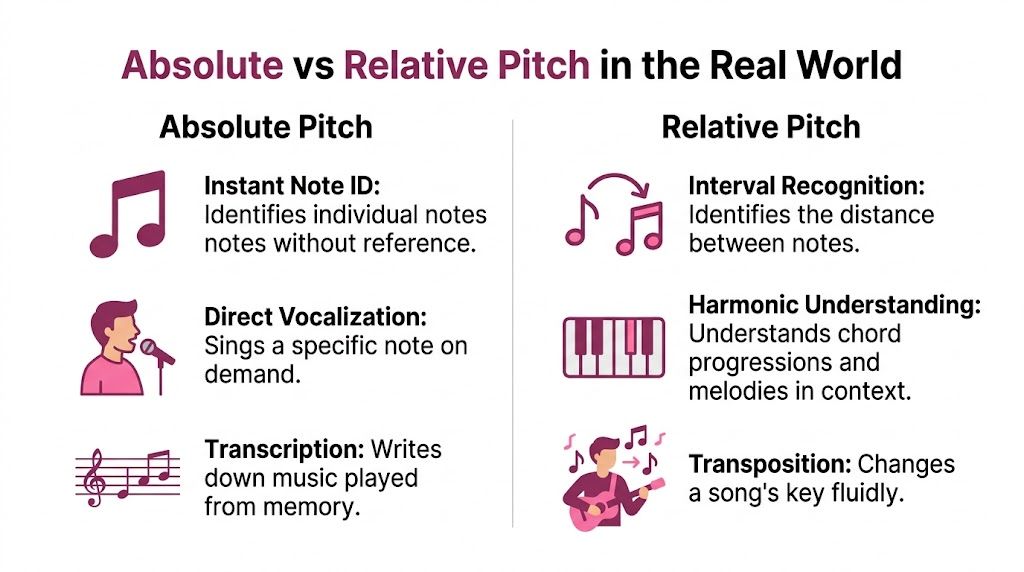
Side by side in common situations
| Musical situation | Absolute pitch helps with | Relative pitch helps with | Which matters more most of the time |
|---|---|---|---|
| Hearing a single note | Naming the exact pitch | Comparing it to a reference if one exists | Absolute pitch |
| Figuring out a melody | Identifying starting notes | Tracking intervals and contour | Relative pitch |
| Learning chords by ear | Labeling some tones | Hearing chord quality and movement | Relative pitch |
| Transposing a song | Knowing original note names | Moving the whole pattern to a new key | Relative pitch |
| Improvising | Recognizing available note names | Hearing function, tension, and resolution | Relative pitch |
| Playing with singers | Noticing original key quickly | Adapting to a comfortable new key | Relative pitch |
That table explains why many learners feel stuck. They spend practice time chasing isolated note recognition when their real musical problems involve movement, context, and harmony.
Three real examples
Transposing for a singer
A singer says, “Can we do it lower?”
If you rely only on note labels, you may know the original key but still struggle to move the progression smoothly. Relative pitch helps you hear the pattern underneath the song, so you can shift the whole thing without losing its shape.
Figuring out chords from a recording
You may catch the bass note once in a while. That isn’t enough. You need to hear whether the chord feels major, minor, tense, open, or resolved. You need to notice where the progression wants to go.
That’s relative pitch at work.
Improvising over harmony
A solo that sounds connected isn’t built from random correct notes. It responds to the chord underneath, leans into tension, and resolves with purpose.
Coach’s shortcut: If you want better solos, train your ear to hear chord function before you train it to name every passing note.
Where absolute pitch still has value
Absolute pitch isn’t useless. It can be handy when:
- Recalling exact starting notes quickly
- Checking pitch memory without an instrument
- Notating remembered music with more direct pitch access
But in day-to-day musicianship, those advantages are narrower than commonly expected.
The deeper difference
Absolute pitch answers, “What note is this?”
Relative pitch answers, “What is this note doing?”
That second question usually matters more when you’re trying to play by ear, jam with other musicians, write songs, or improvise.
If your ear training isn’t leading to those outcomes, the issue often isn’t effort. It’s focus.
Which Skill Should You Actually Train
For most musicians, the answer is clear. Train relative pitch first, and train it seriously.
That might sound disappointing if you’ve been taught to put perfect pitch on a pedestal. But it should feel freeing. Relative pitch is the skill that helps you stop guessing and start hearing music as a system.
Why perfect pitch isn’t the top priority
Research on musical cognition points to a useful reality check. People with absolute pitch can be slower at tasks that require relative pitch judgments, because the automatic labeling of notes can interfere with hearing broader harmonic relationships, as described in this paper on absolute pitch and cognitive processing.
That matters.
If your goal is improvisation, transposition, chord recognition, or real-time listening, you don’t want a training approach that pulls your attention away from musical function.
What musicians usually need in practice
Most players aren’t trying to win a note-labeling contest. They want to:
- Hear chord changes without staring at charts
- Catch melodies faster on guitar, piano, or voice
- Jam confidently with a band
- Transpose songs when a singer needs a different key
- Write better harmony because they can hear what a section needs
All of those depend more on relative pitch than on perfect pitch.
A better priority order
If you’re deciding how to spend your limited practice time, use this order:
-
Train intervals first
Learn to hear movement. Up, down, step, leap, familiar melodic shapes. -
Train chord quality next
Hear major, minor, and the emotional color of simple harmony. -
Train progressions after that
Start recognizing how chords behave in sequence. -
Add melody-to-instrument work
Hear a phrase, sing it, then find it. -
Treat absolute note work as optional
Useful for some goals, but not the center of your plan.
That’s the practical path to functional ear training with a daily app.
Train the skill that solves your musical problems, not the one that sounds rarest.
When absolute pitch training makes sense
It can still make sense to explore note memory if you’re curious. Some musicians enjoy practicing drone-based note recall, fixed reference singing, or pitch memory games.
Just don’t confuse that with the main engine of musicianship.
A balanced view looks like this:
| If your goal is… | Focus more on… |
|---|---|
| Playing songs by ear | Relative pitch |
| Improvising over chord changes | Relative pitch |
| Singing harmonies | Relative pitch |
| Naming isolated notes instantly | Absolute pitch |
| Becoming more musically flexible | Relative pitch |
The big takeaway is simple. Perfect pitch is optional. Relative pitch is essential.
Your Daily Ear Training Plan
Understanding this is helpful. Training it is what changes your playing.
The good news is that your ear responds well to steady, focused repetition. You don’t need marathon sessions. You need consistency. 10 minutes a day is enough to build momentum when the practice is deliberate.
A useful mindset shift helps here. Relative pitch is trainable for everyone, while the development of absolute pitch is strongly tied to early childhood exposure. Adults can still improve pitch perception, but they need realistic goals and a path that fits their background, as discussed in this overview of perfect pitch and relative pitch training.
A simple 10 minute routine
Here’s a practical structure you can repeat daily.
Minute 1 to 3: Sing and match
Play one note on your instrument. Sing it back. Then play another and match again.
This sounds basic, but it builds the bridge between hearing and producing pitch. If your voice shakes or slides, that’s normal. Stay with it.
Minute 4 to 6: Interval work
Play two notes. Ask one question only: did it go up, down, or stay close?
Then get more specific. Start recognizing common sounds by feel. A small step has one character. A larger leap has another. Use familiar songs if that helps at first, then move beyond them.
Minute 7 to 8: Chord quality
Play or listen to simple chords and classify what you hear.
Try prompts like:
- Major or minor
- Stable or tense
- Bright or darker
- Open or closed feeling
That language may seem informal, but it matters. Ear training starts with perception before terminology becomes reliable.
A daily system beats random practice
Structure is beneficial. Trill: Ear Training Daily is one example of a daily practice system built around short sessions for intervals, chords, notes, and scales, with real-audio exercises and habit features like Focus Lock.
If you don’t use an app, build your own checklist and keep it visible. The key isn’t the platform. It’s repeating the same listening behaviors often enough that they become instinctive.
Small habit, big payoff: Ten focused minutes every day beats occasional long sessions that leave your ear cold for the rest of the week.
Here’s a guided example if you want something to follow along with during practice:

If you also want to explore perfect pitch
Keep it light and realistic.
You can try:
- Reference note anchoring by memorizing one pitch and checking it daily
- Single note recall after hearing a tone and waiting a few seconds
- Voice-to-note matching where you sing a target and verify it
But don’t let this replace relative work. If your main goal is to play by ear, hear chords, and improvise, relative pitch should still dominate your practice plan.
What progress should feel like
At first, progress feels messy. Then certain sounds start becoming familiar.
You notice that a chord change no longer feels random. A melody lands under your fingers faster. You stop searching every note one by one. That’s what real ear training progress looks like.
Not perfection. Recognition.
Common Questions About Ear Training
Can adults learn perfect pitch
Adults can improve pitch perception, note memory, and pitch matching. But true absolute pitch development is strongly tied to early childhood exposure, so adult learners should keep expectations realistic and focus on practical listening gains.
Can you have both absolute and relative pitch
Yes. They can coexist. But for most musicians, relative pitch should carry the bigger workload because it supports playing by ear, transposition, harmony, and improvisation.
I sing out of tune sometimes. Is ear training still for me
Yes. In fact, it may help more than you think. A lot of tuning problems come from weak pitch awareness, not lack of effort. Matching notes, singing intervals, and checking yourself against a reference can improve accuracy over time.
What if I feel “untalented”
Most struggling musicians aren’t untalented. They’re untrained in listening. Ear training works when you practice consistently and connect sounds to real musical situations.
How do I know it’s working
You’ll guess less. You’ll hear chord changes sooner. You’ll find melodies faster. And you’ll trust your ears more than your luck.
If you want a simple way to build that habit, Trill: Ear Training Daily offers short, structured ear training sessions designed to help musicians recognize chords, intervals, notes, and scales through daily practice so they can play by ear with more confidence.