Playing by Ear vs Reading Music: Which Should You Learn?
“Learn to read music first. The ear will follow.” You’ve heard that advice. It’s standard, it sounds responsible, and it’s the reason plenty of musicians can play a page cleanly and still can’t tell you what chord is sitting under a held vocal note.
Then there’s the other line, the one about talent. Some people are born with a good ear; the rest of us squint at chord charts forever. That one does more damage, because it gives you permission to stop trying.
Both pieces of advice get the sequencing backwards. Playing by ear vs reading music isn’t a choice between two kinds of musician. It’s a question of which skill you feed first, and whether you keep feeding the other one afterward. Get the order wrong and something quiet happens. The page starts doing all the listening for you.
Table of Contents
- Playing by Ear and Reading Music Side by Side
- What Ear Training Builds and Why It Is Trainable
- What Reading Music Gives You That Your Ears Cannot
- Where Each Skill Wins in Real Playing
- The Hidden Cost of Relying on Notation Alone
- How to Train Both in 10 Minutes a Day
- Choose Your Starting Skill Based on Your Goal
Playing by Ear and Reading Music Side by Side
| Criteria | Playing by ear | Reading music |
|---|---|---|
| Core skill | Hearing pitch, rhythm and harmony, then reproducing them | Decoding written symbols into sound at a set tempo |
| Needs a chart or score | No | Yes |
| Best suited for | Jamming, improvising, learning songs from recordings | Ensemble parts, orchestral music, exact reproduction of written material |
| Main limitation | Slow for long or complex notated pieces | Can weaken pitch recall when it becomes the only input |
| Earliest visible result | Hearing chords in familiar songs within weeks of daily practice | Playing a notated piece at the level of the notation’s difficulty |
Reading music means taking symbols off a page and turning them into sound at tempo, in time, without stopping to work out each note. Playing by ear means hearing pitch, rhythm and harmony and putting them straight onto your instrument with nothing in front of you.
Take the chart row first, because it decides where each skill lives. An ear player walks into a jam with no paper and no prepared part. A reader walks into rehearsal with a folder. Neither is more musical. They’ve built a different entry point.
The earliest-result row is the one that keeps people practising. Ear work shows up fast in the songs you already love, often within a couple of weeks of daily listening. Reading shows up as the ability to play whatever sits in front of you, at whatever difficulty that page happens to be.
Here’s the concrete version. A guitarist can play a chord progression from a recording after two listens but freezes when someone hands them a lead sheet. A pianist reads a full score cleanly but can’t find the melody of a song by ear at a party. Same amount of talent, different training.
Formal music education doesn’t treat notation as a substitute for listening, either. A 2021 analysis of university aural-skills teaching found sight-singing and dictation reported by 99% of respondents, and a related review found instructors estimated spending more than 73% of class time on singing, dictation and transcription, as reported in Music Theory Online. Students are expected to decode symbols and identify pitch by sound at the same time.
The real difference: it isn’t talent, and it isn’t difficulty. It’s the input. One skill starts with a page, the other starts with a sound, and the input you practise is the input you get good at.
Before your next gig, lesson or jam, name the input it will rely on. If someone hands you charts, you’re building the reader. If someone says “watch me and come in”, you’re building the ear. That answer decides which skill you start with this week.
What Ear Training Builds and Why It Is Trainable
A song comes on and the bass steps down under the last line of the chorus. You feel the floor tilt a little before you can name a single note. That tilt is what ear training turns into a reliable skill, and it’s the thing that makes playing by ear possible.
Four abilities sit underneath it. Hearing the distance between two notes, which musicians call an interval. Telling a major chord from a minor one. Following where a melody moves. Singing back a phrase you just heard. None of them need perfect pitch, and all of them improve with repetition.
The evidence that this is taught rather than inherited comes from a controlled classroom study. Sixteen matched pairs of UK music students aged 10 to 14 were taught either traditionally or by learning from audio recordings without notation. The ear-playing group outperformed the control group on every assessed aural criterion, including pitch, rhythm, contour, tempo, closure and overall performance (Ear Playing Project study).
Perfect pitch isn’t the entry fee
Pitch memory responds to training in adults too. A University of Chicago summary of the research on perfect pitch reports that some adults learned to remember and identify notes after only brief training and kept the improved accuracy for months. In an eight-week experiment, some participants eventually reached the accuracy of people who naturally had perfect pitch, though others did not.
That last clause matters, so don’t skip it. Trainability doesn’t promise identical results for everyone. It promises that your ear gets better than it is now, which is the only comparison that affects your playing.
A practice you can run today: pick one reference note. Play it, sing it, then sing a note you guess is a fourth above it, and check on your instrument. You’re not testing whether you’re gifted. You’re testing whether the sound you imagined matched the sound you made.
What this builds shows up in playing, not in quizzes. You start hearing the chord change under a vocal line, finding a melody on the keys without hunting, and improvising a phrase that fits the harmony instead of fighting it. The wider set of ear training exercises follows the same order, sound first, answer checked second.
Try this first: play a familiar song and decide whether it feels major or minor, then check the chord on a piano or guitar. Do it once a day for a week and you’ll notice the feeling arriving before the guess.
What Reading Music Gives You That Your Ears Cannot
A score is a storage system. It holds a piece steady across time and distance, so the version you play tonight matches the version someone played last year in another city. That’s not a small thing, and no amount of ear skill replaces it.
What a score carries precisely is the stuff memory drifts on. Exact rhythm, dynamics, articulations, repeat structures, the difference between a passage marked pp and one marked ppp. An ear player who learns a song in March often plays a slightly different version in June. A reader plays the bar count the composer wrote.
Two places the page wins outright
A session player receives a chart with a tempo marking, precise bar counts and a two-bar fill notated at the end. There’s no recording to learn from and no second take. Reading is the only way in.
A classical musician working on a sonata has every note, every phrase marking and every pedal instruction printed. The printed edition is the reference, and the performance is measured against it.
Now the limit. A score doesn’t tell you what it sounds like until you hear it. It encodes sound symbolically, and the performer still has to convert those symbols into accurate pitch, rhythm and phrasing. That conversion is an ear skill wearing a reading costume.
So build the loop. Read a phrase and predict its sound before you play a note. Play it. Then check the result against the score. The prediction step is what turns decoding into musicianship, and it’s the step most readers skip.
Reading is a trained skill with a physical footprint, not a talent. A 2024 study in Scientific Reports compared 60 healthy professional musicians with control participants while examining how music literacy affects reading-related brain processes, which is what you’d expect from something learned rather than inherited.
It’s also worth remembering how recent the page is. The earliest known musical notation comes from Nippur in ancient Mesopotamia around 2000 BCE, and the modern five-line staff was adopted in 16th-century France, according to this history of musical notation. People learned music by ear for a very long time before anyone wrote it down.
If you work from scores regularly, listen to each passage before you play it, even once. Our sight reading exercises are built around that predict-then-play loop.
Where Each Skill Wins in Real Playing
Picture the two most common scenes a working musician walks into: a room with no music stands, and a rehearsal where everyone has a folder.
| Situation | Stronger skill | Why |
|---|---|---|
| Jam session with no chart | Playing by ear | You follow the band’s harmony by listening |
| Unfamiliar orchestral or ensemble part | Reading music | Written parts carry exact rhythm, dynamics and cues |
| Learning a song from a recording | Playing by ear | The ear finds the chords and melody directly |
| Improvising over chord changes | Playing by ear | Anticipating harmonic movement needs hearing |
| Learning a new classical sonata | Reading music | Notation fixes every note and phrase marking |
| Transcribing a solo | Playing by ear first, then reading | Notation checks what you heard |
| Accompanying a singer in a new key | Playing by ear | You transpose by sound rather than by rewriting a chart |
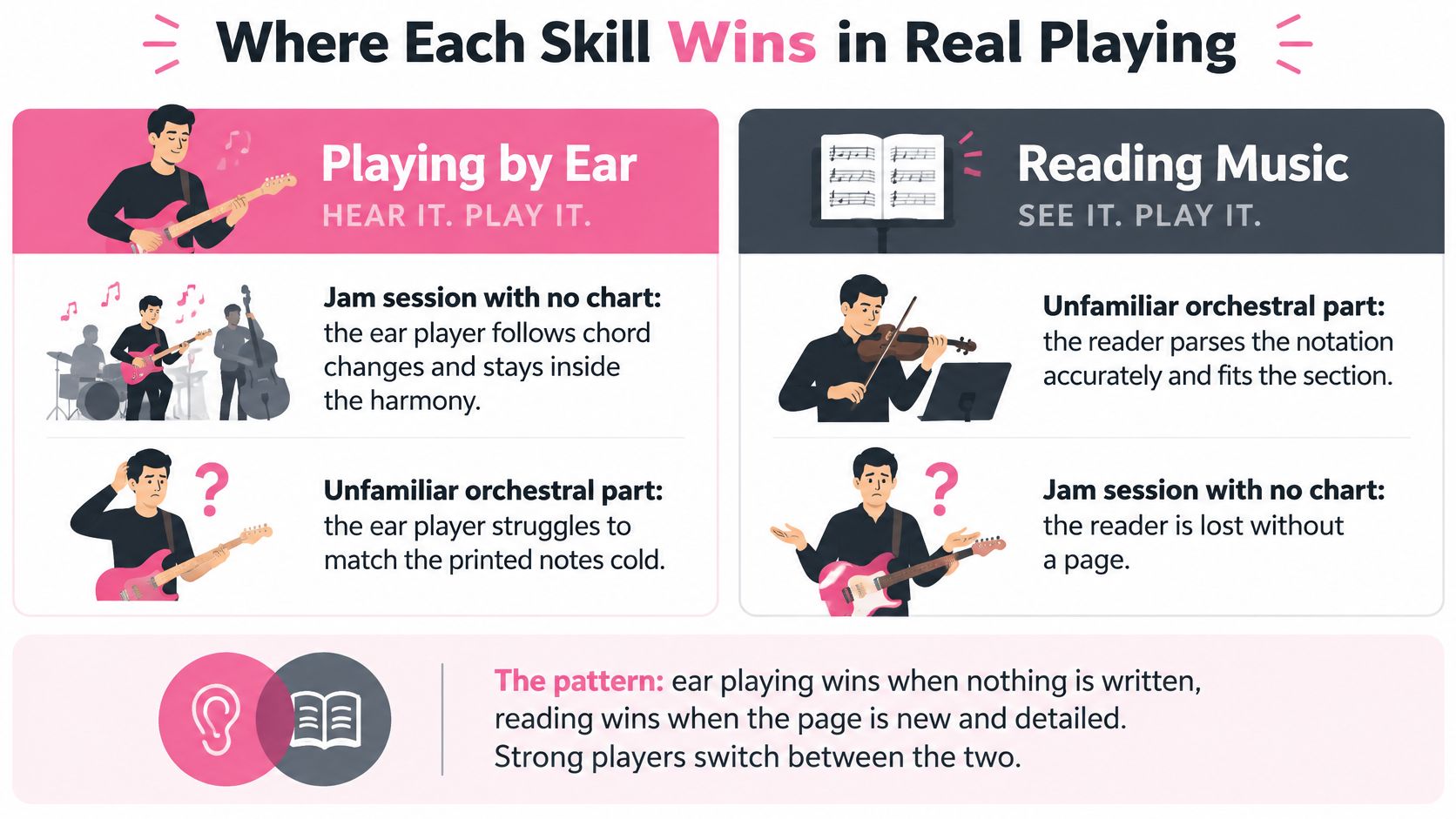
The pattern behind the table is simpler than it looks. When nothing is written, the ear carries you. When the page is new and detailed, the page carries you. Most real playing asks for both, sometimes inside the same song.
At a jam with no chart, the ear player stays inside the harmony because they’re tracking the bass and the chord colour as it moves. Hand them an unfamiliar orchestral part cold and they struggle, because printed accidentals, cues and dynamic markings arrive faster than listening can decode them.
Here’s the part that surprises readers who see this as two separate camps. Reading leans on the ear more than is often realised. A study of 70 university wind players found that aural-spatial pattern recognition and technical mastery jointly explained 51% of the variance in sight-reading performance, as reported in the Journal of Research in Music Education. Reading isn’t a purely visual act. It’s predicting what the symbols should sound like, fast.
The switching rule that beats both
Learning a song from a recording is an ear job, full stop. The chords and melody are in the audio, and hunting for a tab teaches you the tab, not the song. Improvising over changes is the same: you have to feel where the progression is heading before you can choose a note that lands.
A new classical sonata is a reading job, and transcribing a solo runs in two stages. Ears first to find what was played, notation second to confirm you got it right. Accompanying a singer who calls a new key mid-set is ear work by definition, because rewriting a chart in real time isn’t a thing.
Musicians describe the split almost exactly this way. A 2024 study in Musicae Scientiae surveyed 64 musicians about reading music and learning by ear. Participants reported that notation supports faster learning and theoretical understanding, while learning by ear was associated with expressive freedom and improvisation.
Practical rule: use notation when exact reproduction and ensemble coordination matter. Use the ear when the music is unwritten, changing, or has to be learned quickly from sound.
The Hidden Cost of Relying on Notation Alone
Here’s the part almost nobody tells you when they hand you your first method book. The page can take work away from your ear, and your ear gets weaker when it stops doing that work.
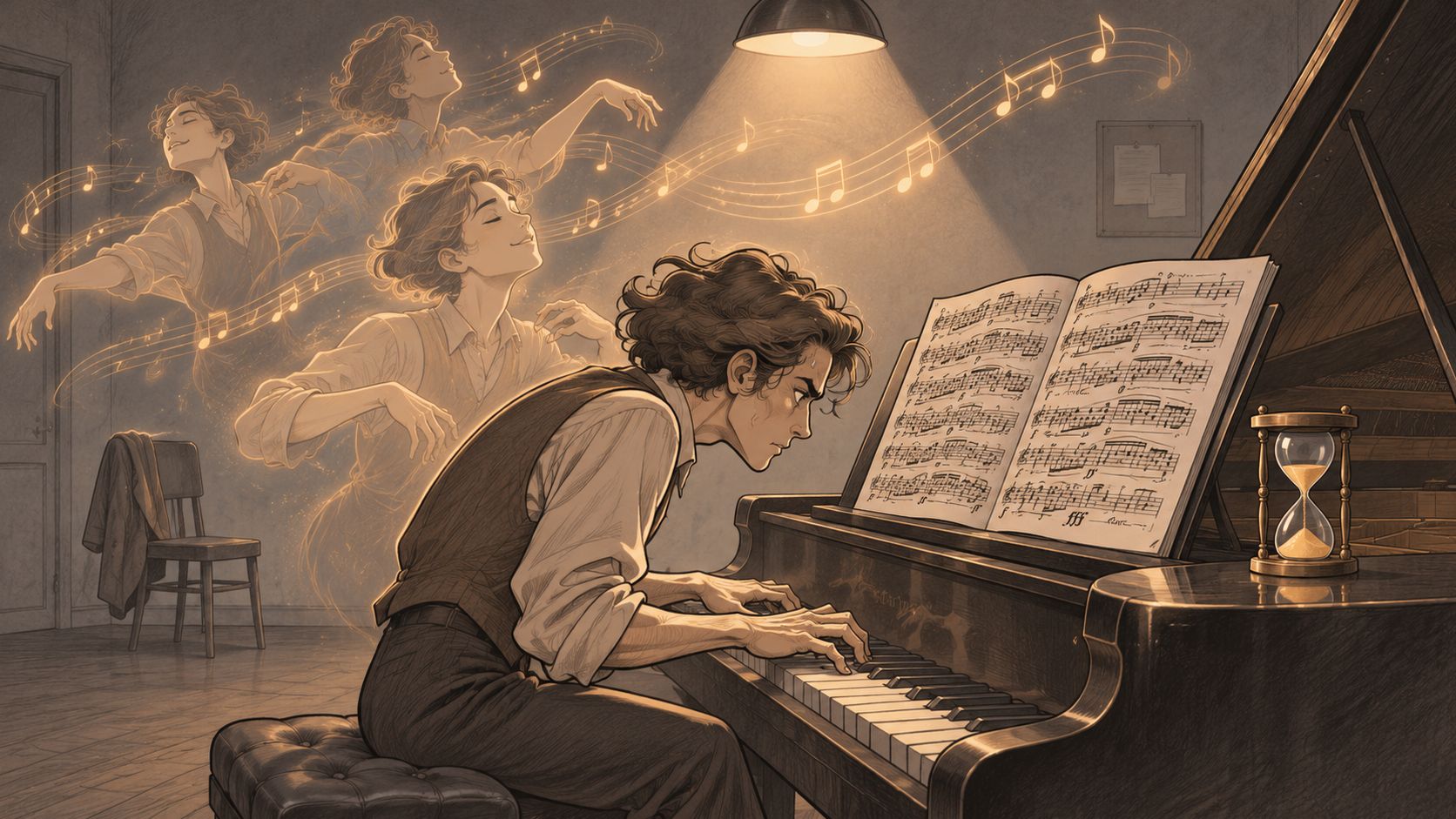
Research on 20 notationally literate classical musicians found that participants with greater score dependence struggled significantly more to reproduce melodic pitch content aurally, while their rhythm reproduction did not show the same disadvantage (Royal College of Music research on score dependency). Think about what that means. Reading preserved their timing. It let their pitch-finding go slack.
Recognition is not recall
Many players fool themselves here, and it’s worth slowing down for. Recognising a note on a staff is a different act from producing that note from sound alone.
You can point at the second line of the treble staff and say “G” all day. That’s recognition, and it’s a reading skill. Singing a G with no reference, or finding it on the fretboard after hearing it, is recall. That’s an ear skill. Players who can do the first often assume they can do the second, right up until the chart is taken away.
Run the test today. Play a short melody from a recording with no notation in sight, then check it on the keyboard or against the score. Score pitch and rhythm separately, because they fail separately. If your rhythm is solid and your pitch wanders, you’ve found the gap the study describes.
The study’s authors interpret the result as possible overlearning from score-focused performance environments, which points at the fix. Regular ear-led playing acts as a counterbalance, especially for classically trained musicians who spend years in front of printed music.
The safeguard is a habit, not a rule. Alternate sound-only tasks with notation tasks, and look at the score only after you’ve given your answer. Attention is the scarce resource here. In our onboarding survey, the most common reason musicians gave for not improving was that they can’t focus, at 30%, and looking at the page too early is one of the easiest ways to lose focus without noticing.
Give the answer first. Then check the page.
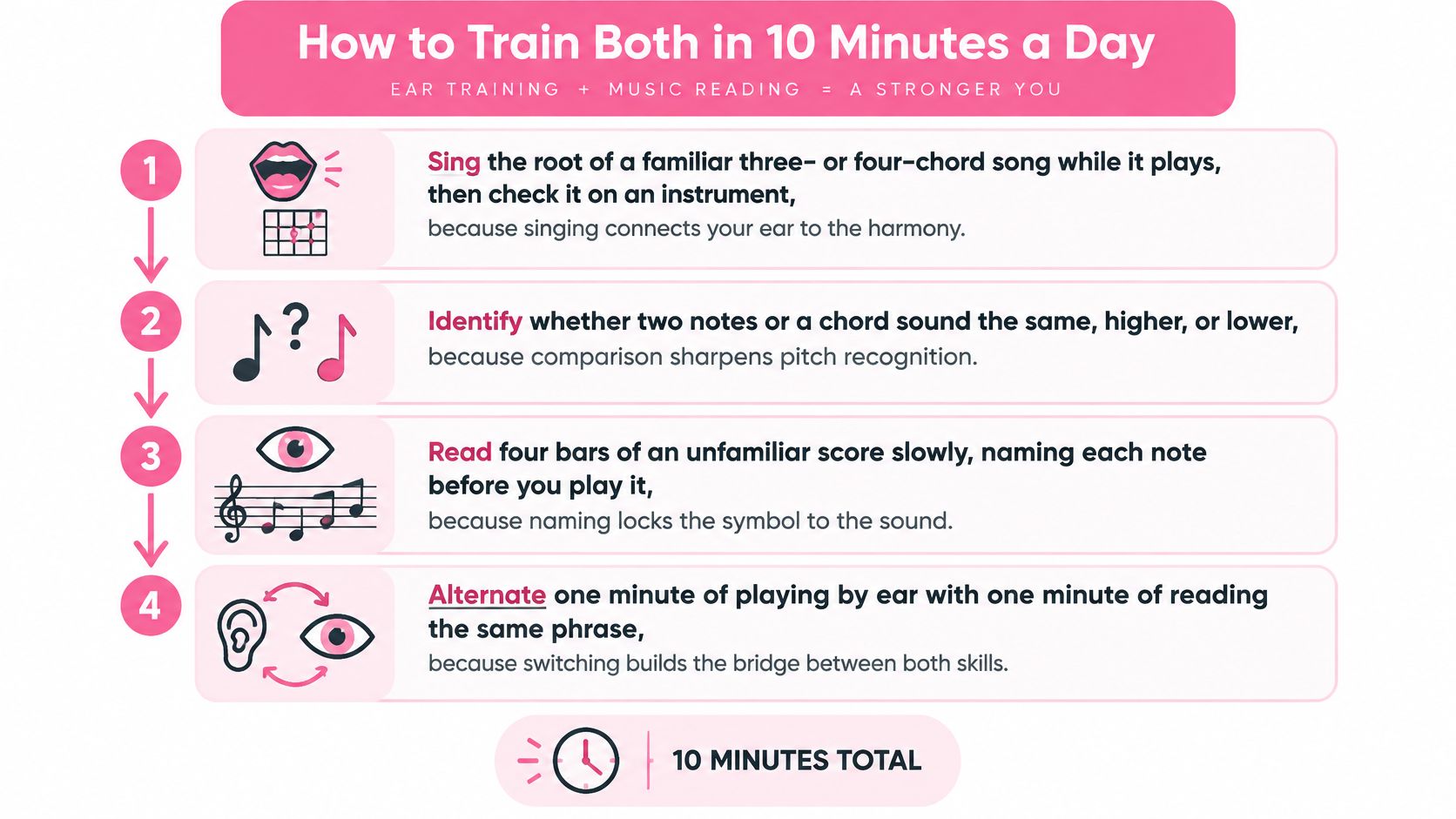
How to Train Both in 10 Minutes a Day
Ten minutes is enough to touch both skills if you know what goes in those minutes. The routine below runs in order, and each step earns its place.
-
Sing the root of a familiar song. Play a three- or four-chord song you know, listen for the lowest note of each chord, sing it as the harmony changes, then check it on your instrument. Singing is what connects the sound in the air to the sound in your head. Berklee’s ear training exercises point at the same target when they recommend learning to hear the I, IV and V chords by listening for dominant and plagal cadences.
-
Call major or minor on a chord or a pair of notes. Use the same reference note every day, so your ear isn’t starting from a different place each session and guessing.
-
Hear four bars, sing them back, then play them with no notation in front of you. This is the step that most directly targets pitch recall, because there’s nothing on the page to fall back on. When you’re ready to take apart a full solo, this walkthrough on how to transcribe music by ear uses the same hear-first order at a slower pace.
-
Transpose a short progression like I–V–vi–IV into a new key by ear. Play it where you know it, move it somewhere unfamiliar, then rebuild it without a chart. Comparing the same progression across keys trains relative pitch, because you’re hearing how chords relate rather than memorising shapes, as this guide to chord progressions lays out.
-
Read four bars slowly, but hear them first. Predict the sound of the phrase, play it, then check against the page.
-
Check each answer immediately and log the one mistake to fix tomorrow. One mistake, not five. A single focus point survives to the next session.
Why ten minutes beats an hour on Sunday
Nobody has established that exactly ten minutes is the ideal length. A review of practice research from The California Conservatory notes that no study has settled on an ideal practice duration, that a small study of 29 adult musicians found gains when sessions were separated by a day, and that a study of 109 young violin and viola students found total time spent learning was the strongest predictor of eventual level, rather than how much they practised.
Read that as permission to keep sessions short and repeatable. A brief daily block is easy to start, easy to restart after a missed day, and easy to keep for a month. A two-hour Sunday session is none of those things.
A structured app removes the decision. When you start in Trill, you tell the app your goal and your level, and the journey adapts from single notes to full chord progressions. Trill is an ear training app covering chords, intervals, perfect pitch and melodies, built around a 10-minute daily practice. And the reason structure matters more than willpower is in the numbers: in our onboarding survey of about 60,000 musicians in 2026, 78% said focus, consistency, structure or time is what blocks their progress.
A healthy week looks like this. Five ear sessions, two reading sessions, and one session that combines both, where you hear a phrase, reproduce it, then confirm it on the page. That last session is the one that makes the other seven stick.
Choose Your Starting Skill Based on Your Goal
Enough theory. Here’s the direct answer for each goal, so you can stop deliberating and start on Monday.
You want to jam, learn songs off recordings, or play with a band that doesn’t use charts. Start with playing by ear and add reading later for arrangements. The ear is the entry ticket to those rooms.
You’re heading toward orchestra, ensemble work, graded exams or classical repertoire. Start with reading, and add ear training so notated passages sound right in your head before your hands touch the instrument. That order saves you years of playing correct notes without hearing them.
You want to improvise or write songs. Start with the ear and use notation to write ideas down so you don’t lose them. Written symbols serve the idea here, not the other way round.
The goals themselves are scattered, which is why picking one starting point matters so much. In our onboarding survey, 16.5% of musicians want to learn chord recognition, 14.7% want to play by ear, 14.3% want perfect pitch, 13.8% want interval recognition, 13.2% want music theory and 13.1% want relative pitch. Different goals, same first move: decide which input you’re feeding.
If you’re unsure whether sheet music is supporting your playing or covering a weak ear, test it. Run sound-only exercises, track your chord and interval accuracy, and only then add notation back as feedback rather than as the starting point, an approach outlined in the Royal College of Music study on notation independence.
The two skills were never rivals. Ear training builds the prediction that reading depends on. Reading checks what the ear found.
Decision rule: pick the skill your next playing situation requires, then practise the other one in your daily 10 minutes.
Now write your goal on a sticky note, choose the starting skill that gives you the fastest route to it, and run the daily routine for two weeks before you reassess. Two weeks of hearing before checking beats two years of reading without listening.
Trill: Ear Training Daily is built for exactly this problem: a short daily session that trains your ear to recognise chords, intervals and melodies, then carries those skills into real playing. You start by telling the app your goal and your level, and the exercises scale from single notes up to full chord progressions, with instant feedback so you hear the answer instead of guessing it. If you’re ready to stop guessing and start hearing, visit Trill: Ear Training Daily and put in your first ten minutes today.