10 Ear Training Exercises to Play Music By Ear
Stop Guessing, Start Hearing: Your Path to Musical Freedom
You hear a melody on the radio and reach for your instrument, but your fingers hesitate. You know the sound is simple. You just can’t find it fast enough.
The same thing happens at rehearsals and jam sessions. Someone calls a tune, the chart is missing, and suddenly you’re guessing instead of listening. That gap isn’t a talent problem. It’s an ear problem, and ear training fixes it.
Playing by ear is trainable. It isn’t reserved for people born with perfect pitch. It’s closer to building timing, touch, or technique. The musicians who seem to “just hear it” usually built that skill through repeated, focused practice.
A 2013 study on pianists found that stronger aural skills were tied to better memory performance, especially when players had to rely on hearing rather than physical repetition. Pianists with higher aural skill averaged 80% on aural tests, compared with 46% for lower-skill players, and they played 25% more correct notes from memory in auditory-only practice after just 10 practice trials of short excerpts (details from Bulletproof Musician’s summary of the study). That’s the practical payoff of ear training. You stop depending on the page, and your inner hearing gets stronger.
The fastest way forward is to stop treating ear training as one vague skill. It’s a set of trainable abilities. Interval hearing, chord recognition, rhythm, melodic memory, harmonic function. Train them separately, then connect them in real music.
Table of Contents
- 1. Interval Recognition Training
- 2. Chord Recognition and Progression Identification
- 3. Melodic Dictation
- 4. Rhythm Recognition and Transcription
- 5. Relative Pitch Development Through Sol-Fa
- 6. Harmonic Dictation and Voice Leading Analysis
- 7. Active Listening with Score Following
- 8. Pitch Memory and Perfect Pitch Simulation Training
- 9. Timbral Differentiation and Instrument Identification
- 10. Functional Listening and Harmonic Context Training
- 10-Point Ear Training Exercises Comparison
- Build Your System for Daily Ear Training
1. Interval Recognition Training
Intervals are the first layer of real ear training. If you can’t hear the distance between two notes, melodies stay blurry and chords stay vague.
Most beginners make this harder than it needs to be. They try to memorize all twelve intervals at once. Don’t. Start with the ones that have a strong shape and a clear emotional pull, like the perfect fourth, perfect fifth, and octave. Then work inward toward the trickier pairs, especially the minor and major versions of seconds, thirds, sixths, and sevenths.
Start with the intervals that feel obvious
Use short daily drills. Sing the first note, hear the second note in your head, then check it on your instrument. Apps help, but the app isn’t the skill. The skill is hearing the gap before you touch the note.
A practical sequence works well:
- Begin with wide landmarks: Learn fourths, fifths, and octaves first because they sound less ambiguous.
- Train both directions: Ascending intervals are easier for many players than descending ones. Practice both.
- Switch contexts: Do melodic intervals first, then harmonic intervals where both notes sound together.
- Check on your instrument: After naming the interval, find it physically and play it cleanly.
If you want a quick refresher on how intervals are organized, this guide to intervals in music is useful alongside listening practice.
Practical rule: If you’re still guessing between minor third and major third, slow down and sing them every day. Hearing improves faster when your voice is involved.
What doesn’t work is treating interval drills like trivia. If all you do is tap multiple choice answers, you’ll get better at quizzes. You won’t necessarily get better at playing by ear. Always connect the sound to singing, to your instrument, or to a melody from real music.
2. Chord Recognition and Progression Identification
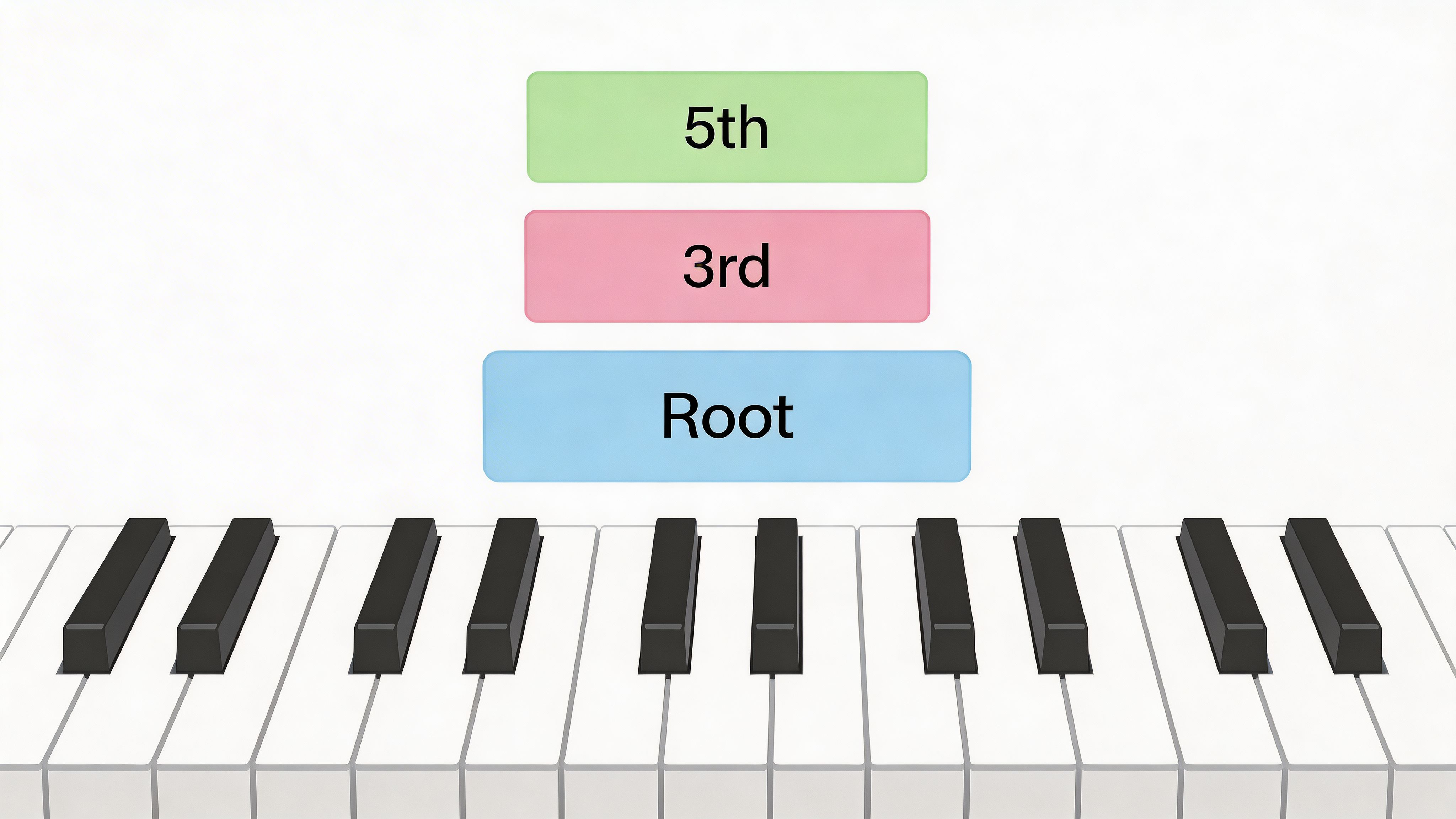
A lot of musicians can name a major chord in isolation but freeze when chords start moving in a song. That’s because chord recognition isn’t only about quality. It’s about context.
When you train progressions, your ear starts hearing patterns instead of random harmony. That’s when songs get easier to decode.
Train chords in songs, not in a vacuum
Musical U notes that chord progression training helps musicians recognize patterns in over 80% of popular three-chord songs, because so much pop, rock, and folk music leans on a small group of common progressions (ear training exercises explained by Musical U). That matches what working players run into every day. Once your ear locks onto I, IV, V, vi, and ii in real songs, you stop chasing every chord like it’s a surprise.
A strong progression routine looks like this:
- Start with triads: Major and minor first. Don’t rush into dense jazz voicings if basic triads still blur together.
- Track the root movement: Bass motion often gives away the progression before chord color does.
- Use one key for a week: Hear the same progression shapes repeatedly before transposing.
- Move into real tracks: Learn the progression from a song, then play it in another key.
For players who need harmony to feel less abstract, this piece on chords as the foundation of musical emotion connects the theory to what you hear.
The common mistake is chasing exotic chords too early. Most musicians don’t need altered dominants on day one. They need to hear major, minor, dominant, and basic movement clearly enough to follow a band.
3. Melodic Dictation
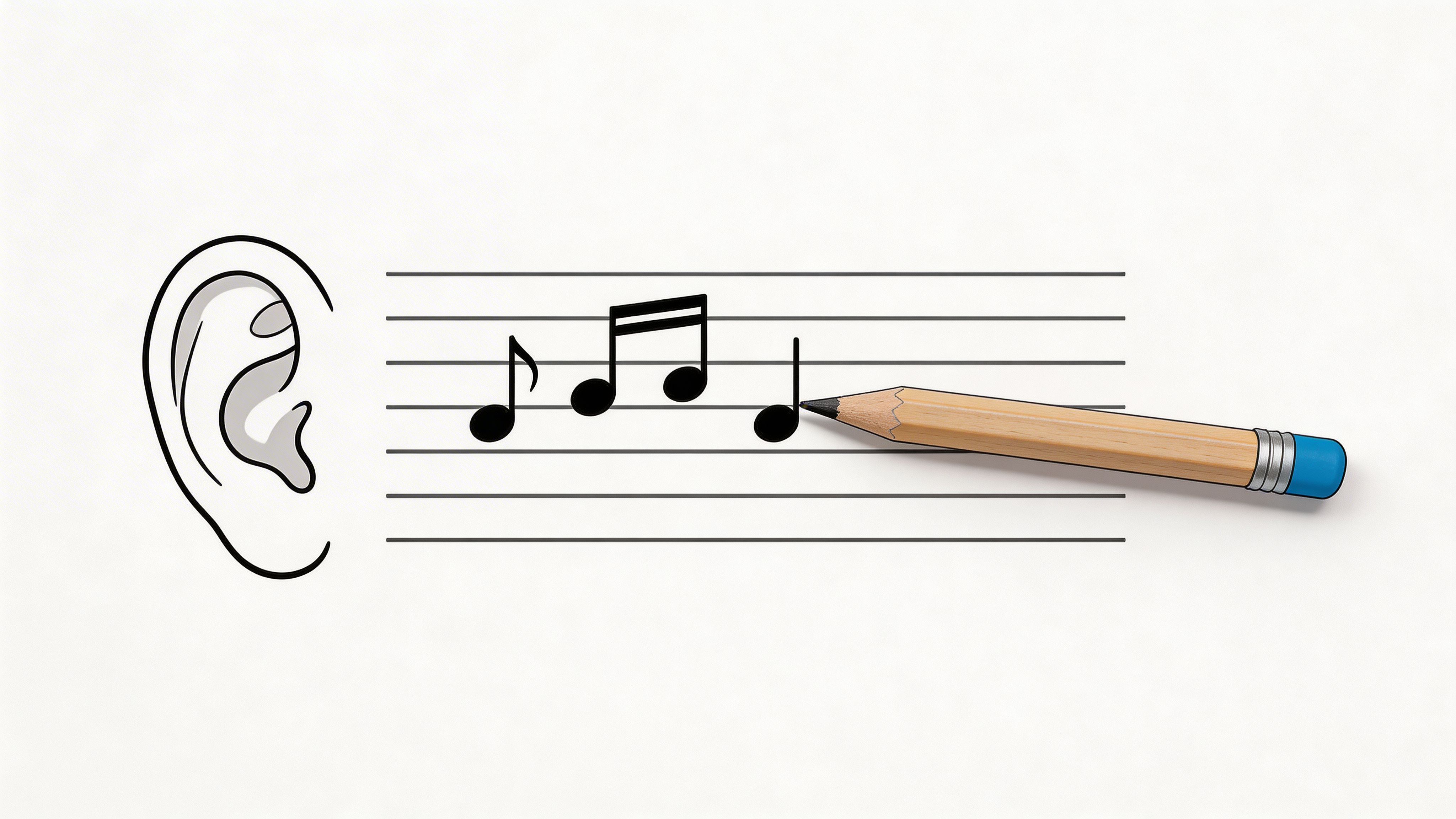
Melodic dictation sounds academic, but in practice it’s one of the most useful ear training exercises you can do. It’s just this: hear a phrase, then sing it, play it, or write it down accurately.
If you want to play by ear, the skill becomes obvious here. You hear a line and turn it into music under your fingers.
Keep the melody short enough to remember
Beginners often start too big. They’ll try to transcribe a full verse, then lose the thread after two notes. Shrink the task.
Take a melody of four to eight notes. Listen several times. Sing it back before touching your instrument. Then find the first note, work out the contour, and check each pitch against the recording.
The earlier memory research matters here. In the pianist study summarized by Bulletproof Musician, players with stronger aural skills reached 85% note accuracy in the auditory-only condition, compared with 62% for lower-skill players. The same experiment used 40 pianists across normal, motor-only, auditory-only, and covert practice conditions. The message is simple. Better hearing supports better recall when the instrument isn’t doing all the work for you. I already linked that study summary earlier, so keep that result in mind as you practice.
Hear the phrase first. Your fingers should confirm what your ear already knows, not go fishing for answers.
What works especially well is transcribing music you like. A guitarist should pull melodies from guitar-forward songs. A singer should grab vocal hooks. A producer should transcribe top lines, bass figures, and short motifs from tracks they admire. The closer the exercise is to your real musical life, the more likely you’ll stick with it.
4. Rhythm Recognition and Transcription
Pitch gets most of the attention in ear training. Rhythm is what makes the notes usable.
I’ve seen plenty of musicians identify the right pitches and still miss the line because the timing is loose. If the rhythm is wrong, the phrase isn’t right.
Separate rhythm from pitch
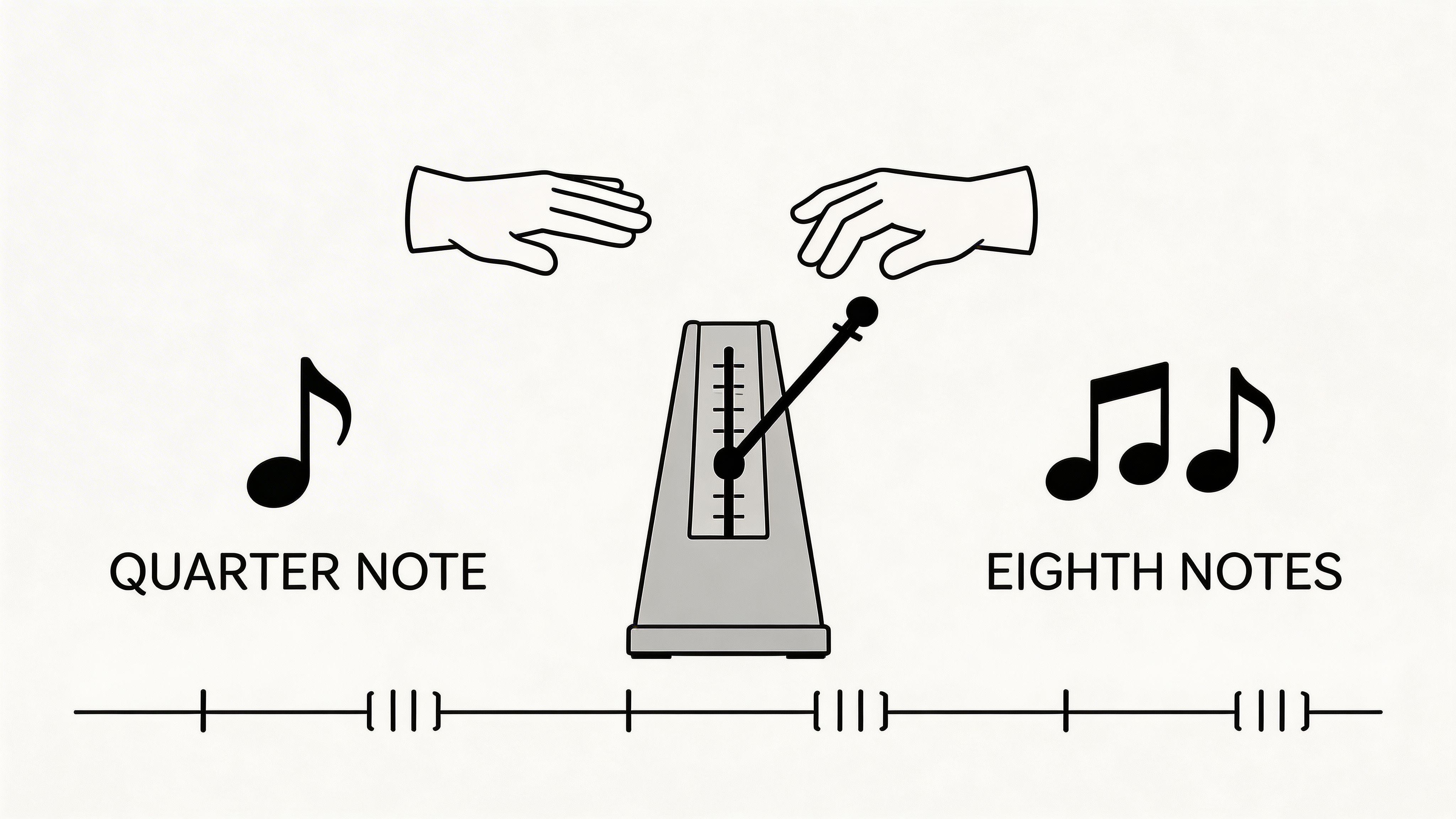
The fastest fix is to stop training both at once when a phrase is difficult. Clap or tap the rhythm first. Count it. Loop it with a metronome. Only after the pulse feels steady should you add notes.
That split matters because rhythm hearing is its own skill. A clean approach looks like this:
- Tap the pulse first: Don’t transcribe rhythm without knowing where the beat sits.
- Clap the phrase before playing it: Your body usually understands rhythm before your fingers do.
- Use a metronome as a reference: Start slow enough that syncopation still feels controlled.
- Write stems and spacing if needed: Even rough notation helps you see the shape of the rhythm.
Good rhythm practice also keeps your inner pulse honest. If you rely on visual notation but can’t hear subdivision internally, you’ll always feel late to the music.
What doesn’t work is trying to “feel it out” at full tempo from the start. Slow it down. Loop one bar. Then rebuild the groove. This is especially important for swing, syncopated pop lines, funk guitar parts, and anything with tied notes across the beat.
If you use Trill alongside instrument practice, pair short rhythm drills with the metronome, then apply the pattern immediately to a riff or melody on your instrument.
5. Relative Pitch Development Through Sol-Fa
Solfège gets dismissed because people associate it with classrooms. That’s a mistake. Singing scale degrees is one of the cleanest ways to build relative pitch.
Relative pitch is what most musicians need. You hear where notes sit against a tonal center, and that lets you play by ear without needing true perfect pitch.
Sing before you play
The old sol-fa systems lasted for a reason. The historical tradition of solfège work, with methods such as Tonic Sol-fa and Kodály, focuses on singing intervals as relationships, not isolated facts. The verified background also notes that Kodály-influenced training emphasized interval singing and that children trained this way achieved stronger interval recognition than untrained children, which lines up with how working musicians build hearing through voice before instrument.
The practical version is simple:
- Set one key center: Play or sing the tonic until it feels stable.
- Sing do-re-mi patterns: Keep them slow and accurate.
- Use movable do: That keeps your ear focused on function.
- Match your instrument after singing: Voice first, fingers second.
This is one of the few ear training exercises where being imperfect is useful. If you sing a note slightly wrong, you feel the correction. That feedback sharpens your hearing.
One habit that works: Sing roots and scale degrees out loud, even if you play an instrument. Silent recognition develops slower.
What doesn’t work is mumbling through syllables without listening closely. Solfège is not a pronunciation exercise. It’s hearing training. If “fa” and “sol” don’t feel different in your ear and body, slow the exercise down until they do.
6. Harmonic Dictation and Voice Leading Analysis
Advanced players often hit a wall here. They can hear the chord name, but not what the inner parts are doing.
Harmonic dictation fixes that by training you to hear movement inside the harmony. Not just C major to G major, but which note stayed put, which voice rose, and where the tension came from.
Listen for movement inside the chords
Start with the top note and bass note. Those are usually the easiest anchors. Then listen for what happens in between.
If you’re working from a recording, loop two chords only. Sing the bass. Then sing the top note. Then see if one middle note moves by step. That’s often enough to make the whole progression feel understandable instead of crowded.
A good progression:
- Begin with simple textures: Hymns, chorales, piano ballads, and acoustic arrangements work well.
- Identify cadences first: Endings reveal function and make the section easier to map.
- Track common tones: Notes that stay the same help your ear organize the change.
- Use visual support carefully: A chord visualizer can confirm voice movement after you’ve listened.
This is one place where abstract app drills can fall short if you never bring them back to your instrument. One practitioner source puts it plainly: “many musicians are led to believe ear training happens away from their instrument… this couldn’t be further from the truth” (discussion of ear training on the instrument).
That trade-off matters. Pure listening drills sharpen recognition, but on-instrument work makes the recognition usable. If you hear a dominant chord resolving but can’t find the voices under your hands, the skill is still incomplete.
7. Active Listening with Score Following

Score following is underrated because it sounds passive. Done right, it is not passive.
You listen to a performance and track the notation in real time. That forces your eyes and ears to agree. If they don’t, you notice exactly where your reading and hearing disconnect.
Use the page to sharpen the ear, not replace it
The best way to do this is in rounds.
First listen with no score at all. Find the pulse, phrase shape, and rough form. Then bring in the page and follow only one line. In ensemble music, don’t try to hear everything at once. Follow the melody, bass, or a single inner voice.
A few habits make this effective:
- Choose readable material: Simple lead sheets, chorales, and single-line melodies work better than dense scores at first.
- Mark structure lightly: Circle repeats, cadences, and section changes so your ear expects them.
- Pause when the sound surprises you: That’s where your hearing grows.
- Compare recordings: Different performances reveal what is written and what is interpretive.
This exercise is especially useful for players who read well but don’t internalize sound quickly. It also helps musicians preparing for ensemble work where you need to hear ahead, not just react after the fact.
What doesn’t help is staring at the page and letting your eyes do all the work. If you finish a pass and can’t sing back the line you followed, you weren’t really listening.
8. Pitch Memory and Perfect Pitch Simulation Training
Perfect pitch gets too much mythology. Most musicians don’t need true absolute pitch. They need reliable pitch memory plus strong relative pitch.
That combination is enough to identify keys more quickly, start songs on a confident note, and correct mistakes faster when you’re singing or playing.
Build reliable reference notes
The simplest version is daily pitch recall. Pick one anchor note, sing it from memory, then check it with a tuner. Middle C is common, but the best reference note is often one that’s central to your instrument or voice.
For a grounded explanation of the difference between these skills, this article on relative pitch vs perfect pitch is worth reading.
Then do the work:
- Memorize one note first: Don’t scatter your attention across all twelve notes.
- Recall it at different times of day: Pitch memory can drift with fatigue and context.
- Verify immediately: Use a tuner after you sing, not before.
- Expand slowly: Add a second and third anchor only when the first one feels dependable.
The trap here is chasing labels instead of function. Musicians sometimes obsess over whether they’re “getting perfect pitch.” That distracts from the practical benefit, which is faster orientation in real music.
Pitch memory training is most useful when attached to songs, instrument ranges, and keys you play. If your band lives in E, A, G, and D, those tonal centers will become easier to recall than remote ones. That’s normal. Use it.
9. Timbral Differentiation and Instrument Identification
Not every ear training exercise is about notes and chords. Sometimes the problem is simpler. You can’t tell what’s in the track.
If you produce, arrange, mix, or transcribe ensemble music, timbre matters. You need to hear whether that line is doubled by guitar and piano, whether the pad is covering the vocal range, or whether a part moved from clarinet to flute.
Hear who is playing what
The best training starts with isolated listening, then moves into mixes.
Listen to solo recordings of common instruments in different registers. A flute low in its range doesn’t behave like a flute high up. A guitar voicing played clean, muted, or with drive can sound like different instruments to an untrained ear. Then move into arrangements and ask simple questions: who’s carrying the melody, who’s filling harmony, and who’s shaping the attack of the groove?
A few ways to sharpen this:
- Compare neighboring timbres: Alto sax versus clarinet. Nylon guitar versus piano. Synth pad versus organ.
- Study register changes: The same instrument can sound almost like a new one when it shifts range.
- Transcribe texture, not just notes: Write “doubling melody,” “counterline,” or “pad” before naming exact pitches.
- Use real records: Isolated test tones don’t prepare you for actual arrangement decisions.
This kind of listening pays off for producers especially. It helps you hear arrangement density, not just harmony. And for band players, it makes ensemble listening more active. You stop hearing “the group” and start hearing parts.
What doesn’t work is relying only on generic MIDI sounds. Real-world timbre is messy, expressive, and register-dependent. Train on real recordings whenever possible.
10. Functional Listening and Harmonic Context Training
This is the exercise that makes everything else feel musical.
A chord is not just major or minor. A note is not just E or B. In real music, sounds have jobs. Some feel like home. Some pull away. Some create tension and demand resolution. Functional listening teaches your ear to hear that job.
Function beats labels
If you can hear tonic, predominant, and dominant movement, songs stop sounding like separate facts. They start sounding like one language.
This is especially useful for improvisers and accompanists. You don’t need to identify every extension in real time if you already hear where the harmony is heading. In many pop and folk settings, progression recognition becomes easier once your ear feels the pull of common functions instead of hunting for isolated chord names.
One efficient way to train this is to loop a short progression and ask a narrow question each time:
- Where does home feel strongest?
- Which chord increases tension?
- Which chord sounds unfinished?
- What bass note makes the return feel complete?
Then play variants. Change one chord and compare how the function shifts. Theory helps here, but only if it’s tied to hearing. Roman numerals on a page won’t help much if you can’t feel the difference between a stable chord and a leaning chord.
The broad app market around ear training keeps growing as more musicians use phones for self-paced practice, and one projection tied that growth to wider smartphone adoption of over 6.8 billion users globally in 2025 (industry projection on the ear training app market). The practical takeaway is simpler than the market talk. More players are using daily digital drills, but the drills only matter if they train functional hearing that transfers to songs.
10-Point Ear Training Exercises Comparison
| Item | Implementation Complexity 🔄 | Resource Requirements ⚡ | Expected Outcomes ⭐📊 | Ideal Use Cases 📊 | Key Advantages 💡 |
|---|---|---|---|---|---|
| Interval Recognition Training | Low-Moderate, systematic drills | Low - apps, instrument, audio examples | ⭐⭐⭐⭐ Foundation for pitch relationships; initial progress in 2-3 weeks | Beginners, ear-training foundation, improvisers | Builds universal pitch vocabulary, transferable across instruments |
| Chord Recognition & Progression Identification | Moderate-High, adds harmonic context | Moderate - recordings, chord libraries, instrument | ⭐⭐⭐⭐ Immediate real-world utility; basic results in 3-6 weeks, progress to months | Intermediate/advanced players, songwriters, band settings | Enables playing by ear, supports transcription and improvisation |
| Melodic Dictation | Moderate, focused listening + transcription | Moderate - notation tools, playback controls, instrument | ⭐⭐⭐⭐ Improves transcription and musical memory; short melodies in 1-2 weeks | Musicians aiming to play by ear, students, jazz transcribers | Direct bridge from hearing to playing/writing music |
| Rhythm Recognition & Transcription | Moderate, requires embodied practice | Low - metronome, percussion, apps | ⭐⭐⭐⭐ Better timing and groove; basics in 1-2 weeks, complex in months | Percussionists, groove-based musicians, transcribers | Essential for ensemble sync and accurate transcription |
| Relative Pitch (Sol-fège) | Moderate, vocal training required | Low - voice, reference instrument, hand signs | ⭐⭐⭐⭐ Develops relative pitch and intonation; syllable fluency in 2-3 weeks | Vocalists, young students, ensemble singers | Multisensory method with strong pedagogical tradition |
| Harmonic Dictation & Voice Leading Analysis | High, advanced harmonic listening | High - scores, recordings, theory study | ⭐⭐⭐⭐⭐ Deep harmonic insight; basics in weeks, mastery in months | Arrangers, composers, advanced theory students | Teaches functional harmony and voice movement for arranging |
| Active Listening with Score Following | Moderate, integrates reading + listening | Moderate - scores, recordings, score-following tools | ⭐⭐⭐⭐ Strengthens notation-to-sound mapping; comfort in 2-3 weeks | Orchestral musicians, students studying repertoire | Bridges ear training and notation, clarifies orchestration |
| Pitch Memory & Perfect-Pitch Simulation | High (long-term practice) | Low-Moderate - tuner, reference tones, daily drills | ⭐⭐⭐ Initial pitch recall in weeks; reliable recall over months | Vocalists, producers, musicians seeking stronger pitch recall | Reduces dependence on external reference; improves pitch confidence |
| Timbral Differentiation & Instrument ID | Moderate, requires varied listening | Moderate - diverse recordings, orchestration references | ⭐⭐⭐ Improves instrument ID and orchestration awareness in weeks | Producers, arrangers, orchestral musicians | Practical for mixing, orchestration, and detailed transcription |
| Functional Listening & Harmonic Context Training | High, abstract pattern recognition | Moderate - repertoire exposure, theory resources | ⭐⭐⭐⭐ Builds predictive harmonic intuition; basic in 4-6 weeks | Improvisers, composers, jazz musicians | Teaches why progressions work, improves on-the-spot playing |
Build Your System for Daily Ear Training
The biggest mistake musicians make with ear training is treating it like an occasional side task. They do a few drills, get frustrated, stop for a week, then start over. That cycle keeps the ear weak because hearing improves through repetition and recall.
Short daily work is better.
Verified sources recommend regular, short ear training practice, describing the benefit in the way language learning works: repeated exposure turns unfamiliar sounds into familiar ones over time. You’re not cramming for a theory test. You’re teaching your brain what musical patterns feel like.
The second big mistake is doing only one type of exercise. If all you practice is interval quizzes, you’ll get decent at intervals and still struggle to follow songs. The ear works better as a system. Train intervals, then melodies. Train chords, then progressions. Train rhythm on its own, then combine it with pitch. Sing. Play. Transcribe. Check yourself. Repeat tomorrow.
For most musicians, a practical week looks something like this in spirit, even if the exact order changes: a few minutes of interval work, a few minutes of chord or progression hearing, a few minutes of singing or dictation, then immediate application on your instrument. That last step matters. If a skill never leaves the app or the worksheet, it stays fragile.
Consistency is also a motivation problem, not just a musical one. Another practitioner source points out that many musicians know repetition matters but don’t have a structure that helps them stick to it, especially when daily life gets noisy and distracted (discussion of consistency and habit in ear training). That’s why habit design matters: Short sessions, clear sequence, minimal friction.
The best ear training routine is the one you’ll still be doing next month.
If you’re using an app as part of that routine, use it as a daily training system, not a substitute for listening to music. Trill: Ear Training Daily is one option built around short sessions with tools like a tuner, metronome, and visualizers that support the exercises in this guide. Used well, tools like that can help turn ear training from a vague goal into a repeatable habit.
Keep the focus where it belongs. Learn to hear music, not guess it. If you stay with these ear training exercises for a few minutes a day, your playing changes. You react faster. You memorize better. You recognize chords sooner. You improvise with less fear. And the music starts sounding less like a puzzle and more like a language you understand.
If you want a simple place to build that daily habit, try Trill: Ear Training Daily. It’s designed to help musicians practice ear training in short sessions so you can recognize intervals, chords, and progressions, improve pitch accuracy, and play by ear with more confidence.