8 Sight Singing Exercises to Finally Play By Ear
Sing What You See: The Secret to Developing Your Musical Ear
Walk into a rehearsal, get handed fresh sheet music, and sing it cleanly on the first pass. That sounds like a rare gift until you understand what sight-singing is. It’s a trainable connection between the page, your inner ear, and your voice.
A lot of musicians treat sight singing exercises like choir homework. That’s too narrow. Done well, they become some of the best ear training you can do because they teach you to hear relationships instead of guessing note by note.
That matters whether you sing, play guitar, produce, write songs, or want to play by ear without depending on tabs and charts. If you can look at notes and internally hear them before you sing or play them, you’re not reacting anymore. You’re predicting sound.
This skill has deep roots in practical music teaching. John Curwen’s Tonic Sol-fa system, established in 1841, centered relative pitch and helped democratize music reading for non-elite learners, with early classes reporting strong results after limited training time according to the provided historical summary and reference link. The big lesson still holds up. Musical hearing improves when you train it directly.
You don’t need perfect pitch. You need repetition, a clear system, and about 10 minutes a day of focused work.
Table of Contents
- 1. 1. Movable Do (Solfège) System: Hearing the Relationships
- 2. 2. Interval Recognition Drills: The Building Blocks of Sound
- 3. 3. Scale Degree Singing: Hearing Where a Note ‘Lives’
- 4. 4. Melodic Dictation: Hearing It and Writing It Down
- 6. 6. Rhythm Reading and Clapping Drills: Feeling the Pulse
- 6. 6. Rhythm Reading and Clapping Drills: Feeling the Pulse
- 7. 7. Chord Quality Identification: Hearing the ‘Color’ of Chords
- 8. 8. Real-Time Application: Sight-Singing from Sheet Music
- Sight-Singing Exercises: 8-Point Comparison
- Your 10-Minute Daily Path to Musical Freedom
1. 1. Movable Do (Solfège) System: Hearing the Relationships
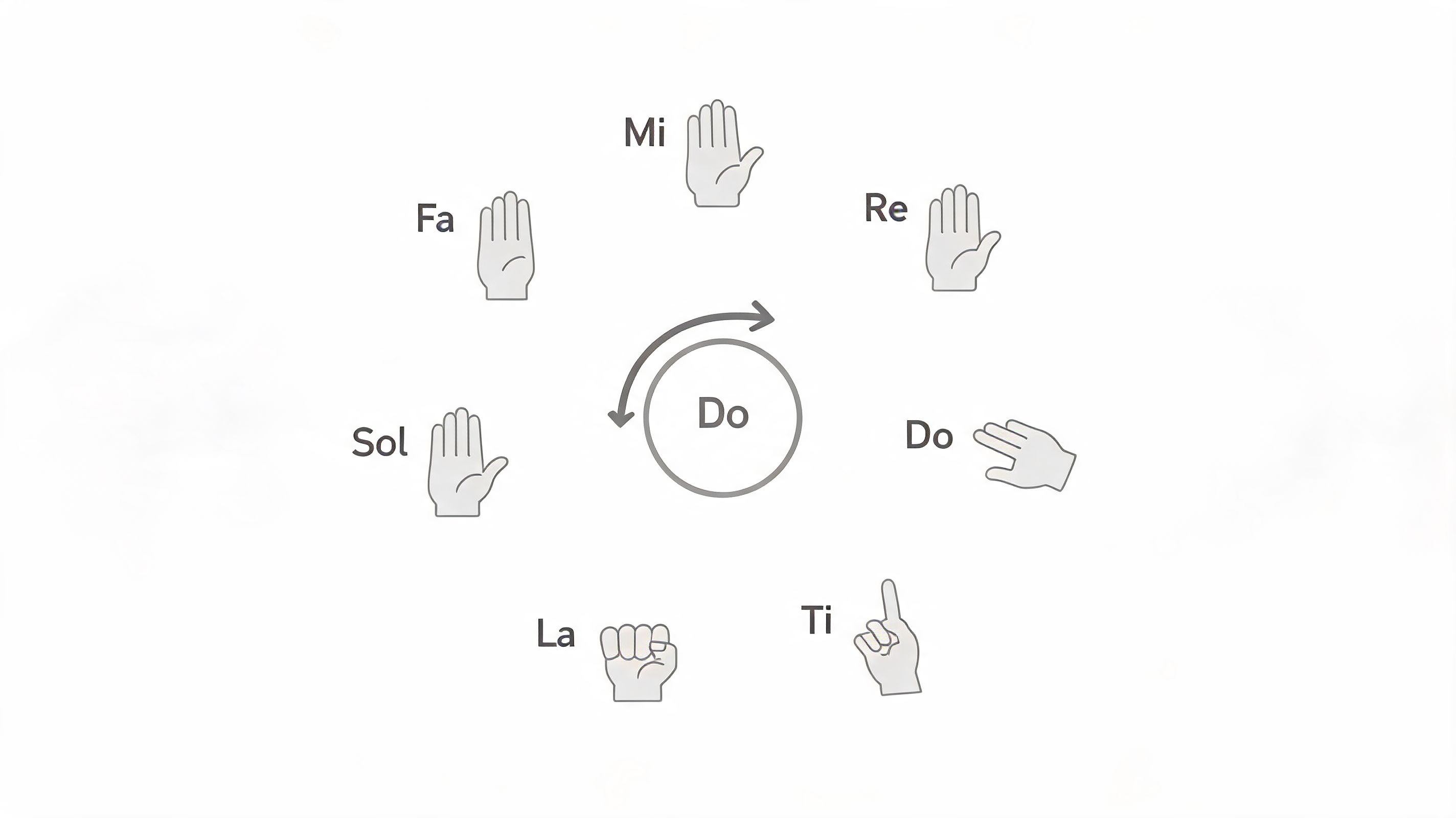
Movable Do works because it shifts your attention away from isolated note names and toward function. In C major, C is Do. In G major, G is Do. Your ear starts tracking how notes behave inside a key, which is exactly what you need if your larger goal is ear training and playing by ear.
That approach isn’t new or niche. The Kodály method drew inspiration from Curwen’s work, and the historical summary provided says Hungarian schoolchildren reached strong sight-singing accuracy on stepwise melodies after sustained training under that system by 1945, according to the cited Iowa State sight-singing chapter summary.
Hearing function instead of note labels
When singers get stuck, they often ask, “What note is this?” A better question is, “What is this note doing?” Is it resting like Do, leaning like Ti, or opening harmony like Sol?
That change makes sight singing exercises much more useful outside choir class. It helps guitarists hear chord tones, helps singers find their starting pitches faster, and helps improvisers stop treating melodies like random dots.
A practical routine:
- Sing one major scale daily: Use Do Re Mi through one comfortable key, then switch keys tomorrow.
- Add hand signs: Curwen’s system used hand signs for a reason. Physical motion helps lock in sound relationships.
- Pause on unstable notes: Hold Fa and Ti, then resolve them. You want to feel the pull, not just recite syllables.
Practical rule: If your solfège feels mechanical, slow down until each syllable has a sound and a role in your ear.
If you want a clearer sense of why this works, the difference between hearing relationships and memorizing fixed pitches is the same distinction explained in relative vs absolute pitch. For most musicians, relative hearing is the skill that enables musical freedom.
2. 2. Interval Recognition Drills: The Building Blocks of Sound
Every melody is built from distances between notes. If you can’t hear those distances, sight singing turns into educated guessing. If you can hear them, melodies start making sense almost immediately.
Short, daily drills beat occasional long practice. The provided Chorus America summary says consistent sight-singing practice of 10 to 15 minutes daily improved relative pitch recognition by 72% among auditioning singers in a 2023 study, using gradated exercises in simple meters and common melodic patterns.
What good interval work actually looks like
Start with intervals that feel stable and obvious. Unison, fourth, fifth, octave. Then add thirds and sixths. Save the trickier colors until the basic shapes are automatic.
Most players make one of two mistakes. They either practice one interval in blocks for too long, or they memorize song references without learning the actual sound. Song associations can help at first, but they shouldn’t become a crutch.
Use drills that force recognition in mixed order:
- Alternate direction: Sing intervals up and down. Descending intervals expose weak spots fast.
- Name and sing: Hear a pair of notes, identify the interval, then reproduce it with your voice.
- Connect sound to shape: Use tools like interval ear training practice to pair the audio with a visual pattern, then close your eyes and keep the sound.
Don’t aim to guess faster. Aim to hear more clearly.
In real playing, interval recognition shows up everywhere. A singer hears a leap and lands it cleanly. A guitarist hears a melody and finds it without hunting. A songwriter hears the top note move from the root to the third and already knows how that changes the emotional shape of the phrase.
3. 3. Scale Degree Singing: Hearing Where a Note ‘Lives’
A note means more when you hear its place in the key. G isn’t just G. In C major, it’s 5. In D major, it’s 4. That shift matters because your ear responds to role, not spelling alone.
Scale degree singing is one of the most practical sight singing exercises for musicians who want to play by ear. It teaches you where a melody sits against the harmony and where it’s likely to move next.
Train the pull of each note
Start with numbers if solfège feels unfamiliar. Sing 1 2 3 4 5 6 7 1, then come back down. After that, stop singing scales straight through and begin isolating common moves like 1 to 3, 5 to 6, or 7 to 1.
What works best is repetition with contrast. Sing the same degree pattern in several keys so your ear stops depending on one comfortable pitch range.
Try this simple progression in practice:
- First pass: Sing 1 3 5 3 1 in C major.
- Second pass: Move the same pattern to G major and then D major.
- Third pass: Hold 7 and resolve to 1, then hold 4 and resolve to 3.
That last step is where musical hearing starts to deepen. You’re no longer identifying notes as labels. You’re feeling tension and release.
The provided NATS summary links sight-singing proficiency to real outcomes. In its 2022 survey of 5,200 US collegiate singers, 82% of those who passed sight-singing tests secured choral scholarships, compared with 31% of those who failed under the survey’s criteria. That makes scale degree work more than an academic drill. It’s tied to auditions, placement, and confidence in the room.
For songwriters, this skill is just as useful. You start hearing that a hook lands hard because it leans on 5 and resolves to 3, or because the melody delays the arrival of 1 until the right moment.
4. 4. Melodic Dictation: Hearing It and Writing It Down
Melodic dictation is where ear training stops feeling theoretical. You hear a line, then prove to yourself that you understood it by singing it back, writing it down, or finding it on your instrument.
This is one of the best sight singing exercises for anyone who says, “I can sort of hear it, but I can’t grab it.” Dictation forces precision. You either heard the contour, rhythm, and tonal center, or you didn’t.
Keep the melody short and sing before you write
Start with very short phrases. Four notes is enough. Eight notes is plenty. If you jump straight into long phrases, you’ll train panic instead of hearing.
Use this order:
- Listen once for shape: Is the line mostly stepwise, or does it leap?
- Sing it back before writing: Your voice reveals what your ear caught.
- Write or play it after singing: This locks hearing to action.
A common trade-off shows up here. If you write too early, you start drawing symbols instead of hearing sound. If you wait too long, memory gets foggy. The sweet spot is quick, repeated contact with very short phrases.
The provided research summary on expert strategy use in sight-singing identified 82 techniques across seven domains, including attentional control, anticipation, audiation, body-based rhythm support, and automatic skills, with audiation and automaticity most closely linked to stronger performance in the study’s framework from Psychology of Music. Melodic dictation trains those exact habits because it forces you to hear ahead, prioritize what’s important, and internalize patterns quickly.
Sing first. Pencil second. Instrument third.
In real life, dictation helps producers capture vocal ideas before they disappear, helps guitarists learn riffs without tabs, and helps singers memorize parts faster because they understand what they’re hearing.
6. 6. Rhythm Reading and Clapping Drills: Feeling the Pulse
You sing the right notes, then the line still collapses by bar three. The problem is often rhythm, not pitch. Sight-singing only feels free when the pulse stays steady enough for the ear to think ahead.
That is why rhythm practice deserves its own lane. Clap it. Tap it on your leg. Count it out loud. Remove pitch long enough to find out whether the beat is stable or whether the voice has been covering for weak subdivision.
I use this with students constantly because rhythm errors hide well inside melodic work. A singer can fake a pitch correction in real time. A rushed entrance or a late subdivision usually exposes itself immediately, especially in ensemble settings.
Separate rhythm from pitch on purpose
Isolating rhythm is not a shortcut. It is a diagnostic tool. If the pulse wobbles during clapping, adding solfège will not fix it.
Keep the sequence simple and repeatable:
- Clap quarter-note and eighth-note patterns first: Stay relaxed and keep the beat physically consistent.
- Count subdivisions aloud: Use one counting system and stick with it long enough for it to become automatic.
- Add rests early: Many readers can handle attacks but lose time during silence.
- Introduce ties, syncopation, and triplets one at a time: Accuracy improves faster when each new pattern has a clear place in the routine.
- Sing on one pitch only after the rhythm is solid: This connects inner hearing to time without overloading attention.
The trade-off is straightforward. If you mix difficult pitch and difficult rhythm too soon, practice turns into survival mode. If you isolate rhythm for a few focused minutes first, your later sight-singing work gets cleaner and much less tense.
Body movement helps here too. Conducting the beat with one hand while clapping subdivisions with the other can sharpen internal time. Stepping the pulse works well for players and singers who understand rhythm physically before they understand it on the page.
Done daily, these drills build the practical bridge between hearing music in your head and performing it on command. That is why I treat rhythm reading as ear training, not just counting practice. You are training the body to hold time steady so the ear can stay free.
6. 6. Rhythm Reading and Clapping Drills: Feeling the Pulse
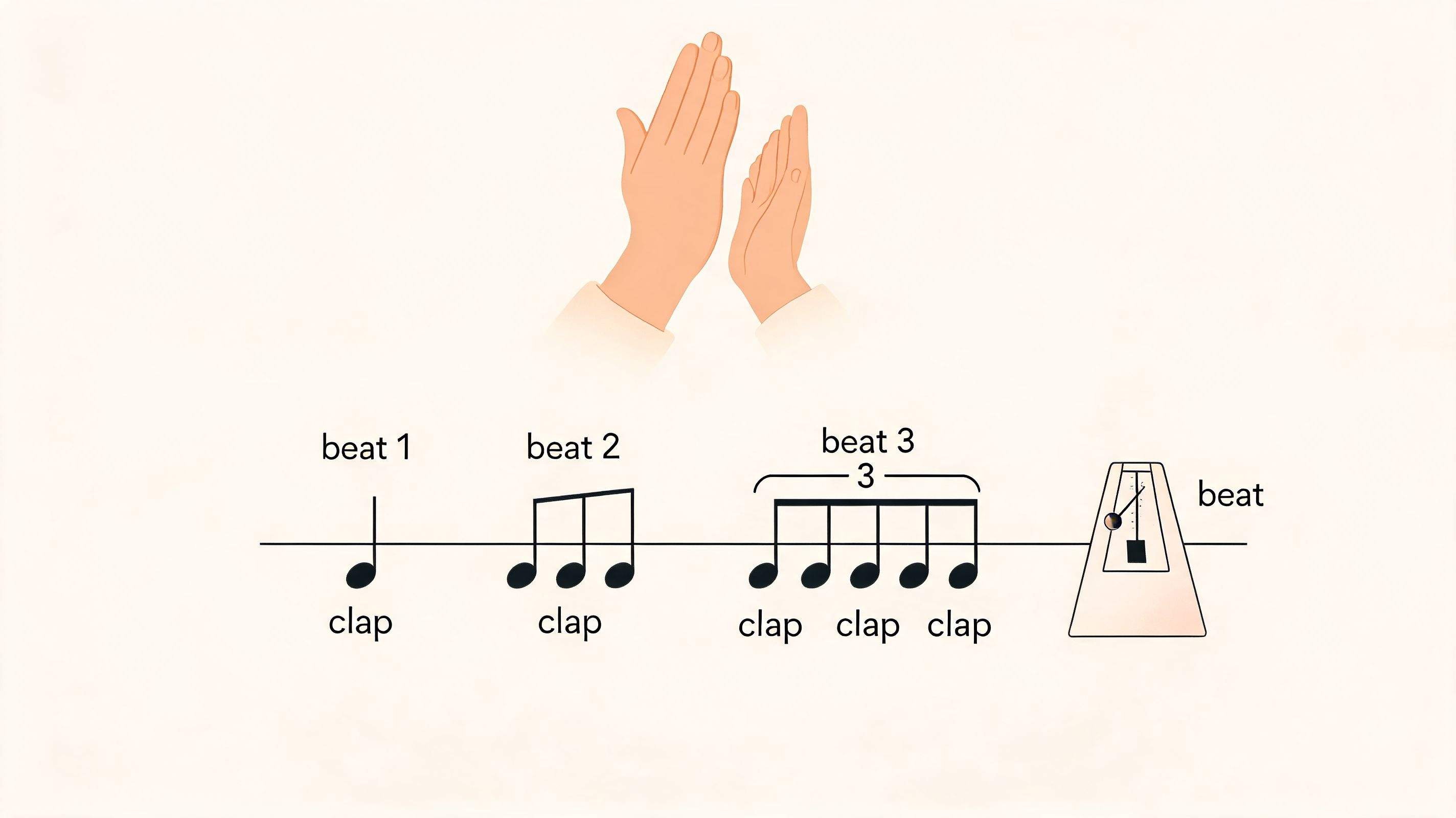
Pitch gets most of the attention, but rhythm is often the underlying reason a sight-singing attempt falls apart. A singer can know the notes and still derail the phrase by rushing, dragging, or misreading the subdivision.
That’s why I like isolating rhythm completely. Clap it. Tap it. Count it out loud. Strip pitch away until the pulse is stable.
Separate rhythm from pitch on purpose
This doesn’t make practice easier in a lazy way. It makes it honest. When pitch and rhythm are tangled together too early, many musicians hide one weakness inside the other.
A structured semester approach appears to help. The provided ACDA summary says choirs using structured sight-singing exercises improved ensemble pitch accuracy by 68% and reduced rehearsal time by 35% over a semester, with Level 1 to 2 materials built around basic note values and accessible melodic motion through the historical summary link.
Use a simple progression:
- Clap quarter and eighth-note patterns first: Keep your body relaxed and your pulse steady.
- Count subdivisions aloud: Use a system you can stick to consistently.
- Only then add pitch: Sing on one repeated note before returning to the written melody.
One warning: If you can’t clap it evenly, you probably can’t sing it accurately yet.
This pays off in ensembles fast. Rehearsals move quicker because singers aren’t burning energy solving rhythm and pitch at the same time. It also helps outside classical settings. Funk lines, syncopated pop vocals, and spoken rhythmic phrasing all depend on a reliable internal clock.
7. 7. Chord Quality Identification: Hearing the ‘Color’ of Chords
Chord quality is the emotional fingerprint of harmony. Major feels open. Minor feels darker. Diminished feels unstable. Augmented feels suspended and strange. Those aren’t perfect definitions, but they’re useful starting points.
If your goal is to play by ear, you need to hear these colors quickly. Not after trial and error on your instrument. In the moment.
Start with color, then add context
The best first step is contrast. Play major and minor back to back. Then major and diminished. Then minor and augmented. Wide contrast trains the ear faster than subtle comparison.
Don’t overcomplicate voicings at the beginning. Root-position triads are enough. Your ear needs a clear picture before it can handle more musical clutter.
A short daily sequence works well:
- Isolate one quality at a time: Spend a minute singing the chord tones of a major triad, then a minor triad.
- Arpeggiate before stacking: Hearing 1 3 5 or 1 b3 5 makes the quality easier to internalize.
- Test inside songs: Pause a track and decide whether the harmony sounds bright, dark, tense, or suspended before checking.
The hybrid angle matters here. The provided summary on integrating sight-singing with aural apps argues that musicians often struggle to bridge notation-based training and real-time listening, and it describes combined visual-aural training as improving transcription accuracy faster in the cited background summary through the referenced video link. In practice, that means singing arpeggios from notation, then immediately training your ear to recognize the same quality by sound alone.
For producers and songwriters, this skill shows up when choosing harmony by instinct. For guitarists, it shows up when hearing whether the next chord in a song is major or minor before your hand moves.
8. 8. Real-Time Application: Sight-Singing from Sheet Music
Now, all the separate drills earn their keep. Put a short melody in front of you that you haven’t practiced, find the tonic, check the rhythm, and sing it.
That moment feels exposing because it is. But it also gives the clearest feedback. If intervals, rhythm, scale degrees, and harmonic hearing are improving, you’ll feel it here before anyone else tells you.
Put the parts together under light pressure
Start below your ego level. Easy keys. Modest range. Simple rhythms. Success builds speed far better than constant struggle does.
A platform with endless variation helps because memorization can fake progress. The summary provided for SightReadingFactory describes a proprietary generation system that creates unique exercises and lets teachers customize parameters for rhythm, melody, ensemble format, difficulty, and other settings through NAfME’s description of the software research. That’s useful because authentic sight reading depends on seeing something new.
Before you sing, give yourself a brief process:
- Find home: Establish Do or scale degree 1 clearly.
- Scan for traps: Large leaps, repeated accidentals, rhythmic syncopation.
- Separate if needed: Clap once, then sing.
- Record the attempt: Listening back reveals whether you heard the phrase or survived it.
A good demonstration tool can help you practice this in context:

For beginners, the provided Iowa State summary reports that first exercises can be mastered successfully after a small number of focused sessions when learners follow a sequence like key identification, tonic establishment, and separating pitch from rhythm. That’s exactly why real-time reading gets easier once your process is stable.
Sight-Singing Exercises: 8-Point Comparison
| Exercise | Implementation Complexity 🔄 | Resource Requirements | Speed / Efficiency ⚡ | Expected Outcomes 📊 | Key Advantages ⭐ / Tips 💡 |
|---|---|---|---|---|---|
| 1. Movable Do (Solfège), Hearing Relationships | Moderate, learning syllables & hand signs | Low–moderate: daily practice, solfège charts, optional Trill app | Medium, noticeable gains in weeks with daily practice | Strong relative-pitch, easier transposition, improved harmonic function | Trains functional hearing; tip: use hand signs and start in simple keys. |
| 2. Interval Recognition Drills, Building Blocks | Low–moderate, systematic, repeatable drills | Low: audio examples, interval visualizer, 5–10 min/day | High, rapid transfer to transcription & improvisation | Instant interval ID, better pitch accuracy, chord recognition foundation | Directly practical; tip: start with perfect intervals and practice both directions. |
| 3. Scale Degree Singing, Hearing Function | Moderate, needs basic theory and tonal context | Low–moderate: scale charts, Trill scale visualizer, daily singing | Medium, solid intuition in weeks with consistent practice | Predict melodic motion, clearer chord-degree relationships | Strengthens tonal predictability; tip: sing numbers in varied keys. |
| 4. Melodic Dictation, Hear & Write | High, combines intervals, rhythm, memory | Moderate–high: notation tools, recorder, steady practice time | Low initially, slow to master but high long-term payoff | Play-by-ear ability, improved aural memory, transcription skill | Most direct to play-by-ear; tip: start short, listen once then transcribe. |
| 5. Harmonic Progression Recognition, Hear the Story | High, requires chord quality + function understanding | Moderate: chord charts, Trill chord visualizer, listening practice | Medium, practical for jamming once foundational skills solid | Predictable chord changes, improved improvisation & accompaniment | Essential for ensemble work; tip: learn common progressions in many keys. |
| 6. Rhythm Reading & Clapping Drills, Feel the Pulse | Low, isolated rhythmic focus, iterative practice | Low: metronome, scores, short daily sessions | High, quick improvements with focused practice | Stronger sight-reading, internal pulse, ensemble timing | Quick gains for sight-singing; tip: practice subdivisions aloud with a metronome. |
| 7. Chord Quality Identification, Hear Color | Moderate–high, triads → sevenths → extensions | Moderate: chord examples, Trill visualizer, varied listening | Medium, efficient once interval base is set | Rapid chord-type recognition, better arranging/songwriting | Clarifies harmonic color; tip: master triads before seventh/altered chords. |
| 8. Real-Time Application, Sight-Singing from Sheet | Very high, integrates all component skills | High: repertoire, regular ensemble practice, teacher or app feedback | Low initially, very efficient once integrated | Real-world sight-singing, musical independence, performance readiness | Ultimate practical test; tip: combine short daily app drills with live score practice. |
Your 10-Minute Daily Path to Musical Freedom
Sight-singing isn’t magic, and it isn’t reserved for “naturally gifted” musicians. It’s a repeatable ear training practice. The more often you connect notation, sound, and physical response, the less you guess.
That’s the part many musicians miss. They think sight singing exercises are only about passing theory classes or surviving choir auditions. But the deeper payoff is musical independence. You hear intervals faster. You recognize chord movement sooner. You learn songs without waiting for tabs, tutorials, or someone else to spoon-feed the answer.
That practical value shows up in formal settings too. The provided summary notes that UNESCO data from 2020 found 65% of music curricula in 45 countries include sight-singing milestones, which reflects how widely the skill is treated as a foundation of musical literacy in that summary. It also appears in audition settings, scholarship pathways, and professional ensemble expectations, as noted earlier.
Still, the true transformation unfolds in ordinary moments. You hear a melody and can sing it back. You look at a line and can audiate it before making a sound. You recognize when a progression is heading home. That’s what “play by ear” starts to feel like in daily musicianship.
If I had to simplify the routine, I’d do this:
- Two minutes of movable Do: Sing the scale and a few common patterns in one key.
- Two minutes of interval drills: Mix ascending and descending intervals.
- Two minutes of rhythm work: Clap a notated pattern before singing anything.
- Two minutes of chord hearing: Compare major, minor, and one other quality.
- Two minutes of live application: Sight-sing one short melody you haven’t seen before.
That’s enough. Ten focused minutes beats one long, scattered session every weekend.
The trade-off is patience. Progress doesn’t always feel dramatic day to day. Some days you’ll miss obvious intervals or lose the tonic halfway through a phrase. That’s normal. Ear training builds the same way physical technique does, through repeated, accurate reps.
An app-based system helps because it removes friction. You don’t have to invent drills, search for examples, or rely on motivation alone. You just show up, train your ear, and build the habit. Over time, abstract theory turns into instinctive hearing.
Stop asking yourself to guess better. Train yourself to hear better.
If you want a simple daily system for ear training, Trill: Ear Training Daily is built for exactly that. It helps musicians recognize intervals, chords, notes, and scales through short sessions designed for real listening skills, not theory for theory’s sake. If your goal is to play by ear, improve chord recognition, build toward perfect pitch, or stop relying on sheet music as a crutch, Trill gives you a practical way to train every day and turn hearing into instinct.