How to Improve Pitch Accuracy Singing: An Ear Training Guide
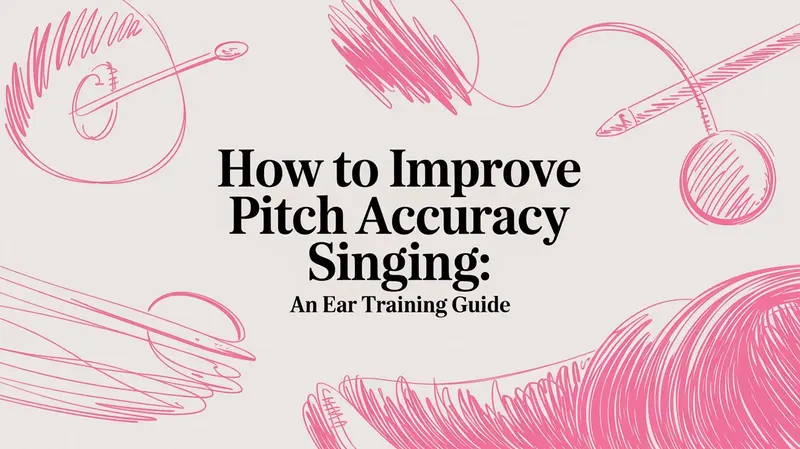
You sing a line, it feels fine, then you hear the recording back and wince. The notes drift. A few land under the pitch. Others sound like you reached for them instead of hearing them first.
That gap frustrates a lot of singers because it feels personal. People assume the voice is the problem. Often it isn’t.
If you’re trying to learn how to improve pitch accuracy singing, start with a simpler idea. Your voice can only follow what your ear can recognize. If the note isn’t clear in your mind, your body guesses. Sometimes it guesses well. Sometimes it doesn’t.
The good news is that this is trainable. Ear training isn’t just for people chasing perfect pitch. It’s for singers who want to stop guessing, match notes faster, hold harmony with confidence, and eventually play by ear with more freedom.
Table of Contents
- Why Pitch Accuracy Starts With Your Ear Not Your Voice
- The Foundational Skill Pitch Matching and Audiation
- Core Ear Training Drills to Sharpen Your Accuracy
- Use a Tuner for Unbiased Feedback and Progress
- Troubleshooting Common Pitch Problems
- Your 10-Minute Daily Habit for Lasting Results
Why Pitch Accuracy Starts With Your Ear Not Your Voice
Most singers try to fix pitch by pushing harder. They sing louder, tense the jaw, lift the chin, or repeat the same phrase until frustration kicks in. That usually makes the problem worse.
Pitch accuracy starts earlier than the vocal cords. It starts with hearing the note internally, then sending a clear instruction to the voice. If that internal target is fuzzy, the voice has nothing reliable to match.
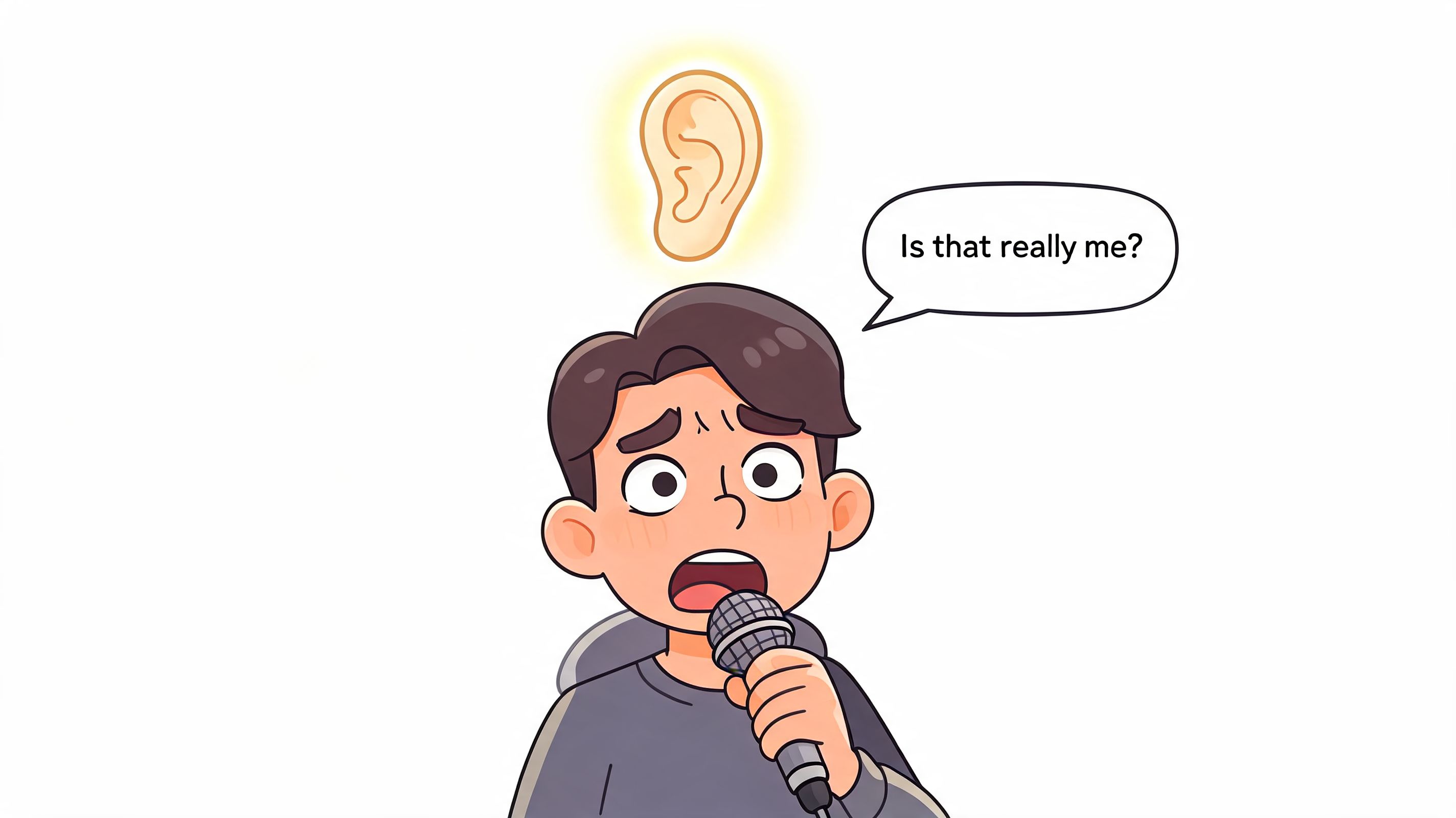
Your ear gives your voice a destination
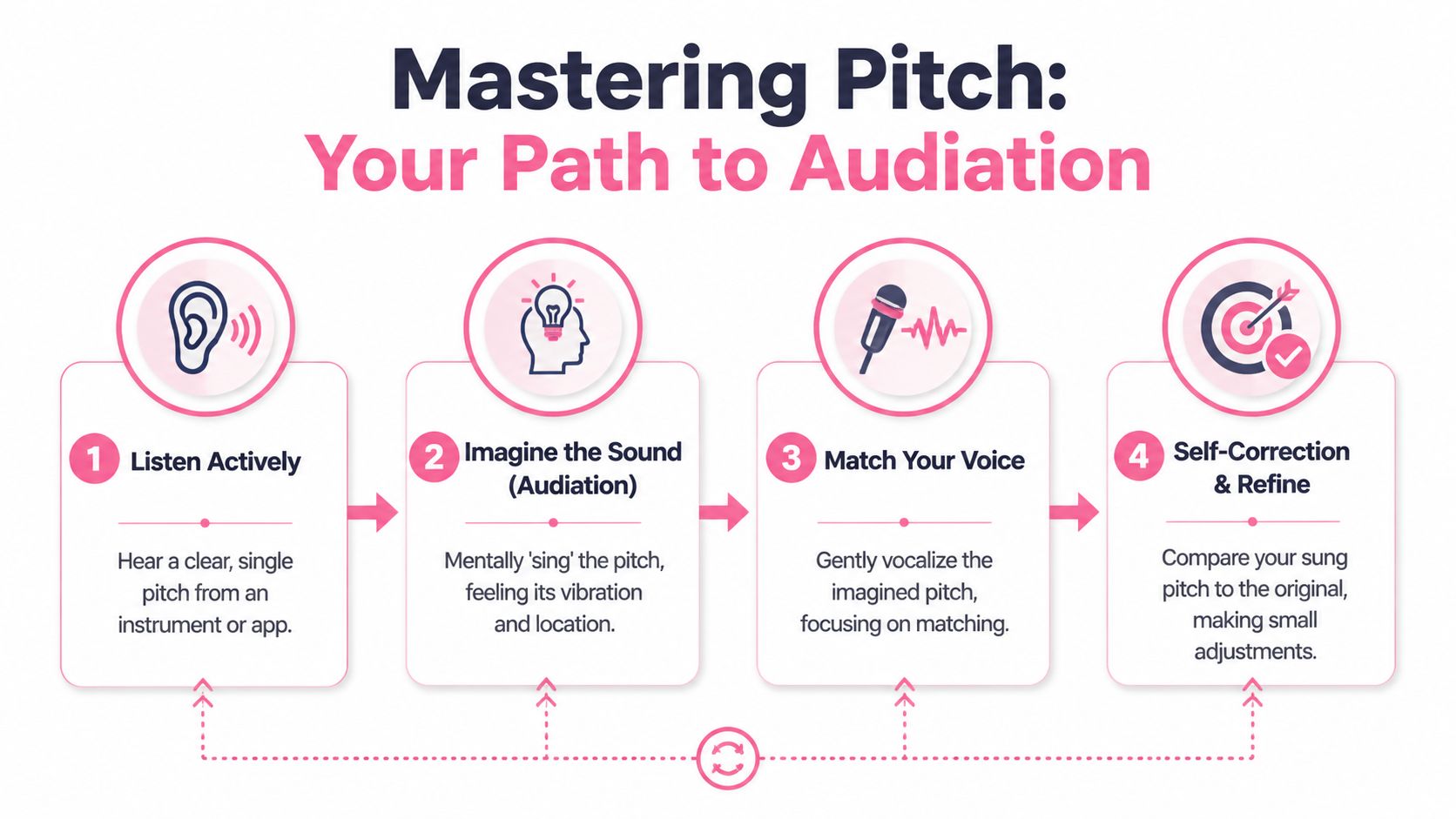
A lot of singers think singing in tune is a throat skill. In practice, it’s a brain ear voice loop. You hear a pitch, imagine it, attempt it, listen back, then adjust. The faster and cleaner that loop gets, the more accurate your singing becomes.
That internal hearing skill has a name: audiation. It means hearing music in your mind before you make sound. If you’ve ever mentally replayed a melody, you’ve already used it.
Practical rule: Don’t sing first and hope to find the note on the way up. Hear first, then sing.
This matters whether you’re trying to sing one note cleanly, lock into harmony, or build the kind of pitch awareness that supports relative pitch and absolute pitch training.
What actually improves
When singers train the ear before the voice, pitch usually settles down faster. One reason is that the brain stops treating every note like a fresh guess.
A structured example comes from VoSci’s Listen-Audiate-Sing approach. It emphasizes internal hearing before vocalization and has been reported to improve beginner pitch accuracy by 40 to 60%. In a 2023 pilot with 120 amateur singers, participants showed a 55% average improvement in pitch matching after 14 days of 10-minute daily sessions according to VoSci’s discussion of the Listen-Audiate-Sing protocol.
That’s the main reframe. If your singing feels inconsistent, don’t assume your voice is broken. Train the ear that guides it.
What doesn’t work well
A few common habits slow progress:
- Chasing notes physically: sliding around until something sounds close can help you locate a pitch once, but it doesn’t build reliable hearing.
- Practicing only songs: songs are useful, but they hide the weak link. If single-note matching is shaky, songs won’t fix it.
- Relying only on muscle memory: some singers can repeat familiar notes without really hearing them. That falls apart when the melody changes.
The fastest improvement usually comes from short drills that sharpen listening first. Then the vocal work has something precise to follow.
The Foundational Skill Pitch Matching and Audiation
If you want one drill that does the most work, start with matching a single note. Not a whole song. Not runs. Not a scale at full speed. One note, clearly heard, then clearly sung.
Here, singers learn to stop guessing.
The basic drill
Use a piano, keyboard, tuner app, or any tool that gives you one clean reference note.
-
Play one note Pick a comfortable pitch in the middle of your range.
-
Pause and mentally hear it Close your eyes if that helps. Replay the note in your mind before you sing.
-
Hum or sing it easily Use an easy sound like “mm,” “ng,” or “ah.” Keep the onset gentle.
-
Check the result Compare your note to the reference. If you were off, don’t judge it. Reset and try again.
Why this works
This drill builds the missing link between hearing and producing. You’re teaching your system that singing isn’t random. It’s a response to a sound you already know.
The strongest part of the drill is the silent hearing step. The Mental Audiation Protocol reports that 85% of vocalists can reach pitch accuracy within 5 cents after 4 weeks of daily practice, and data from ear training apps cited there indicates a 70% failure rate when singers skip audiation and try to sing immediately. That’s from Arabella Voice Studio’s summary of the Mental Audiation Protocol.
Hear the note in your mind long enough that singing it feels like recall, not discovery.
Make the drill easier, not harder
Beginners often sabotage this exercise by choosing notes that are too high, too low, or too exposed. Start where your voice feels ordinary.
A few practical adjustments help:
- Use short notes first: sustained notes reveal wobble. Short notes help you lock the center of pitch.
- Repeat the same note several times: don’t rush to new material.
- Keep the volume moderate: extra force usually pulls the pitch away from center.
If you miss the note, don’t slide dramatically toward it. Stop, hear it again, and take another clean attempt. That’s how you train the ear to lead.
Core Ear Training Drills to Sharpen Your Accuracy
Single-note matching is the base. After that, you need drills that teach your ear to recognize distance between notes, not just isolated targets. That’s what makes singing more musical and less mechanical.

One of the most useful findings here is range. A 2024 study in Music Perception found that singers trained across a wide one-octave range improved single-pitch accuracy from 45% to 72%, while narrower-range training didn’t produce the same meaningful result, as described in the Music Perception study on wide-range pitch matching. That matters because many singers stay in a tiny comfort zone and wonder why their pitch doesn’t generalize.
Drill one interval jumps
Pick two notes and alternate between them. Start with easy, familiar distances, then widen them over time.
- Unison to check center: sing the same note twice and make both land in the same place.
- Stepwise motion: move up and down by nearby notes so your ear starts tracking direction cleanly.
- Larger skips: practice jumps that feel less obvious. These expose whether you’re hearing the destination or just moving vaguely upward.
This is how singers start to hear intervals instead of just reacting to contour. That same skill supports harmony, improvisation, and learning to play by ear.
Drill two staccato five-note patterns
Short, detached notes are excellent for pitch work because they don’t let you smear from one note into the next. Each note has to land.
Use a simple five-note shape on a syllable like “mm-mma” or “da.” Keep it light and clean. Think of each pitch as a target, not a slide.
A related staccato five-note approach has been shown to reduce pitch variance by 40% in 21 days in the verified data provided for this article. The practical takeaway is straightforward. Short notes expose imprecision quickly, which makes them useful for correcting it.
Drill three arpeggios for chord hearing
Arpeggios matter because songs aren’t just made of single notes. They’re shaped by chords. When you sing root-third-fifth patterns, your ear starts to recognize the sound of stability, tension, and color inside harmony.
That helps in real music situations:
- Backing vocals: you hold your chord tone more confidently.
- Songwriting: you hear where melodies belong against chords.
- Improvisation: you stop wandering and start choosing notes that fit.
A quick demonstration helps more than a long explanation:

Rotate drills instead of grinding one thing
A short rotation keeps your ear alert:
| Drill | What it sharpens |
|---|---|
| Single-note matching | Pitch center |
| Interval jumps | Note-to-note distance |
| Staccato five-note scale | Fast pitch landing |
| Arpeggios | Chord awareness |
Variety matters because real singing isn’t one task. Your ear has to recognize notes, distances, and harmonic context in the same session.
Use a Tuner for Unbiased Feedback and Progress
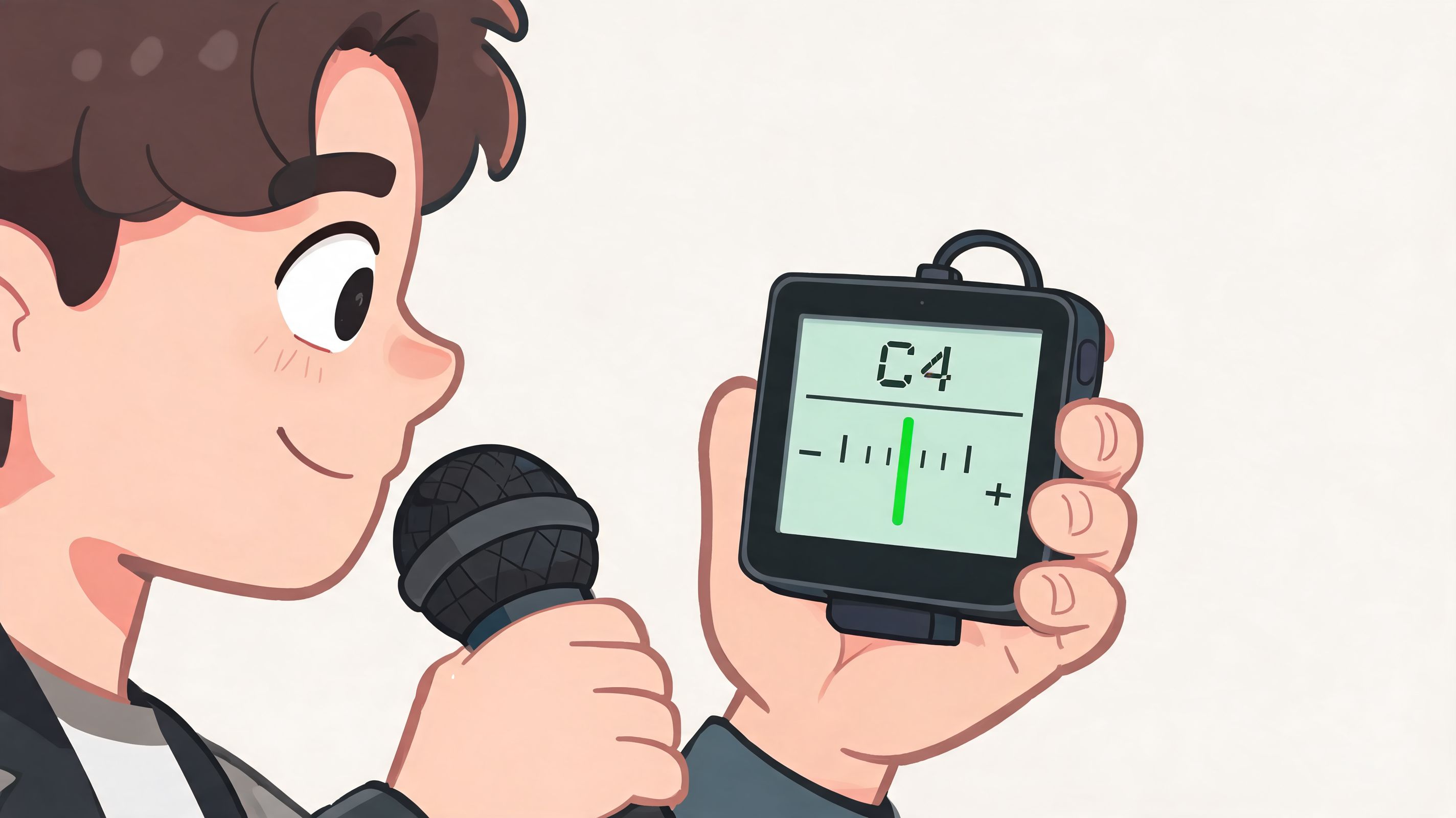
Your own ear is the skill you’re building. But while it’s still developing, you need outside feedback that doesn’t flatter you and doesn’t get tired. That’s what a tuner does.
A tuner won’t teach musicality on its own. It will show you whether the note landed where you thought it did. For beginners, that removes a huge amount of confusion.
What a tuner catches that you may miss
Many singers have habits they don’t notice in real time. Some start flat and drift up. Others attack sharp and then settle. Some sing the right note class but never center it.
A tuner makes those habits visible.
Use it for short checks, not constant obsession. Sing the note, look at the result, then sing again. Over time you start noticing patterns such as always undershooting leaps or going sharp when singing louder.
How to use one without becoming robotic
Treat the tuner like a mirror, not a judge. It gives information. You still need to listen.
A practical routine looks like this:
- Check single notes first: match one reference pitch and watch whether you land above or below it.
- Use it on held notes: notice whether your pitch stays stable or drifts.
- Test interval accuracy: sing one note, then jump to another and see if the landing is clean.
- Review tendencies: write down whether you usually go flat on high notes or sharp when you push volume.
For singers who want one place to practice, Trill’s tuner tool can be used alongside interval and ear training work so the feedback loop stays in one routine.
A tuner doesn’t replace listening. It confirms whether your listening is accurate.
The reason this matters is simple. If you only go by feeling, you can repeat the same mistake for weeks. Objective feedback speeds correction because it shows you the exact direction of the error.
Troubleshooting Common Pitch Problems
Pitch problems usually aren’t random. They tend to repeat in recognizable ways. If you know the pattern, you can fix the cause instead of getting frustrated at the symptom.
Going flat on high notes
This often happens when the singer reaches physically instead of hearing the note first. The body tightens, the breath gets heavy, and the pitch sits low.
Try this:
- Hear the note before you move: don’t launch upward blindly.
- Lighten the attack: high notes often respond better to less force, not more.
- Practice the note in short bursts: brief repetitions are easier to tune than long, dramatic holds.
If you’re consistently flat only at the top of your range, bring the exercise down and rebuild accuracy there first.
Going sharp when singing louder
Loud singing can trick you into overshooting. The pitch rises with the extra push, especially when the neck and jaw join in.
A simple fix is to sing the phrase at medium volume until the pitch is dependable. Then increase energy without increasing pressure. If the louder version goes sharp, you’ve learned something useful. The issue isn’t hearing alone. It’s coordination under intensity.
Most singers improve faster when they separate volume practice from pitch practice for a while.
Wavering on held notes
If the start of the note is fine but the pitch drifts, your internal target probably wasn’t stable enough, or you changed breath and shape during the sustain.
Use this reset:
- Match the note briefly.
- Hold it for a short count.
- Release.
- Repeat with the goal of keeping the center unchanged.
Short holds are better than long ones at first. Stability comes before endurance.
Sliding into every note
Some scooping is stylistic. Constant scooping is usually a sign that you don’t trust where the note is.
Practice with staccato entries and clean onsets. That forces your ear to commit to a pitch before the voice moves. If a phrase only works when you slide into it, the ear hasn’t learned the target yet.
Singing well with others but poorly alone
This usually means your ear can follow but hasn’t fully internalized. Group singing gives external support. Solo singing removes it.
The answer isn’t to avoid solo work. It’s to alternate between both. Sing with a reference, then echo it alone. That’s how support turns into independence.
Your 10-Minute Daily Habit for Lasting Results
Long practice sessions aren’t the main answer. Consistent ones are. Most singers get farther with focused daily work than with occasional marathon sessions that leave them tense and discouraged.
Ten minutes a day is enough to build the ear to voice connection, if those ten minutes are deliberate.
A short routine works because it keeps the nervous system fresh. You don’t need to fight your way through fatigue to improve pitch. You need frequent reps where listening stays sharp.
A sample week you can actually follow
Use this as a simple template. Keep each session short and specific.
| Day | Focus (10 Minutes) |
|---|---|
| Monday | Single-note pitch matching and audiation |
| Tuesday | Interval jumps between nearby and wider notes |
| Wednesday | Staccato five-note scales |
| Thursday | Arpeggios and chord-tone singing |
| Friday | Held notes with tuner feedback |
| Saturday | Sing along, then repeat phrases alone |
| Sunday | Light review of the weakest drill from the week |
Keep the habit friction-free
A good routine is one you don’t need to negotiate with every day.
A few ways to make that easier:
- Practice at the same time: attach it to coffee, commute prep, or another stable part of the day.
- Stop while you’re still focused: don’t drag a 10-minute session into 30 distracted minutes.
- Track one thing: note what improved or what kept missing.
If you want structure around short daily sessions, Trill’s daily ear training practice flow is built around that kind of repetition and habit consistency.
What lasting results actually feel like
They usually don’t arrive as one dramatic breakthrough. They show up as smaller signs.
You match notes faster. Harmony feels less stressful. You recover from mistakes sooner. You hear chord movement more clearly. You start to trust your ear enough to improvise, learn songs faster, and play by ear without freezing.
That freedom is the main goal. Better pitch is part of it, but the deeper win is that music starts sounding organized instead of mysterious.
If you want a structured way to build these skills every day, Trill: Ear Training Daily offers short ear training sessions focused on hearing notes, intervals, chords, and scales with real audio so you can stop guessing and start hearing music more clearly.