Ear Training for Musicians: How to Finally Play by Ear
You hear a song you love. The verse starts, the chorus hits, and your hands reach for your instrument almost automatically.
Then you stop.
You don’t know the chords. You don’t know the starting note. You open tabs, search YouTube, and hope someone else has already done the listening for you.
That stuck feeling is exactly why ear training for musicians matters. It’s the bridge between hearing music and playing it. Not guessing. Not hunting for charts. Hearing it, understanding it, and responding in real time.
The good news is that this skill isn’t reserved for people with perfect pitch or some mysterious natural gift. Your ear works more like a muscle. If you train it with short, focused reps, it gets stronger. If you ignore it, it stays uncertain.
Musicians have used systematic ear training for a very long time, but the goal has always been the same. Build a reliable connection between sound and action. When that connection gets stronger, you can play by ear, improvise with more confidence, and understand what music is doing while it’s happening.
A daily habit matters more than heroic effort. Ten focused minutes can do a lot when you repeat them often.
Table of Contents
- Introduction
- What Is Ear Training Really And Why It’s Not Magic
- Why Ear Training Unlocks Your Musical Freedom
- The Building Blocks of a Well-Trained Ear
- Your 10-Minute Daily Ear Training Plan
- Common Mistakes That Keep Musicians Guessing
- Start Hearing Music Today It’s Your Turn
Introduction
Most musicians don’t struggle because they lack effort. They struggle because they’ve never been shown how to connect what they hear to what they play.
That gap creates a strange kind of frustration. You may know scales, chords, and songs on paper, but when music happens live, your ear still feels one step behind. Someone changes key, adds a harmony, or plays a progression by feel, and you’re back to trial and error.
Ear training fixes that gap in a practical way. It teaches you to recognize sounds as musical ideas. A note stops being “some pitch.” It becomes the root, the third, the melody note, the tension, the resolution. Once you hear that clearly, your fingers and voice stop wandering.
Practical rule: Ear training isn’t about becoming impressive. It’s about becoming accurate.
If you’ve ever thought, “I’m just not one of those people who can play by ear,” that belief usually comes from a training problem, not a talent problem. A good system starts small, repeats often, and connects every exercise to real music.
What Is Ear Training Really And Why It’s Not Magic
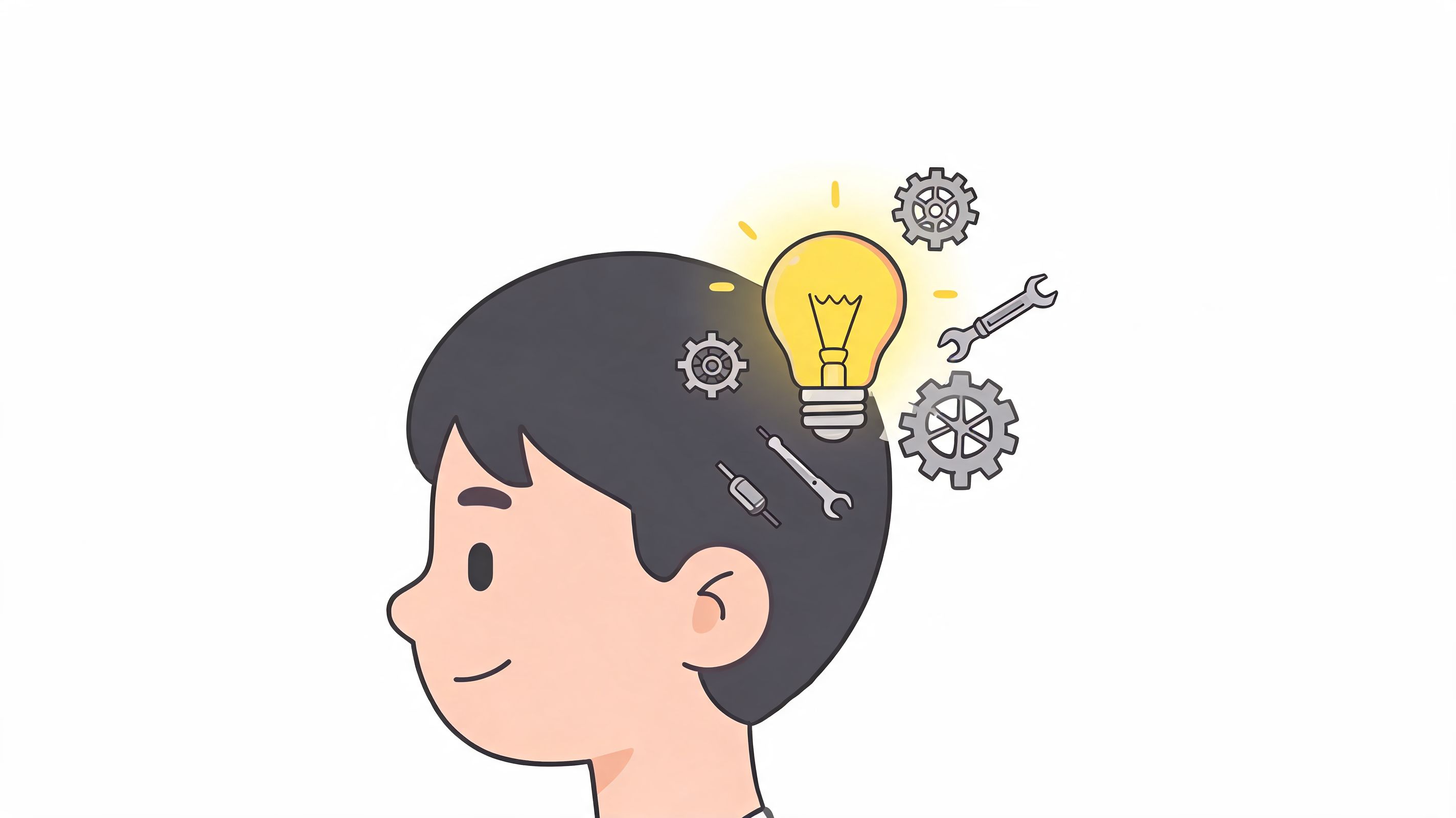
Ear training is the practice of learning what sounds mean.
That sounds obvious, but many musicians miss it. They think ear training is a weird side subject. Something academic. Something only conservatory students do. In reality, it’s one of the most practical skills you can build because it teaches you to hear structure inside the music you already love.
It’s sound recognition with meaning
Learning music is much like acquiring a spoken language. At first, the sounds you hear are merely noise. Eventually, your brain begins to group these sounds into meaningful patterns without any conscious effort. Music functions in the same manner. A trained ear stops hearing random notes and starts perceiving relationships.
That’s why old teaching systems mattered so much. A significant historical milestone in ear training goes back to the 11th century, when Guido d’Arezzo developed the Guidonian hand. His method helped singers connect hand positions to pitches and made sight-singing and ear training possible without notation, shaping music education for over 1,000 years, as described in this history of ear training and the Guidonian hand.
So ear training isn’t a modern hack. It’s a tested learning method.
Perfect pitch isn’t the point
A lot of confusion starts here. People hear “ear training” and assume it means naming any random note instantly, like a party trick. That’s one narrow skill. Most musicians don’t need that to become strong listeners.
What they need is relative pitch. That means hearing how notes relate to a tonal center, a chord, or a melody. That’s the skill that helps you find the key, hear chord movement, sing harmony, and play by ear in real situations. If you want a clearer breakdown, this guide on relative pitch vs perfect pitch in ear training explains the difference well.
The goal isn’t to guess isolated sounds. The goal is to hear context.
Consider this simple perspective:
- Untrained listening hears a chord and thinks, “I’m not sure.”
- Trained listening hears a chord and thinks, “That sounds stable, bright, and like home.”
- Skilled musical listening hears a chord and thinks, “That’s probably the tonic major chord in this key.”
That progression is trainable.
If the phrase “good ear” has ever felt mysterious, strip away the mystery. A good ear is just a collection of smaller habits built over time. You listen. You compare. You label. You repeat. Eventually, recognition feels natural.
Why Ear Training Unlocks Your Musical Freedom
Ear training matters because it changes what you can do in the room, not just what you know in theory.
A trained ear gives you options. You can join a jam without waiting for someone to spell out every chord. You can sing a harmony line instead of searching for it. You can hear a bass movement in your head and put it into your session instead of poking at notes until something fits.
For guitarists singers and producers
If you’re a guitarist, ear training loosens your dependence on tabs. You hear a progression and start testing likely chord functions instead of staring at six different versions online. Even when you don’t get it instantly, you know where to listen.
If you’re a singer, the payoff is even more immediate. You start noticing when you’re drifting sharp or flat. You hear where harmony should sit. You can match pitches faster because your ear gives your voice better instructions.
For producers and songwriters, ear training makes your ideas easier to capture. You stop treating the keyboard or piano roll like a guessing board. You hear movement, tension, and resolution more clearly, so the sound in your head reaches your DAW with less friction.
Here’s the practical point. Musical freedom doesn’t mean you never use charts or notation again. It means you’re no longer trapped without them.
Why the work pays off
There’s strong support for this kind of practice. A 2015 study in Psychology of Music found that intermediate pianists who practiced ear training for 20 minutes daily improved interval and chord recognition accuracy by 67% in six weeks, directly supporting better play-by-ear ability, according to this summary of the 2015 ear training study.
That matters because recognition changes behavior. When your ear identifies a sound faster, your hands make decisions faster. You’re not frozen between options.
A short demonstration helps make that real:

Some of the most valuable outcomes aren’t flashy. They’re small moments that add up:
- You recover faster: If you miss a note, you can hear how to correct it.
- You learn songs faster: You recognize common patterns instead of decoding every event from scratch.
- You improvise with less fear: Your ear starts leading, not your fingers.
- You collaborate better: You can follow what other musicians are doing in real time.
A trained ear doesn’t remove effort. It removes fog.
That’s why ear training for musicians feels so powerful once it clicks. It doesn’t just improve one niche skill. It makes all your other musical skills more usable.
The Building Blocks of a Well-Trained Ear
When people say they want “a better ear,” they often imagine one giant ability.
It’s not one giant ability. It’s a set of smaller listening skills that work together. Once you separate them, the whole process feels much less intimidating.
Intervals are distance
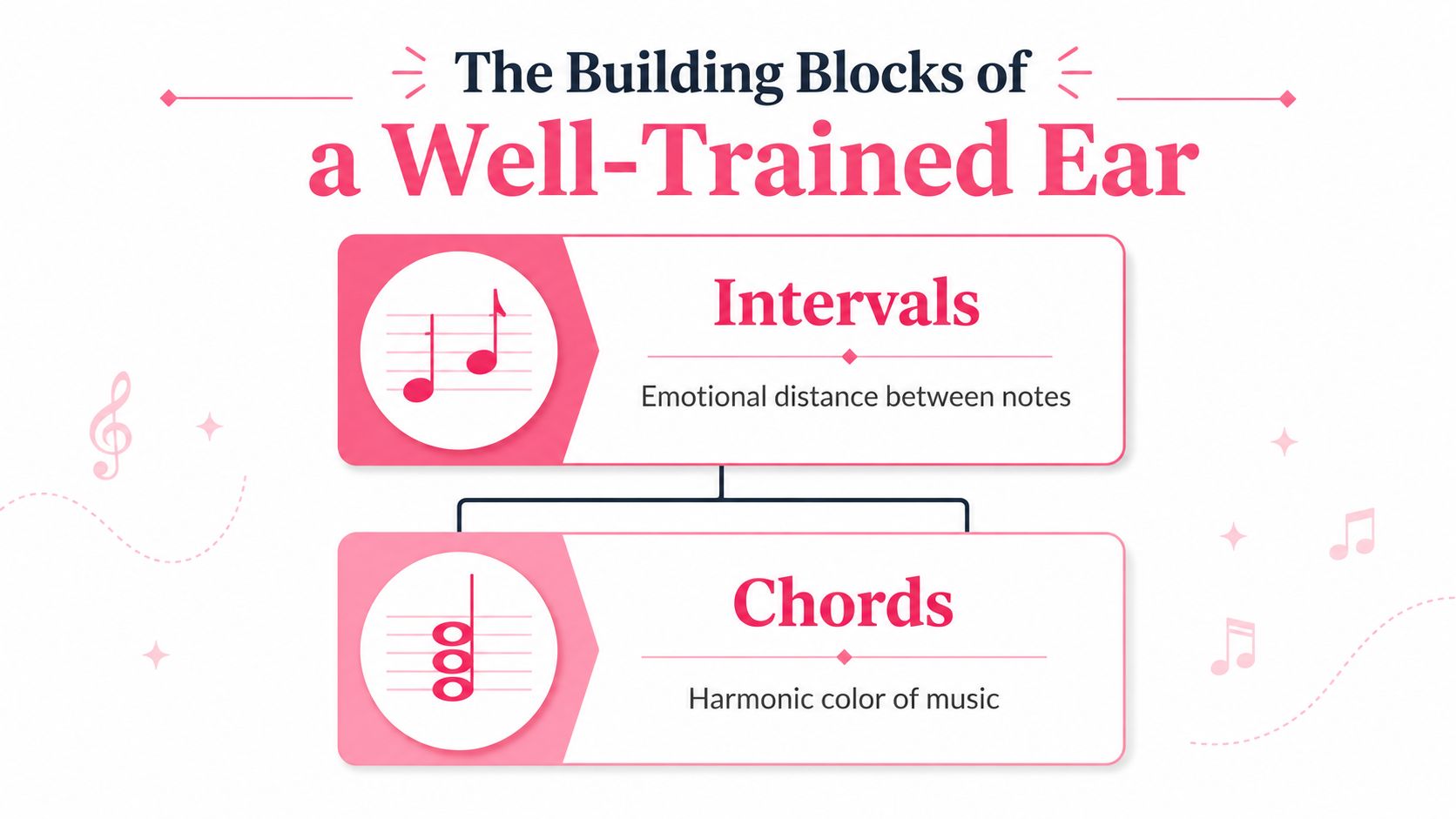
Intervals are the space between two notes. You can think of them as musical distance. Some feel tight and tense. Others feel open and settled.
You don’t need to start with every interval at once. Just get used to hearing that some note pairs feel close, while others feel wide. That alone starts building useful instincts.
If you want a simple starting point, this introduction to music theory intervals for ear training helps connect the concept to actual listening.
Chords are color
If intervals are distance, chords are color.
A major chord often feels brighter and more settled. A minor chord often feels darker or more reflective. A dominant chord tends to sound like it wants to go somewhere. You don’t need advanced theory language to hear those differences. You just need repeated exposure.
Try this at your instrument. Play a major chord, then a minor chord with the same root. Don’t ask, “Which one is correct?” Ask, “How does the emotional color change?” That question trains the ear better.
Melody is direction
Melody is what most musicians notice first because it’s the part people sing.
But hearing melody well means more than recognizing a tune. It means noticing whether a line rises, falls, repeats, or leans toward a note that feels like home. That directional hearing is what helps you pick out songs by ear.
A useful beginner exercise is call and response:
- Sing or play a short phrase.
- Pause.
- Repeat it exactly.
- Check whether your version rises and falls the same way.
Even a two or three note phrase is enough.
Rhythm is your internal clock
Rhythm is often ignored in ear training conversations, but it’s one of the reasons musicians sound secure or uncertain.
If pitch tells you what notes are happening, rhythm tells you when they matter. A player with strong pitch hearing but weak rhythm still sounds hesitant. A player with a solid internal pulse can lock in, copy grooves, and learn phrases more accurately.
Here’s a quick overview of the four building blocks:
| Building block | What you’re hearing | Real playing outcome |
|---|---|---|
| Intervals | The space between notes | Better note finding |
| Chords | Harmonic quality and function | Faster chord recognition |
| Melody | Shape and direction | Easier song learning |
| Rhythm | Pulse and pattern | Tighter timing and transcription |
Key idea: You don’t train “your ear” all at once. You train these parts until they start working together.
That’s when listening begins to feel musical instead of mechanical.
Your 10-Minute Daily Ear Training Plan
Most musicians fail at ear training for a boring reason. They make the plan too big.
If your routine requires perfect focus, a long block of free time, and endless motivation, you probably won’t keep doing it. A better approach is short daily work that targets one listening skill and one real-world application.
A simple plan you can actually follow
Functional ear training is especially useful here because it teaches you to hear notes in context. It emphasizes scale degrees inside a key, and it has been described as twice as effective for real-song transcription as isolated interval drills, with daily 10 to 15 minute sessions producing 70% to 80% identification accuracy in 8 weeks, according to this Berklee-based overview of functional ear training.
That’s why your practice should connect hearing to actual music.
Here’s a compact routine you can repeat.
| Level | Focus Skill (5 Mins) | Application (5 Mins) | Trill Module to Use |
|---|---|---|---|
| Beginner | Major vs. minor chord recognition with repeated listening | Pause a simple song and decide whether the chord sounds bright or dark before checking | Chord recognition |
| Intermediate | Hear common progression movement such as I IV V vi by function | Listen to a chorus and map where “home” feels stable and where it moves away | Progression and scale degree drills |
| Advanced | Melodic dictation and richer chord qualities | Transcribe a short phrase or identify the color of a chord change before playing it | Melody, chord, and interval exercises |
One useful option for building this as a habit is Trill: Ear Training Daily, which offers short ear training sessions, daily challenges, instant feedback, and tools such as a chord visualizer and interval visualizer. Used that way, it functions as a simple daily system rather than a one-off practice tool.
How to use the ten minutes well
The exact ten minutes matter less than the structure. Keep the first half focused on recognition. Keep the second half connected to real music.
A strong daily flow looks like this:
- Minute 1: Match your attention. Put on headphones, sit at your instrument, and remove distractions.
- Minutes 2 to 5: Do one narrow listening task only. Don’t mix intervals, rhythm, melody, and chords in the same short block.
- Minutes 6 to 10: Apply that one task to a song, progression, or short phrase you can sing or play.
Many musicians improve quickly in this context. Their progress occurs not because the drills are magical, but because the drill and the application point in the same direction.
If you’re new, start embarrassingly simple. Major or minor is enough. Up or down is enough. Same or different is enough. Those tiny decisions train accuracy.
If you’re more advanced, resist the urge to overcomplicate things. The goal is still recognition with confidence, not collecting harder exercises. A clean answer on a basic sound is better than a messy guess on an advanced one.
Sing what you hear, then play it. If you can’t sing it at all, you probably don’t hear it clearly yet.
That one habit changes everything because singing exposes blurry hearing. Your fingers can hide uncertainty. Your voice usually can’t.
Consistency is the engine. When you train every day, your brain keeps the sound fresh. When you wait for occasional long sessions, each practice block begins with relearning.
Common Mistakes That Keep Musicians Guessing
A lot of ear training frustration doesn’t come from lack of effort. It comes from practicing in ways that don’t transfer to real music.
When that happens, musicians start believing they’re bad at listening. Usually they’re just using a method that keeps them stuck.
Mistakes that slow progress
One common mistake is cramming. You practice for a long stretch once in a while, then do nothing for days. That feels productive in the moment, but ear training responds better to regular exposure.
Another mistake is drilling isolated sounds forever without hearing how they behave in songs. That’s a major reason pop and rock musicians get discouraged. A 2024 Juilliard study found that relative pitch training in melodic context improved transcription speed 250% faster than isolated drills, as reported in this discussion of ear training for real-world musicians.
A third mistake is obsessing over perfect pitch. Many players assume they’re behind because they can’t name random notes instantly. In practice, most of the musical wins they want come from stronger relative pitch.
Here are the patterns that usually keep people guessing:
- Too much theory, not enough sound: You understand labels but don’t recognize them by ear.
- Too much isolation: You train intervals or chords with no key center, then wonder why songs still feel confusing.
- No real-music application: You finish exercises but never test them on recordings, melodies, or progressions you care about.
- Starting too hard: You jump to advanced chord qualities before you can hear stable basics reliably.
Simple fixes that work better
The fix for inconsistency is small daily practice. Not more ambition. Less. Make the habit so easy you can repeat it without a debate.
The fix for isolated drilling is context. Hear the note against a tonic. Hear the chord inside a progression. Hear the melody against harmony. Context gives sound meaning.
The fix for perfect pitch anxiety is to stop treating it like the goal. Most musicians who want to play by ear need to recognize relationships. Home versus away. Tension versus release. Bright versus dark. Rising versus falling.
Try these swaps:
| Instead of this | Do this |
|---|---|
| Random interval quiz only | Hear notes against a clear tonal center |
| Long weekend practice session | Short daily repetition |
| Memorizing labels silently | Sing, then check |
| Learning exercises only | Apply the same skill to a real song |
If your ear training never reaches actual music, it stays an exercise instead of becoming a skill.
This is especially important for guitarists, songwriters, and producers. Many traditional materials were built for classroom drills, not for the actual moment when you want to lift a chorus, catch a bassline, or follow a chord change without tabs.
A better method feels less impressive at first because it starts smaller. But it works better because it connects listening to the situations you care about.
Start Hearing Music Today It’s Your Turn
You don’t need a special gift to build a strong ear. You need repetition, attention, and a process simple enough to repeat tomorrow.
That’s the big shift. Stop treating ear training like a mysterious talent test. Treat it like daily physical training for your hearing. Small reps. Clear targets. Real musical application.
If you stay with that approach, the changes show up in ordinary moments first. You hear when a chord turns darker. You catch the direction of a melody. You find notes faster. You stop relying on lucky guesses.
That’s how musicians learn to play by ear. Not all at once. Not through magic. Through steady listening that becomes instinct.
Start with ten minutes. Keep it daily. Train what you hear, then use it in real music.
If you want a simple way to make that habit stick, Trill: Ear Training Daily offers short structured ear training sessions built around chords, intervals, notes, and scales so you can practice consistently and spend less time guessing at your instrument.