Chord Progression Exercises Guitar: 7 Ear Training Drills
Someone calls a song at jam night. The band kicks in, there’s no chart on the stand, and the rhythm player is already sliding into the fourth chord before the singer finishes the first line. Nobody handed them the progression. They heard it.
That’s the whole skill in one moment, and it’s trainable. A peer-reviewed study found that some adults can develop genuine absolute pitch, often called perfect pitch, through structured listening practice, with the improvement still measurable four months later (the pitch-training study). Six adults, three protocols, four days a week. Nothing mystical about it.
Guitarists make up 29% of Trill’s musicians, more than any other single instrument, and 78% of about 60,000 musicians in Trill’s 2026 onboarding survey said focus, consistency, structure or time is what blocks their progress.
So this isn’t a theory list. These are seven chord progression exercises guitar players can run in ten minutes a day, graded easy to hard, each tied to a sound you already hear on records. The goal is to hear music, not guess it.
Table of Contents
- 1. Can You Hear the Three-Chord Trick in Your Favorite Songs?
- 2. Why Does This Four-Chord Loop Sound Familiar Everywhere?
- 3. Could You Name the Blues Changes Without Looking?
- 4. Does Minor Sound Sad or Just Different?
- 5. Can You Hear the Moment a Song Turns Major or Minor?
- 6. Why Do Jazz Players Hear a Hidden Pattern Everywhere?
- 7. Can You Feel the Difference Between Two Cadences?
- How the seven chord progression drills compare
- Turn the Seven Drills Into Your Daily 10-Minute Set
1. Can You Hear the Three-Chord Trick in Your Favorite Songs?
Play C, F and G on your guitar and you’ve just played the engine behind most of the music you love. In C major those are the tonic, subdominant and dominant, and the harmonic function underneath them stays identical in every key. Roman numerals describe the relationship, not the pitch, which is why I–IV–V in G feels like the same idea as I–IV–V in C.
That’s why this is drill one. Country, folk, blues and a huge slice of classic rock live on these three chords. Once your ear locks onto them, the changes to thousands of songs stop being a mystery.
Here’s the framework on paper next to the instrument that plays it.
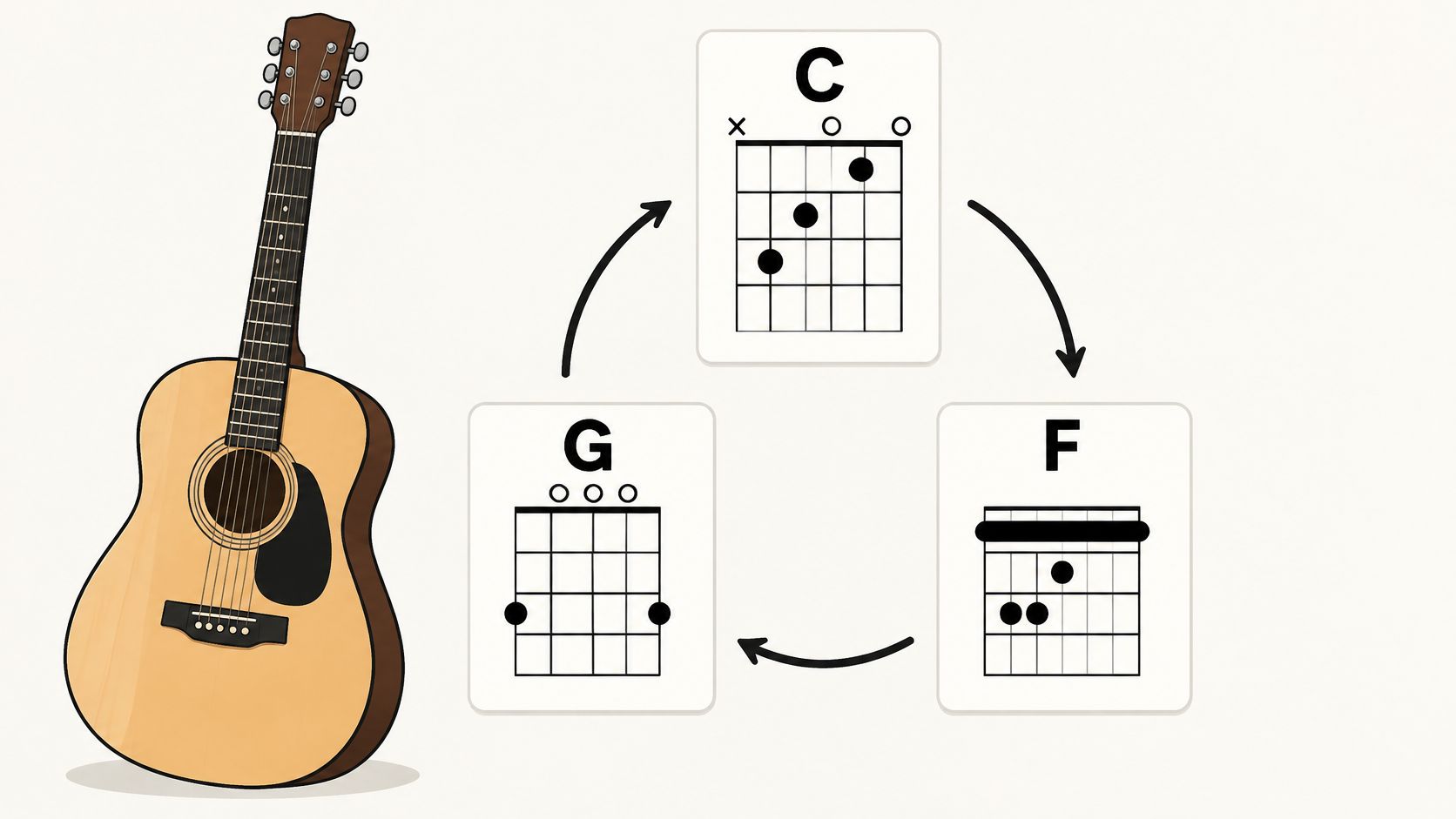
The drill, in three passes
- Pass one, listen (2 minutes): Loop C, F, G, C slowly. Don’t watch your fretting hand. Hum the root of each chord as it lands.
- Pass two, predict (4 minutes): Hear one chord, then sing what you think comes next before you play it.
- Pass three, move it (4 minutes): Repeat the loop in G and D. Same sound, new shapes, which is the entire point of functional hearing.
Sing the root out loud before you name the chord. Naming first turns the drill into a memory test, and memory tests don’t build hearing.
Practical rule: if you can’t hum the root, you didn’t hear the chord. Go back a step, not forward.
Ten minutes a day of this and the pull toward V starts to feel obvious. That pull is what lets you land on the right chord in a song you’ve never played.
2. Why Does This Four-Chord Loop Sound Familiar Everywhere?
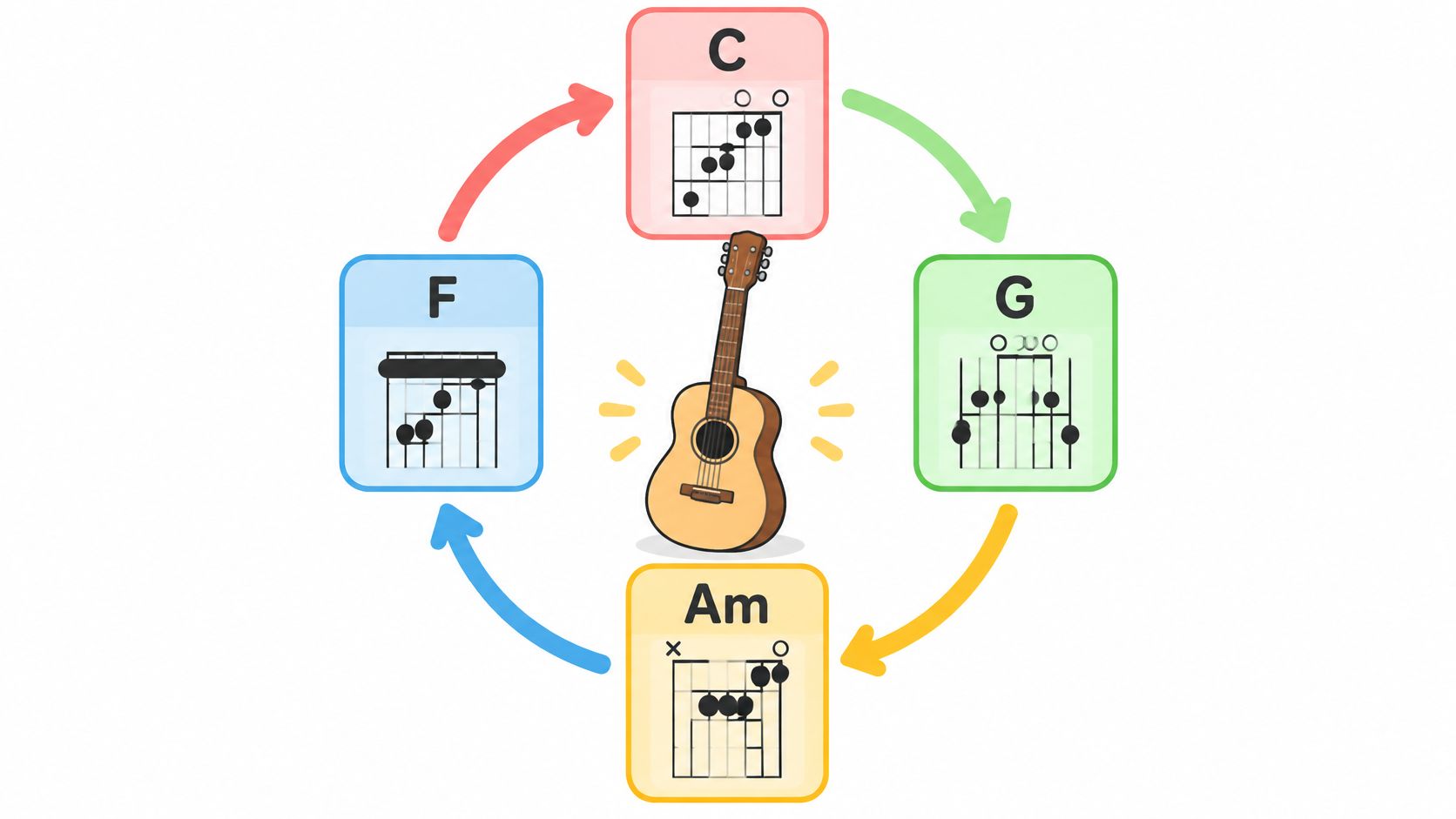
C, G, Am, F. Strum the loop and you may recognize its sound from pop songs, even if you cannot name the chords yet. It is I–V–vi–IV, a progression used in many pop arrangements. Change the key or capo position, and the chord shapes move while the pattern stays the same.
For guitarists, the useful skill is hearing what each chord does, not just memorizing the fretting shapes. A study comparing sound-producing practice, muted practice, listening and sight-reading suggests that practicing with sound may build a stronger link between a chord shape and what it sounds like than silent practice alone (the auditory feedback study).
Listen for the drop
In C, the vi chord is Am. Hear how the loop shifts from G into Am, then moves to F before returning to C. That change can sound darker, but the effect depends on the melody and arrangement. Practice the loop for 10 minutes, with each round adding a listening task:
- Round one, easy: Strum C, G, Am, F slowly. Hum along without naming the chords.
- Round two, medium: Pause on each chord and describe its sound. Listen for the move from G to Am.
- Round three, harder: Hear the loop without looking at your hand. Name the Roman numerals, then check by playing.
For more examples of how this pattern appears in songs, explore this guide to pop song chord progressions. Then put the page away and try to identify the progression by ear. That’s the skill that helps you follow changes when another musician calls a song and starts playing.
3. Could You Name the Blues Changes Without Looking?
The 12-bar blues is the most forgiving structure in guitar playing and the most punishing if you can’t hear it coming. Twelve bars, three chords, one predictable path. When you feel bar nine approaching without counting under your breath, you can sit in with players you’ve never met.
Here’s the form played straight so your ear can catch the turnarounds.

Why rotating beats repeating
A controlled study of advanced musicians had them practice excerpts either in blocked 12-minute segments or in interleaved three-minute rotations, with total practice time held constant (the interleaved practice study). The interleaved group had to rebuild each excerpt after their attention moved elsewhere, which is exactly what a jam demands.
So don’t play the blues forty times in a row. Rotate it with two other progressions in short cycles and give each cycle a different job.
- Cycle one: Strum the form while tapping the bar count on your knee.
- Cycle two: Identify the bass movement by ear, no strumming.
- Cycle three: Play it in a second position or voicing.
Rotation is the drill. Three minutes on each of three progressions teaches more than twelve minutes on one.
Keep a metronome running while you count. Steady time hides nothing and forgives nothing, which is why it works.
4. Does Minor Sound Sad or Just Different?
Play Am, F, C and G and the room changes color. That’s i–VI–III–VII in A minor, the loop behind more film cues and rock ballads than you’d guess. Minor isn’t automatically sad. It’s heavier and more closed, and it makes the next major chord feel like a window opening.
Most beginner material never gets you to hear that. A music college’s guidance on practice routines shows the standard pattern: recommended exercises isolate changes like D–Em, four beats per chord, tempo climbing from roughly 60 BPM, plus advice on keeping the strumming hand steady. All of it useful. None of it asks whether you can identify the progression by sound.
That gap is where this drill lives.
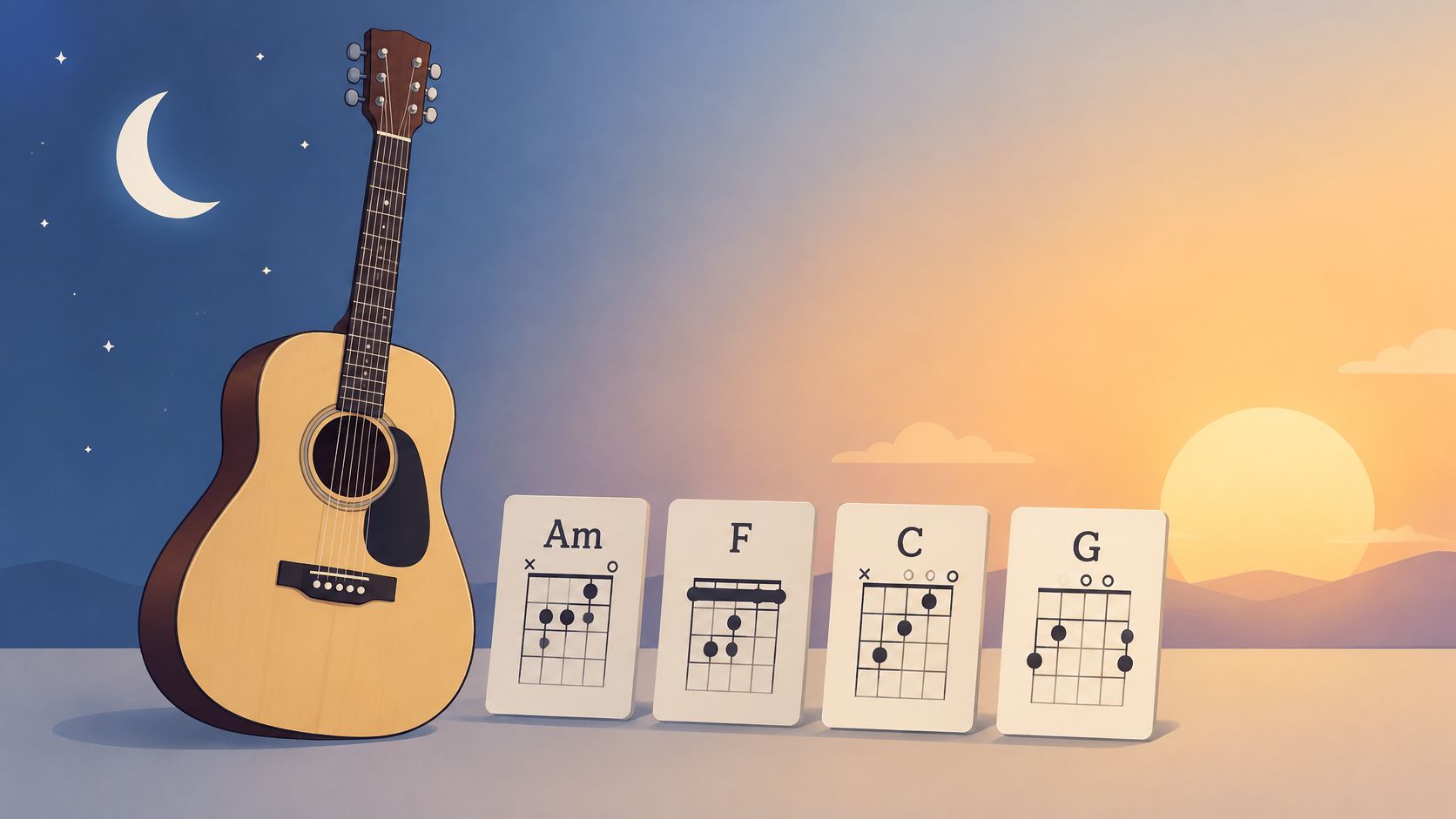
Hear the weight before the name
- Round one (3 minutes): Loop the four chords and give each one a single word as it lands. Heavy, open, bright, tense. No chord names.
- Round two (4 minutes): Same loop, name the Roman numerals from sound only, checking after each answer.
- Round three (3 minutes): Play the same progression in the relative major and hear what changed.
Compare major and minor versions of the same chord in a walkthrough of major and minor chords, then close the tab and test by ear the next day.
Track minor-key recognition separately from major. Most players are noticeably better in major and never notice, because they never split the score.
5. Can You Hear the Moment a Song Turns Major or Minor?
Same root, same bass note, different quality. D then Dm. A then Am. Gospel and soul use that flip to lift a chorus, and pop writers use it to turn a verse dark without changing key or tempo.
Hearing one chord change its character is a core piece of chord recognition, and it’s the drill with the fastest feedback loop on this list.
A University of Chicago study trained adults to identify piano notes by ear across three blocks of 60, 180 judgments in total, with immediate feedback after every answer (the note-identification training). Most of the improvement was still there months later. The structure did the work: hear, commit, get corrected, go again.
Set it up in three minutes
- Play a root note on the low E string, then a major chord above it. Name the quality before you look at your hand.
- Alternate slowly and keep the rounds short, around three minutes, because ear fatigue flattens your accuracy fast.
- Answer out loud. Silent guessing lets you hedge, and hedging hides the error you need to hear.
Name it before you play it. Every time.
The point isn’t to be right on instinct. It’s to notice the moment your ear tells you something before your hand confirms it, because that’s the moment playing by ear becomes possible.
6. Why Do Jazz Players Hear a Hidden Pattern Everywhere?
A bass line walks from D to G, then settles on C. Add Dm7, G7 and Cmaj7, and you hear a ii–V–I: the fifth chord builds tension, then the tonic releases it. Jazz standards use this move in bridges and endings. R&B and soul use it too. Recognizing the sound helps you follow a song by ear and join a bandmate on an unfamiliar tune.
The pull is the point
Start with the G7. Its third and seventh create a pull toward Cmaj7. Listen for those notes resolving, rather than trying to name every chord at once.
- Hear it in three keys: Try C, F and B-flat. Keep the progression slow enough to catch the resolution.
- Focus on the guide tones: Sing the third and seventh of G7, then hear how each moves into Cmaj7.
- Predict the landing: Pause before the final chord and sing the note you expect to hear. Then play the progression and check.
Hearing harmonic pull, like recognizing pitches, improves through many short listening trials with correction. A focused 10-minute daily drill gives you repeated chances to hear the tension, make a call and check the result. Start with a slow ii–V–I, then raise the tempo as your predictions get more reliable. That practice helps when another musician calls a progression and you need to hear where it is going.
For more examples of the progression in real music, explore this guide to jazz chord progressions. The chord shapes show you what to play. Listening for the pull helps you play it by ear.
7. Can You Feel the Difference Between Two Cadences?
V–I lands like a full stop. IV–I, the Amen cadence, settles like a door closing softly. Hymns end plagal. Most pop and rock phrases end authentic.
Tell those two apart by ear and you can predict where a song is heading before it gets there. That’s the difference between following a tune and hoping.
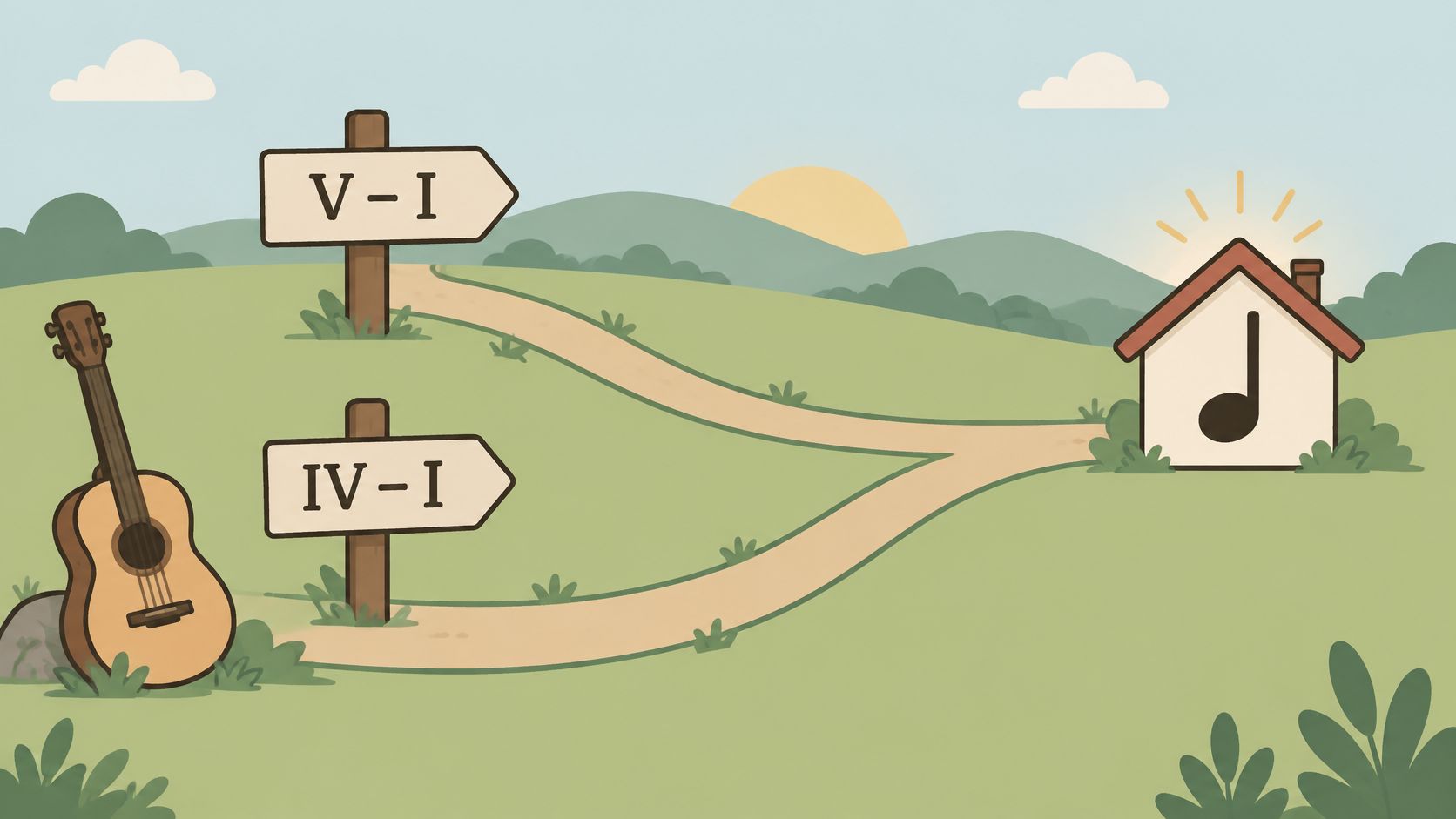
Space the reps out
Twenty-nine musicians learned a nine-note piano sequence in sessions separated by 5 minutes, 6 hours or 24 hours. Significant accuracy gains in the second session showed up only in the 24-hour group, and later speed gains appeared at the 6-hour and 24-hour intervals (the spacing study). Spacing your reps across days does work a single long session can’t.
- Play V–I, then IV–I, back to back, and pick which felt more final.
- Sing the last note of each cadence to lock the sound into your voice.
- Test tomorrow, not in ten minutes. Delayed recall is the honest measure.
What to track: first-attempt accuracy after a night’s sleep, not your best run in one sitting.
A player who nails both cadences by ear starts hearing song endings coming three bars early. That’s musical freedom, and it’s built in minutes, not years.
How the seven chord progression drills compare
| Item | Progression (in C) | Difficulty | Best for |
|---|---|---|---|
| Can You Hear the Three-Chord Trick in Your Favorite Songs? | C–F–G (I–IV–V) | Beginner | Learning core chords by ear |
| Why Does This Four-Chord Loop Sound Familiar Everywhere? | C–G–Am–F (I–V–vi–IV) | Beginner | Pop songwriting and playing along |
| Could You Name the Blues Changes Without Looking? | 12-bar blues: C7–F7–G7 (I–IV–V) | Intermediate | Blues jamming and tracking form |
| Does Minor Sound Sad or Just Different? | Cm–Ab–Eb–Bb (i–VI–III–VII) | Intermediate | Recognizing minor-key mood |
| Can You Hear the Moment a Song Turns Major or Minor? | No fixed progression; compare major and minor chords on the same root | Beginner to intermediate | Hearing chord-quality changes |
| Why Do Jazz Players Hear a Hidden Pattern Everywhere? | Dm7–G7–Cmaj7 (ii–V–I) | Advanced | Jazz harmony and improvisation |
| Can You Feel the Difference Between Two Cadences? | G–C (V–I); F–C (IV–I) | Beginner to intermediate | Hearing phrase endings and resolution |
Turn the Seven Drills Into Your Daily 10-Minute Set
A chord change can feel familiar before you can name it. Use that moment as your cue to listen, identify the progression, then find it on the guitar.
Choose three drills for the week: one easy, one medium, and one hard. Start with the three-chord trick, move to a major-minor comparison, then tackle the ii–V–I or a cadence. Keep the order steady and fit all three into ten minutes.
Try this split: spend two minutes recalling yesterday’s progression without prompts. Use four minutes to identify and play it in two or three keys. Spend two minutes playing it with a song-like rhythm, then use the final two minutes to test your recall after a pause.
Track first-attempt accuracy, not your longest streak of correct answers. Repeating a pattern fluently in one sitting can make it feel learned before it sticks. When you can name the progression before reaching for the guitar, raise the difficulty with sevenths, inversions, or a faster tempo.
There is a trade-off between speed and recognition. Fast chord changes help in a jam, but they do not tell you what you are hearing when the chart disappears. Learn to hear the changes first, then build the speed to play them comfortably with other musicians.
Keep the practice short enough to repeat tomorrow. Trill: Ear Training Daily is designed for 10-minute daily ear training, with focused exercises and instant feedback. Its progress dashboard tracks accuracy and response speed session by session. Open Trill: Ear Training Daily and start with a ten-minute session today.