7 Guitar Ear Training Exercises That Build a Real Ear
7 Guitar Ear Training Exercises That Build a Real Ear
What would change at the next jam if you could hear a song and know the chords before anyone called them out? Most guitarists treat that moment like a gift. It is not. Ear training is a trainable skill, the same way fretting and strumming are. You do not need perfect pitch to play by ear. You need a short daily habit that teaches you to hear the music instead of guessing it.
These seven guitar ear training exercises move from the gap between two notes to full chord progressions. Each one fits in about 10 minutes a day. Guitar rewards the player who hears first and finds the shape second, because the same pitch lives in several places on the fretboard. Tabs hide that choice. A trained ear makes it.
Start with intervals, then scale degrees, chord color, progressions, copied melodies, bass roots, and tuning. Ten focused minutes beat a rare two-hour quiz night.
Table of Contents
- 1. Interval Recognition and the Gap Between Two Notes
- 2. Singing Scale Degrees Before You Play
- 3. Chord Quality Recognition for Happy, Sad, or Tense Sounds
- 4. Chord Progression Recognition and the Story Behind the Song
- 5. Melody Copying Without the Chart
- 6. Bass Note and Root Detection
- 7. Pitch Matching and Tuning by Ear
- 7 Guitar Ear Training Exercises at a Glance
- Build Your Daily Ear Training Habit and Play by Ear With Confidence
1. Interval Recognition and the Gap Between Two Notes
Every riff you copy by ear comes down to two notes and the gap between them. That gap is an interval. Melodies and chords are built from those distances, so once you can name one, you can find it anywhere on the neck.
A familiar tune gives you a fast check. The first two notes of “Here Comes the Bride” sit a perfect fourth apart, and the climb into “little star” in Twinkle Twinkle is a perfect fifth. A major third inside a chord is the bright note that makes it sound happy rather than sad. Work a riff the same way: if the opening leap is a fifth, you already know where the second note lives relative to the first, even with the tab closed.
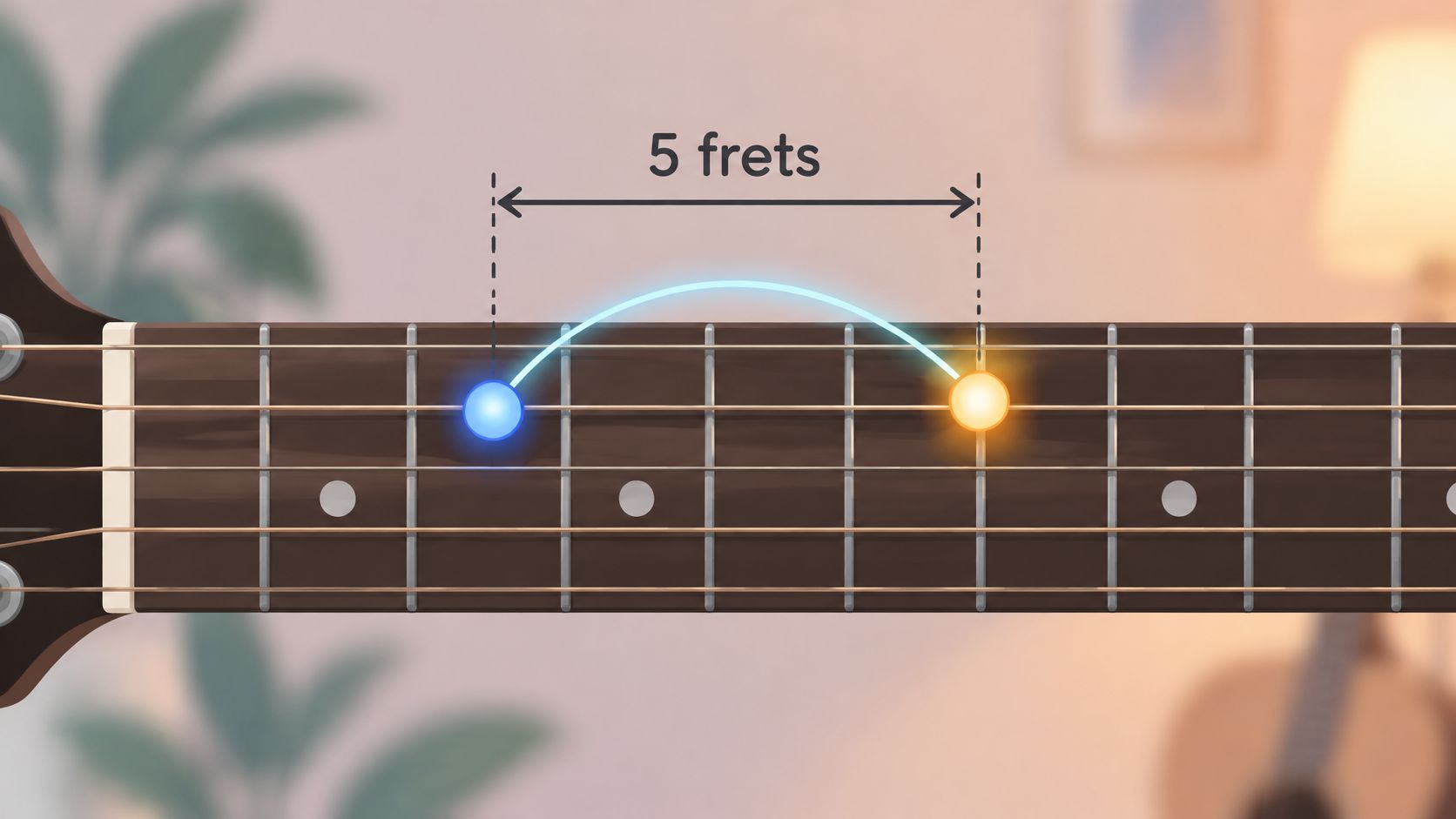
Long quiz marathons are the weaker design. Hear the pair, then sit with the sound for a few seconds before you answer. Short daily sessions that mix quick naming with relaxed replaying teach the gap faster than rapid-fire guessing, because the ear needs a moment on each distance before it can hold it.
A tight 10-minute block:
- Two or three intervals only: Fifths, fourths, and major thirds are enough for one week.
- Sing, then name: Match the leap with your voice before you say the label.
- Check at once: A wrong name corrected immediately sticks better than a score you see later.
At rehearsal, loop the first two notes of the song you are learning. Name the leap, then play it from the low E string. Your ear picks the fret. Your hand follows.
2. Singing Scale Degrees Before You Play
What if the notes of the key were already in your ear before you touched a string? Scale-degree singing does that. You hold one home pitch, then sing do, re, mi and the rest of the ladder until each step has a place.
Scale degrees are just names for those places. Do is home. Mi is the bright step. Sol pulls back toward home. Once you can sing them, a chorus melody stops being a pile of frets and becomes a path you can move to another key.
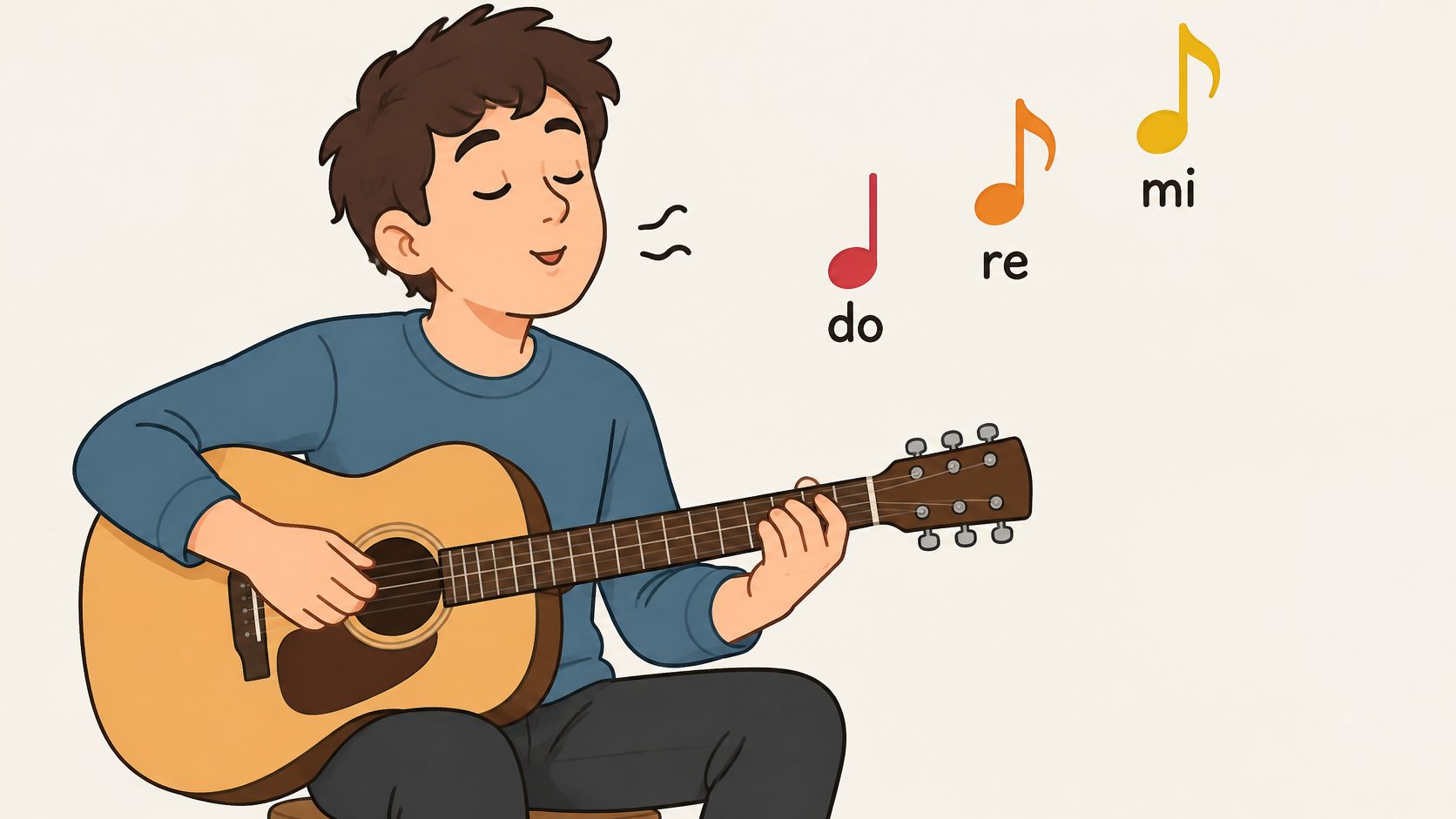
The Berklee music-theory and ear-training handbook tells students to use one reference pitch, Do, and to sing before they check the instrument. That order matters on guitar. If you hunt frets first, you memorize a shape. If you sing first, you memorize the sound.
Practical rule: Play one reference note, sing the target step from memory, then match it on the guitar and compare.
Use the first 5 to 10 minutes of practice. Warm a band the same way before rehearsal. Everyone sings the scale, then the melody of the first song in numbers. You will spot the wrong key before the count-in, not after the first chorus falls apart.
3. Chord Quality Recognition for Happy, Sad, or Tense Sounds
A friend plays one chord and asks if the chorus should feel settled or heavy. You should hear that before you try shapes. Major sounds bright and at rest. Minor sounds darker. Diminished sounds unstable. Augmented sounds like it has to move.
Say you are writing a harmony for a demo. The verse sits on minor, then the chorus opens on major. That switch is the emotional turn. If you only know the grip names, you miss it. If you hear the color, you can answer in the room.
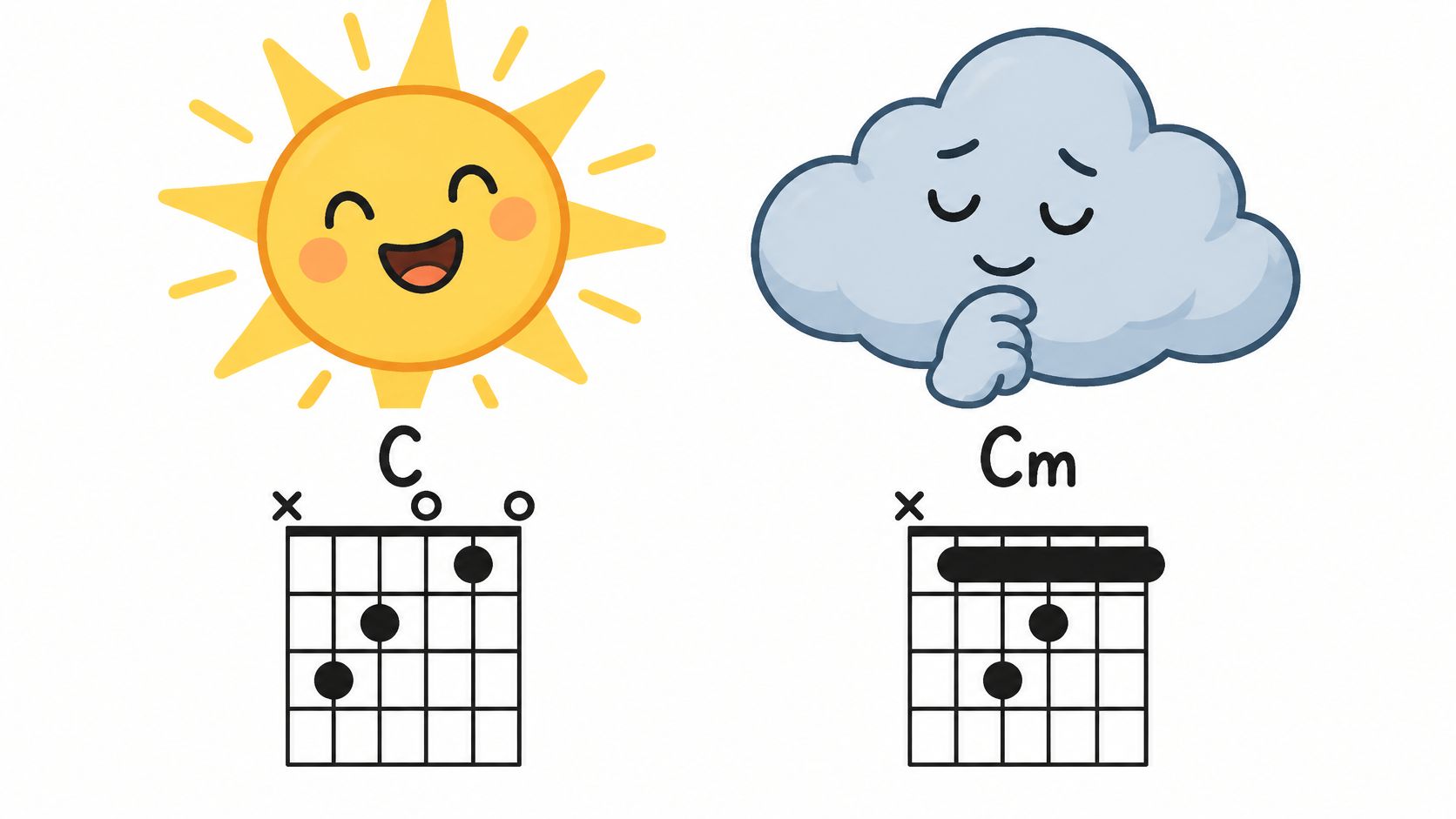
Play C major, then C minor, back to back. Hum the root under both. The root stays. The third changes the mood. That is the whole test.
Blocked drilling has a trap. Run the same pair in the same order and your memory answers before your ear does. Shuffle the qualities so each chord lands cold, the way it does inside a song, and a short daily session builds real recognition faster than long stretches of one predictable drill.
How a 10-minute chord session runs
- One quality first: Spend the first sessions on major against minor. Add diminished and augmented once the pair is automatic.
- Root hum: Sing the bass note under each chord so the color has an anchor.
- Then mix: Shuffle qualities in random order so you cannot lean on the last answer.
Chord color is also where harmony starts to mean something in real songs. The foundation of musical emotion is the difference you just hummed. In a jazz standard, a diminished chord usually wants to resolve. Hear the tension, wait for the landing, and the next grip becomes a decision instead of a guess.
4. Chord Progression Recognition and the Story Behind the Song
Single chords are colors. A progression is the plot. Most pop rooms live on I–V–vi–IV. A blues shuffle walks I–IV–I–V. A jazz turnaround often closes on ii–V–I. Hear the sequence and you can jam before anyone hands you a chart.
Tap the change with your foot. If you can feel when the harmony moves, naming it gets easier.
Start with three chords. Play G, C, and D until you can call the order with your eyes off the neck. Then put on a recording and predict the next chord out loud before it lands. A miss is useful. Rewind four bars and listen only for the bass leap.
At a jam, this is the skill that keeps you in the song. The singer calls a key. You hear home, then the move to the four chord, then back. You are not reading. You are following a story you have already practiced for 10 minutes a day, one progression at a time, until the pattern has a name.
Group playing pushes the same ear further. A Canterbury Christ Church University study treats group ear-playing as practical training, covering harmony, imitation, and improvisation together. Try it with one other player. Hold a two-chord loop. Call the change, then answer with a short phrase that sits on the new chord. That is musical freedom you can use on Saturday night.
5. Melody Copying Without the Chart
Can you lift a riff from a recording with the tab closed? That is the core of learning to play by ear. Hear a short phrase, sing it, then find it. Start with two or three notes. Stop there until they are clean. Speed comes after the notes are right.
A phrase from a favorite solo is a better drill than a random quiz tone. Loop four beats. Sing the shape. Find the first note, then each step by whether it rises or falls and how far. Record yourself and line it up with the original. Rhythm mistakes show up fast when you hear both versions.
Hearing a phrase and playing it back is also how transcription starts. This guide to transcribing music by ear walks that same loop from short phrases to full lines. Use one new phrase per day, about 10 minutes, then stop. Tomorrow you will still remember it.
The clip below shows the slow-down method in a real song, which is the pace you want before you chase the original tempo.

In a controlled study of 28 middle-school band students, the group that learned melodies by ear in one familiar key and two unfamiliar keys improved at playing by ear in both new keys. The notation-practice group did not improve in any tested key. Move the phrase you copied into a new key this week. Unfamiliar frets force you to hear the intervals again.
An Oxford chapter on playing by ear calls this an aural database built through mental and auditory imagery, linking eyes, ears, and fingers. Hear the phrase, imagine the next note, sing it, then play. That is the order in a rehearsal when the singer changes the key on the spot.
6. Bass Note and Root Detection
Every chord sits on a root. Find that bass note and the rest of the chord gets smaller. In a dense mix, ignore the guitar for a minute and follow the bass or the lowest piano note. That note is usually the name of the chord.
A worship chart with no diagram is a common test. The singer holds a long chord. You hum the bottom pitch, match it on the low E or A string, then decide major or minor by playing both over that root. One will lock. The other will clash. Writers do the same with a phone demo. Bass first, color second, melody last.
Keep the session small:
- One song: Ten minutes on a single bass line beats five songs half-heard.
- Hum the root: Play the chord, then sing the foundation until it feels obvious.
- Headphones: They separate the bass from cymbals and strumming so the root is not a guess.
Once the roots of a verse are clear, say them as a progression while you play. You just connected bass hearing to the story skill from the last exercise, without a chart in your lap. That is the skill producers and bandmates need when a part has to be rewritten in the room.
7. Pitch Matching and Tuning by Ear
Tuning by ear is the drill guitarists skip, then regret when the tuner battery dies before a gig. Play a reference note. Sing it. Turn the peg until the open string stops beating against that pitch. Small waves in the sound mean you are close. A steady tone means you matched.
This is relative pitch, not a party trick. It is how you stay with a singer in a loud room and how you check intonation up the neck. Fret the fifth fret on the low E and compare it with the open A. If they pulse against each other, the guitar is not ready, even if last week’s tuner said it was.
I recommend the first 5 to 10 minutes of every session for this, before chords or songs. Set one string with a clip-on tuner, hide the tuner, and match the other five by ear. Then uncover it and see which strings drifted. Sing the reference before you touch the peg so your ear leads your hand.
A 2024 music-psychology review cites a meta-analysis linking performance improvement to practice quality and quantity at about r = 0.61. Minutes with the app open are a weak signal. Pitch accuracy, how fast you lock the note, and whether you still hear it tomorrow are the signals that transfer to a rehearsal.
Check the octave at the 12th fret against the harmonic. If the fretted note is sharp, you will hear it clash with the singer on high melodies even when open strings look fine. That check takes one minute and saves a take.
7 Guitar Ear Training Exercises at a Glance
| Exercise | Skill You Build | Difficulty | Best For |
|---|---|---|---|
| Interval Recognition: Hear the Gap Between Two Notes | Recognizing the distance between notes | Beginner to intermediate | Learning melodies by ear |
| Singing Scale Degrees: Hear the Notes Before You Play Them | Hearing notes in relation to a key’s tonic | Beginner | Building relative pitch and warming up |
| Chord Quality Recognition: Is This Chord Happy, Sad, or Tense? | Identifying major, minor, diminished, and augmented chords | Beginner to intermediate | Recognizing chords and their emotional character |
| Chord Progression Recognition: Hear the Story Behind the Song | Hearing and naming chord patterns | Intermediate | Playing along, improvising, and following song structure |
| Melody Copying: Play What You Hear, Not What You Read | Reproducing melodies by ear on guitar | Beginner to intermediate | Learning songs without tabs and improving improvisation |
| Bass Note and Root Detection: Find the Foundation of Any Chord | Hearing the root note beneath a chord | Intermediate | Transcribing harmony and finding chord foundations |
| Pitch Matching and Tuning by Ear: Hear When Something Is Off | Matching pitches and hearing tuning differences | Beginner to intermediate | Tuning by ear and playing in tune with others |
Build Your Daily Ear Training Habit and Play by Ear With Confidence
Your ear is a muscle. Short, steady work builds it. A rare marathon quiz does not. Pick two of these exercises, not all seven. Intervals and chord quality are a strong pair if jams are your goal. Melody copying and root finding are the pair if you are tired of tabs.
Put the 10 minutes on the calendar, same time, guitar in hand. Measure progress by something you can do in a room. Name the chords at a jam. Copy a four-note riff with the chart closed. Match a singer in the warm-up. A streak of correct quiz taps is not the same thing.
Trill: Ear Training Daily is the system we built for that habit. Sessions are a 10-minute daily practice covering chords, intervals, perfect pitch, and melodies. You tell us your goal and your level, and the path adapts from single notes to full chord progressions. The toolkit beside the drills includes a tuner, a metronome, and chord, scale, and interval visualizers, so the sound you just named has a shape under your fingers.
Stop guessing. Hear the change, sing it, then play it. Ten minutes today is how musical freedom starts.
Trill: Ear Training Daily gives you short sessions for intervals, chord qualities, progressions, and melodies, the same skills you need to hear a song and play it. Use it as the 10-minute system behind these guitar ear training exercises, then take the sounds straight to a jam or a riff you are learning without tabs. Start the habit at Trill: Ear Training Daily.