Guitar Diatonic Scale: Unlock the Fretboard & Play by Ear
You know the feeling. Your fingers can run a few familiar boxes, maybe a pentatonic lick or two, but when you try to improvise over a song, everything starts sounding the same. You’re not really hearing the music. You’re guessing and hoping your hand lands somewhere safe.
That’s where a lot of guitar players get stuck. Not because they’re lazy, and not because they lack talent. They’ve learned shapes, but they haven’t learned how those shapes sound. The guitar diatonic scale changes that because it connects fretboard patterns to the actual language of songs.
If you want to play by ear, recognize chords faster, and stop depending on tabs for everything, the answer isn’t more random scale diagrams. It’s ear training. Once you start hearing the diatonic sound, the fretboard stops looking like disconnected dots and starts feeling like music.
Table of Contents
- Why Your Guitar Playing Is Stuck (And How to Fix It)
- What Is the Diatonic Scale (And Why It Sounds So Familiar)
- Visualizing the Diatonic Scale on the Guitar
- How to Train Your Ear to Hear Diatonically
- From Scales to Songs How Diatonic Chords Work
- Improvising and Playing Songs by Ear
- Your Daily Path to Musical Freedom
Why Your Guitar Playing Is Stuck (And How to Fix It)
A student sits down, plugs in, and starts soloing in the same pentatonic box they’ve used for months. The fingers move fine. The bends are in tune. But after a minute, every phrase feels recycled.
That’s not a technique problem. It’s a listening problem.
Many players believe that the next step involves memorizing additional shapes. While this can provide a temporary benefit, the same frustration often returns because the underlying issue is deeper. Your hands know where to go, but your ear isn’t leading.
The diatonic scale matters because it’s not some niche theory topic. It’s the sound system behind a huge amount of the music guitarists already love. The diatonic scale has been foundational to Western music for over 2,500 years, with origins tracing back to Ancient Greece, and this seven-note system became the backbone of music from classical to modern pop, as explained in this history of popular guitar scales.
That’s why diatonic sounds familiar the first time you hear it. You’ve been listening to it your whole life.
The real trap
The trap isn’t that pentatonic is bad. It’s great. The problem comes when it becomes your whole world.
- You memorize shapes but can’t hear what note should come next.
- You learn solos from tabs but can’t pull the same ideas into another key.
- You know where the scale is but don’t know why some notes feel settled and others feel tense.
You don’t need more fretboard information first. You need stronger sound recognition.
When your ear starts hearing scale degrees and melodic pull, the guitar opens up. You stop asking, “What pattern fits here?” and start asking, “What sound do I want here?” That’s a much better question.
The fix
Use the guitar diatonic scale as musical language, not just finger exercise material.
Viewing the scale as a language makes it clearer. Memorizing shapes without ear training is comparable to memorizing the positions of letters on a keyboard without knowing what words sound like. You can type, but you can’t really say anything meaningful.
The fix is simple, though not instant. Pair one diatonic shape with daily listening work. Sing the notes. Hear the root. Notice which notes brighten the line and which ones want resolution. That’s how you build the connection between hand and ear, and that’s what makes improvisation and playing by ear start to feel natural.
What Is the Diatonic Scale (And Why It Sounds So Familiar)
The diatonic scale is a seven-note scale. If that sounds technical, make it simpler. It’s the note set behind a huge amount of melody and harmony in everyday music.
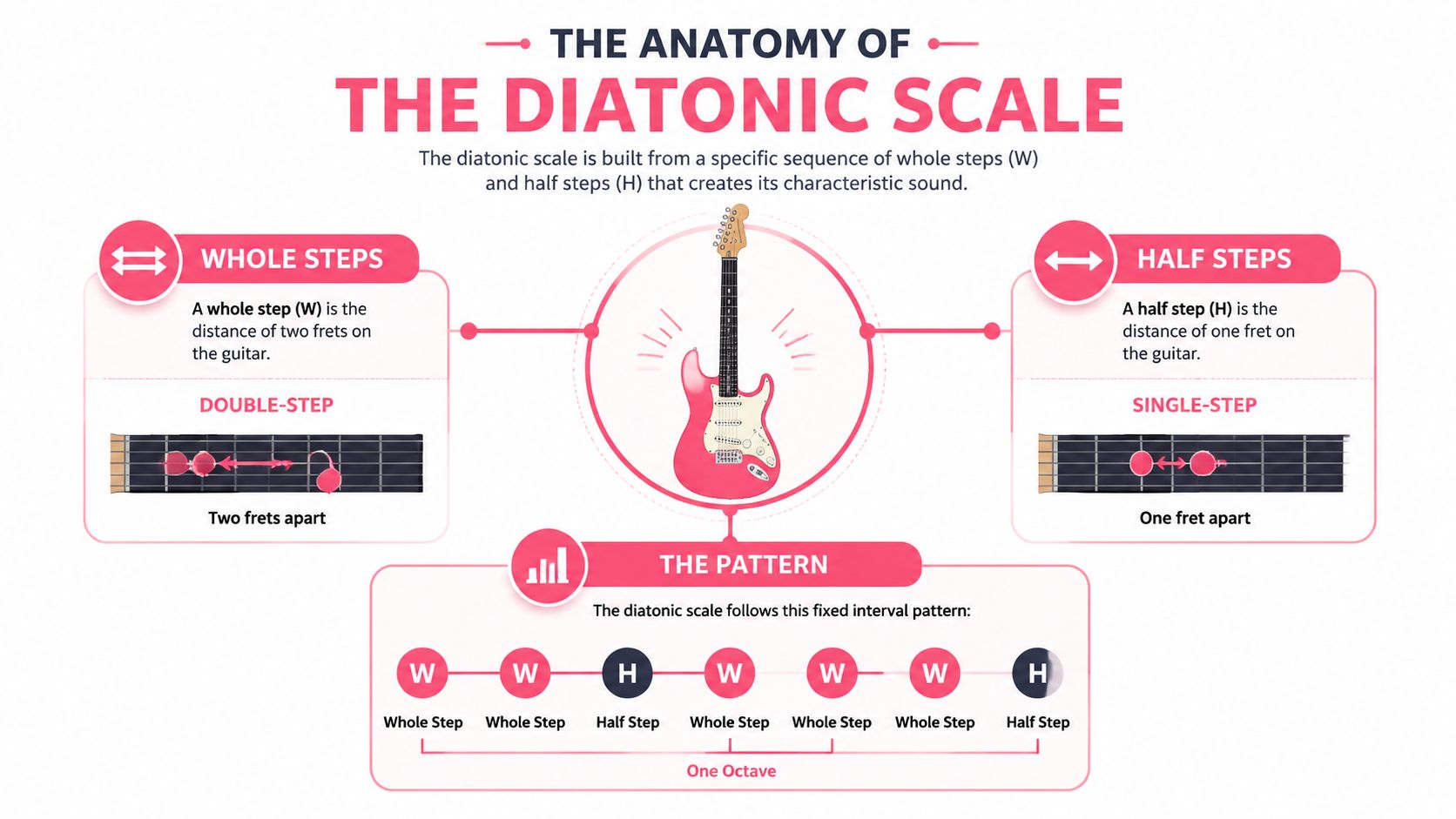
It follows one fixed interval pattern: whole step, whole step, half step, whole step, whole step, whole step, half step. That pattern stays the same no matter what key you start on, which is why the sound stays recognizable across keys, as described in this diatonic scale overview.
The seven-note sound you already know
Think of the diatonic scale as a seven-letter musical alphabet. Once your ear knows those letters, songs stop sounding random.
On guitar, a whole step means moving two frets. A half step means moving one fret. So the pattern gives you a map of distances. But the more important part is the sound of those distances.
Here is the ear-first approach to this concept:
- Some notes feel like home. They sound settled.
- Some notes feel like motion. They pull your line forward.
- Some notes add color. They don’t sound wrong. They just add more personality.
That last point matters because many players begin with pentatonic and then feel nervous adding the two missing notes. But those extra notes are often what make a melody sound more complete, lyrical, or song-like.
Why pentatonic feels safe and diatonic feels complete
The major pentatonic scale uses five notes from the seven-note diatonic scale: 1, 2, 3, 5, and 6, as explained in this pentatonic scale history and lesson. That’s one reason pentatonic feels easy to use. It trims away some of the tension points that make beginners hesitate.
A simple analogy helps. Pentatonic is like sketching with a few reliable colors. Diatonic gives you the fuller palette.
That doesn’t mean diatonic is harder in some mysterious way. It means your ear has more to organize. And that’s why hearing matters so much. If you only memorize the pattern, the scale feels crowded. If you hear the function of each note, the scale feels expressive.
Practical rule: Don’t ask, “What are the seven notes?” first. Ask, “Which note sounds finished, and which note sounds like it wants to move?”
Try this today. Play a major scale slowly from the root to the octave. Pause on each note and listen to the emotional pull. One note may feel calm. Another may feel bright. Another may feel unfinished. That’s the beginning of real ear training, and it’s much more useful than chasing the idea of perfect pitch right away.
Visualizing the Diatonic Scale on the Guitar
Most players get overwhelmed because they think they need every mode, every position, and every note name before the guitar diatonic scale becomes useful. You don’t.
Start with one shape you can move.
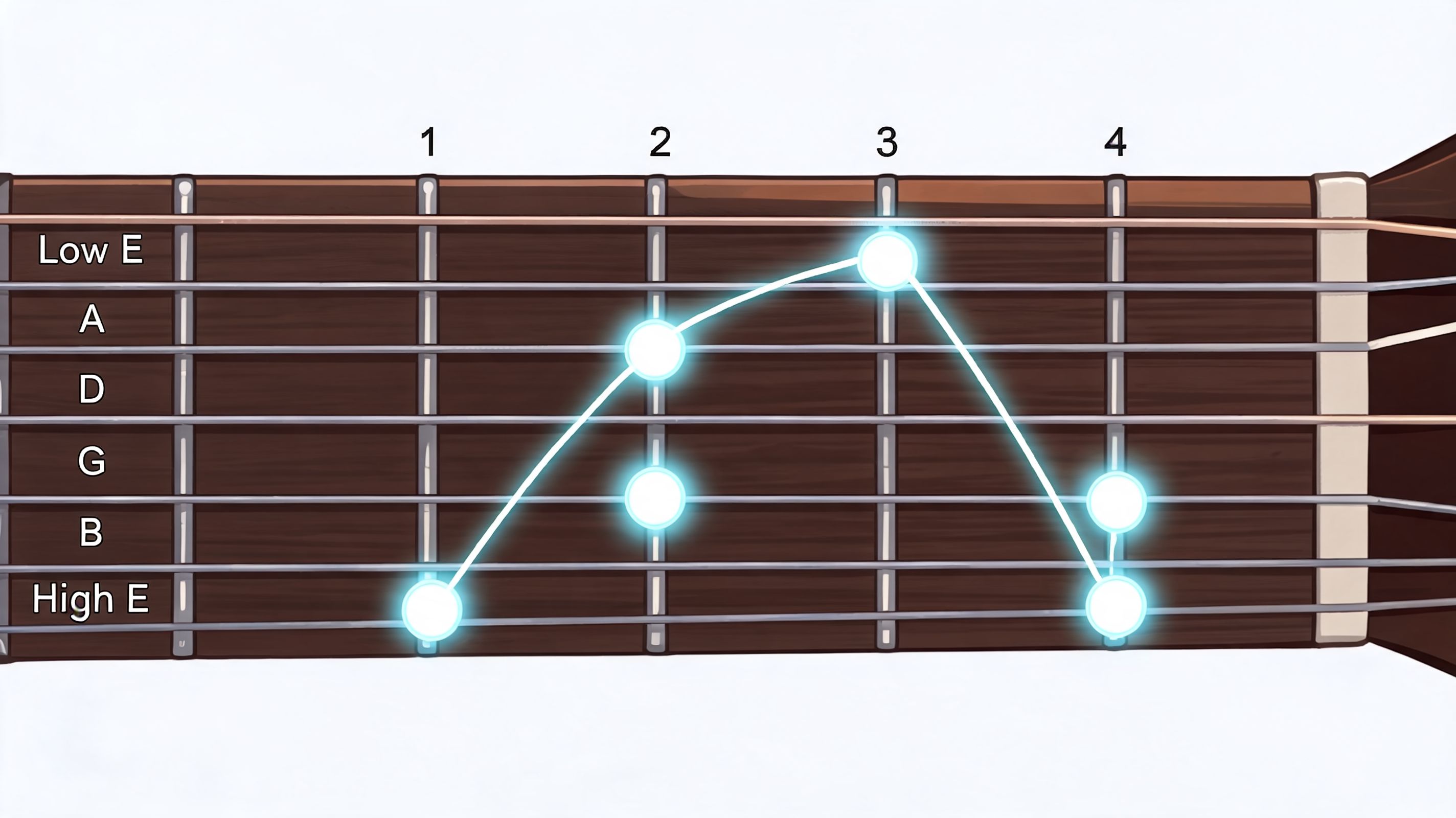
If you want a visual reference while you practice, a scale visualizer for guitar shapes can help you see the pattern clearly across the fretboard without turning the exercise into pure memorization.
Start with one movable shape
Pick a common major-scale fingering on two or three strings first. Don’t try to own the whole neck at once.
Here’s the mindset that works better:
- Find the root note. That note is your home base.
- Play the shape slowly. Hear the sound of the scale rising and falling.
- Move the same shape to a new root. Let your ear notice that the sound relationship stays the same even though the pitch changes.
This is the power of movable guitar logic. The shape shifts, but the interval pattern stays intact.
A lot of confusion comes from mixing up note names with note function. Note names matter later. At first, function matters more. Which note is the root? Which note feels tense? Which note resolves nicely back to home?
Hear the root before you move your fingers
Many guitarists look at a fretboard diagram and immediately think in dots. Try flipping that around. Before you play the scale, strum or hold the root note for a moment. Let your ear settle there.
Then play the shape and keep checking how every other note relates back to that root.
A short practice loop works well:
- Play the root
- Sing the root
- Play two or three notes from the shape
- Return to the root and listen for resolution
If the root feels blurry, the whole scale will feel blurry.
That’s why shape learning alone doesn’t reveal the full potential of the fretboard. The shape becomes useful when your ear recognizes what the shape is doing. Once that happens, even a single position starts feeling musical. You’re not just climbing a ladder of notes. You’re hearing a set of relationships.
How to Train Your Ear to Hear Diatonically
Muscle memory is helpful. But muscle memory without listening is just hand movement. If you want to play by ear, your ear has to become the boss.
This is the missing piece in most guitar diatonic scale lessons. They show where to put your fingers, but they don’t spend enough time teaching you how the scale sounds when it’s alive inside a song.

If you want a deeper ear-focused starting point, this guide on how to play by ear fits well with the exercises below.
Ear training is a skill, not a gift
Some players still think hearing chords, scales, and intervals is something you either have or don’t have. That belief stops a lot of progress before practice even begins.
Your ear gets better the same way your fretting hand gets better. Repetition. Attention. Consistency.
You don’t need instant perfect pitch. You need stronger pattern recognition. The diatonic scale gives you a clear set of sounds to train because the note relationships stay consistent in every key.
Here are three useful ear exercises.
- Sing scale degrees: Play the root, then sing up the scale one note at a time. Don’t worry if your voice is rough. The point is matching what you hear.
- Pause-and-predict: Play part of the scale, stop, and try to hear the next note in your head before you touch the string.
- Resolve to home: Start from different notes in the scale and listen for how they want to resolve back to the root.
A simple 10-minute practice loop
You can do this in a short daily session.
| Time | Practice focus | What to listen for |
|---|---|---|
| 2 minutes | Hold or repeat the root note | Stability and tonal center |
| 3 minutes | Play and sing the scale slowly | The pull of each note |
| 3 minutes | Improvise with only a few notes | Which tones sound finished |
| 2 minutes | Listen to a simple song and find the home note | Key center by ear |
This kind of short daily work is where progress happens. That’s one reason some players use tools built for repeated aural drills. Trill: Ear Training Daily presents short exercises for recognizing notes, chords, intervals, and scales through audio, which fits naturally into a daily ear training routine.
Train your ear every day, even when you don’t feel “ready.” Readiness comes from repetition.
If you stay with this, something important changes. You stop hearing the scale as seven separate facts. You start hearing it as one sound world. That’s when improvisation gets easier and song learning gets faster.
From Scales to Songs How Diatonic Chords Work
Single notes are only half the story. Songs also move through chords, and those chords come from the same sound world as the scale.
Diatonic chords are built using only notes from the parent scale, which creates a predictable pattern across the seven scale degrees: I major, ii minor, iii minor, IV major, V major, vi minor, vii° diminished, as explained in this introduction to diatonic chords.
The chord family inside one key
This pattern is a huge ear-training advantage because it means chords in a key are not random. They belong to a family.
Here’s the pattern in a major key:
| Scale Degree | Chord Number | Chord Quality | Example in C Major |
|---|---|---|---|
| 1 | I | Major | C |
| 2 | ii | minor | Dm |
| 3 | iii | minor | Em |
| 4 | IV | Major | F |
| 5 | V | Major | G |
| 6 | vi | minor | Am |
| 7 | vii° | diminished | Bdim |
If you want to explore these chord relationships on the neck, a guitar chord visualizer can make the family easier to see and hear together.
A student often has an “aha” moment here. They realize songs feel coherent because the chords are related. They’re built from the same pool of notes.
Why this helps you hear progressions faster
Suppose you’ve identified the key by ear. That already narrows the field. Now, instead of guessing from every chord on earth, you can listen for members of that diatonic family.
That’s useful in real playing situations:
- When learning songs: You can test likely chord choices first.
- When jamming: You can hear whether a melody tone belongs comfortably inside the harmony.
- When writing: You can choose chords that support the sound world you’ve already established.
The key gives you the family. Your ear learns the personalities inside that family.
The V chord often feels like it wants to go home. The vi often feels reflective. The IV has its own lift. You don’t have to memorize poetic labels for every function, but you should listen for these tendencies.
That’s where theory becomes practical. The guitar diatonic scale isn’t just a row of notes. It’s the source of the chords that make songs feel connected. Once you hear that connection, chord recognition stops feeling like blind guesswork.
Improvising and Playing Songs by Ear
The payoff is simple. Once you can hear the guitar diatonic scale and the chord family behind it, you can make better musical choices in real time.

A lot of players think improvisation means playing more notes. Usually it means hearing better targets.
Stop running scales and start making phrases
If you run up and down the scale, listeners hear an exercise. If you aim for notes that match the current chord, they hear melody.
Try this over a backing track in a major key:
- Land on the root when the phrase ends: That gives your line a sense of arrival.
- Aim for chord tones on strong beats: Your solo will sound connected to the progression.
- Use passing notes between targets: That’s where the diatonic scale becomes expressive instead of mechanical.
A short phrase with clear direction sounds better than a fast blur of correct notes.
Here’s a useful listening habit. Before you play the next note, try to sing it. Even if you miss, that attempt trains the exact skill that matters most: hearing before touching the string.
A play-by-ear workflow for real songs
When you want to learn a song without tabs, keep the process simple.
- Find the home note. Hum along and look for the note that feels settled.
- Test the scale sound. See whether the melody seems to live naturally inside that diatonic world.
- Listen for likely chords. Once the key feels clear, check the common chord family first.
- Match melody to harmony. Notice which melody notes line up with each chord change.
This kind of demonstration helps if you want to watch the process in action:

Don’t worry if this feels slow at first. Playing by ear always starts slower than copying from tabs. But it builds something tabs never can: independence.
Every song you figure out by ear strengthens your internal map of melody, harmony, and fretboard connection.
That’s musical freedom. Not perfection. Not flashy speed. Just the ability to hear something and trust yourself to find it.
Your Daily Path to Musical Freedom
The guitar diatonic scale isn’t just theory to memorize. It’s the sound of a huge amount of real music, and it becomes useful when your ear recognizes it, not when your fingers merely survive it.
If you’ve felt stuck in boxes, that’s good news. It means the problem probably isn’t a lack of ability. It means your practice needs more listening and less guessing.
Keep it small and consistent. 10 minutes a day is enough to build momentum when those minutes are focused. Sing the root. Play one shape. Hear the pull of each note. Test chords by ear. Repeat tomorrow.
That steady routine matters more than rare marathon sessions. Your ear learns through repeated contact with sound, the same way your hands learn through repeated contact with the strings.
Give yourself permission to train this slowly. You do not need perfect pitch to make real progress. You need daily contact with the sounds you want to understand.
If you want a simple daily system for building ear training, chord recognition, and play-by-ear confidence, try Trill: Ear Training Daily. It’s built around short practice sessions that help musicians stop guessing and start hearing music more clearly.