How to Harmonise a Melody by Ear: A Practical Guide
You sit at your instrument, pick out a melody you know, and then stall on the next step. The tune is clear. The chords aren’t. So you try one. It kind of works. Then another. That one sounds wrong. After a few minutes, it feels like harmonising is something other musicians can just do, while you’re left guessing.
That feeling is common, and it has very little to do with talent. If you want to learn how to harmonise a melody, the shift is this: stop treating chords as theory homework and start treating them as sounds your ear can learn to recognise. You don’t need perfect pitch to do that. You need repeated listening, simple tests, and daily practice until the sound of “home,” “tension,” and “resolution” becomes familiar.
Theory still helps. But theory works best when it confirms what you can already hear. If your goal is to play by ear, improvise, write accompaniments, or stop depending on chord charts, your ear has to lead.
Table of Contents
- Why Harmonising a Melody Feels So Hard and How to Fix It
- Hear the Foundation Before You Build the House
- Find Your First Chords by Listening Not Calculating
- Turn Chords Into Music with Harmonic Rhythm
- Add Emotional Color with Simple Reharmonisation
- Build Your Musical Freedom in 10 Minutes a Day
Why Harmonising a Melody Feels So Hard and How to Fix It
Most beginners think the hard part is finding the right chord. Usually, the harder part is not knowing what to listen for. If you haven’t trained your ear yet, every chord choice feels random, even when the theory is sitting right in front of you.
A lot of teaching starts from the written side. In traditional harmony study, a common method uses a 9-step sequence that begins with key identification and moves through chord selection, bass writing, and inner voices, as outlined in Iowa State’s harmonising a melody lesson. That process is useful because it gives structure. It also asks the student to think a lot before they’ve learned to hear enough.
Practical rule: If your ear isn’t involved, harmonising feels like solving a puzzle with half the pieces missing.
What works better in real playing is a mixed approach. Use just enough theory to narrow the options, then let your ear choose between them. That’s how players operate when they accompany singers, work out songs from recordings, or sit in at a rehearsal without charts.
Here’s what usually doesn’t work:
- Starting with every possible chord. Too many options create noise.
- Ignoring the melody’s resting points. Not every note matters equally.
- Changing chords because you feel you should. Chord changes need a reason you can hear.
- Treating wrong answers as failure. In ear training, “wrong” often means “compare again.”
A stronger approach is simpler. First hear where the melody wants to settle. Then hear which basic chords support that feeling. Then decide when those chords should move. That sequence is musical, not academic.
If you practice this for 10 minutes a day, your brain starts storing harmonic patterns the way it stores spoken phrases. You stop guessing so much. You start hearing function, pull, and release. That’s the point where learning how to harmonise a melody becomes practical instead of intimidating.
Hear the Foundation Before You Build the House
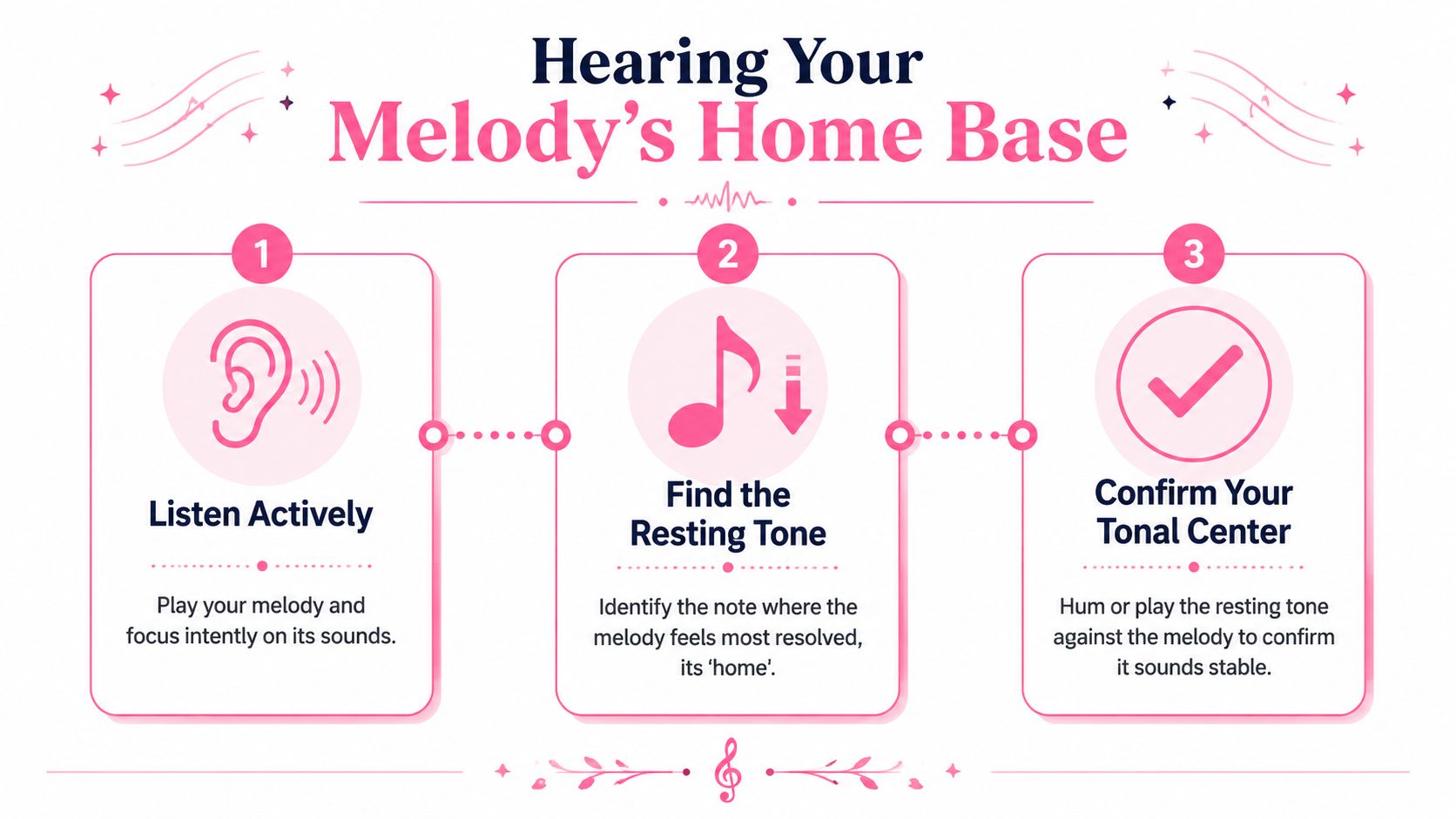
Before you test chords, find the note that feels like home. If you skip that step, every later decision gets harder.
Many players call this the key center or tonal center. By ear, it’s simpler than that. It’s the pitch that feels settled, final, and stable when the melody comes to rest.
Find the note that feels finished
Play or sing the melody slowly. Then stop on important notes and hum a single pitch underneath. You’re looking for the pitch that makes the whole phrase feel complete rather than suspended.
Try this in order:
- Sing the last note of the melody. Sometimes that’s home, sometimes it isn’t.
- Hum the note you want the melody to land on. Your ear often knows before your hands do.
- Check it against several phrase endings. A real tonal center keeps sounding stable.
If you struggle with this, interval work helps because it sharpens your sense of distance and pull between notes. Practising how intervals sound in real music makes it much easier to hear why one note feels final while another feels unfinished.
The home note usually doesn’t beg for attention. It absorbs tension.
Decide whether the melody leans major or minor
Once you’ve got a home note, listen to the emotional color around it. Does the melody feel bright and open, or darker and more inward? That won’t solve every tune, but it gives you a useful first filter.
A quick ear exercise:
- Play the home note as a drone and sing the melody over it.
- Test a major third above the home note, then a minor third.
- Notice which one matches the tune’s character more naturally.
For optimal results, your first harmonies should come from the scale world the melody already implies. If the melody clearly leans one way and you force chords from the other, you’ll feel friction immediately.
At this stage, don’t chase advanced theory. Stay with sound. Your task is not to name everything. Your task is to hear the foundation strongly enough that later chord choices stop floating.
Find Your First Chords by Listening Not Calculating
Once you can hear the home note, don’t reach for complicated harmony. Start with the small group of chords that most often support a melody clearly. In many songs, the first useful family is the tonic, subdominant, and dominant. On paper, that’s I, IV, and V. By ear, it’s home, lift, and pull.
A practical beginner method is to identify the key, build a chord bank from the diatonic triads in that key, and then match melody notes to chords that already contain them. Using inversions can then smooth out the bass line, as shown in this harmonising walkthrough on YouTube.

Use a small chord family first
If you’re in C major, begin with C, F, and G. If you’re in G major, begin with G, C, and D. That limitation helps your ear sort function before color.
Take a simple melody such as “Twinkle, Twinkle, Little Star.” Don’t analyse every note first. Play the opening note, hold a C chord under it, and listen. Then test F. Then G. One of them will usually sound more settled than the others for that moment.
What works:
- Testing chords under long notes because they reveal fit more clearly
- Listening for stability rather than trying to be clever
- Repeating the same phrase with different chords so your ear compares directly
What doesn’t:
- Changing chords on every melody note
- Judging too fast
- Starting with seventh chords and extensions before you can hear the basic function
If you’re working on chord recognition in parallel, training with chord ear exercises that focus on real listening helps connect what you hear in songs to what you play.
Test chords against long or strong melody notes
Not every melody note needs its own chord. Some notes are passing tones. Some are decoration. The notes that usually tell you more are the ones that land on strong beats, last longer, or mark the end of a phrase.
Here’s a practical listening filter:
| Melody moment | What to ask |
|---|---|
| Long note | Does this chord make the note feel supported or exposed? |
| Strong beat | Does the harmony sound grounded here? |
| Phrase ending | Does the chord create rest or leave a question? |
Ear check: When two chords are both technically possible, choose the one that makes the phrase breathe more naturally.
Many students improve quickly when they realize harmonising isn’t about finding a secret answer. It’s about reducing the field, testing real sounds, and learning to hear why one option gives the melody more shape.
Turn Chords Into Music with Harmonic Rhythm
A correct chord under a melody can still sound stiff. The missing ingredient is often harmonic rhythm, which means when the chords change.
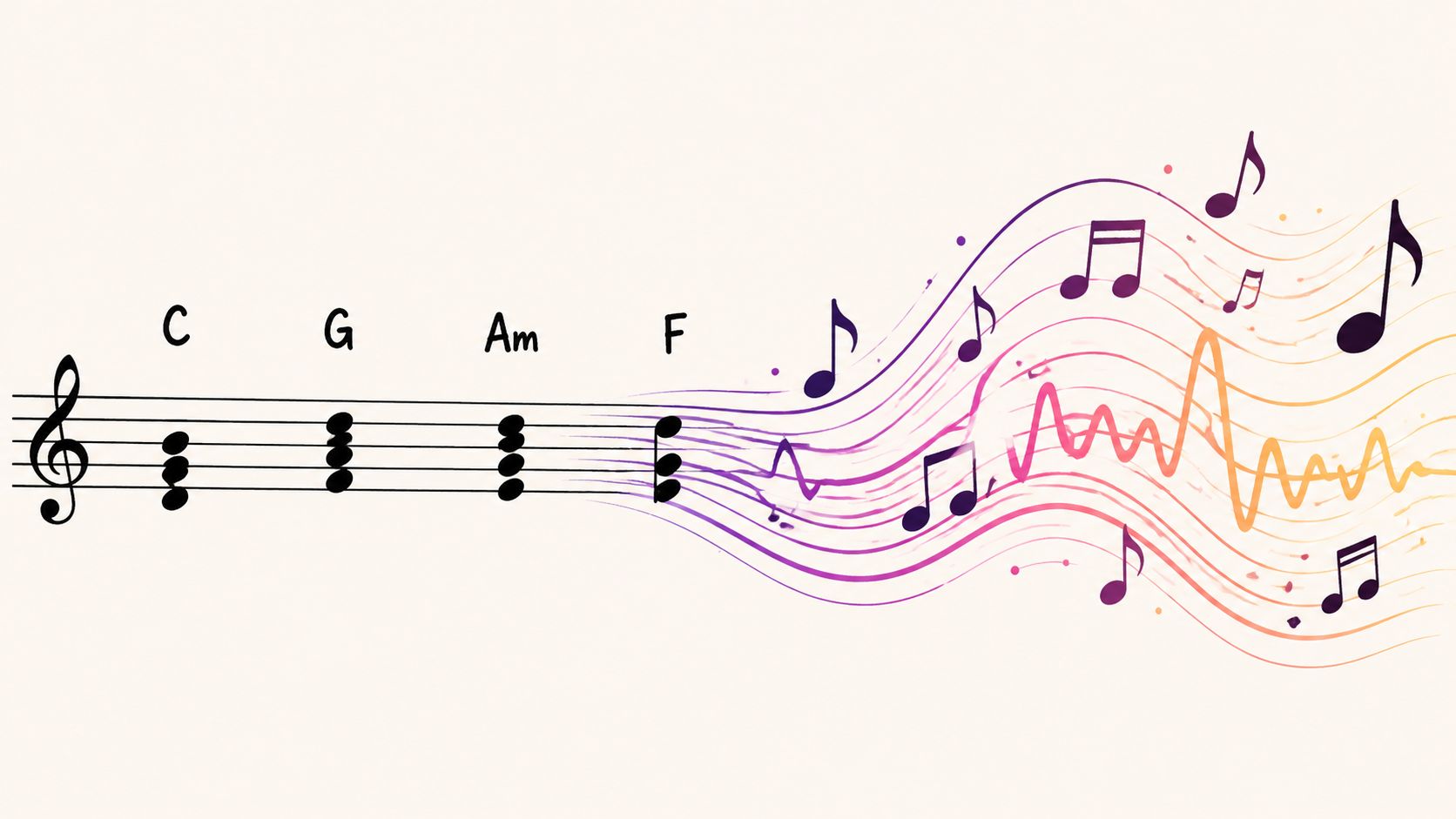
If you change too often, the tune feels over-explained. If you change too rarely, the melody loses momentum. Good accompaniment sits between those extremes. It supports the line and moves when the phrase asks for motion.
Research supports what working musicians hear. A key milestone in this area is the 2013 corpus study Statistical Analysis of Harmony and Melody in Rock Music, which found that melody is interpreted through both harmonic context and metrical placement. In practical terms, a harmony fits not only because of pitch content, but also because the chord change aligns with the melody’s rhythmic pulse, as discussed in Temperley and de Clercq’s study.
Chord changes need timing not just correctness
The same three or four chords can tell very different stories depending on where they move.
Play a melody and try these options:
- One chord per bar if the tune is calm or repetitive
- Two chord changes in a bar if the phrase is building
- Faster movement near the cadence if the ending needs a stronger sense of arrival
A lot of beginner accompaniments fail for one reason. The player finds acceptable chords, then changes them by visual habit instead of listening to phrase shape.
A chord progression starts sounding musical when the changes line up with the melody’s breathing points.
This is useful to hear in action:

Make the bass move like it means something
Even simple harmonisations sound better when the bass has direction. If the top note is the melody and the middle notes fill the chord, the bass often decides whether the whole thing feels clumsy or connected.
One reliable move is to use inversions so the bass travels by step instead of jumping all over the keyboard or fretboard. Another is to treat common progressions as emotional pathways rather than formulas. For example, a sequence like C, G, Am, F has a recognisable rise and release in many pop settings because each chord pulls differently against the melody.
Try this comparison:
| Bass approach | Result |
|---|---|
| Root position every time | Clear, but often heavy |
| Occasional inversions | Smoother, more singable |
| Stepwise bass where possible | Feels intentional and connected |
When students start hearing harmonic rhythm and bass motion together, their playing changes fast. Suddenly they aren’t just placing chords under notes. They’re shaping time, tension, and release. That’s the moment chords begin to sound like music instead of labels.
Add Emotional Color with Simple Reharmonisation
Once the basic harmonisation works, you can change the feeling without changing the melody. That’s reharmonisation in plain language. Same tune, different emotional light.

Advanced harmonisation is often less about textbook correctness and more about style, tension, and desired effect. Cadence points, final bars, and harmonic rhythm matter a lot, and arrangers regularly go beyond basic diatonic chords to match genre and mood, as described in this discussion of harmonizing style and tension.
Swap the mood without losing the melody
A simple place to begin is with relative major and minor color. If a melody note belongs to both chords, you can often move from one emotional shade to another without breaking the tune.
For example:
- Use the relative minor in place of the major tonic family sound when you want more ache or softness
- Keep the melody note fixed and change only the chord underneath
- Compare the emotional result immediately instead of deciding by theory alone
That last point matters. Reharmonisation should be heard, not admired on paper.
Use extra tension on purpose
A second useful move is adding a chord that pushes harder into the next one. Many players learn this later through theory language, but your ear can notice the effect first. You hear a stronger pull, a brighter flash of tension, then a release.
Try it near cadences or important lyric moments:
- Play your plain version first
- Insert a more tense chord just before arrival
- Listen for whether the melody now feels more directed
If the reharmonisation draws attention away from the melody, it’s too much. If it deepens the melody’s meaning, keep it.
Different styles want different amounts of color. Pop often rewards clarity. Gospel may welcome richer movement. Jazz can tolerate much more tension. The right choice isn’t the fanciest one. It’s the one that lets the melody speak in the accent you want.
Build Your Musical Freedom in 10 Minutes a Day
The biggest mistake players make is waiting until they have a big block of time. Ear training doesn’t need heroic effort. It needs repetition.
If you spend 10 minutes a day hearing tonal centers, testing basic chord families, singing bass movement, and comparing harmonic choices, your listening gets sharper in ways that transfer directly to real playing. You recognise progressions faster. You accompany more confidently. You stop relying so heavily on charts and tabs.
A short daily routine can look like this:
- Minute 1 to 3. Find the home note of a melody by singing and checking at your instrument.
- Minute 4 to 6. Test tonic, subdominant, and dominant sounds under phrase endings.
- Minute 7 to 8. Move the bass more smoothly with inversions.
- Minute 9 to 10. Reharmonise one phrase and compare the emotional result.
If you want a structured system for that habit, Trill: Ear Training Daily is one option. It focuses on short daily ear training for chords, intervals, notes, and scales, and includes tools such as a chord visualizer and interval visualizer that support play-by-ear practice.
Musical freedom doesn’t arrive all at once. It builds when your ear starts trusting itself. That’s how you learn how to harmonise a melody in a way that survives outside the practice room.
If you want a daily routine that helps you stop guessing and start hearing chords, Trill: Ear Training Daily is built for that kind of practice. Use it to train chord recognition, interval hearing, scale awareness, and the listening habits that make it easier to play by ear, improvise, and harmonise melodies with confidence.