Develop Your Ear: How to Recognize Chords by Ear
You’re probably here because this has happened more than once.
A song comes on. You grab your guitar, sit at the piano, or open your DAW. You can feel the music clearly, but the chords still feel hidden. So you try one shape, then another. Some are close. Some are way off. After a few minutes, it turns into guessing.
That’s the moment ear training matters.
Learning how to recognize chords by ear isn’t about having a rare gift. It’s about building a reliable connection between what you hear and what your hands do. When that connection gets stronger, songs stop feeling like puzzles and start feeling readable. You hear movement, tension, release, and emotional color. Then you can play by ear instead of chasing tabs and chord charts.
Table of Contents
- Stop Guessing Start Hearing
- Your Ear Is a Muscle Not Magic
- The First Step Always Start with the Bass
- Learning the Emotional Color of Each Chord
- How to Learn Thousands of Songs with Four Chords
- The Hidden Skill Hearing Inversions and Seventh Chords
- Your 10-Minute Daily Ear Training System
Stop Guessing Start Hearing
Most musicians don’t struggle because they’re lazy. They struggle because they’ve never been shown what to listen for.
When a chord plays, beginners often hear a blurry block of sound. That blur creates panic. Panic creates guessing. Guessing creates the feeling that playing by ear is only for people with “natural talent.” It isn’t.
Ear training is the skill of hearing music in a more organized way. Instead of asking, “What random chord is that?” you start asking better questions. What is the bass doing? Does the chord feel bright or dark? Does it sound stable, tense, or unresolved?
That shift changes everything.
A lot of players stay stuck because they rely on tabs, chord charts, and trial-and-error for every song. Those tools can help, but they don’t train your ear. If you want real freedom, you need to hear the music itself. That’s the difference between copying and understanding.
Practical rule: Don’t try to identify the whole chord at once. Listen for one clue at a time.
If you’ve been frustrated by always feeling one step behind the song, this is a useful place to reset your approach. The habit of guessing chords instead of hearing them clearly is common, and it can be unlearned.
Three mindset shifts help right away:
- Sound comes first: Theory works better when it names something you already hear.
- Small wins matter: Hearing one bass note correctly is progress.
- Consistency beats intensity: Ten focused minutes daily will teach you more than occasional long sessions where your attention drifts.
You don’t need to hear like an expert on day one. You need to start labeling what you already notice.
That’s how guessing begins to disappear.
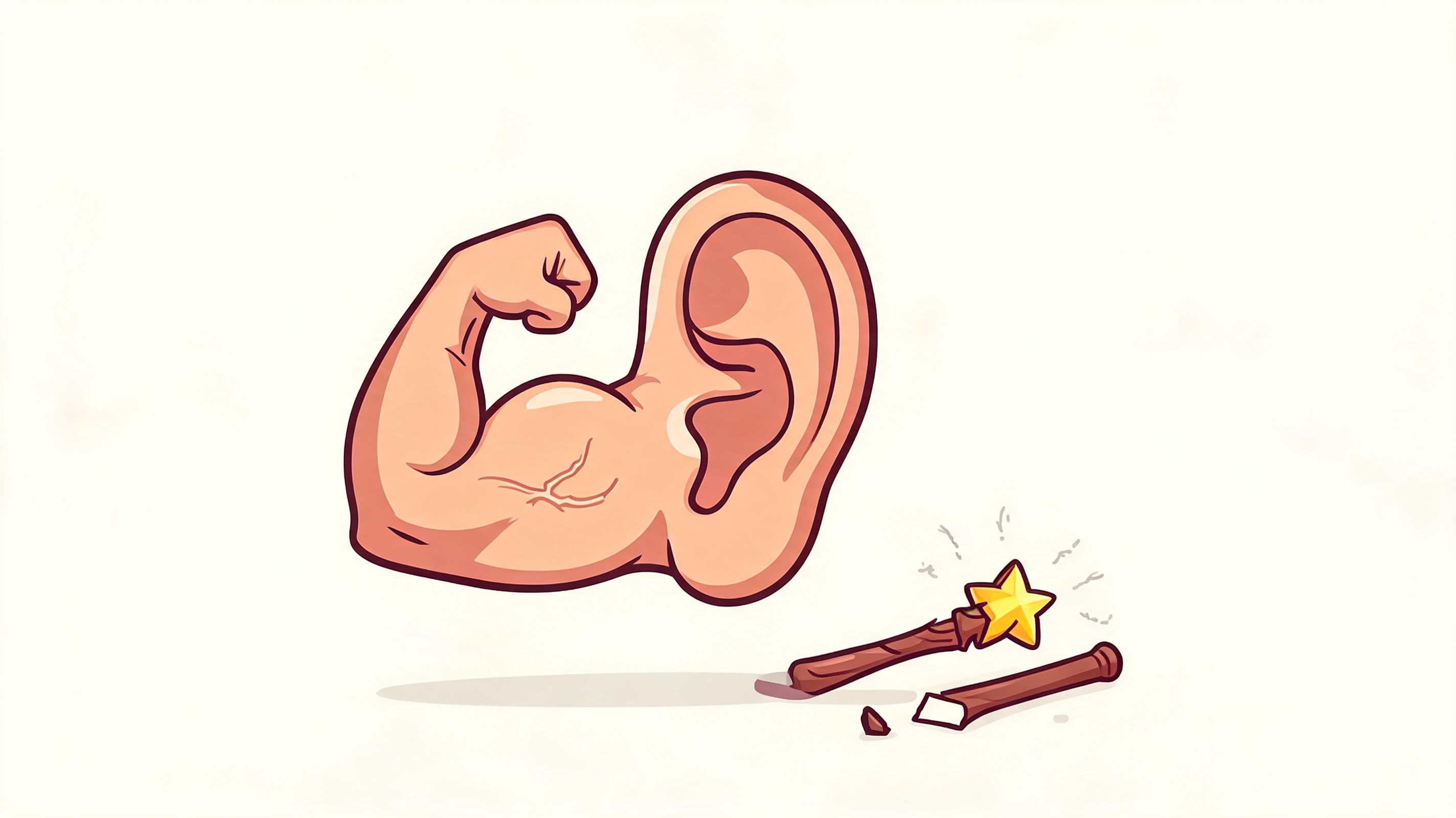
Your Ear Is a Muscle Not Magic
A lot of players assume ear training is a gift you either have or do not have. That belief stops progress before practice even begins.
Playing by ear depends far more on relative pitch than perfect pitch. Perfect pitch is the ability to name a note with no reference at all. Relative pitch is the ability to hear how notes and chords relate to each other. That is the skill musicians use in actual songs, because songs are built from movement, contrast, tension, and release.
Language works as a good comparison. At first, an unfamiliar language sounds like one blur of sound. Then your brain starts noticing repeated words, familiar rhythms, and common patterns. Music works the same way. Your ear learns to sort a busy sound into pieces you can recognize and name.
Relative pitch is the most useful skill
If someone plays a C major chord and then an A minor chord, relative pitch helps you notice that the mood changed. One chord feels more settled and bright. The other feels softer, darker, or more reflective. You may not know every note yet, but you are already hearing something meaningful.
That matters because chord recognition is not just a theory exercise. It is a listening exercise. In a sound-first approach, you begin by noticing character and function. How does the chord feel? Does it sound like home, like motion, or like a question that wants an answer?
Those are trainable observations.
Relative pitch helps you:
- Play with other musicians: You hear the direction of the harmony instead of waiting for chord names.
- Learn songs faster: You narrow your choices by sound, not blind trial and error.
- Improvise more musically: Your hands start following what you hear.
Many students relax when they understand this. The goal is not to become a human note-scanner. The goal is to connect what you hear to something you can use on your instrument.
You are not trying to guess more cleverly. You are teaching your ear to notice clearer patterns.
Trainable means repeatable
An untrained ear is not a broken ear. It is just an ear that has not had enough focused repetition.
That is why short daily practice works so well. Hear a chord. Label its color. Check your answer. Repeat. Over time, your brain starts storing those sounds the way it stores familiar voices. Major, minor, suspended, and dominant chords stop feeling random because each one leaves a different emotional fingerprint.
This is also why many players get stuck when they study theory before they study sound. Theory gives you names. Your ear gives those names meaning. Once both start working together, progress feels much less mysterious.
If you have spent years telling yourself, “I am not one of those people,” replace that thought with a better one. “I have not trained this yet.”
That sentence leaves room for growth.
The First Step Always Start with the Bass
When you listen to a full chord, there’s a lot happening at once. The fastest way to reduce that complexity is to go straight to the lowest note.
That note is the bass.
The bass gives your ear something solid to hold onto. In real songs, it’s usually easier to follow than the notes stacked above it. That’s why the single-note method works so well. Beyond the Guitar’s explanation of the single-note chord identification method shows that players can identify a whole chord by hearing just one note first, then using theory and trial-and-error to narrow down the options.
Why the bass note matters most
If you’ve ever felt overwhelmed trying to hear all the notes in a chord, this is the fix. Don’t hear everything. Hear the foundation first.
On guitar, try muting the strings and just singing the lowest moving note in a song. On piano, play along one note at a time until you match the bottom of the chord. If you don’t play an instrument, hum the bass movement while the song plays.
This changes your listening from “What chord is that?” to “Where is the ground moving?”
That question is much easier to answer.
A few things happen when you focus on bass first:
- The song starts to feel organized: You hear direction instead of a wall of harmony.
- Your guesses get smaller: Once you know the bass note, fewer chords are possible.
- Progressions become easier to track: The movement from one chord to the next starts making sense.
Listening shortcut: If the chord feels blurry, drop your attention downward. The bass often tells the clearest story.
A simple exercise you can do today
Use any song with slow chord changes. Pause after the first chord. Then try this:
- Hum the lowest note you can hear.
- Find that note on your instrument or piano app.
- Write down only the bass movement for four chords.
- Replay the song and check whether the pattern repeats.
After that, add the harmony back in and test likely chord types above each bass note.
For a quick visual example of the idea in action, this lesson is useful:

Keep the practice plain. Don’t jump to advanced jazz voicings or dense arrangements right away. Rooted, simple songs teach your ear faster because the bass line is easier to trace.
Once you can follow the bottom note, chord recognition stops feeling random.
Learning the Emotional Color of Each Chord
You hear a chord, find the bass, and still feel unsure. That usually means the missing piece is color.
Chord quality is the color of the harmony. It is the difference between a doorway that feels open, a room that feels shaded, and a moment that feels unstable enough to make you wait for what comes next. Your ear can learn those colors the same way it learns familiar voices. By hearing them often, comparing them directly, and attaching each sound to a clear feeling.
Theory names these sounds. Your ear recognizes them first.
Major and minor are the first contrast to learn
Start with the two chord qualities that show up everywhere. Major tends to feel open, settled, and clear. Minor tends to feel more inward, heavier, or reflective. Those words are not strict rules, but they give your ear something useful to hold onto.
A good comparison is light in a room. The furniture may be the same, but changing the light changes the whole mood. The root stays the same when you play C major and C minor. What changes is the emotional tint.
That is why sound-first practice works. You are not trying to memorize a spelling test. You are learning to notice how the air changes when the chord changes.
Here’s a simple map of the main chord colors:
| Chord type | What it often feels like | What to listen for |
|---|---|---|
| Major | Stable, bright, settled | Openness and release |
| Minor | Inward, serious, reflective | A darker emotional center |
| Diminished | Tight, tense, uneasy | A sound that feels unstable |
| Augmented | Strange, floating, unresolved | A widened sound with no easy resting point |
Context still matters. A major chord can sound bittersweet in one song and triumphant in another. A minor chord can sound tender instead of sad. The goal is not to force one emotion onto every chord. The goal is to notice the family resemblance.
Train by contrast. Play the same root as major, then minor, and ask what changed in the feeling before you name the chord.
If you want a deeper explanation of why these sounds affect listeners so strongly, this guide to how chords shape musical emotion connects harmony to what we feel when we listen.
How to practice chord quality without getting stuck in theory
Keep one note on the bottom and swap the chord quality above it. Play C major, then C minor. Stay there until the difference feels obvious in your ear and body.
Then build the exercise in layers:
- Round one: Alternate major and minor on the same root.
- Round two: Add diminished, then augmented.
- Round three: Describe the feeling out loud before naming the chord.
- Round four: Test yourself with random playback inside Trill and answer by sound first, label second.
That last step matters because real songs do not pause and announce the answer. Daily practice in short bursts helps you respond to the sound in real time.
Many learners get thrown off here by inversions. A chord may sound less obvious when the notes are rearranged, even if its quality stays the same. That does not mean your ear is failing. It means you are hearing the chord in a different shape, like recognizing the same friend in different clothes. Start with root-position triads, then revisit the same qualities in new voicings so the color stays familiar even when the surface changes.
Different musicians can practice this in different ways. Singers can label the feeling aloud. Guitarists can move one triad shape across a fretboard set. Producers can loop a drum beat and switch chord qualities over one bass note. Pianists can play blocked triads, then spread them out and check whether the emotional color still comes through.
What matters is daily contact with the sound. A few focused minutes will teach your ear more than a long session of guessing.
When chord quality becomes something you can feel, recognition gets faster, steadier, and much less mysterious.
How to Learn Thousands of Songs with Four Chords
You sit down with a song you love, ready to figure it out by ear, and after a minute you notice something surprising. The harmony is not a parade of random chords. It keeps circling through the same few sounds.
That pattern is one of the biggest reasons playing by ear becomes easier faster than many learners expect.
According to Improvise For Real’s guide to recognizing chords by ear, a huge amount of popular music relies on four familiar harmonic functions: 1, 4, 5, and 6-. Those numbers matter more than the letter names, because they describe the job each chord does inside the key.
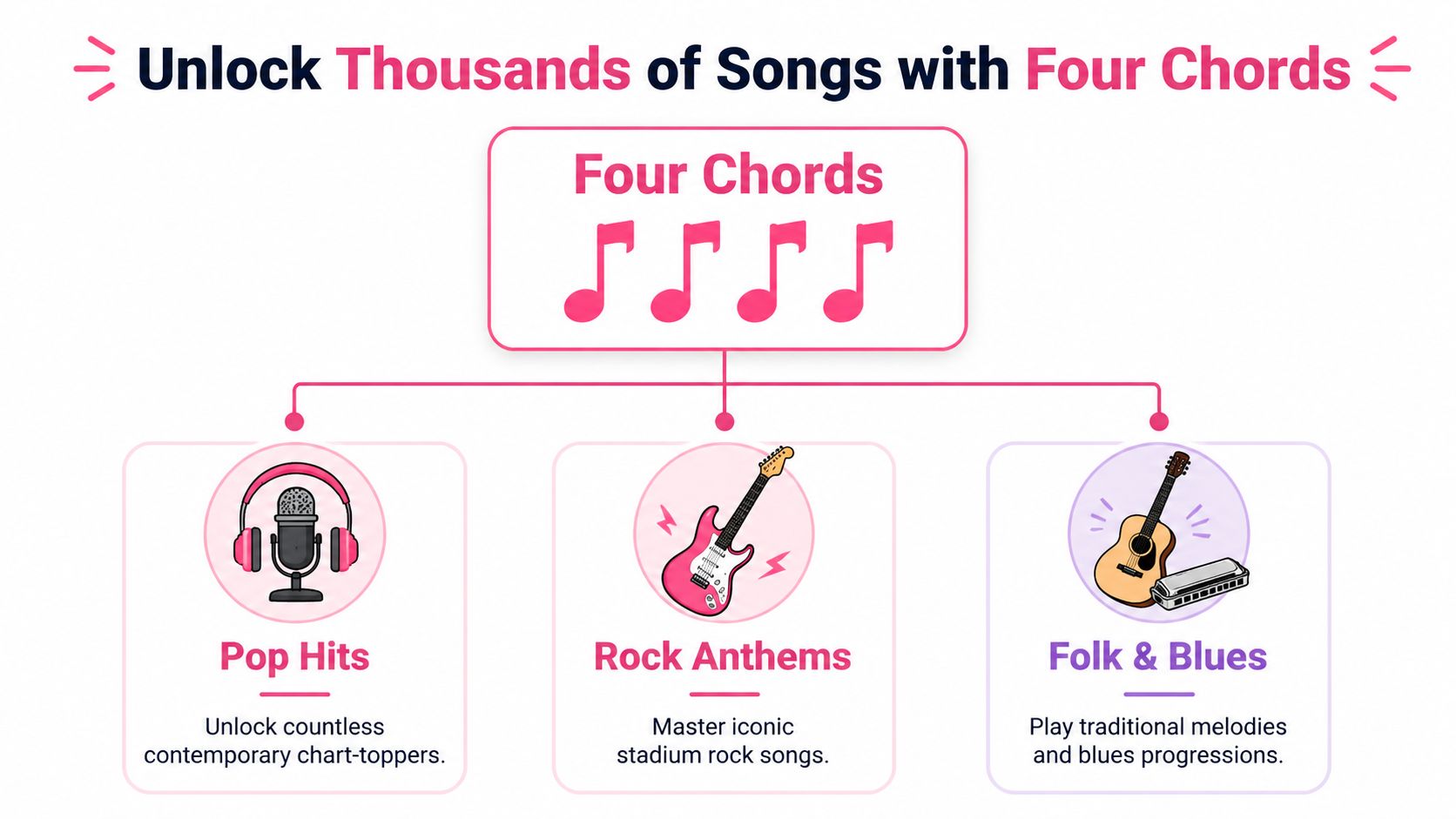
If you train your ear to recognize those four functions by sound, many songs stop feeling like puzzles and start feeling like familiar conversations.
The four sounds that appear again and again
Each of these chords has a distinct emotional character. That is the sound-first shortcut.
- 1 chord: Home. Settled. The place where the music can rest.
- 4 chord: A gentle move away from home. It feels open, like the song is stepping outward.
- 5 chord: Tension and direction. It creates a strong urge to resolve.
- 6 minor chord: A softer, more reflective color that still belongs to the same key family.
Those descriptions may sound simple, but they are practical. In real songs, your ear often catches the feeling of a chord before it catches the label.
A good comparison is storytelling. The 1 chord feels like the main room in the house. The 4 chord walks into the hallway. The 5 chord reaches for the doorknob. The 6 minor chord turns the lights dimmer and changes the mood without leaving the house entirely.
Hear the role, then name the chord
Many learners get stuck because they try to identify chords as isolated facts. C major. G major. A minor. That approach can work on paper, but songs move too quickly for that to be your first filter.
Function is faster.
Try this in one key. Play 1 and let it settle in your ear. Play 4 and notice the sense of lift. Play 5 and listen for the pull forward. Return to 1 and feel the release. Then add 6 minor and notice how the song becomes more inward or wistful while still sounding connected.
| Function | Feeling in the song | What your ear may notice |
|---|---|---|
| 1 | Home base | “This sounds settled” |
| 4 | Opening outward | “The song is expanding” |
| 5 | Tension and pull | “It wants to resolve” |
| 6- | Reflective color | “This feels more tender or emotional” |
That is the skill to practice. Hear the role first. Name it second.
A daily way to make these four chords familiar
Use one progression and repeat it in several keys. For example, play 1, 5, 6-, 4 in C, then in G, then in D. The note names change. The emotional pattern stays the same.
A short Trill session can be particularly helpful. Set up drills that loop these four functions in random keys, then answer based on sound and feeling before checking the label. A few focused minutes each day teaches your ear to recognize the family resemblance between songs.
After a week or two, you will start noticing these same functions in music you already know. That moment matters. It shows that ear training is not about memorizing more theory terms. It is about hearing how songs are built from a small set of familiar emotional moves.
The Hidden Skill Hearing Inversions and Seventh Chords
A lot of musicians can identify clean root-position triads in practice, then freeze when they try real songs.
The missing piece is often inversions.
An inversion happens when the bass note is not the root of the chord. So the chord may still be major or minor, but the bottom note changes the weight and shape of the sound. That makes the harmony harder to identify if you only trained on tidy textbook examples.
Why inversions trip up good musicians
This frustration is common for a reason. Musical U’s discussion of chord ear training points out that recognizing chords in inversions is a major pain point, and that 40-60% of chords in popular songs appear inverted.
If you’ve ever said, “I can identify chords in drills, but not in songs,” that may be exactly what’s happening.
The fix is not to abandon the bass-first method. The fix is to refine it.
Try this approach:
- First, identify the bass note anyway: Even when it isn’t the root, it still gives you a reliable anchor.
- Next, test the chord quality above it: Ask whether the chord still sounds major, minor, or more complex.
- Then, separate bass from identity: The lowest note may describe the voicing, not the chord’s true root.
Real music doesn’t arrange chords for your convenience. Your ear has to learn to hear through the voicing.
How seventh chords change the flavor
Seventh chords add another layer of color. They often sound richer, jazzier, more soulful, or more tense than plain triads.
You don’t need to start by naming every subtype instantly. Start with the broad feeling. Does the chord sound complete like a triad, or does it have an extra note that adds pull, softness, or sparkle?
A useful drill is to compare these pairs on the same root:
- Major triad vs. major seventh
- Major triad vs. dominant seventh
- Minor triad vs. minor seventh
Listen for how the chord’s identity stays related while the emotional texture changes.
Inversions and seventh chords are where many intermediate players lose confidence. Stay patient there. These sounds become clearer once your ear stops demanding perfect root-position examples.
Your 10-Minute Daily Ear Training System
You don’t need a huge practice block to improve. You need a short routine you’ll repeat.
Ten minutes is enough if the listening is focused.
A practical daily routine
Use this structure:
-
Minute 1 to 2
Sing or hum a single note and match it on your instrument. This settles your attention. -
Minute 3 to 4
Listen to a simple song and track only the bass movement. Don’t name full chords yet. -
Minute 5 to 6
Compare major and minor chords on the same root. Say the quality out loud before you check yourself. -
Minute 7 to 8
Play a four-chord progression in one key and identify the function by feel. Hear home, departure, tension, and release. -
Minute 9 to 10
Test one inversion or one seventh chord against a plain triad. Ask what changed in the sound.
That’s enough for a daily ear training habit. Short sessions work because they keep your attention sharp and reduce burnout.

How to make the habit stick
Consistency gets easier when the routine has structure. Some musicians use a piano, voice memos, and a keyboard app. Others prefer a dedicated system. Trill: Ear Training Daily is one option for short daily ear training sessions, with chord recognition exercises, streaks, instant feedback, and Focus Lock to reduce distractions during practice.
Two habits make the biggest difference:
- Practice at the same time each day: Attach it to coffee, a warm-up, or the first few minutes with your instrument.
- Stop while you’re still fresh: Ear training works better as a daily signal than an exhausting marathon.
If you want to learn how to recognize chords by ear, treat listening like physical training. Reps matter. Frequency matters. Small daily effort compounds into musical freedom.
If you want a simple way to turn these exercises into a daily habit, Trill: Ear Training Daily gives you short ear training sessions built around chord recognition, intervals, notes, and playing by ear. It’s designed for consistent practice, so you can stop guessing and start hearing music more clearly every day.