Can You Develop Perfect Pitch: A 2026 Guide
You hear a song once. You reach for your instrument. Then the guessing starts.
Is that first note the tonic, or am I imagining it? Is the chord major or minor? Why can some musicians seem to hear everything instantly while everyone else has to hunt around?
That question often turns into a bigger one: can you develop perfect pitch?
The short answer is yes, to a point, for some people. But that answer needs context. Perfect pitch isn’t just a magical switch that turns on. It’s better understood as a range of note-hearing abilities, and that changes how you should train.
If your real goal is to play by ear, recognize chords faster, improvise with more confidence, and stop relying on trial and error, then the smartest path is not to obsess over a label. It’s to train your ear every day in a way that improves real musicianship.
Table of Contents
- The Dream of Instant Note Recognition
- Perfect Pitch vs Relative Pitch What Is the Difference
- The Science Behind Acquiring Perfect Pitch
- Your Daily 10-Minute Ear Training Plan
- Realistic Goals and Common Training Pitfalls
- How Trill Creates Your Daily Training System
The Dream of Instant Note Recognition
Most musicians don’t want perfect pitch for bragging rights. They want what they think perfect pitch will give them.
They want to hear a melody and play it back without fumbling. They want to catch chord changes in real time. They want to sing in tune more easily, improvise with less fear, and feel at home inside the sounds they’re hearing.
That’s why the idea of perfect pitch is so powerful. It sounds like a shortcut to musical freedom.
But people often stumble. They frame the whole problem as talent. Either you were born with a special ear, or you missed your chance. That story is discouraging, and it also hides the more useful truth. Hearing music well is trainable.
Practical rule: Don’t ask only, “Can I name isolated notes?” Ask, “Can I hear what the music is doing?”
Those are different goals.
A musician with strong listening skills can often figure out melodies, hear chord quality, notice bass movement, and respond musically on the spot. That kind of ear doesn’t depend on a rare gift. It depends on training, repetition, and learning to connect sound to meaning.
If you’re asking can you develop perfect pitch, a better question might be this: what kind of hearing can you build with steady practice, and which kind helps you most in actual music?
For most players, the answer starts with ear training that makes music clearer day by day. You stop guessing. You start recognizing. Then playing by ear becomes less mysterious and more practical.
Perfect Pitch vs Relative Pitch What Is the Difference
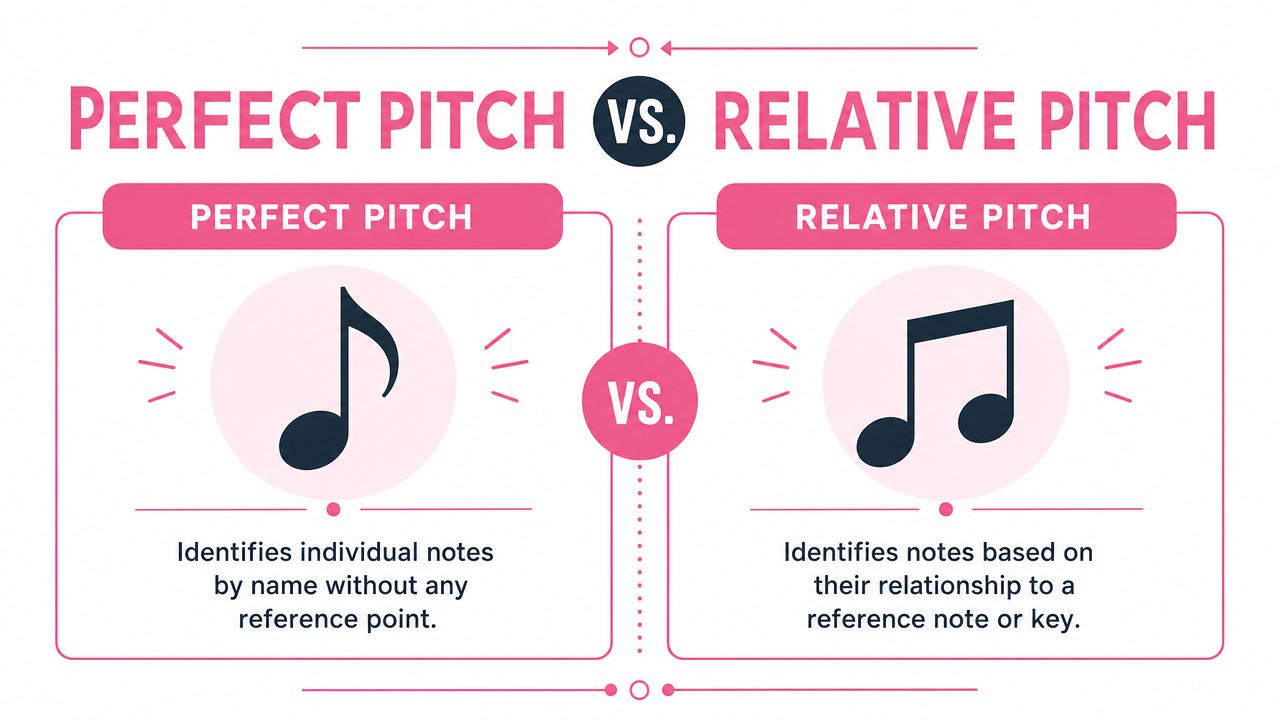
Two ways musicians recognize sound
Perfect pitch, also called absolute pitch, means you can identify or reproduce a note without hearing a reference tone first. If someone plays an F-sharp out of nowhere and you know it’s F-sharp, that’s the basic idea.
Relative pitch works differently. You hear one note, then identify other notes by their relationship to it. If you know the starting note is C, and the next note sounds like it rises by a major third, you can work out that the next note is E.
A simple analogy helps.
| Skill | Everyday analogy | Musical result |
|---|---|---|
| Perfect pitch | Knowing a paint color name just by seeing it | Naming a note without reference |
| Relative pitch | Comparing one color to another | Hearing intervals, chords, and movement |
That difference matters because music almost never happens as isolated notes floating in empty space. Music happens in context. Notes pull against a key. Chords create tension and release. Melodies make sense because of how one note leads to the next.
If you want a deeper breakdown, this guide on relative pitch and absolute pitch gives a useful side-by-side view.
Why relative pitch matters more in real music
People often talk about perfect pitch as if it were a single rare superpower. A University of Chicago explainer on perfect pitch notes that it’s often cited as occurring in about 1 in 10,000 people, or 0.01%, but it also points to research showing 4% of music students with perfect pitch and much higher rates in some musician subgroups depending on how the ability is defined. That’s a clue that this skill isn’t as simple as “has it” or “doesn’t.”
It also means the phrase can you develop perfect pitch has a more nuanced answer than most articles give. If pitch labeling exists on a spectrum, then training can help many musicians strengthen parts of that spectrum even if they never become the person who names every random note instantly.
The useful question isn’t whether your ear becomes perfect. It’s whether your hearing becomes reliable.
Relative pitch does that job every day.
With strong relative pitch, you can:
- Hear intervals clearly so melodies become easier to copy on your instrument
- Recognize chord quality so major, minor, and seventh sounds stop blending together
- Track progressions so songs make more sense as moving harmony, not random shapes
- Play by ear faster because you hear function and movement, not just isolated pitches
This is why ear training should center on relationships between sounds. That’s where musical freedom lives.
The Science Behind Acquiring Perfect Pitch
A lot of confusion comes from the phrase itself. People hear “perfect pitch” and imagine one fixed trait. Research points to something more layered.
What researchers mean by absolute pitch
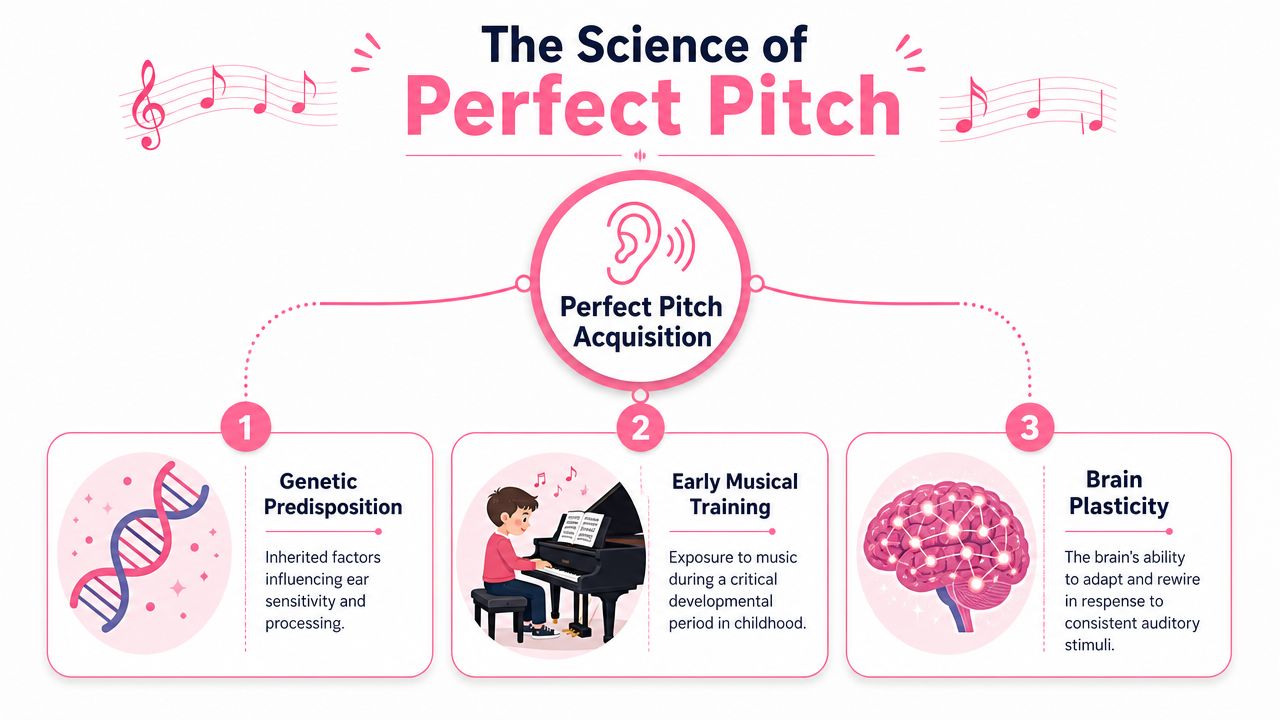
A review in PMC describes early musical training as strongly associated with absolute pitch acquisition. The same review also supports a polygenic predisposition and reports a segregation ratio of 0.089, while also confirming that adult learning is possible. In plain language, biology may influence how easily someone learns this skill, but training and environment still matter.
That’s a much more practical way to think about it.
You don’t need to choose between “it’s all genetic” and “anyone can fully master it with enough grit.” The evidence suggests a middle ground. Some people may start with advantages in perception, memory, or categorization. But the brain also learns to connect a heard pitch to a label through repeated exposure and focused listening.
The ability itself also isn’t one single behavior. The overview of absolute pitch describes it as the ability to identify or reproduce a note without a reference tone, and notes that it can show up as naming, mental categorization, or accurate reproduction. That’s important because a learner might improve in one area before another.
For example, you might get better at singing a target pitch from memory before you get fast at naming random notes on a piano.
A related read on musicians with perfect pitch and ear training helps place this idea in a musician’s daily practice context.
What this means for adult learners
Adults usually want a yes-or-no answer. Can I still build this skill, or not?
Here’s the honest version. Adults can improve pitch memory, note labeling, and pitch reproduction. What varies is how far those abilities go and how stable they become under pressure.
This video gives a helpful visual explanation of how musicians think about the skill in practice.
What matters most is this: adult training still changes your hearing. You can become more accurate. You can recall pitches more consistently. You can hear note color more clearly. You can connect sound and label more quickly than before.
Your ear isn’t a lottery ticket. It’s a system you train.
That doesn’t mean every adult will end up with flawless absolute pitch. It means the skill can be developed in parts, and those parts are musically useful.
If you’ve been waiting for permission to train seriously because you thought the window had closed, you don’t need that old story anymore.
Your Daily 10-Minute Ear Training Plan
Most musicians don’t need a heroic practice session. They need a repeatable one.
A simple practice loop that works
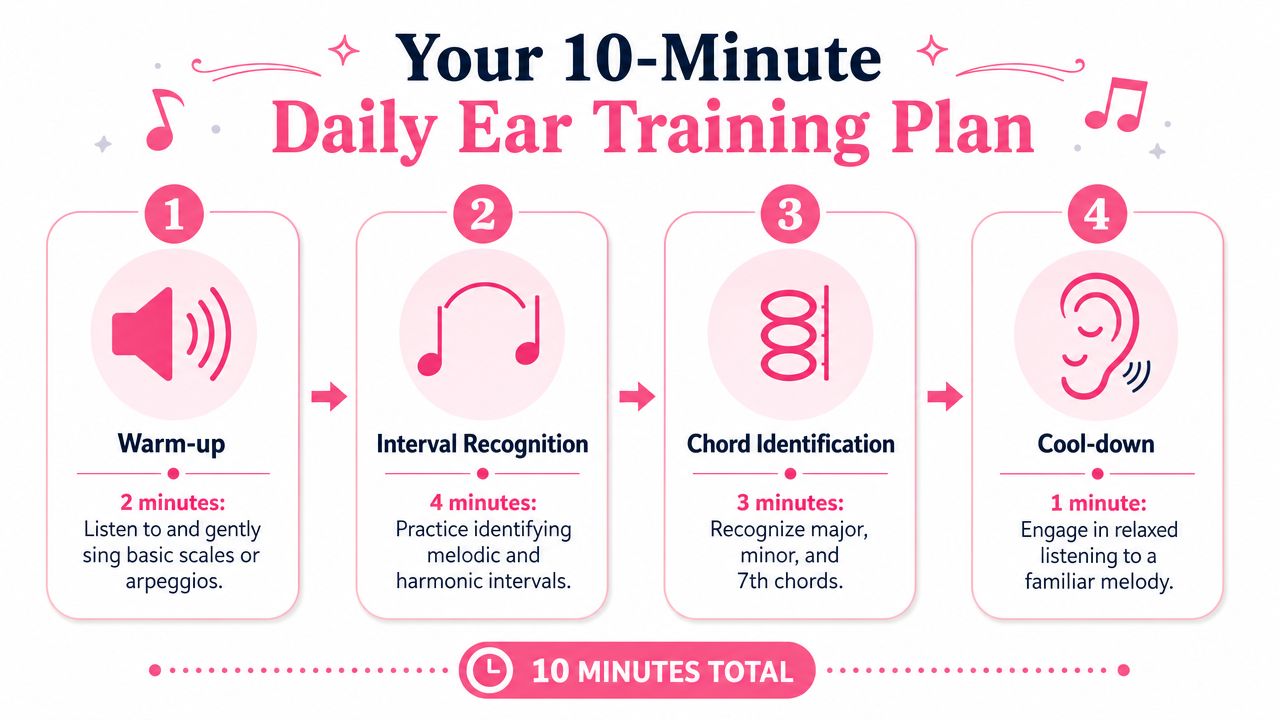
Use this 10-minute ear training routine every day. Keep it short enough that you won’t skip it.
-
Warm up for 2 minutes
Play a simple scale or arpeggio on piano, guitar, or a training app. Sing along softly. Don’t judge your voice. Just lock your attention onto the sound and try to match it cleanly. -
Train intervals for 4 minutes
Work with a small set, not all intervals at once. Start with easy contrasts like unison versus octave, then major third versus minor third, then perfect fifth. Hear them melodically and harmonically if you can. -
Practice chord recognition for 3 minutes
Listen for the sound of major, minor, and seventh chords. Don’t treat them like theory flashcards. Ask what each one feels like. Bright? Dark? Stable? Tense? -
Cool down for 1 minute
Put on a familiar melody and listen actively. Try to hear the first note, the direction of the melody, and the chord mood under it.
This routine builds useful layers of hearing at once. Singing strengthens pitch matching. Interval work sharpens relationships. Chord recognition helps you play by ear in real songs.
How to make the exercises musical
A lot of ear training fails because it becomes abstract too fast.
Don’t just label sounds. Attach them to music you know. If you’re learning a major third, connect it to the opening leap of a familiar tune. If you’re training minor chords, listen for them in songs you already play. If you’re working on note recall, sing the target note, then check it on your instrument.
Try these practical versions:
- For note memory: Choose one home note for the week. Hum it several times during the day, then check it later.
- For intervals: Sing from the root up to the target interval and back down again.
- For chords: Arpeggiate the chord after you identify it so your ear hears its internal shape.
- For playing by ear: Pause a song after a short phrase and find the melody by singing first, then playing.
Don’t train your ear to pass a quiz. Train it to solve musical problems faster.
That’s when the practice starts paying you back.
A weekly focus that keeps you improving
Instead of changing everything every day, keep one theme for a full week.
| Week focus | Main question | Real-world payoff |
|---|---|---|
| Pitch matching | Can I sing what I hear? | Better vocal tuning and instrument intonation |
| Intervals | Can I hear distance between notes? | Easier melody learning |
| Chord quality | Can I hear the mood of harmony? | Faster comping and accompaniment |
| Progressions | Can I hear where chords want to go? | Better improvisation and song learning |
If you want structure, use tools that organize these categories and give immediate feedback. A keyboard, a drone, a tuner, and a focused ear training app can all help. The key is consistency.
Do this daily and you’ll notice a change that matters more than a perfect-pitch test. Songs start sounding less blurry. Chords stop feeling random. Your hands find notes faster because your ear got there first.
Realistic Goals and Common Training Pitfalls
The biggest mistake in this whole topic is chasing an idealized version of perfect pitch while ignoring the listening skills that make music easier right now.
What a good goal actually looks like
A strong goal for most musicians is not “I will instantly name every note forever.” A stronger goal is something like this:
- I want to hear chord quality without guessing
- I want to sing back notes more accurately
- I want to learn melodies by ear faster
- I want to improvise based on what I hear, not finger memory
Those goals are trainable, practical, and intrinsically connected to musicianship.
A Musical U article on learning perfect pitch makes this point clearly. For most musicians, it’s more effective to spend time on relative pitch instead of chasing absolute pitch. Prioritizing interval, chord, and progression recognition gives more immediate value for skills like playing by ear and improvising.
That doesn’t mean note-label training is useless. It means it shouldn’t crowd out everything else.
Mistakes that slow your ear down
Some pitfalls show up again and again.
-
Overfocusing on isolated note names
If all your practice happens with random single tones, you may get better at a narrow test while staying weak at hearing songs. -
Practicing too long, too rarely
Ear training responds well to daily exposure. A short session every day usually beats one big session that leaves you mentally fried. -
Listening passively
Background music doesn’t count as ear training. Active listening means you ask a question and try to hear the answer. -
Skipping singing
Even if you’re not a vocalist, singing connects your inner hearing to your body. That link matters. -
Treating mistakes like proof you lack talent
Wrong answers are part of ear training. They aren’t evidence that you can’t improve. They show you where your ear still needs reps.
A better ear is usually built by boring consistency, not dramatic breakthroughs.
If you keep your focus on practical listening, you’ll make progress you can use on your instrument. That’s the point.
How Trill Creates Your Daily Training System
Knowing what to practice isn’t always the hard part. Doing it every day is.
One option is to build your own setup with a keyboard, notebook, metronome, and a list of exercises. Another is to use a structured system that handles the daily sequence for you. Trill: Ear Training Daily is one example. It focuses on note recognition, intervals, chords, scales, and pitch-matching through short sessions with feedback.
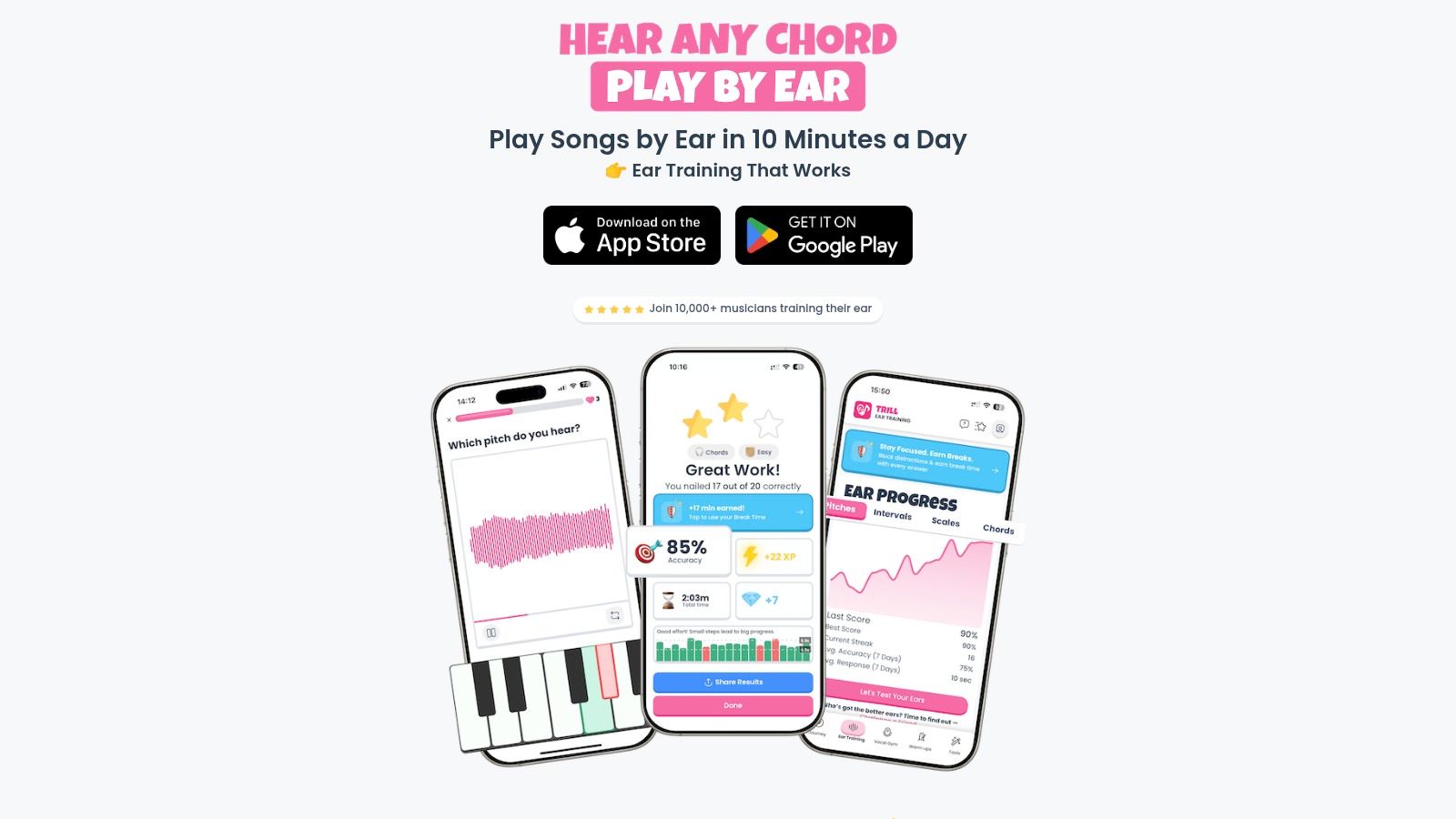
That kind of setup fits the training principles above for a simple reason. Ear training works better when the practice is easy to start, short enough to repeat, and clear enough that you know what you got right and wrong.
A daily system is useful when it helps you do four things:
- Show up consistently because the session is already prepared
- Repeat key sounds often so your memory gets stronger
- Recall actively instead of just reacting passively
- Connect skill to music through intervals, chords, and progressions you can hear in songs
For a beginner, that means less time wondering what to do. For an intermediate player, it means keeping your ear sharp without turning practice into a planning project. For singers, producers, and musicians, it creates one place to work on hearing instead of guessing.
The main point is not the app itself. It’s the habit loop. If a tool helps you train your ear for 10 minutes a day, hear more clearly, and play by ear with more confidence, it’s serving the right job.
If you want a simple way to turn ear training into a daily habit, Trill: Ear Training Daily offers short guided practice for notes, intervals, chords, scales, and pitch matching so you can spend less time guessing and more time hearing music clearly.