How to Develop Perfect Pitch: Pro Secrets

Perfect pitch used to be treated like a musical superpower you either got at birth or never got at all. That story no longer holds up.
A 2025 study reported by the University of Chicago found that adults improved pitch naming through structured training, with pitch-naming accuracy increasing by 128.1% and two participants reaching full mastery comparable to natural perfect pitch possessors after an eight-week program (University of Chicago explainer on perfect pitch research). That should change how you think about ear training.
If you want to know how to develop perfect pitch, start with a simpler idea. Learn to hear music accurately every day. Learn to match pitch, hear intervals, recognize chord color, and stop guessing. Perfect pitch sits on top of that work. It doesn’t replace it.
Most musicians don’t need magic. They need a repeatable system, a few minutes a day, and enough patience to let hearing catch up with intention.
Table of Contents
- The Myth of Perfect Pitch Is Officially Broken
- Build Your Relative Pitch Foundation First
- Your 10-Minute Daily Ear Training System
- Progressive Exercises from Intervals to Note Naming
- Your 12-Week Practice Plan and How to Track Progress
- Frequently Asked Questions About Ear Training
The Myth of Perfect Pitch Is Officially Broken
Perfect pitch is not reserved for a tiny, chosen group. Adults can train note naming, improve it in measurable ways, and build a skill that was long treated as fixed.
That shift matters because the old story stopped capable musicians from training their ears at all. If you were told the window closed in childhood, you were likely to treat absolute pitch as trivia instead of a practical skill.
What changed
The conversation changed once researchers tested adults with structured training instead of assumptions. In the University of Chicago summary of a 2025 study, adult musicians completed an eight-week online program totaling more than 21 hours. By the end, participants identified an average of seven pitches at 90% accuracy or better, and two participants identified all twelve pitches with near-native speed and precision (University of Chicago explainer on perfect pitch research).
I would not oversell that result. It does not mean every adult will develop full absolute pitch in two months. It does mean the old claim, that adults cannot meaningfully train this skill, no longer holds up.
That is a practical difference, not a philosophical one.
For working musicians, the useful question is not whether perfect pitch is mystical. The useful question is whether your ear can improve with focused repetition. Modern evidence says yes, and good training systems make that improvement more likely because they pair consistent exposure with immediate feedback.
What this means for working musicians
This changes how practice should be organized.
Absolute pitch training works best when it is treated like ear conditioning. Short daily reps, stable reference points, careful recall, and enough repetition for note labels to stick in long-term memory. That is why app-based training can help adults. It gives you frequent, controlled exposure without turning every session into a random guessing contest.
The trade-off is real. Chase isolated note naming too early and many musicians become quick at guessing while staying weak at hearing context. Build the ear in the right order and note naming starts to attach to a stronger internal sense of sound. If you need a clearer distinction, relative pitch and absolute pitch training serve different jobs.
Adults who succeed at this usually do boring things well. They sing reference notes. They test themselves briefly every day. They correct mistakes immediately. They come back tomorrow.
The myth is broken. Good. The better question now is simple: what can you train your ear to recognize more reliably today than it recognized yesterday?
Build Your Relative Pitch Foundation First
Most musicians who ask how to develop perfect pitch are asking for something broader. They want to play by ear, hear chord changes faster, sing in tune, and stop feeling lost without sheet music.
That starts with relative pitch.
What perfect pitch does and does not do
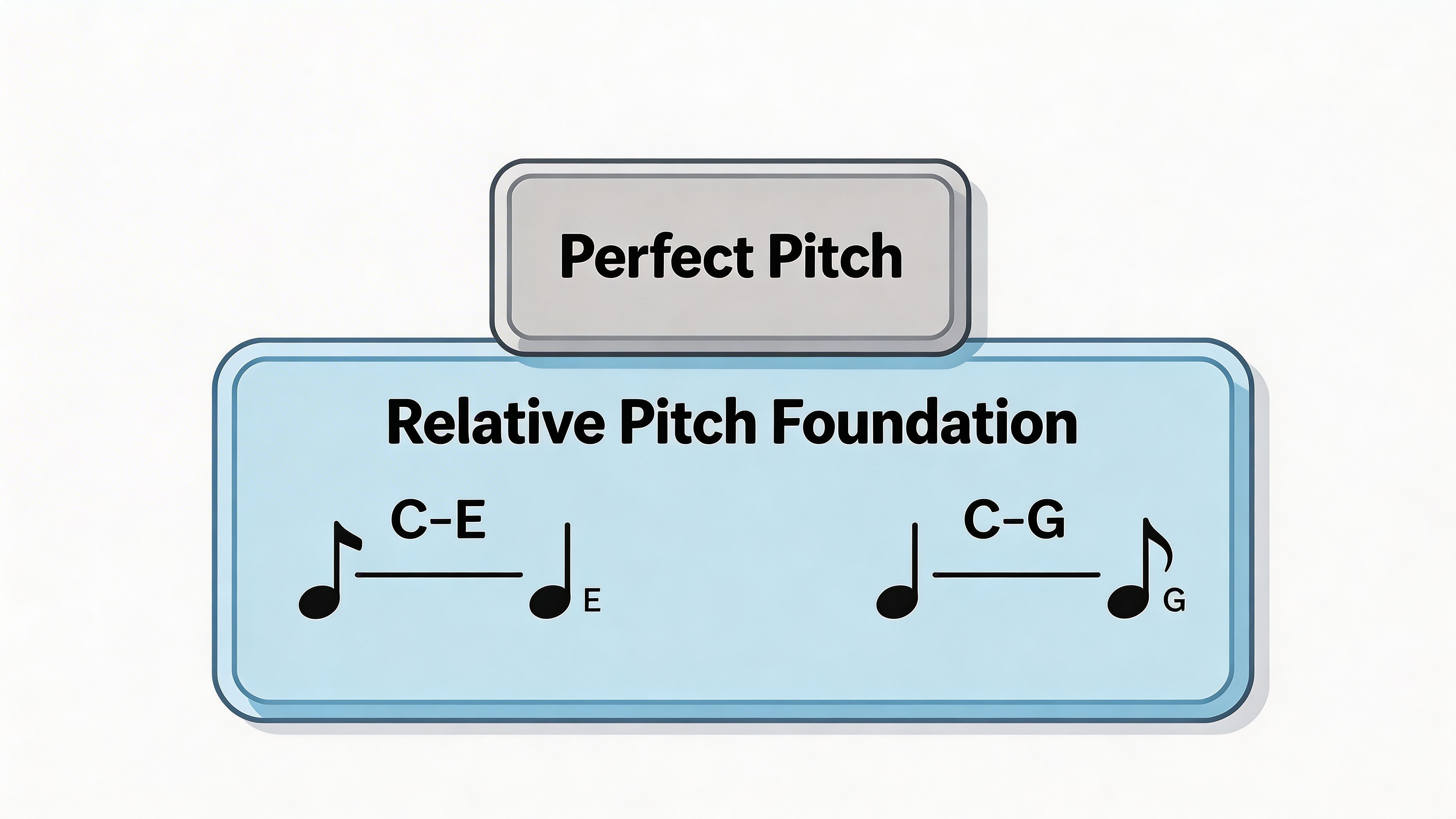
Perfect pitch means naming a note in isolation. You hear a sound and identify it as C, F sharp, or B flat without a reference.
Relative pitch means hearing relationships. You hear that one note moved up a third. You hear that the chord changed from major to minor. You hear that the melody resolved instead of hanging.
In real music, relative pitch does more of the heavy lifting.
A singer with strong relative pitch can lock into harmony faster. A guitarist can find a progression by hearing function. A producer can transcribe a hook by hearing contour and interval movement. That’s why interval ear training in practical music theory is such a useful starting point.
Why relative pitch comes first
Research summarized by the American Psychological Association showed a striking difference in note-labeling ability across language backgrounds. 63% of Mandarin-speaking music students named notes accurately at a high level, compared with 7% of English-speaking American music students, which suggests pitch labeling is strongly shaped by early exposure and learning rather than fixed talent (APA Monitor report on pitch and language exposure).
That matters for one reason. Pitch labeling is learned behavior.
If you didn’t grow up attaching stable labels to pitch, your ear needs a bridge. Relative pitch is that bridge.
Here is the order I use with students:
- Hear direction first. Can you tell whether the note went up or down?
- Hear distance next. Was it close, or was it a leap?
- Hear quality after that. Does this sound stable, tense, bright, dark, major, minor?
- Label last. Once the sound means something, the name sticks better.
A lot of stalled practice comes from reversing that order. Players jump straight to flash-card note naming. They memorize answers without hearing function.
This short demonstration is worth studying before you do your next practice block.

If you can’t hear a major third inside a melody, naming isolated C sharp won’t help much on a bandstand.
Build the foundation first. It doesn’t slow down perfect pitch training. It makes it usable.
Your 10-Minute Daily Ear Training System
Long sessions feel serious. Daily sessions get results.
If you only have ten minutes, that’s enough. The point is to train hearing every day, not to wait for the perfect practice window and do nothing for three days.
A simple daily routine
Use the same structure every day for a while. Your brain learns faster when the routine is familiar.
-
One minute of pitch matching
Play a note on piano, keyboard, or tuner app. Hum it back. Don’t rush. Stay on one pitch until your voice settles. -
Two minutes of interval hearing
Listen to two notes. Say whether they moved up or down, then identify the interval if you can. -
Two minutes of chord quality
Alternate major and minor triads. Hear the emotional color before you name it. -
Three minutes of anchor-note work
Pick one note you want to internalize. Sing it, check it, reset, and repeat. -
Two minutes of real music
Put on a simple song and find the first note, bass note, or tonic by ear.
That last part is where ear training stops being abstract. You’re training for songs, not quizzes.
What consistency changes
The strongest practice habit is the one that survives ordinary days.
Research summarized in the provided material states that inconsistent practice can halve gains in frequency following response, a brain measure linked to sound processing, and that gamified apps can triple adherence (essay discussing perfect pitch training and adherence). Put plainly, your ear improves when you return before yesterday’s work fades.
A simple daily system helps because it removes decision fatigue.
- Use the same time slot. Morning coffee, lunch break, or right after work. Pick one.
- Keep one instrument nearby. If setup takes effort, practice gets skipped.
- Track completion, not mood. You don’t need to feel inspired to do ten minutes.
- Stay focused. If you’re using Trill: Ear Training Daily, use its daily lessons and Focus Lock as a way to ring-fence those ten minutes and get through a structured session without distractions.
The biggest mistake isn’t practicing too little on one day. It’s turning ear training into an on-again, off-again hobby.
Some days will feel sharp. Some won’t. That doesn’t mean the session failed.
Good ear training is often quiet. You repeat. You check. You correct. Then one day you hear a chord change in a song you used to miss, and you realize the work has been accumulating the whole time.
Progressive Exercises from Intervals to Note Naming
Don’t train note naming as an isolated stunt. Build it in layers.
The cleanest model I know is the Pitch Ladder, a 7-stage progression that moves from basic pitch detection to accurate vocal reproduction. It begins with hearing high versus low, passes through timbre-based identification and clear absolute recognition, and warns against skipping steps because unstructured practice leads to a 70% dropout rate (Pitch Ladder method overview).
That sequence matches what I see in practice. People improve fastest when each drill prepares the next one.
Start with hearing direction and distance
Your first job is not naming notes. Your first job is hearing movement.
Try these exercises:
-
High or low drill
Play two notes. Answer only one question. Did the second note go up or down? -
Near or far drill
Once that becomes easy, decide whether the move was stepwise or a leap. -
Sing the gap
Hear two notes, then sing them back slowly. Feeling the distance in your voice helps lock in the sound.
This stage seems simple, but it matters. If the ear can’t hear shape, labels won’t stick.
Move into chords and function
After intervals, start hearing vertical sound.
Use triads first. Major and minor are enough at the beginning. You’re not trying to win a theory contest. You’re trying to hear quality without guessing from mood words alone.
A few practical drills:
- Major versus minor comparison
Alternate the same root with major and minor quality. Listen for the shift in color. - Root plus chord
Play the root note first, then the full triad. This helps tie the sonority to a stable anchor. - Song application
Pause recordings and ask, “Did the harmony brighten, darken, or stay stable?”
When this gets easier, start hearing common progressions by function. If you can hear home, tension, and return, you play by ear much faster.
Hear what the chord is doing before you worry about what the chord is called.
Bridge from reference notes to isolated note naming
Many players get impatient at this stage. Don’t.
Absolute note recognition often grows out of repeated contact with a few stable references. Pick one note and make it familiar. Sing it. Hear it on one instrument. Check it after a short pause. Repeat daily.
A practical progression looks like this:
-
Choose one anchor note
Middle C works well for many players because it sits comfortably in the voice and on the keyboard. -
Match and verify
Sing the note before checking. The check matters more than the guess. -
Add one contrasting note
A second anchor creates separation. You begin to feel one note’s identity against another. -
Use one timbre first
Piano is often the easiest place to start because familiar timbre supports recognition better than artificial sounds, as noted in the earlier research summary. -
Test in short bursts
Randomize a few notes. Name one. Reset. Don’t machine-gun guesses. -
Sing the named note back
Hearing and producing reinforce each other.
A lot of bad practice happens here.
- Don’t cram all twelve notes immediately. That turns the exercise into confusion.
- Don’t depend on visual clues. Looking at keys weakens the listening.
- Don’t let relative pitch do all the work. If you always compare from a fresh reference, you never build note identity.
The true aim isn’t fast guessing. It’s stable recognition.
When you can hear a note, sing it, and verify it without tension, you’re building something durable.
Your 12-Week Practice Plan and How to Track Progress
Most musicians improve when the plan is simple enough to repeat and clear enough to measure. You don’t need a heroic overhaul. You need a timeline that tells you what to practice this week and what progress should look like.
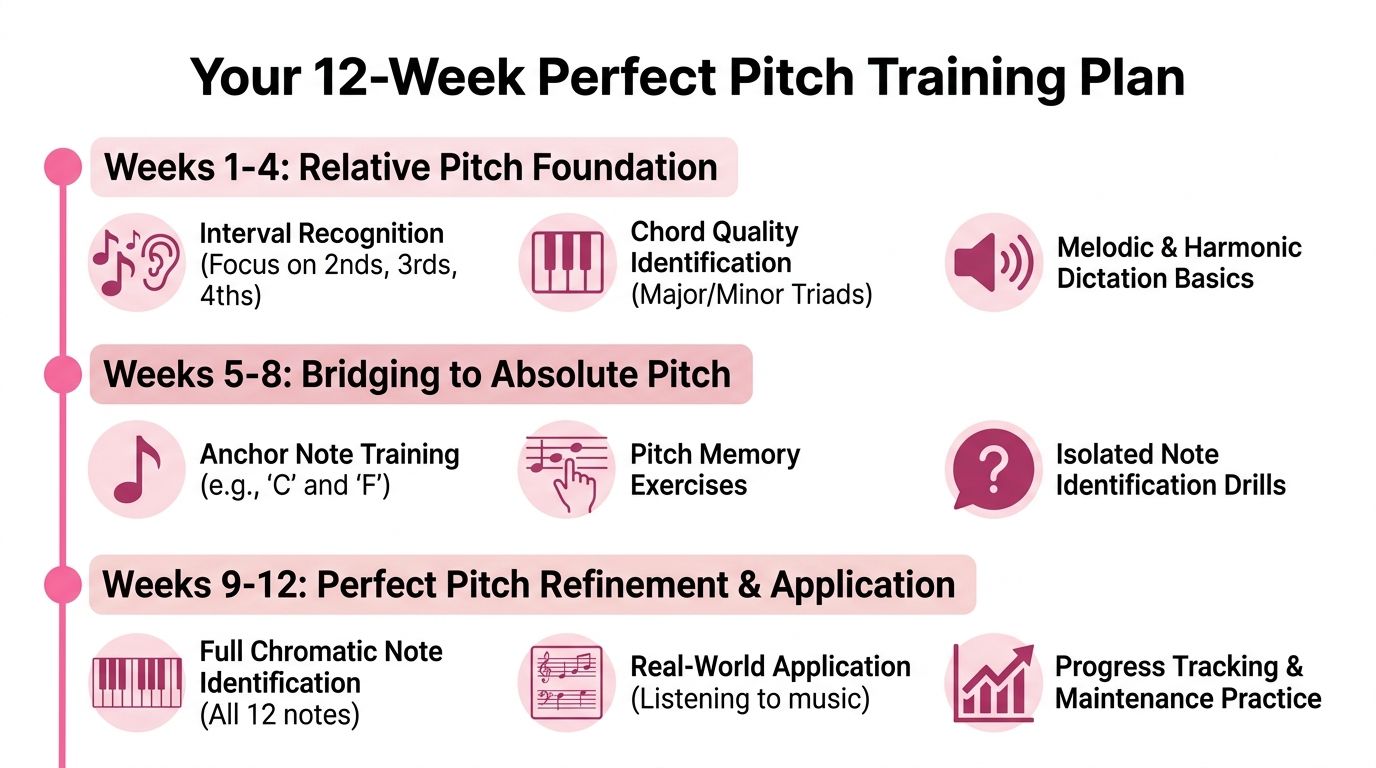
A practical training timeline
Think in three phases.
Weeks 1 to 4 are for relative pitch basics. Your goal is hearing motion, interval size, and simple chord quality.
Weeks 5 to 8 connect those listening skills to fixed anchors. You begin building stronger pitch memory around one or two notes.
Weeks 9 to 12 apply the skill in music. You test note recognition more directly, but you keep the musical context alive through songs, bass lines, and melody fragments.
If you want accountability, a dedicated music practice tracker app can help you log whether you did the work, which drills felt solid, and where your hearing still slips.
Sample 12-week ear training plan
| Weeks | Primary Focus | Daily Exercise (10 min) | Milestone |
|---|---|---|---|
| 1 to 4 | Relative pitch foundation | Pitch matching, up or down drills, interval recognition, major or minor triads | You stop relying on random guesses and begin hearing basic movement consistently |
| 5 to 8 | Bridging to absolute pitch | Anchor-note singing, note memory checks, isolated note drills with a small note set | One or two notes start to feel familiar before you verify them |
| 9 to 12 | Perfect pitch refinement and application | Expanded note naming, singing named notes, identifying notes and chords inside real songs | You can carry note recognition into actual listening and playing situations |
How to measure real progress
Use practical checkpoints, not vanity metrics.
Here are better questions than “Do I have perfect pitch yet?”:
- Can you match a single note faster than before?
- Can you hear whether a melody moved by step or leap without hesitating?
- Can you tell major from minor more reliably in isolation and in songs?
- Can you hold an anchor note in memory briefly, then check it?
- Can you figure out the first note or bass note of a simple song by ear?
Those changes matter because they transfer.
A player who hears intervals better improvises more cleanly. A singer who matches pitch faster rehearses more efficiently. A songwriter who hears chord movement more clearly writes with more freedom.
Common plateaus usually come from one of three problems:
-
Too much variety
Constantly changing drills prevents deep familiarity. -
Too much speed
Quick guessing feels productive but often hides weak hearing. -
Too little review
New material is exciting, but retention comes from revisiting old sounds until they’re automatic.
Keep one short log after each session. Write what you missed, not just what you completed.
That note matters. If you always miss descending intervals, or you confuse one anchor note with another, the pattern tells you what to repeat tomorrow.
Progress in ear training is rarely dramatic from day to day. Over several weeks, though, your hearing becomes less foggy. That’s the shift you want. More clarity, less guessing, and more control when music is moving in real time.
Frequently Asked Questions About Ear Training
Am I too old to learn this
No.
Adult learners can improve their pitch labeling and listening accuracy. The bigger issue isn’t age. It’s whether practice is structured, regular, and honest. Adults often do well because they can follow a system and listen with intention.
How long until I notice a difference
Usually sooner than full note naming arrives.
Most players notice changes first in pitch matching, interval recognition, chord hearing, and their ability to play by ear in simple songs. If you practice daily, the early wins tend to show up as less hesitation and fewer random guesses.
Can I train with just a piano
Yes.
A piano or keyboard is enough to start. A tuner can help with singing checks. An app can help with structure, randomization, and tracking. The tool matters less than whether you use it consistently and whether the drills move from simple to demanding in the right order.
What if I keep guessing wrong
Then slow down.
Wrong answers aren’t the problem. Fast, careless answers are the problem. Hear the note, sing it back, commit to a choice, and verify it. If you’re missing the same sounds repeatedly, narrow the drill. Fewer notes. One timbre. More repetitions.
Is perfect pitch the main goal
For most musicians, no.
The primary goal is hearing music clearly enough to respond in real time. That includes pitch accuracy, chord recognition, melodic memory, and harmonic awareness. If absolute note naming grows from that process, great. If your relative pitch becomes strong enough to let you improvise, transcribe, and play with confidence, that’s already a major musical gain.
Should I practice even on bad ear days
Yes.
Bad ear days are part of training. Keep the session short. Strip it down to pitch matching and one listening drill. The habit matters because it keeps the sound fresh in your memory and makes tomorrow easier.
If you want a daily system for ear training, Trill: Ear Training Daily is built around short sessions that help musicians recognize intervals, chords, notes, and scales through regular practice. If your goal is to play by ear with more confidence, a simple routine you can stick to is what moves the needle.