How to Transpose Music & Play Any Song in Any Key
You’re usually not trying to “do transposition” in the abstract.
You’re trying to make a song fit a singer. You’re trying to move a riff to a friendlier guitar key. You’re trying to hear a melody once and play it somewhere else without freezing. That’s why learning how to transpose music matters. It’s not a theory stunt. It’s a working musician’s skill.
Most explanations start on paper. They tell you to count semitones, rewrite notes, or use software. Those tools help. But if your ear isn’t involved, you can end up with the right answer and still not feel where the music is going. For jam sessions, rehearsals, church gigs, songwriting, and playing by ear, that gap shows up fast.
Table of Contents
- Why Transposing Is Really About Musical Freedom
- The Secret to Transposition Is Hearing Intervals
- Transposing Melodies by Number and by Ear
- How to Hear and Transpose Chord Progressions
- Quick Transposition Tricks for Live Performance
- Your Daily 10-Minute Transposition Workout
Why Transposing Is Really About Musical Freedom
A common rehearsal problem goes like this. The band starts a song in the original key, and the singer says, “Can we take that down a bit?” If you only know chord shapes or memorized note names, everything suddenly feels unstable. If you hear relationships, it’s manageable.
This is the fundamental value of transposition. It lets you keep the same musical idea while moving it to a new starting point. The melody still feels like itself. The chords still pull the same way. The groove still works. Only the key changes.
Existing content on transposition often leans heavily on visual methods and software, which leaves a gap for musicians who want to improvise or jam without scores. An ear-first approach is worth taking seriously because it can build relative pitch faster in practice settings. One summary of that gap notes 25 to 40% faster interval recognition after 10 daily sessions for ear-based work, in the context of auditory training and transposition by ear, as discussed in this overview of music transposition tools and the limits of visual-first methods.
Practical rule: If you can hear what stayed the same when the key changed, you’re actually learning transposition.
Paper methods still matter. You should know how to count intervals, spot a key signature, and double-check a chart. But those are support skills. In live music, nobody pauses the room so you can rebuild the song from scratch.
A better target is this: hear the song as movable relationships. Hear “up to the fifth,” not only “from C to G.” Hear “the four chord wants to resolve,” not only “that’s F major.” That’s the skill that helps you play by ear, back up singers, improvise, and stop depending on luck.
The Secret to Transposition Is Hearing Intervals
If transposition feels slippery, intervals are usually the missing piece.
An interval is the distance between two notes. That sounds technical, but in practice it’s simple. Intervals are what your ear recognizes when a melody rises, falls, opens up, or tightens. They are the part of the song that survives when the key changes.
Intervals are the sound of distance
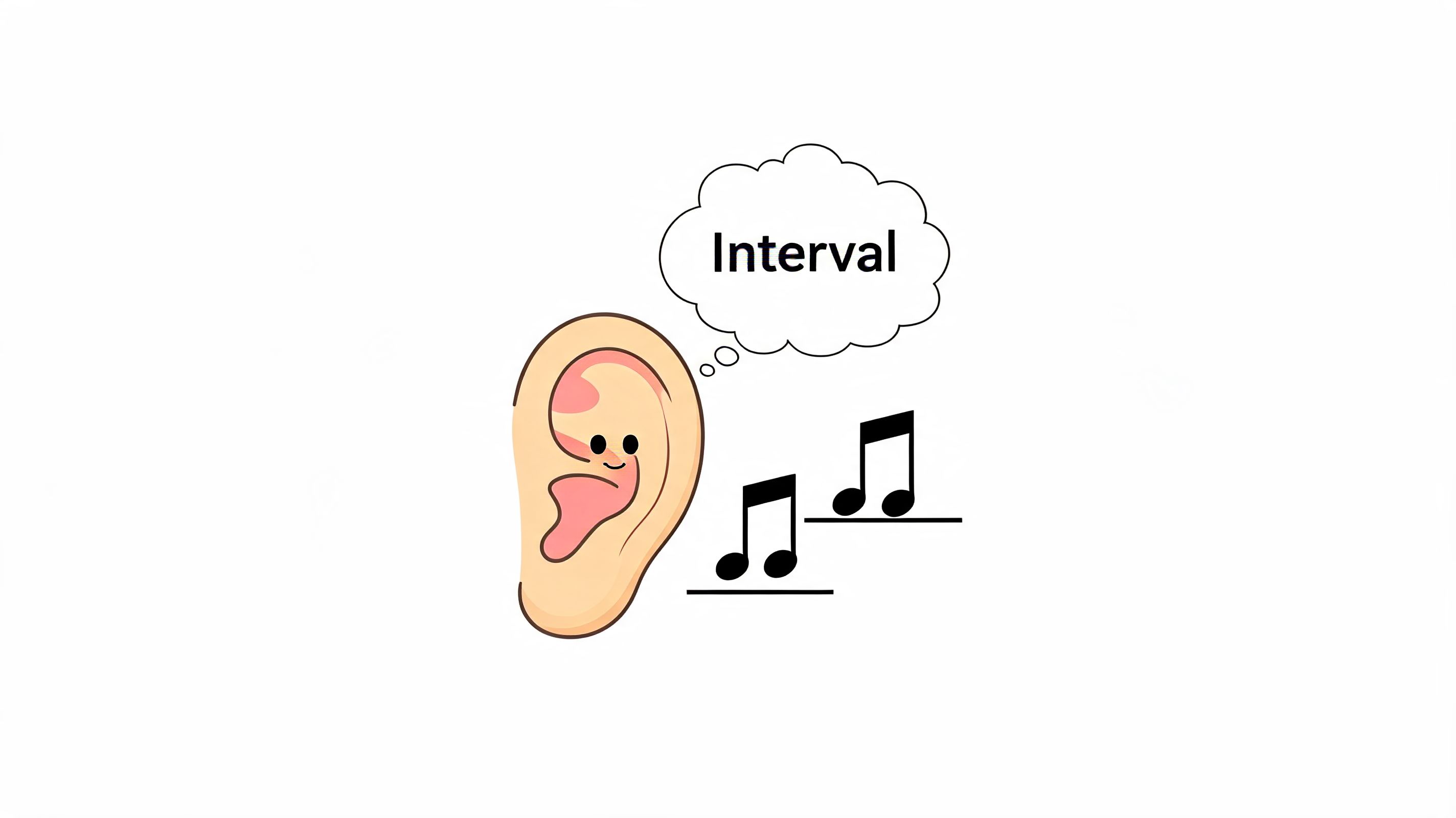
Western transposition relies on the 12-semitone chromatic scale, and a perfect fifth is always +7 semitones within that system. That consistency is what makes it possible to move a melody or chord shape cleanly into a new key. A summary of this framework also notes that daily practice can lead users of ear training apps to 85% accuracy in identifying transpositions within 4 weeks. You can read that in EarMaster’s explanation of semitones and interval structure.
You don’t need perfect pitch for this. You need to hear distance and direction.
Try thinking of a few common intervals like this:
- Perfect fifth feels open and settled. It’s the jump many people hear at the start of familiar children’s songs.
- Major second feels like a nearby step.
- Minor third has a darker, more reflective color.
- Octave feels like the same note moved higher or lower.
Those labels matter less than the sound. If you hear a melody as “same note, up a step, back down, leap upward,” you’re already closer to real transposition than someone who only memorized note names.
Train your ear before your fingers
A lot of players make the same mistake. They transpose with their hands first and hope their ear catches up later. That often creates guessing.
A better sequence is:
- Sing the first note
- Sing the next note’s distance, not just the target pitch
- Name the interval if you can
- Play it after you hear it
This can be slow at first. That’s normal. Ear training is trainable, and repetition matters more than talent myths.
If you want a focused way to drill this, an interval training tool for hearing note distances can help you connect the label, the sound, and the physical response on your instrument.
Don’t ask, “What note is that?” first. Ask, “How far did it move?”
That one shift changes everything. It’s also the doorway into playing by ear with more confidence, whether your long-term goal is improvisation, chord recognition, or even building stronger pitch memory than you thought you could.
Transposing Melodies by Number and by Ear
For melodies, the cleanest method is to stop thinking in note names for a moment and start thinking in scale degrees.
That means you hear the notes of the key as numbers: 1, 2, 3, 4, 5, 6, 7. The first note of the scale is 1. The second is 2. And so on. Once a melody becomes a pattern of numbers, you can start it on a different note and keep the pattern intact.
Turn notes into scale degrees
Take a simple tune like “Happy Birthday.” Instead of storing it as fixed note names, hear it as a sequence of positions in the key. That makes it movable.
Here’s the practical process:
-
Find the home note
Sing or play the note that feels like rest. That’s your 1.
-
Map the melody against that home note
Ask whether the next note is the same, a step up, a skip, or a return.
-
Play the same pattern in a new key
If the melody starts on 5 in one key, it should start on 5 in the next key too.
Playing by ear becomes much easier. You’re no longer trapped by “What was the original note?” You’re following a shape and a function.
A melody is portable when you hear its pattern, not when you memorize its spelling.
If you want more help building that kind of listening, this guide on ear training and learning to play by ear fits well with number-based melody work.
Use notation as a check, not a crutch
There’s a place for written transposition. When melodies get more chromatic, or when you’re reading parts, a visual method keeps you honest. In more advanced melodic transposition, players shift every note by a fixed interval and adjust the key signature. One summary of that approach notes that experienced players can get under 5% error by visualizing the staff as a movable grid, and that daily solfege practice can raise transposition accuracy to 95% by internalizing interval movement aurally, as described in this practical guide to mastering transposition.
That’s useful. But the ear-first lesson is even more useful.
When a melody moves up a minor third, hear that color. When it climbs by step, hear the tension build. When it lands on the tonic, feel the release. If you only move notes on paper, you may transpose correctly and still not recognize the song when someone changes key in real time.
A strong exercise is to sing a short melody in one key, then immediately sing it higher or lower without touching your instrument. After that, check yourself by playing it. That order matters. Ear first. Fingers second. Page third.
How to Hear and Transpose Chord Progressions
Melodies are one part of transposition. Harmony is where a lot of players either become flexible or stay stuck.
If you can hear chord function, you can move an entire song quickly. If you only remember chord names, every new key feels like new material. That’s why Roman numerals matter. They give you a hearing-based map of what each chord is doing.
Roman numerals let you hear function
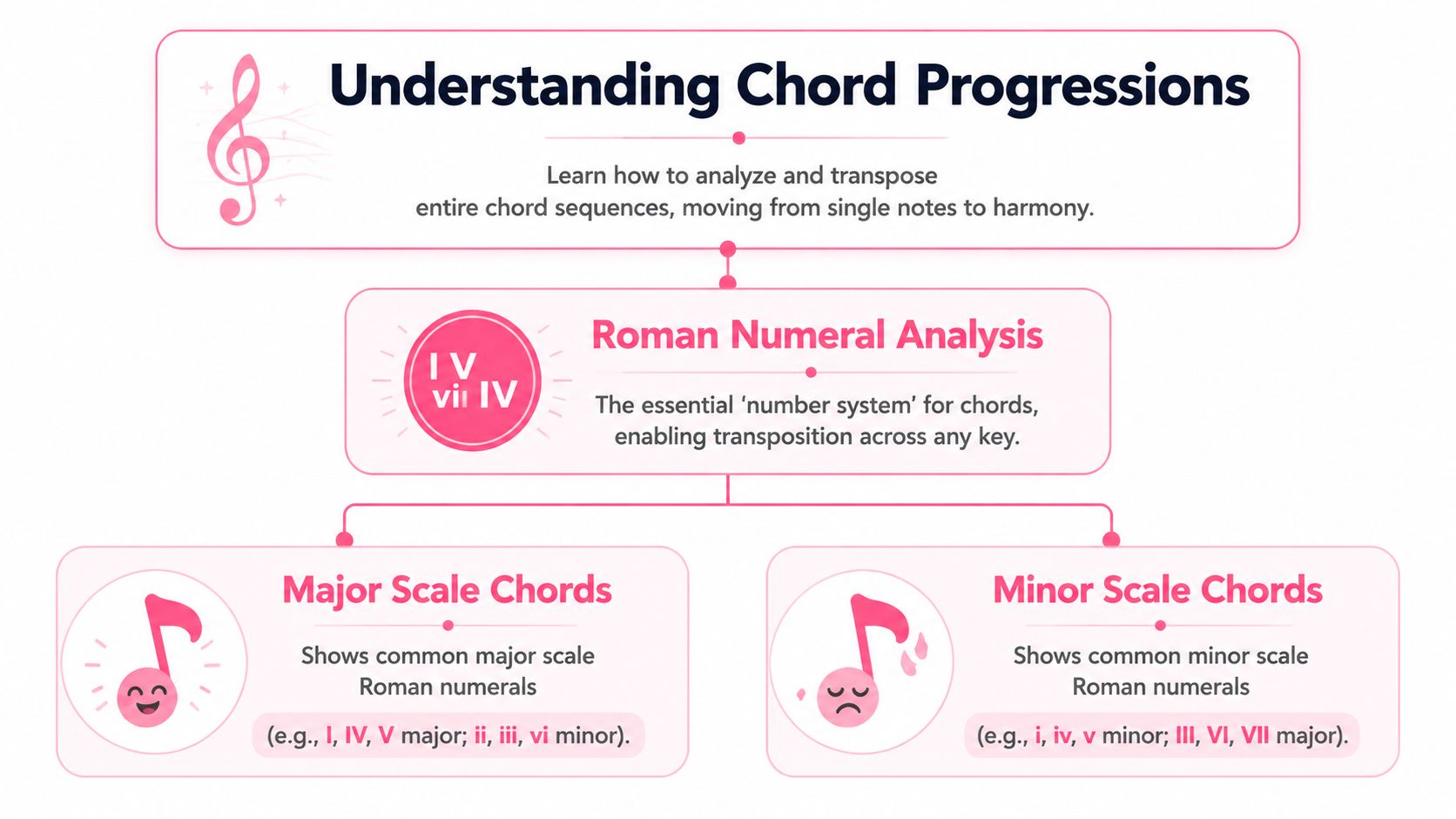
In a major key, chords can be labeled with Roman numerals like I, ii, iii, IV, V, vi, vii°. That turns a chord progression into a movable pattern. C, F, G, Am in C major becomes I, IV, V, vi. Move to G major, and the same pattern becomes G, C, D, Em.
That’s not just theory shorthand. It’s a hearing shortcut. You start to recognize the pull of the I chord, the lift of the IV chord, the tension of the V chord, and the emotional color of the vi chord.
Using Roman numerals this way helps musicians shift keys mentally, and one practical summary reports 92% accuracy in mental transposition after 2 weeks of daily practice with this method. The same summary notes that this kind of pattern recognition is used in 85% of jazz standards, which shows how central it is to real repertoire. See this breakdown of transposing progressions with Roman numerals.
For extra work on hearing harmony rather than guessing shapes, this article on ear training for chord recognition is a useful companion.
What works in real songs
If you’re a guitarist or pianist, start with progressions you already know by feel.
A few strong examples:
-
I to V to vi to IV
This is one of the most common pop movements. Learn to hear its emotional arc, not just one key’s chord names. -
I to IV to V
This is direct, stable, and common in folk, rock, and early pop. It’s one of the best starting points for transposing by ear. -
vi to IV to I to V
Same family, different center of gravity. The song feels different even though the harmonic material overlaps.
A simple way to practice is to listen to a song and ask two questions. First, where does “home” sound like? Second, which chord sounds like it wants to leave home, and which one sounds like it wants to return?
When you hear function, chords stop being isolated facts and start behaving like characters in a story.
What doesn’t work well is relying only on fretboard shapes, keyboard patterns, or chord apps. Those can help you start. They won’t teach you to hear a progression across keys. The goal is to recognize the movement itself so you can follow a singer, adapt in rehearsal, and accompany without panic.
Quick Transposition Tricks for Live Performance
Some situations don’t give you time for deep analysis. The singer counts off. The band starts. You need a fast answer.
That’s where a few practical shortcuts earn their place.
What each shortcut is good for
A capo is the obvious guitar solution. It lets you keep familiar chord shapes while changing the sounding key. For singer-songwriter work, casual gigs, and quick acoustic adjustments, it’s hard to beat.
A keyboard transpose button is useful for rehearsal and certain live settings. It can save time when you need a fast key change and don’t want to rethink fingerings on the spot.
The Circle of Fifths is the fastest mental map when you need to understand the new key, not just survive it. It visually organizes the 12 major keys and helps you find key signatures quickly. One summary notes that Circle of Fifths training improved musicians’ transposition speed by 67% and highlights its value for transposing instruments and for singers who need a song shifted by a few semitones. See this practical guide to using the Circle of Fifths for transposition.
Here’s a simple comparison:
| Tool | Best use | Main weakness |
|---|---|---|
| Capo | Fast guitar key changes | Doesn’t train hearing by itself |
| Transpose button | Quick keyboard adaptation | Can become a dependency |
| Circle of Fifths | Mental map for keys and signatures | Useless if you never connect it to sound |
Use tools without weakening your ear
The trade-off is simple. Shortcuts help performance. They don’t automatically build musicianship.
If you always reach for the button, you may never learn to hear that the song moved up a whole step. If you always move the capo and keep the same shapes, you may still struggle to name or hear the actual chords.
A better approach is to use the shortcut, then test your ear. Sing the new tonic. Name the interval of the key change. Identify the new I, IV, and V before you play.
This quick demonstration is worth watching before your next rehearsal:

Use the shortcut for the gig. Do the ear work after the gig so the shortcut doesn’t become the whole skill.
That’s the balance. Practical tools for the moment, ear training for the long game.
Your Daily 10-Minute Transposition Workout
If you want transposition to become instinctive, keep the practice short and daily. Ten focused minutes beats the occasional long session because your ear learns through repetition and recall.
Here’s a routine that works well.
A simple daily plan
-
2 minutes on intervals
Sing and identify small distances. Focus on step, skip, fourth, and fifth. Don’t rush. Hear them cleanly. -
3 minutes on one melody
Pick a simple tune. Find it by ear in one key, then move it to a second key without looking anything up. -
3 minutes on one chord progression
Take a common progression and label it by function. Play it in your original key, then in a new key. -
2 minutes on recall
Put the instrument down. Sing the melody or progression from memory in the new key.
What to pay attention to
Some days the notes will come quickly. Some days they won’t. What matters is whether you’re hearing relationships more clearly than you did last week.
Listen for these signs of progress:
- Less guessing when you search for the next note
- Faster recovery after mistakes
- Stronger chord recognition in familiar songs
- More confidence when someone asks for a different key
You do not need perfect pitch to get there. You need consistency, honest listening, and enough repetitions for your ear to stop treating every key as a separate world.
The long-term result is musical freedom. You hear a song, understand its shape, and move it where you need it. This is the essence of what is meant when one states a desire to play by ear.
If you want a structured way to build that skill every day, Trill: Ear Training Daily gives you short, focused ear training for intervals, chords, notes, and scales. It’s built for musicians who want to stop guessing, strengthen pitch recognition, and learn to play by ear with just 10 minutes a day.