Transpose for Clarinet: Hear Music, Not Just Notes
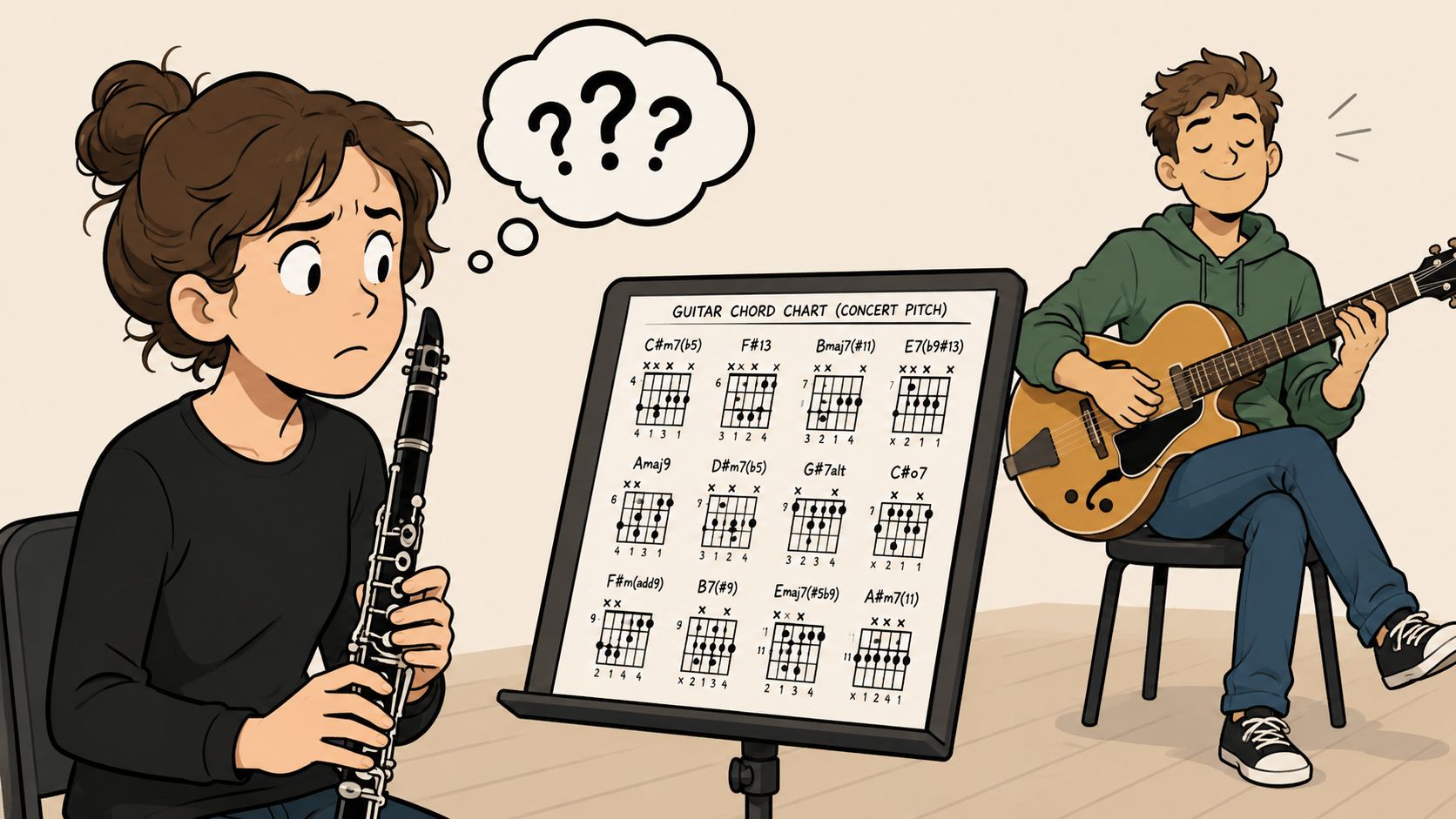
You’re holding a concert-pitch chart, the guitarist is already counting off, and your eyes lock on the first chord as your brain tries to do two jobs at once. Read the harmony. Convert it. Play it cleanly. That’s the moment when clarinet transposition stops being a theory topic and becomes a real musical skill.
Most players start by learning rules. That’s useful. But if you want to transpose for clarinet fluidly in rehearsal, in a pit, at a jam, or when someone says “just take it up,” rules alone won’t carry you very far. The players who do this well aren’t guessing. They’ve trained their ears to hear the interval shift before their fingers move.
That matters because transposition is not just notation management. It’s part of hearing. If you can hear where the music sits, you can respond faster, play by ear more confidently, and make better musical choices without freezing every time the printed key doesn’t match the sounding key.
Table of Contents
- Why Just Move the Notes Up Is Not Enough
- The Nuts and Bolts of Clarinet Transposition
- Train Your Ear to Transpose Instantly
- Actionable Exercises to Build Your Transposition Ear
- Common Transposition Pitfalls and How to Fix Them
- From Transposing to True Musical Freedom
Why Just Move the Notes Up Is Not Enough
A lot of clarinetists know the feeling. Someone hands over a lead sheet meant for piano, guitar, or voice, and you immediately start doing note math in your head. That can work for a few bars. Then the harmony changes, the rhythm gets busy, and the whole thing starts to feel slower than it should.
That frustration makes sense. The clarinet has always been shaped by practical adaptation. The instrument emerged in the 17th century, and a major step came in 1690, when Johann Christoph Denner added a barrel and two keys to the chalumeau. Later, Iwan Müller introduced a 13-key model in 1812, and in the 1840s Louis-Auguste Buffet and Hyacinthe Klosé adapted the Böhm ring system, which is still standard for most clarinets today, except in Germany where it isn’t dominant, as outlined in this history of the clarinet.
Mechanical transposition helps, but it’s slow
If your only strategy is “move everything up,” you’ll eventually hit a wall. You may get the notes right and still sound hesitant, because your ear hasn’t caught up to what your eyes are doing.
That’s why strong transposers don’t rely only on calculation. They hear the relationship first. For a B-flat clarinet, they begin to feel what “up a whole step” sounds like. For an A clarinet, they hear the color of a minor-third shift rather than treating each pitch as a separate puzzle.
Practical rule: If transposition feels stressful every time, the missing piece usually isn’t more theory. It’s faster interval recognition.
Hearing beats guessing
Ear training changes the game. Not because it replaces notation, but because it makes notation usable under pressure. Once you can recognize intervals quickly, transposition becomes more like speaking a familiar language and less like decoding one word at a time.
That’s also why this skill connects so directly to play by ear, improvisation, and even the long-term goal people often describe as perfect pitch. You don’t need rare talent to improve here. You need repetition, listening, and a daily habit that teaches your ear what those interval moves sound like.
The Nuts and Bolts of Clarinet Transposition
Before your ear can take over, your hands and eyes need a reliable map. For most working situations, that starts with knowing what your instrument does to concert pitch.
The most common clarinet is the B-flat clarinet. It’s a transposing instrument, which means the printed note and the sounding note don’t match. Written music sounds one whole step lower than notated, so clarinet parts are written a major second higher than concert pitch, as explained in this guide to transposing instruments and B-flat clarinet notation.
The quick rule you actually use
If you play B-flat clarinet and the band is in concert C, you read in D. If the song is in concert F, you read in G. The practical rule is simple: write or think one whole step higher than concert pitch.
For A clarinet, move the part up a minor third from concert pitch. For many orchestral players, this becomes second nature only after they stop treating it as abstract theory and start hearing the interval shift internally.
A useful workflow is to think in terms of key first, then notes. One practical example shows concert A minor mapping to C minor for A clarinet, then to B minor for B-flat clarinet. That key-first process avoids random note-by-note guessing, as shown in this clarinet transposition workflow.
Clarinet transposition cheat sheet
| Clarinet Type | Transposition Interval (Up) | Example (Concert C becomes…) | Key Signature Change |
|---|---|---|---|
| B-flat clarinet | Whole step, major second | D | Write higher than concert key |
| A clarinet | Minor third | E-flat | Add 3 sharps or remove 3 flats |
| E-flat clarinet | Higher written transposition in practice | Depends on context | Check part against sounding goal carefully |
The B-flat and A clarinet rules above are the ones most players need most often. If you want a broader reference for chart-reading instruments, including a practical overview of B-flat, E-flat, and F instruments, this transposing chart instruments guide is a helpful companion.
Don’t start with the note names. Start with the key center. Your reading gets cleaner much faster.
Why key comes before notes
Players often try to transpose one pitch at a time because it feels safer. In practice, it creates more hesitation. When you identify the concert key first, your brain gets a tonal frame. Then every scale degree has a place.
That’s especially useful when you’re reading chord charts. If the chart says concert B-flat and you’re on B-flat clarinet, think C as your home base before you think about individual chord tones. The result is simpler finger planning, better phrasing, and fewer panic moments when the line moves quickly.
Train Your Ear to Transpose Instantly
A conductor calls for the tune in concert B-flat, you lift the B-flat clarinet, and there is no time to count letter names. In that moment, players who transpose well are hearing the written key and the melodic pull before the fingers move.
That skill can be trained.

Interval recognition is the engine for this skill
Good transposers do not survive by doing faster arithmetic. They hear interval relationships clearly enough that the new key still feels stable. On B-flat clarinet, that usually means hearing everything in written pitch a whole step higher. On A clarinet, it means hearing the line settle a minor third higher on the page while keeping the musical shape intact.
For A clarinet specifically, written pitch sounds 3 semitones lower, so converting concert pitch to written pitch means moving up a minor third and changing the key signature by 3 fewer flats or 3 more sharps, as described in this A clarinet transposition guide.
On the stand, though, theory has to turn into sound. Sing the target note first. Hear the new scale degree against the tonal center. Then play it. That process is slower at first, but it holds up much better in rehearsal than note-by-note conversion.
Daily work builds speed you can trust
I have seen plenty of strong readers freeze when the page disappears or the key changes unexpectedly. I have also seen average readers get comfortable transposing because they spent a few minutes every day singing intervals and checking them on the instrument.
Short, frequent work matters because your ear needs repetition in context. One day, drill major seconds for B-flat clarinet. Another day, drill minor thirds for A clarinet. Then test those sounds with short melodies, hymn tunes, or simple bass lines, where you can hear whether the phrase still points to the right harmony.
For players who want structured daily practice, Trill: Ear Training Daily is one tool built around interval, chord, note, and scale recognition through short sessions. If interval hearing still feels uncertain, this guide to music theory intervals and ear training helps connect the written interval to the sound you need to recognize.
The goal is calm, accurate hearing under pressure.
What instant transposition feels like
When this starts to click, the line stops looking like a puzzle. You begin to track contour, tension, resolution, and scale degree function. If the melody rises to 2 and falls back to 1 in concert pitch, you can feel that same motion in your transposed part without translating every note name first.
That is why ear work changes more than transposition. It strengthens sight-reading, improves intonation, and makes ensemble playing less reactive. Mechanical transposition gets you started. A trained ear is what lets you do it musically.
Actionable Exercises to Build Your Transposition Ear
You don’t build this skill by reading about it once. You build it by hearing, singing, and playing the same interval relationships until they feel normal.
The first exercise is visualized below. Treat it like a daily loop, not a one-time challenge.
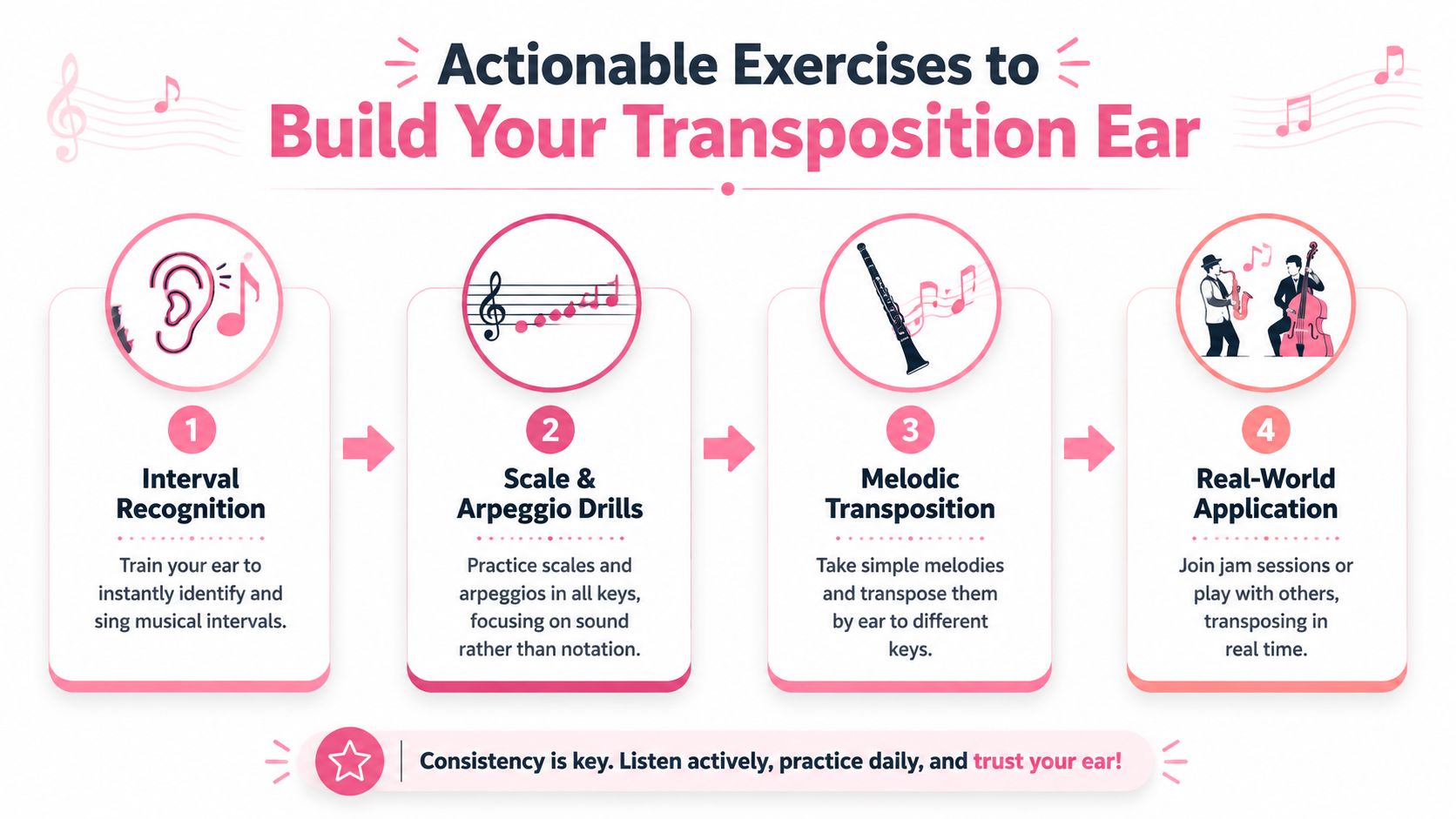
Sing, hear, then play
Pick one interval. Start with the whole step if you mainly play B-flat clarinet.
- Hear a note on piano, tuner, drone, or app.
- Sing the transposed target before touching the clarinet.
- Play what you sang and check if your ear matched your fingers.
This works because it removes guessing. You’re teaching your brain that transposition is a sound first, not a symbol first.
Build a short daily loop
Keep it compact so you’ll be sure to do it.
- Minutes one to three. Sing major seconds up and down from random starting notes.
- Minutes four to six. Play one-octave scales while naming the concert key and your written key.
- Minutes seven to ten. Take a tiny melody and move it into your clarinet key by ear.
For more structured drills, this collection of ear training exercises gives useful practice ideas you can adapt for clarinet.
A short demonstration can also help you hear how players approach this in real musical time:

Use melodies you already know
A familiar tune is better than a complicated etude here. Try a simple melody you can already sing without looking at music.
Start with a melody you can audiate clearly. If you can’t hear it internally, you can’t transpose it reliably.
Take “Mary Had a Little Lamb” or any equally simple tune. First play it in concert pitch on another instrument or sing it. Then, on B-flat clarinet, hear and play it one whole step higher in written form. Don’t write anything down at first. Let your ear lead and let your fingers follow.
Add a real-world layer
Once the simple melody feels easy, move to chord charts. Read the concert key, hear your written key, then improvise using only a few notes from the scale. That’s where transposition starts feeding directly into play by ear, improvisation, and stronger chord recognition.
Consistency matters more than complexity. Ten focused minutes every day trains the habit that rehearsal pressure can’t create on its own.
Common Transposition Pitfalls and How to Fix Them
Most transposition mistakes aren’t about the interval itself. They happen because the notation around the notes gets ignored.
One of the most common problems is forgetting that the key signature must change too, and that every accidental needs to be reconsidered in the new key. A practical guide on transposing key signatures and accidentals points out that many musicians shift notes correctly but still end up with notation that is hard to read or awkwardly spelled.
Three mistakes that cause the most trouble
- Keeping the old key signature. If the notes moved but the key signature didn’t, the part may be technically wrong before the player even reaches measure two.
- Dragging accidentals over mechanically. An accidental makes sense only inside the new key context. Re-check each one instead of assuming it survives unchanged.
- Going the wrong direction. Under stress, players often transpose down because the sounding pitch is lower, when the written part needs to go up.
A cleaner mental checklist
Use this order every time:
- Find the concert key.
- Convert the key signature first.
- Place the notes in the new key.
- Re-read every accidental for readability.
- Play a short phrase and listen for whether it sounds centered.
If the line looks ugly and feels awkward to read, stop and inspect the key signature before blaming your fingers.
Ear training again demonstrates its value. Your ear can often catch a transposition error faster than your eyes can explain it. If the phrase doesn’t sound like it belongs, it probably doesn’t.
From Transposing to True Musical Freedom
Clarinet transposition starts as a practical need. You want to survive the chart, the rehearsal, the quick instrument change, the unfamiliar key. But it becomes something bigger once your ear gets involved.
When you learn to transpose for clarinet by hearing intervals instead of only calculating them, you become more flexible in every musical setting. You follow harmony better. You react faster. You start to play by ear with less fear and more control.
That’s also why daily ear training matters so much. This skill isn’t locked behind talent, and it isn’t reserved for people with perfect pitch. It grows through repeated listening, singing, checking, and playing. A short 10 minutes a day is enough to build momentum if you commit to it.
Musical freedom doesn’t arrive all at once. It shows up when a chart lands on the stand and you don’t tense up. It shows up when you can hear the shift, trust your ear, and play.
If you want a simple daily system for building that habit, Trill: Ear Training Daily is designed around short ear training sessions that help musicians recognize intervals, chords, notes, and scales through real listening. It’s a practical way to stop guessing, strengthen your ability to play by ear, and make transposition feel more natural over time.