Interval Training Piano: A 10-Minute Daily Practice Plan
A friend hums a tune across the room and your hand hovers over the keys. You know the song. You still can’t land the first two notes without sheet music or a chord chart. That stall is what ear training is for. You stop guessing the next pitch and start hearing the distance that gets you there.
Interval training piano is that daily habit. Short, repeated decisions train the ear the way scales train the fingers. Ten minutes a day is enough to build play by ear skill, chord recognition, and the freedom to improvise with other people. Talent is not the gate. Consistency is.
Table of Contents
- Piano Intervals at a Glance
- How to Hear and Name an Interval
- Your 10-Minute Daily Ear Training Routine
- From Isolated Intervals to Real Melodies
- Can You Learn Perfect Pitch as an Adult?
- Start Your First 10-Minute Session Today
Piano Intervals at a Glance
Say a friend hums a line and you want the first two notes on the keyboard, no page in front of you. The gap between those two notes is an interval. Interval training teaches your ear to hear that gap so you can find the second note from the first.
On the piano, measure the distance in half steps, the move from one key to the very next key, black or white. A bigger leap is just more of those steps. You don’t need a theory lecture to use that. You need a sound you already know, then a feeling you can name in one or two words.
Learn the six distances that show up constantly in songs you already sing. Hum the opening, then play those two notes and hold the character in mind.
| Interval | Half steps | Reference melody (opening) | Sound character |
|---|---|---|---|
| Minor third | 3 | Greensleeves | Sad, dark |
| Major third | 4 | Oh When the Saints | Bright, happy |
| Perfect fourth | 5 | Here Comes the Bride | Open, fanfare |
| Perfect fifth | 7 | Twinkle Twinkle Little Star | Strong, open |
| Major second | 2 | Happy Birthday | Gentle step |
| Octave | 12 | Somewhere Over the Rainbow | Same note, higher |
Attach a feeling, not a definition
A minor third feels sad and dark, the Greensleeves opening. A major third feels bright and happy, the start of Oh When the Saints. A perfect fourth is open, almost a fanfare, the way Here Comes the Bride begins. A perfect fifth is strong and open, the first leap in Twinkle Twinkle Little Star. A major second is a gentle step, the start of Happy Birthday. An octave is the same note, higher, the rise at the opening of Somewhere Over the Rainbow.
Practical rule: Learn only the two intervals you hear most in songs you already know. Don’t load all six in week one.
Two familiar gaps, heard in both directions, will do more for playing by ear than a full chart you can’t recall under a melody. Once those two are automatic, add the next one from a song you’re learning.
How to Hear and Name an Interval
Naming works when the distance lives in your voice first, then in your fingers, then in a decision you make before you peek at the answer. The flow below is the whole drill in four moves: sing, play, listen, name.
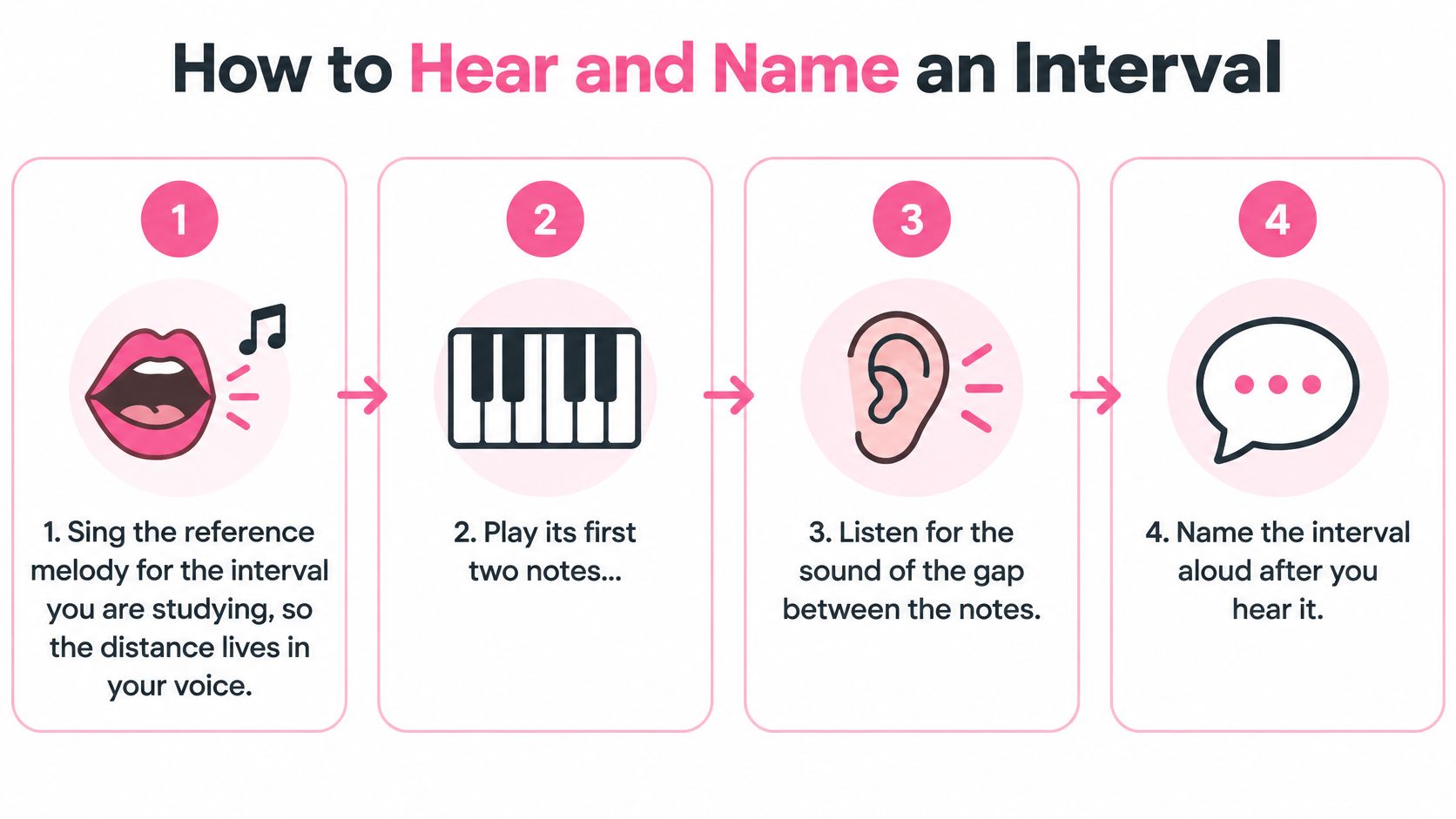
The seven moves
- Sing the reference. Hum the opening of the melody tied to today’s interval so the distance sits in your voice, not only in a label.
- Play the first two notes. Put those pitches on the piano and listen to the gap between them, because your hands need the same sound your voice just made.
- Close your eyes. Have a partner, or an interval trainer, play two random notes so you can’t cheat by watching the keys.
- Name it out loud before you check. Commit to a decision. Guessing after you see the answer doesn’t train hearing.
- Replay the miss. If you were wrong, hear both notes again and sing the reference melody once more so the correction replaces the wrong feeling.
- Go up, then down. Repeat the set ascending, then descending, because the same distance can sound different when it falls.
- Find it in one song line. Play that gap inside a tune you know so the label has to survive real music.
After the active set, spend about two minutes just listening to the target interval. Don’t answer. A controlled four-day protocol found that active naming plus this kind of extra exposure lifted accuracy from 69% on day 1 to 88% on day 4, while comparison routines didn’t improve in a significant way, according to a Psychonomic Society write-up of the interval study. Treat that jump as a lab benchmark, not a promise for your first week.
Watch this walk-through, then run the seven moves on one interval only.
The slip that feels like progress
The common miss is naming from a memorized song without hearing the distance. You recognize Twinkle and say “fifth” while the gap itself never registered. Mix random starting notes early so the tune can’t do the work.
You know it’s landing when you name the interval before you check, and when you can find that same gap inside a song within a week. Speed comes after the decision is honest.
Your 10-Minute Daily Ear Training Routine
Long, rare sessions feel productive and then disappear. Short daily trials stick because each one targets a single error and tells you whether the ear, not your eyes, made the call.
Research on deliberate practice describes a progression from short sessions of roughly 15–20 minutes a day for developing musicians up to several hours at advanced academies, as summarized in a review of deliberate practice. The useful piece for ear training isn’t the academy schedule. It’s focused work with feedback. Ten minutes can hold three real musical questions without turning into a grind.
| Block | Minutes | Task | Skill built |
|---|---|---|---|
| Interval recognition | 3 | Name intervals by ear, ascending and descending | Hearing the distance |
| Chord and progression | 3 | Decide whether a short chord sequence moves up, down or stays centered | Hearing harmony |
| Melody on piano | 4 | Find the first notes of a familiar song on the keys by ear | Playing by ear |
Each block answers something you’d face in a rehearsal. The first asks, “How far did that melody jump?” The second asks, “Did the harmony lift, drop, or sit still?” The third asks, “Can I put that on the keys?” Immediate feedback shows whether you heard it or guessed it.
One interval for the week
Pick a single focus interval on Monday. Review earlier intervals in a minute or two on the days after, so old gaps don’t vanish while you chase a new one. End the timer on the keyboard, not on a screen.
- Same clock time: Park the ten minutes where you already sit at the piano, before you open a chart.
- Log the miss: Write down the interval you got wrong most often that day.
- Don’t skip after a weak day: A bad score is the session that most needs a return visit tomorrow.
- Finish on the keys: The last four minutes are playing by ear, not another quiz.
Track how many of twenty answers you get right each day. Consistency then shows up as a number you can watch rise, instead of a feeling that you “practiced.”
From Isolated Intervals to Real Melodies
A perfect fifth is easy to name in a drill and easy to miss inside a song. The label matters only if you can hear the same distance when the starting note, instrument, or melody changes. Use familiar tunes as a bridge, then test whether you can hear the interval without relying on the tune’s familiar key.
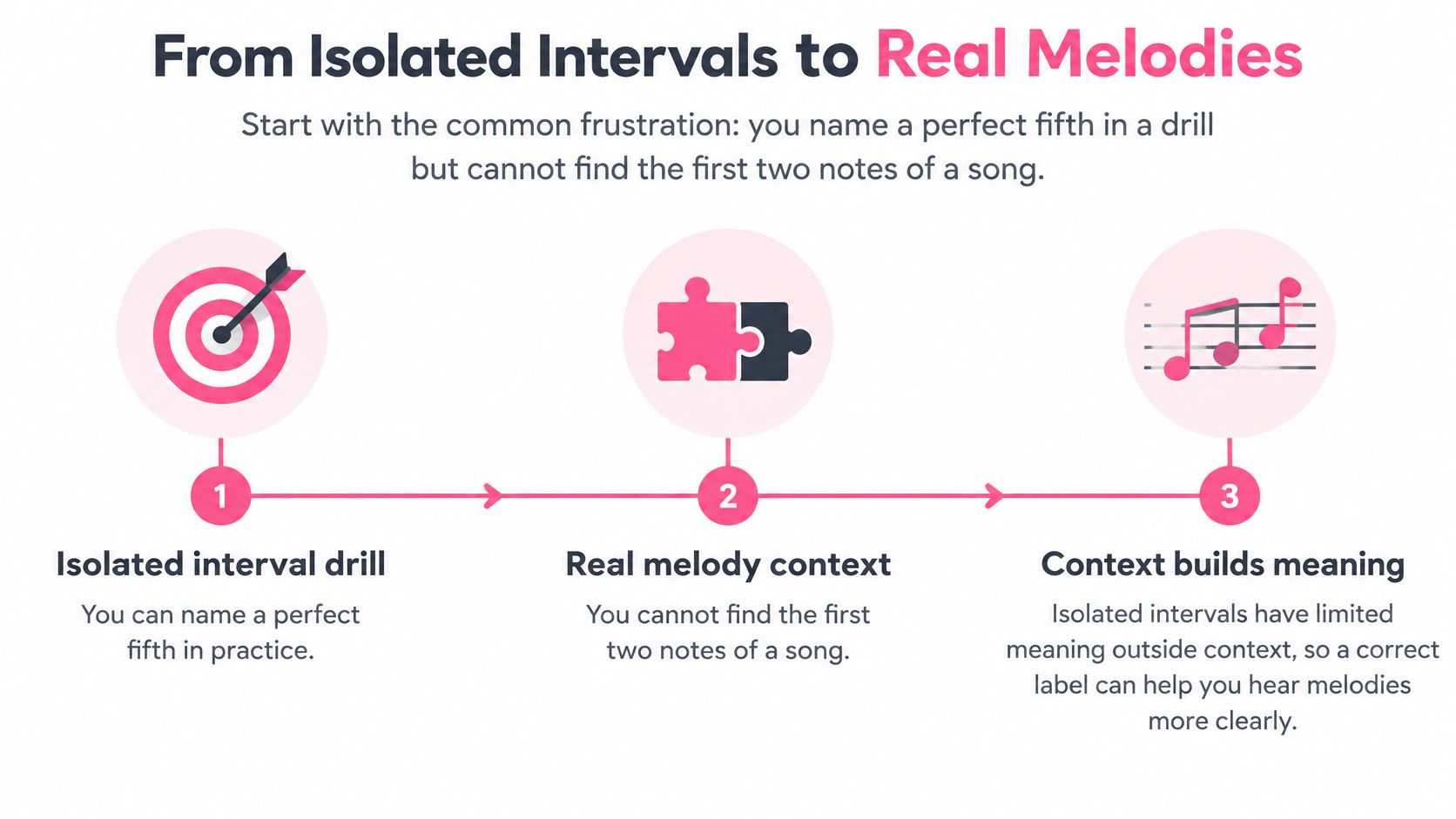
Climb one stage at a time
In a two-week online listening study, participants advanced after reaching at least 80% correct on sets of 20 interval trials. Average training effects remained small, with a Cohen’s d of about 0.13, according to a 2022 study of interval identification. Treat that threshold as a practice checkpoint, not proof that the skill will transfer. Retest the next day.
| Stage | Practice focus | Move on when |
|---|---|---|
| 1. One interval, blocked | Major third, perfect fifth and octave, with a spoken label after each pair | 80% correct on 20 trials, retested the next day |
| 2. Mixed intervals | Add fourth, second and minor third, in both directions | 80% correct in mixed order |
| 3. Register and timbre | Vary octave, starting note and sound, using piano and voice | Accuracy holds in new registers |
| 4. Short melodies | Find intervals inside two-note and three-note openings of real tunes | Name and play back each opening without a reference |
| 5. Transposition and recordings | Find intervals in another key and in recordings with other instruments | Recognize them in songs without a reference melody |
Start with blocked practice to hear one interval clearly. Then mix intervals so you must identify each gap rather than repeat a memorized response. A list of interval reference songs can help you get started, but move on from those anchors and listen to unfamiliar melodies too.
Test the mnemonic crutch
Transpose the opening of “Twinkle, Twinkle, Little Star” up two half steps. The first jump remains a perfect fifth, from C to G in the familiar key or D to A after transposition. If you recognize the fifth only when the melody sits in its familiar key, the tune was doing the hearing for you.
Song anchors help at first. They become a crutch when you recognize the whole tune but cannot identify the interval on its own. Test the gap in a different register or on another instrument, then check whether you can pick it out inside a melody you do not know.
Three common mistakes slow that transfer. Overfitting means you know a fifth only in one piano register. A strong session mistaken for lasting learning means you skip the next-day retest. And a guitarist who names a piano fifth but misses it on guitar needs more practice across registers and sounds before adding new labels.
Give the ladder four weeks, with one stage as the focus each week. Start with blocked fifths, thirds, and octaves; then mix directions, vary register and instrument, and finally find intervals in short openings and transposed recordings. Keep testing whether you can hear the relationship in the melody, not just recall its name.
Can You Learn Perfect Pitch as an Adult?
Plenty of players treat perfect pitch as a childhood gift they missed. Absolute pitch, naming a note with no reference, is harder than relative hearing, and you don’t need it to play by ear. It also isn’t locked to childhood for every adult.
A 2019 peer-reviewed training program had adults practice four times a week, about 4 hours weekly and 32 hours across eight weeks. At least some reached levels classed as genuine absolute pitch, and the strongest learner still had it at least four months later, as reported in a study of adult absolute-pitch learning.
A separate eight-week online study of 12 adult musicians logged 15,327 pitch-naming trials and an average of 21.4 hours. By the end they named an average of 7.08 pitches at 90% accuracy or higher, usually within about 1.3 to 2.0 seconds, and average pitch error fell from 2.62 to 1.50 semitones, according to that pitch-naming trial record.
Repeated listening, a spoken note name, and a correction are what moved those scores. Passive background music doesn’t.
Keep the same ten minutes. Expect steady recognition, not a sudden gift. For most piano players the skill that changes rehearsals is relative hearing, the topic of this relative and absolute pitch comparison. Perfect pitch is a bonus. Playing by ear is the job.
Start Your First 10-Minute Session Today
You can start before this page gets cold. Use a perfect fourth, the Here Comes the Bride opening, as the only focus.
- Sing, then play. Hum the reference and play its first two notes so the open, fanfare sound is in your ear.
- Five going up. Name five random ascending intervals and check each answer before the next pair.
- Five going down. Repeat those five descending. Don’t assume the falling version feels the same.
- One melody on the keys. Find the opening notes of a familiar song by ear and stop when you’ve played them cleanly.
Hold this shape for seven days with one focus interval. If Thursday is messy, come back Friday anyway. The point is the return, not a perfect first score.
A system that keeps the return
Trill: Ear Training Daily is the daily training system built for this exact block of time. It’s an ear training app covering chords, intervals, perfect pitch, and melodies as a 10-minute practice. Interval training asks you to name any two notes by ear. Progression training takes chord sequences such as I–V–vi–IV. Each session is short: you hear a sound, you answer, you get instant feedback, so you know whether your ear made the call. Streaks and a progress view show accuracy and response speed, which matters when focus and consistency are what usually stall musicians.
The outcomes worth caring about aren’t a higher quiz score by itself. They’re hearing a song and playing it, improvising without a chart, recognizing where a progression moved, and sitting in with other players with real musical freedom. Ear training is trainable. It isn’t a talent you either have or don’t. Start the fourth today. Come back tomorrow and do it again.
Trill: Ear Training Daily gives you a ten-minute ear training system for intervals, chords, and melodies so interval drills turn into songs you can play by ear. Hear two notes, name the distance, and get instant feedback instead of guessing. Start today’s session with Trill: Ear Training Daily.