Overcome Music Performance Anxiety: Play Freely
Your hands are colder than they should be. The first phrase is easy in the practice room, but suddenly it feels slippery. You know the piece. You’ve played it dozens of times. Still, a few seconds before you begin, your breathing shortens, your focus narrows, and one thought starts shouting over everything else: don’t mess this up.
That moment is familiar to far more musicians than is commonly acknowledged. An early study found that 49 of 302 musicians, or 16.5%, said anxiety impaired their performance, and over 21% reported anxiety that affected performance to some degree, which shows this has been a recognized problem for a long time, not just a modern buzzword in music circles (early study of musicians and performance-impairing anxiety).
The good news is that this feeling isn’t proof that you’re fragile, untalented, or not built for the stage. In many players, anxiety feeds on uncertainty. Not just uncertainty about memory, but uncertainty about sound itself. If you don’t fully hear what you’re about to play, the stage exposes that weakness fast. If you do hear it fully, your confidence changes. That’s why a better system matters more than pep talks, and why consistent tools like a music practice tracker for daily consistency can help turn scattered preparation into something stable.
Table of Contents
- That Feeling Before the First Note
- What Is Music Performance Anxiety Really
- Your Anxiety Symptom and Trigger Checklist
- The Real Antidote Building Unshakeable Aural Skills
- Your Pre-Performance Routine and Coping Toolkit
- When to Seek Professional Help for Your Anxiety
- Frequently Asked Questions About Music Anxiety
That Feeling Before the First Note
You walk onstage. The bench feels different. The instrument feels different. Even your own fingers feel unfamiliar for a moment.
A lot of musicians assume this means they aren’t ready. Sometimes that’s true. Often, though, the problem isn’t a total lack of preparation. It’s that the preparation lived in the hands, not in the ear.
That distinction matters.
I’ve seen players who can execute a passage flawlessly in the practice room but tense up the second something changes. A dry acoustic. A bright light. A conductor’s faster tempo. A missed cue. They weren’t only battling nerves. They were battling dependence on conditions being perfect.
Practical rule: If your confidence disappears when the situation changes, your security probably sits in habit, not hearing.
That’s why generic advice like “just relax” rarely lands. Relax into what? If your inner sense of pitch, harmony, and direction is shaky, your brain knows it. It won’t be talked out of that by one breathing exercise.
Real confidence feels different. It comes from being able to hear the next note before you play it. It comes from recognizing where you are in the harmony without staring at a page. It comes from knowing that if a memory slip happens, you can recover because your ear still knows the music.
What this moment is really asking for
Before the first note, the stage asks one brutal question: Do you know what you’re about to say in sound?
If the answer is “sort of,” anxiety fills the gap.
If the answer is “yes, I hear it,” the body often settles faster than you’d expect. Not perfectly. Not magically. But enough to play like yourself again.
A calm stage isn’t the goal. A reliable musician is.
What Is Music Performance Anxiety Really
Music performance anxiety is more than ordinary butterflies. It’s a stress response tied to being seen, judged, and exposed while making music. Reviews of the field show that prevalence varies a lot by study, but remains consistently high, with estimates ranging from 16.5% to 60% in student and professional musicians depending on how researchers define and measure it (systematic review on prevalence in professional musicians).
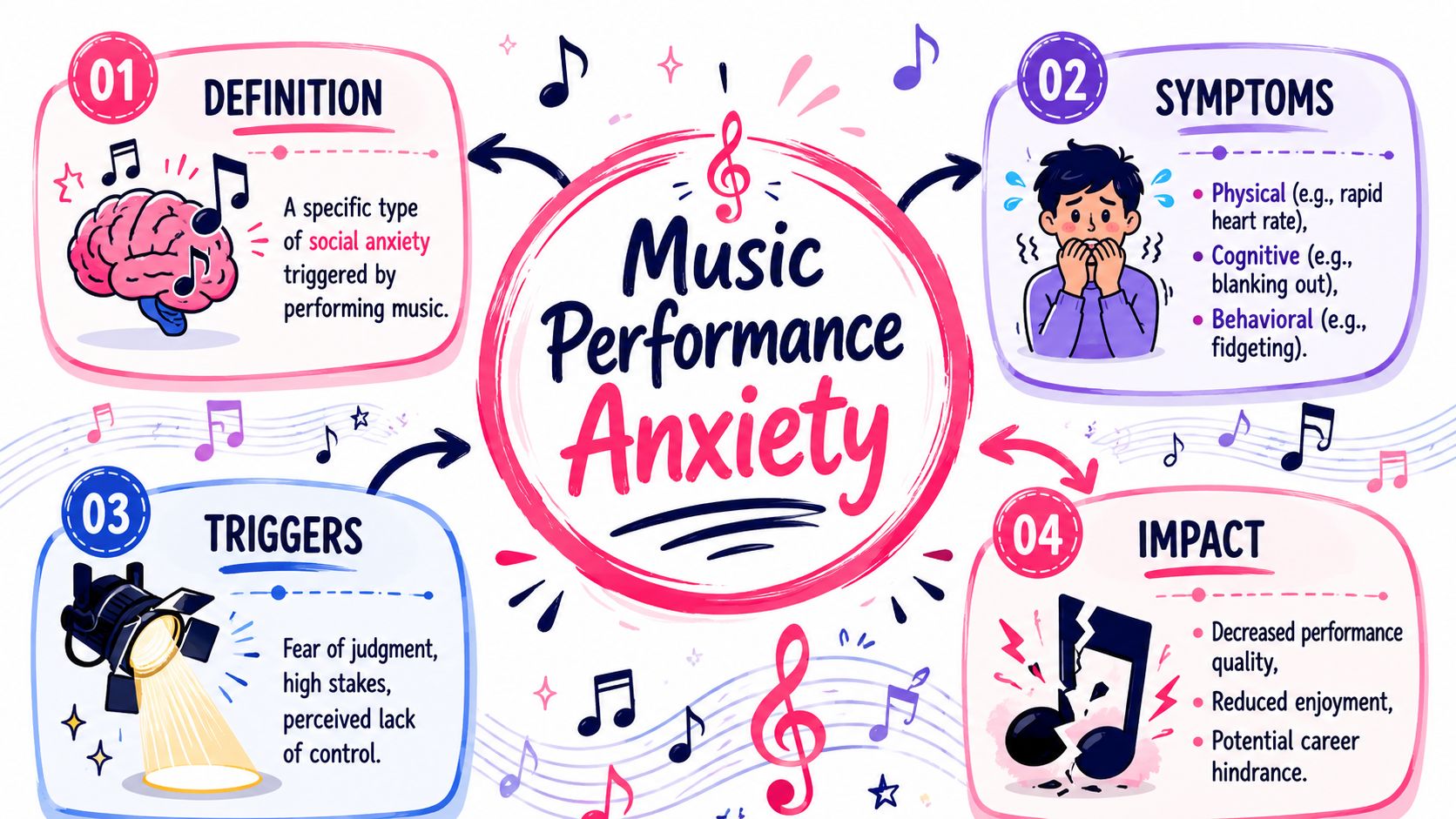
A faulty alarm, not a character flaw
The easiest way to understand it is to think of a smoke alarm that goes off when you make toast.
The alarm system isn’t evil. It’s overreacting.
Your body does something similar onstage. It reads evaluation, uncertainty, and exposure as threat. Then it sends out a full-body warning. Heart rate rises. Breathing changes. Muscles tighten. Attention narrows. Thoughts turn dramatic. You don’t just feel nervous. You feel hunted.
That can be confusing because the room may be safe, the audience may be supportive, and you may be well prepared. But your system doesn’t always respond to facts. It responds to perceived danger.
Why the fear feels bigger than the room
The trigger is rarely just the audience itself. It’s the meaning your brain attaches to the moment.
For one musician, the threat is memory failure.
For another, it’s visible judgment.
For another, it’s losing control in public.
For a perfectionist, it can be one wrong note.
When that alarm fires, two loops feed each other:
| Loop | What happens |
|---|---|
| Body loop | Tight shoulders, shaky hands, dry mouth, fast heartbeat, shallow breathing |
| Mind loop | “I’m blanking.” “Everyone can tell.” “If I slip, it’s over.” |
Once those loops connect, even easy material can feel unstable.
The body says danger. The mind starts explaining why. Then the explanation makes the body even louder.
That’s why music performance anxiety isn’t solved by willpower alone. You can’t bully your nervous system into trust. You have to give it evidence. Better preparation helps, but not all preparation is equal. Repetition without listening can leave you technically busy and psychologically brittle. Deep preparation, the kind that links hearing, memory, and execution, creates a very different experience under pressure.
Your Anxiety Symptom and Trigger Checklist
Some musicians say, “I just get nervous,” but that phrase hides too much. Anxiety becomes easier to manage when you name it precisely.
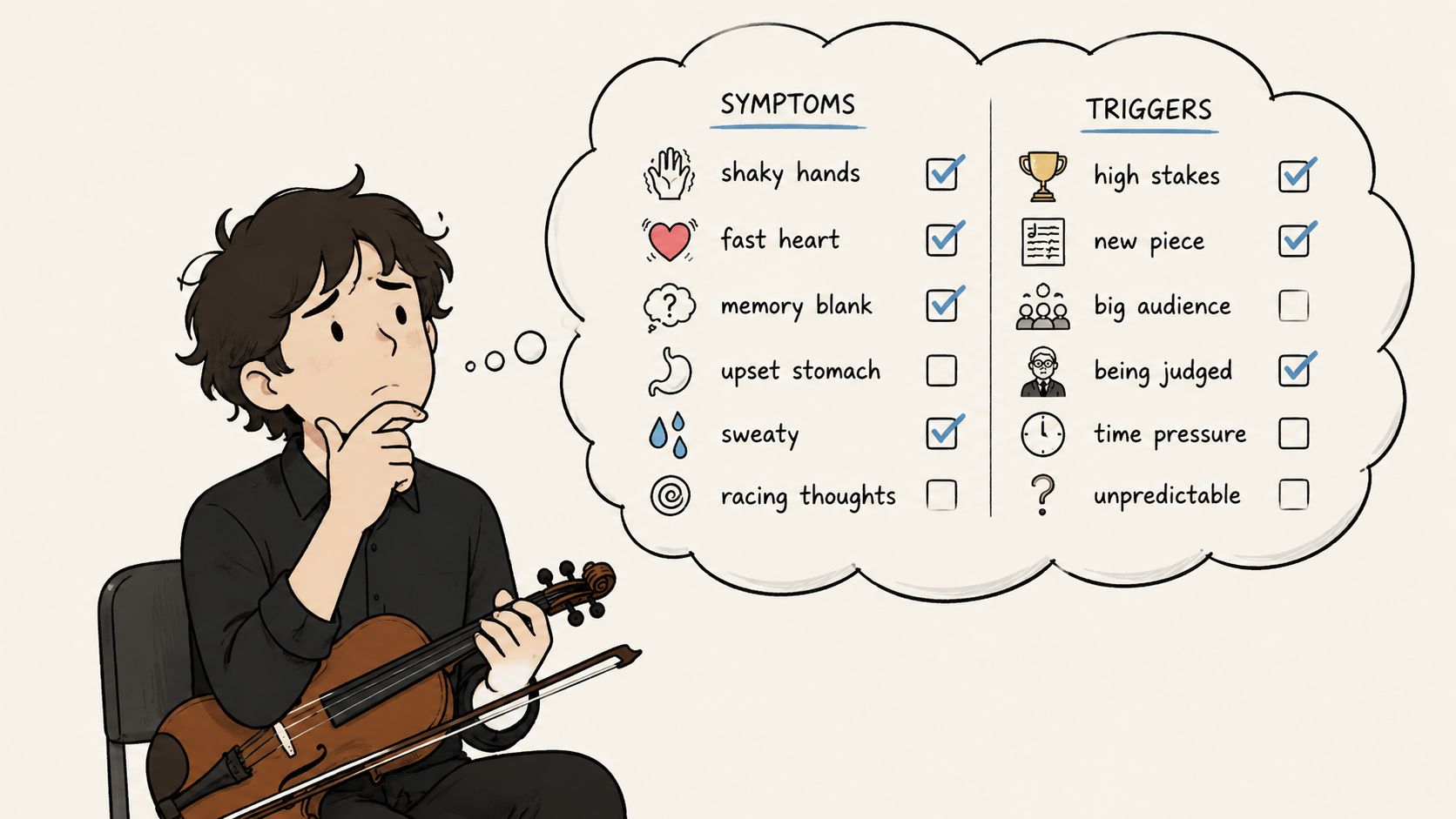
Symptoms you might notice
The symptoms usually show up in clusters, not one at a time.
-
Physical signs
Shaking hands, tight jaw, sweating, dry mouth, nausea, shallow breathing, heavy legs, sudden fatigue, or the feeling that your fingers no longer belong to you. -
Mental signs
Racing thoughts, memory slips, inability to focus on phrasing, obsessive self-monitoring, hearing only mistakes, or a constant inner commentary while you play. -
Emotional signs
Dread before the event, irritability in the hours leading up to it, panic when waiting backstage, shame after small mistakes, or a wave of relief so strong after finishing that it tells you how distressed you really were.
A useful self-check is to ask: What fails first when pressure rises?
For some players, it’s breath.
For some, memory.
For some, time feel.
For many, it’s hearing.
Triggers that often set it off
Not every performance creates the same response. The trigger usually has a shape.
- Solo exposure tends to hit harder than ensemble playing because there’s nowhere to hide.
- Auditions and exams often spike fear because the room feels evaluative instead of musical.
- Sight-reading creates panic when the player doesn’t trust their ability to predict sound in real time.
- Playing from memory can feel dangerous when memory is tied only to finger sequence.
- High personal standards can turn normal performance pressure into self-attack.
- Fear of judgment becomes stronger when self-worth rises and falls with the quality of one performance.
Here’s a quick way to sort your own pattern:
| If your main thought is… | Your likely trigger may be… |
|---|---|
| “I’m going to forget” | Weak internal hearing or fragile memory structure |
| “They’ll think I’m not good enough” | Social evaluation |
| “It has to be perfect” | Perfectionism |
| “I can’t recover if something goes wrong” | Lack of flexible musicianship |
Once you identify the pattern, the solution gets clearer. A breath issue needs regulation. A perfectionism issue needs reframing. A hearing issue needs ear training. Treating all of these as the same problem is where many musicians get stuck.
The Real Antidote Building Unshakeable Aural Skills
Anxiety loves fog. It gets louder when you don’t fully know what you’re hearing, where the harmony is going, or how to recover if something slips.
That’s why I don’t treat confidence as a mindset first. I treat it as a skill outcome.

Psychological research suggests that music performance anxiety can co-develop with performance quality during practice, which means stronger preparation under performance-like demands can directly reduce anxiety over time (psychological review on practice quality and anxiety).
Why uncertainty creates panic
A lot of musicians practice by repetition only. They drill until the hands can survive a familiar route. That works, until something interrupts the route.
Then the hidden weakness appears.
If you rely on muscle memory alone, a small interruption can feel catastrophic. If you rely only on sheet music, losing your place can feel catastrophic. If you’ve trained your ear to recognize the melody, chord function, interval shape, and tonal center, you have backup systems. You don’t just remember movements. You understand sound.
That changes the emotional experience of performance.
When musicians learn to hear music instead of guess it, mistakes stop feeling like cliffs and start feeling like detours.
Ear training becomes more than a theory exercise. It becomes pressure-proofing. The point isn’t to become a trivia machine who names intervals in isolation. The point is to build a live internal map of the music.
Ear training changes what happens under pressure
A strong ear helps in five practical ways:
-
Memory gets deeper
You’re not remembering a finger order only. You’re remembering sound, shape, and harmonic movement. -
Recovery gets faster
If you blank for a second, your ear can pull you toward the next stable point. -
Intonation improves
Singers and other musicians both play with more security when pitch is heard internally before execution. -
Improvisation becomes possible
Even a little improvisational skill reduces panic because you stop treating every deviation as disaster. -
You begin to play by ear
That freedom spills into rehearsals, jam sessions, accompaniment, and learning songs without waiting for notation.
If you’ve been told this depends on talent, ignore that. Ear training is trainable. Perfect pitch gets talked about a lot, but what most musicians need is reliable relative hearing. Chord recognition. Interval recognition. Tonal awareness. The ability to hear a phrase and know where it lives.
For structured daily work, a dedicated aural training system for musicians can help build that consistency.
A simple daily ear training routine
You don’t need marathon sessions. You need repetition that sticks. 10 minutes a day is enough to create momentum if you stay focused.
Try this sequence:
-
Start with interval hearing
Sing two notes, then identify whether the distance sounds narrow, medium, or wide before naming it more specifically. -
Move to chord quality
Hear major, minor, diminished, and dominant-type colors. Don’t guess from theory labels. Listen for emotional flavor. -
Practice melody recall
Hear a short phrase, pause, then sing it back without your instrument. -
Find the bass movement
In a song you know, listen for where the harmony shifts. Bass motion often reveals the progression faster than the top line. -
Finish with real music
Put on a simple track and try to identify the home note, then the first chord change.
Later in the day, watch this and compare your own habits to a more ear-led approach to practice.

The goal isn’t abstract musicianship. The goal is a stage where your hands don’t feel alone.
Your Pre-Performance Routine and Coping Toolkit
Skill-building gives you long-term stability. A routine gives you something reliable on the day itself.
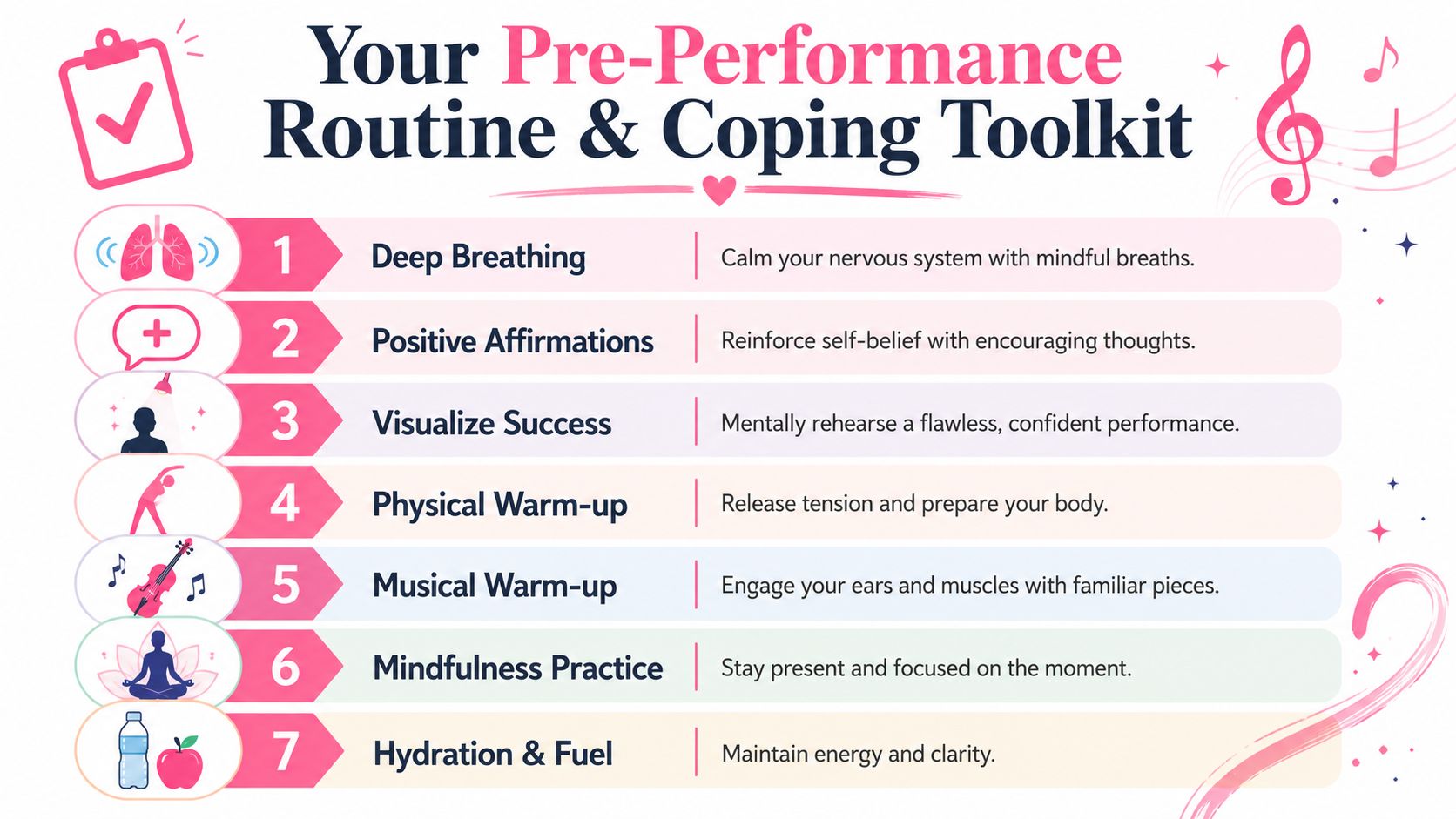
What to do earlier in the day
Don’t spend the whole day proving to yourself that you’re prepared. That usually backfires.
Use the earlier part of the day to lower friction.
-
Keep food simple
Eat something familiar that won’t leave you heavy or jittery. -
Warm the body first
Shoulders, neck, jaw, hands, ribs. Anxiety often grabs the places musicians need most. -
Do a short aural warm-up
Sing scales, identify a few intervals, hear the tonic, or mentally audiate the opening phrase before touching the instrument. -
Run entrances, not everything
Practice beginnings, exposed passages, and re-entry points. Avoid panic-playing the full program repeatedly. -
Protect your attention
Too much phone time before a performance scatters the mind fast.
A singer can pair this with a focused vocal warm-up routine for performance days, but the principle is the same for any instrument. Prepare the body, the ear, and the first few moments.
Your last minutes before walking onstage
In the final stretch, simplicity wins.
Try this checklist:
| Time | Action | Why it helps |
|---|---|---|
| A few minutes before | Breathe low and slow | Signals safety to the body |
| Then | Release jaw, shoulders, hands | Reduces unnecessary tension |
| Then | Hear the opening internally | Gives the brain a clear target |
| Then | Name one musical intention | Keeps focus on expression, not fear |
| Right before | Exhale longer than you inhale | Helps settle adrenaline |
Don’t ask, “How do I feel?” Ask, “What do I hear?”
That question matters. If you keep scanning for nerves, you amplify them. If you listen inwardly for tempo, pitch center, groove, or phrase shape, you redirect the mind toward music.
A few more tools help in the moment:
-
Center on one sound
The first note, the first chord, or the pulse in your body. One anchor is enough. -
Use cue words
Short phrases work better than speeches. “Breathe.” “Sing it.” “Forward.” “Tall sound.” -
Accept some adrenaline
Trying to eliminate all activation often creates another layer of panic. Useful energy is not the enemy. -
Recover publicly without drama
If something slips, continue. Most audiences hear continuity more than the mistake you’re obsessing over.
This routine won’t replace deep preparation. It makes that preparation easier to access when your system is under load.
When to Seek Professional Help for Your Anxiety
Some performance nerves are manageable. Some aren’t. The difference matters.
Research indicates that about 30% of musicians experience moderate-to-severe performance anxiety, and reviews suggest the most effective interventions often combine behavioral techniques with cognitive therapy, addressing both bodily responses and negative thought patterns (review on managing music performance anxiety).
Normal nerves versus a bigger problem
You should consider professional help if anxiety does more than make performances uncomfortable.
Warning signs include:
- You avoid opportunities you actually want because the fear feels unbearable.
- Panic symptoms keep escalating and don’t settle with basic coping skills.
- Your anxiety spills beyond music into sleep, mood, relationships, or daily functioning.
- Perfectionism becomes punishing rather than motivating.
- You can perform only by white-knuckling and then crash afterward every time.
If that sounds familiar, don’t reduce it to “I just need more confidence.” Sometimes you do need better preparation. Sometimes you also need proper treatment.
What kind of help tends to work
Different kinds of support help different musicians.
- A therapist with cognitive and behavioral tools can help you work with catastrophic thoughts, avoidance patterns, and conditioned fear responses.
- A performance coach can help with routines, exposure, rehearsal design, and recovery strategies.
- A teacher who understands performance psychology can adjust how you prepare, not just what notes you play.
- Medical support may matter in some cases, especially if symptoms are severe or tied to broader anxiety.
Getting help is not an admission that you’re weak. It’s a decision to stop letting fear run your musical life.
The best outcomes usually come when support matches the actual problem. If your issue is broad anxiety, you need broader care. If it’s performance-specific, targeted work may help faster. If perfectionism and identity are tangled into it, that needs attention too.
Musicians invest in instruments, lessons, scores, and travel. Investing in mental stability belongs in the same category. It protects both your art and your ability to stay in the work.
Frequently Asked Questions About Music Anxiety
Can ear training help even if I don’t have perfect pitch
Yes. Most confident musicians do not rely on perfect pitch. What they rely on is trained listening. Relative pitch, chord recognition, internal hearing, and the ability to play by ear are all trainable. Those skills matter more onstage than having a rare label.
How do I know if this is perfectionism or broader anxiety
That question matters because music performance anxiety can be a stand-alone issue for some musicians, but it can also co-occur with broader conditions like social phobia, generalized anxiety, panic disorder, OCD, or depression. The literature also notes that inflexibly high standards and self-worth tied to performance can make musicians more vulnerable, which is why the treatment approach may need to change depending on the bigger picture (discussion of MPA, perfectionism, and co-occurring conditions).
A useful clue is scope. If the fear appears mainly around performing, it may be performance-centered. If the same pattern shows up in conversation, work, study, relationships, or daily decisions, look wider.
Will I ever get rid of anxiety completely
Maybe not completely, and that’s okay. The better goal is different. You want anxiety to stop controlling your playing.
Many strong performers still feel activation before important moments. The difference is that the sensation no longer means “I’m in danger.” It means “I’m about to do something that matters.” With better hearing, better preparation, and better coping, the feeling stops owning the room.
If you want a simple way to build that kind of confidence, Trill: Ear Training Daily gives you a focused daily system for ear training, chord recognition, and learning to play by ear. Short sessions, consistent practice, and stronger listening can make performance feel less like survival and more like music.