Effortless: Name That Chord Piano Now
You’re probably here because this keeps happening. A song comes on, you walk to the piano, find one note that sounds right, then spend the next few minutes chasing shapes and hoping one of them matches. Sometimes you land on the chord. Most of the time you circle around it.
That gap between hearing music and playing it isn’t a talent gap. It’s an ear training gap.
The good news is that name that chord piano is a learnable skill. It doesn’t require perfect pitch, and it doesn’t require you to memorize every chord spelling before you touch the keys. It starts with hearing a few stable things on purpose: the bass, the root, the chord color, and the way chords move from one to the next.
Playing by ear gets easier when you stop asking, “What random shape might this be?” and start asking, “What do I hear?” That shift changes everything. It turns chord recognition from guesswork into listening, and listening into musical freedom.
Table of Contents
- Stop Guessing Start Hearing Your Favorite Songs
- First Skill Find the Anchor Note in Any Chord
- Hear the Feeling Major Minor and Other Chord Qualities
- Decode Inversions by Listening for the Bass
- Build a Daily Practice System That Actually Works
- Putting It All Together Hearing a Full Progression
Stop Guessing Start Hearing Your Favorite Songs
Most players begin with the eyes. They learn diagrams, hand shapes, chord charts, and note names. That helps at first, but it also creates a trap. When the music arrives through speakers instead of a page, they don’t know what to trust.
The players who get free aren’t the ones who know the most labels. They’re the ones who can hear structure. They hear the low note first. They hear whether the chord feels bright or dark. They hear whether the sound feels settled or like it wants to move.
You don’t need to guess less. You need to listen more specifically.
That’s why playing by ear feels different from classroom theory. Theory tells you what a chord is on paper. Ear training teaches you how that chord behaves in actual music. That’s the difference between recognizing a C major triad in an exercise book and hearing it inside a verse, under a melody, in real time.
A lot of students think they’re bad at this because they can’t identify chords instantly. Usually the problem is simpler. They’re trying to hear all the notes at once. That’s too much information too early.
A better path is smaller and more musical:
- Catch the lowest note first. That gives your ear a floor.
- Decide on the color. Major, minor, tense, unresolved.
- Listen for movement. Does the next chord feel like a release, a lift, or a turn?
- Check it on the piano. Your hands confirm what your ear suspects.
That process is how musicians learn to play by ear in practical settings. It’s also how you build the hearing that many people wrongly call perfect pitch. In practice, most players don’t need perfect pitch. They need reliable relative hearing and daily repetition.
First Skill Find the Anchor Note in Any Chord
If you can’t hear the bottom of the chord, everything above it feels blurry.
The first listening target is the bass note. Not the full chord name. Not every note inside the voicing. Just the lowest sounding pitch. When students improve quickly, this is usually the skill that enables the rest.
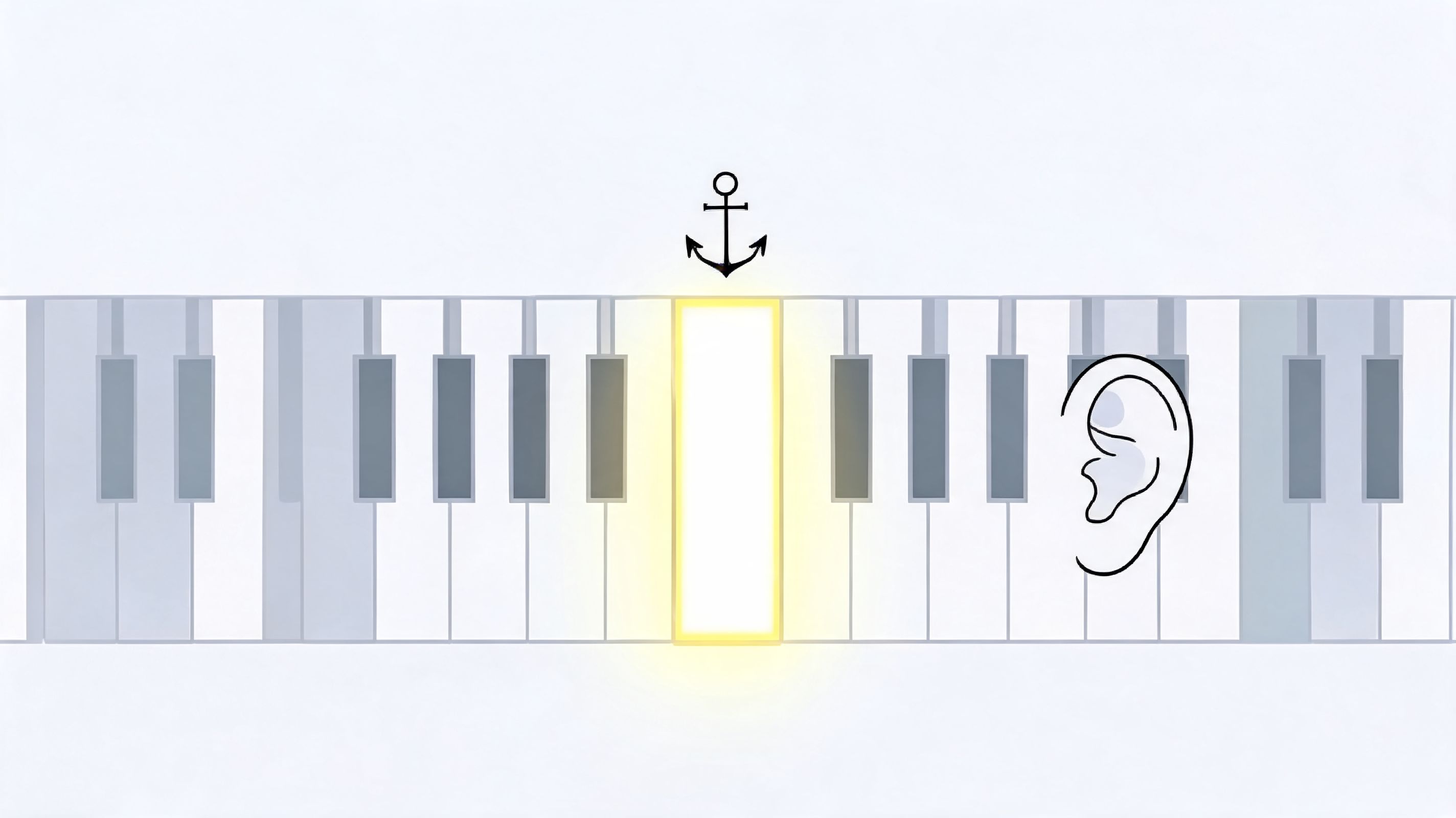
The bass is the first thing to catch
In many simple piano chords, the bass and the root are the same note. That makes the job easier. But don’t merge those ideas too soon. The bass note is the lowest note you hear. The root is the note the chord is built from.
Those are often the same, but not always. That distinction matters later when you start hearing inversions.
A practical way to train this is to make the bass impossible to ignore. Play one low note with your left hand. Hold it or repeat it slowly. Then add a chord above it with your right hand. Keep singing or humming the low note while the upper notes ring.
That one move teaches your ear to separate layers.
For interval support, spend some time with this guide to hearing intervals on piano. It sharpens the exact distance awareness that helps you lock onto roots and bass movement.
A simple drill that works
Use this at the piano for five rounds:
- Play a low single note. Hum it back immediately.
- Add a triad above it. Don’t change the bass yet.
- Stop the chord, keep the hum going. This tests whether you accurately heard the floor of the sound.
- Change only the upper notes. Keep the same bass and notice how the chord quality changes while the anchor stays put.
- Then change the bass. Hear how the entire chord identity shifts.
Practical rule: If your ear feels lost, go lower. The bass usually reveals the harmony faster than the top notes do.
Here’s the trade-off. If you start by hunting for the full chord, you’ll often confuse color with identity. If you start by hearing the anchor note, even a wrong guess becomes useful. You’re narrowing the field with your ears instead of stabbing in the dark.
A short comparison helps:
| Listening approach | What happens |
|---|---|
| Start with hand shape | You copy familiar grips, but miss what the song is actually doing |
| Start with the melody only | You may find notes, but the harmony stays vague |
| Start with the bass | The harmony gets a center, and chord choices become easier to test |
This is the first real doorway into name that chord piano. Once the anchor is clear, the rest of the chord stops sounding like a cloud.
Hear the Feeling Major Minor and Other Chord Qualities
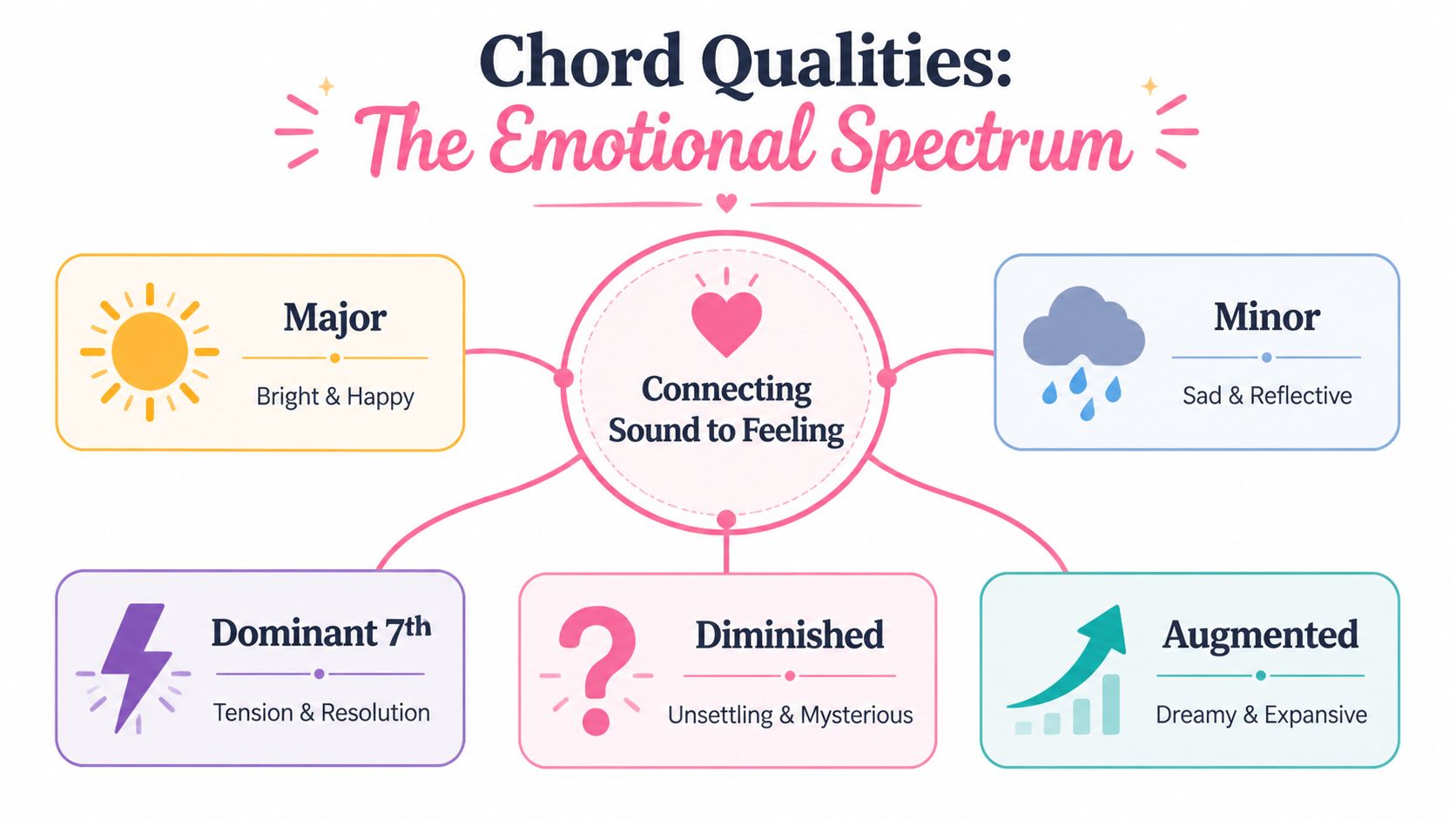
Once the root is in your ear, a new problem shows up. You can tell two chords share the same anchor note, but one sounds settled and another sounds restless. That difference is chord quality, and hearing it is what turns random guessing into useful listening.
Most students feel chord quality before they can name it. That is good news. The ear usually recognizes mood first.
Start with the third
For major and minor, the note that changes the whole mood is the third. A music theory logic guide for chord identification lays out the structure clearly: major chords contain a major 3rd and perfect 5th, while minor chords contain a minor 3rd. On the piano that looks small. In the ear, it is a major shift in color.
Students who play by shape often miss this. They memorize C major and C minor as two hand positions, then freeze when the same sound appears on a different root. Training the ear on the third fixes that problem because you stop depending on a visual pattern and start hearing the chord’s character.
Use a piano chord visualizer and reference tool to keep the root fixed while you compare one quality against another. The point is not to stare at diagrams. The point is to hear what changes when only one note moves.
Train the sound, then name it
Keep the root the same at first. Play C major, then C minor, back and forth for a minute. Listen for the single note that changes and how the whole chord responds.
Then add a few more colors:
- Major feels open and stable.
- Minor feels darker and more inward.
- Dominant 7th carries forward motion and wants resolution.
- Diminished sounds tight, tense, and unsettled.
- Augmented sounds widened and slightly unreal.
These descriptions are useful, but they are only starting points. One student’s “dark” is another student’s “sad.” What matters is consistency. If you can hear the same quality the same way ten times in a row, the label will stick.
Limit the menu early on. Three qualities learned deeply will help your playing more than ten qualities you only half recognize.
A simple drill works well here. Play one root in the left hand. In the right hand, alternate between major and minor triads on that root, then add dominant 7th. Sing a word for the color before you name the chord. I often have students say “bright,” “dark,” or “pulling” first, because that keeps the ear in charge and stops theory from rushing ahead of perception.
There is a trade-off. If you introduce every chord type at once, practice feels productive because there is a lot to cover. Retention gets worse. If you stay with a narrow set of sounds and repeat them across several roots, progress feels slower for a few days, but recognition becomes much more reliable in real songs.
The primary goal is not passing a theory quiz. The goal is hearing a chord in a recording and knowing, within a second or two, whether the color is major, minor, dominant, or unstable. Once that happens, the harmony stops feeling hidden.
Decode Inversions by Listening for the Bass
Many visual-first tutorials fail people at this juncture. They teach inversions as keyboard rearrangements, then wonder why students still can’t hear them in songs.
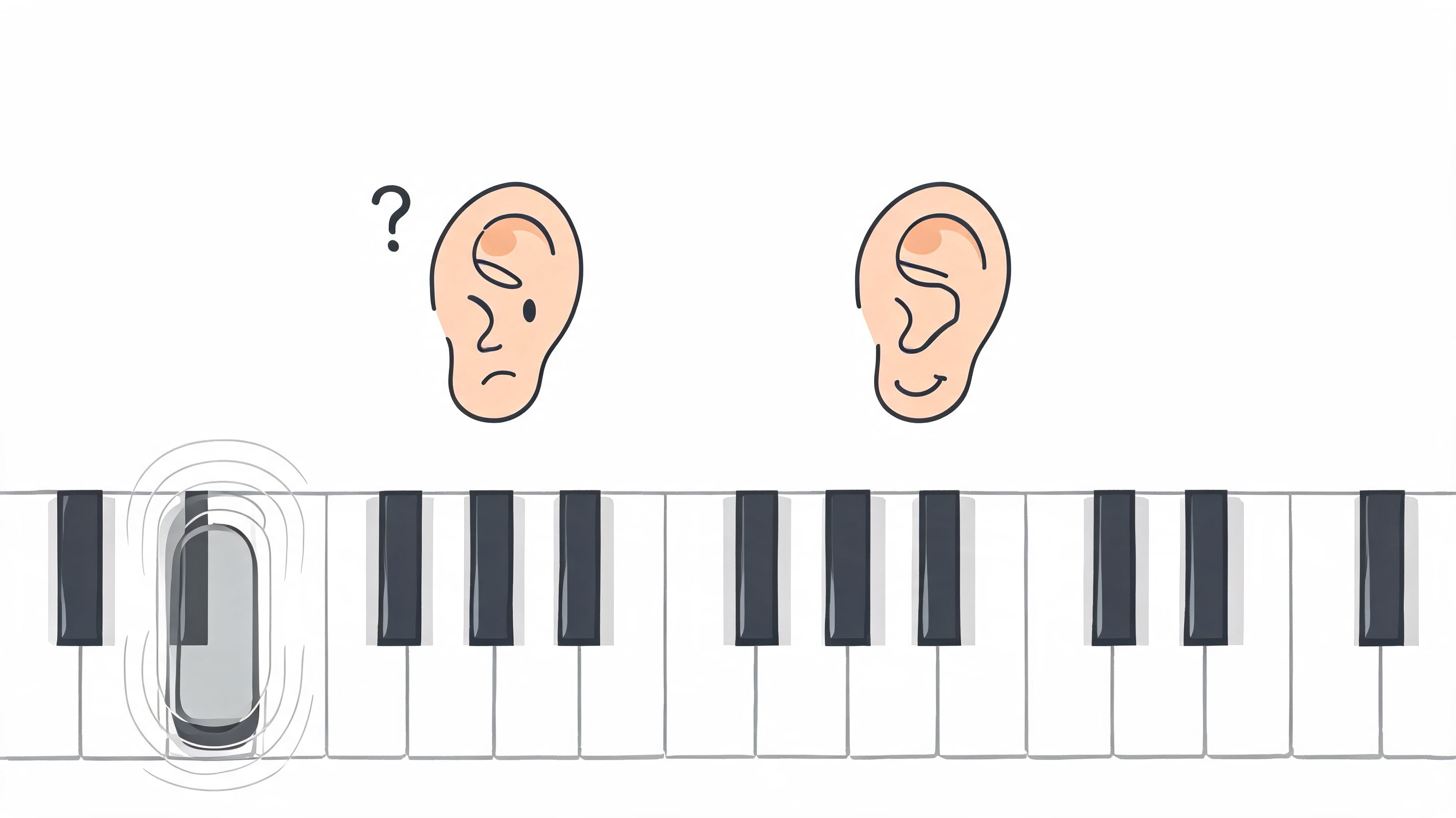
An inversion isn’t just a different shape. It’s a different bass relationship. If you don’t hear the bass clearly, root position and inversion can blur together.
Why visual learners get stuck here
A helpful note from this chord identification discussion is that distinguishing chord inversions by ear is a common blind spot in music education, because most tools center visual notation such as C/G. That matters because real playing by ear depends on hearing the relationship between the bass note and the chord’s root through sound alone.
That’s exactly the problem students run into. They can identify C major on the keyboard. But if the notes are ordered E-G-C, they often hear “a different chord” instead of “C major with E in the bass.”
The fix is not more diagrams. The fix is stricter listening.
A listening test for root position and inversions
Take one chord only: C major.
Play these three versions slowly:
- C-E-G
- E-G-C
- G-C-E
The top sound family stays related, but the bottom note changes the gravity.
Here’s what to listen for:
| Voicing | What your ear should notice |
|---|---|
| C-E-G | Most settled. The chord feels grounded |
| E-G-C | Softer floor. The chord feels lifted |
| G-C-E | More open and less final. Often feels like motion |
The bass tells you how the chord is standing, even when the chord name stays the same.
A strong drill is to play a root-position chord, then an inversion, and sing the lowest note each time before naming the chord. Don’t rush the answer. First identify the bass. Then decide whether that bass is the root or another chord tone.
After you’ve tested it yourself, this short video is useful because it slows the listening process down:

A practical sequence for songs:
- Find the lowest note in the recording.
- Match that note on the piano.
- Test likely chord families above it.
- Ask whether the bass sounds like home or like a color tone.
- Then label the inversion.
What doesn’t work is trying to hear inversions by memorizing visual order. Songs don’t present chords as flashcards. They present them as moving bass lines with harmony on top.
If you can hear that bass movement, you stop hearing “mystery chords” and start hearing structure.
Build a Daily Practice System That Actually Works
A student sits down on Saturday for an hour, grinds through random chord quizzes, then freezes on a simple pop song Monday night. I see that pattern constantly. The problem is not effort. The ear did not get enough spaced reps to store the sound.
Daily work fixes that because recall grows from frequent contact. Earlier research mentioned in this article points in the same direction. Students who train chord hearing in short daily sessions improve far more than students who spend the same energy on occasional, sight-reading-heavy practice. For working musicians, the takeaway is straightforward. Train the ear often enough that the sound becomes familiar before you need it in a song.

Short practice beats scattered effort
Consistency matters more than willpower. A good routine removes choice and puts the same listening jobs in front of you every day until they become fast.
A structured tool helps because it gives repeatable audio prompts and immediate correction. Trill: Ear Training Daily with short guided chord and interval drills covers chords, intervals, notes, and scales in brief sessions with instant feedback. That kind of feedback matters. Students improve faster when they compare what they heard with what was played right away, instead of letting a wrong guess harden into a habit.
Coach’s note: Ten focused minutes every day beats one tired hour on the weekend.
Random practice usually breaks down in a predictable way. A student watches a few videos, tests a few apps, plays part of a song, and never stays with one listening target long enough to sharpen it. You need accumulation. One skill, repeated enough times, then applied in music.
A ten minute routine
Use the same routine for two or three weeks before changing it. The goal is not variety. The goal is faster recognition.
- Two minutes on bass notes. Hear the lowest pitch and sing it back.
- Three minutes on major and minor. Keep the root fixed and identify the color change.
- Three minutes on seventh chords. Focus on tension and release, especially dominant sounds.
- Two minutes on inversions. Name the chord, then name the bass note under it.
That last step is where many visual learners stall. They know the chord on paper but miss how it sits in real music. If you train chord name and bass note together every day, inversions stop sounding like separate mysteries and start sounding like one harmony with a different foundation.
Keep a tiny log after each session. One line is enough. Write what you heard quickly, what fooled you, and whether the mistake came from chord quality or from the bass. That distinction matters. It tells you whether to spend tomorrow on color, function, or inversion hearing.
The trade-offs are simple:
- Apps give clean repetition. They are weaker at showing how the sound behaves inside a song.
- Songs give context. They are slower when you need to isolate one weak spot.
- A strong routine uses both. Drill the sound first. Then test it in recordings.
That is how ear training turns into musical freedom at the piano. You hear the chord, hear the bass under it, and respond without waiting for sheet music or guessing from hand shapes.
Putting It All Together Hearing a Full Progression
Single-chord recognition matters, but songs don’t stay on one chord for long. Real fluency shows up when you hear how one harmony leads to the next.
That’s why progressions matter. Instead of hearing isolated events, you start hearing a story. One chord feels like home. Another pulls away. Another adds tension. Another softens the mood before the loop returns.
Hear function not just chord names
A common pop pattern is I-V-vi-IV. Even if you don’t think in Roman numerals while listening, your ear can learn the feeling of that path. The first chord settles. The fifth creates forward pull. The relative minor changes the emotional color. The fourth opens the door back toward home.
Dominant sound is often the missing piece for beginners. A Yamaha survey summary for beginner chord recognition reports that 64% of beginner piano students struggle to identify dominant 7th chords, while app-based ear training raises recognition to 81% after 100 sessions. That matters because dominant function is one of the clearest signals that a progression is moving somewhere.
You don’t have to memorize theory first. Hear the pull first.
A practical way to transcribe songs
Start smaller than a full four-chord loop. Take any recording and work in layers.
- Catch the bass motion. Ignore upper detail at first.
- Decide on each chord color. Bright, dark, tense.
- Test roots on the piano. Match what the recording suggests.
- Notice repeated patterns. Pop songs often cycle.
- Then listen for inversions. A line can sound smoother because the bass is walking through chord tones instead of jumping root to root.
A simple example helps. If the first chord feels settled, the next one feels more urgent, the third turns inward, and the fourth opens back up, your ear is already hearing function. That is the beginning of transcription.
Don’t ask, “Can I identify every note immediately?” Ask, “Can I hear where the harmony is going?”
That question leads to much more musical answers. It also leads to improvisation, accompaniment, reharmonizing, and playing with other people without waiting for charts.
If you want a consistent way to build that hearing every day, Trill: Ear Training Daily is built for exactly that kind of practice. It focuses on short ear training sessions for chords, intervals, notes, and scales so you can stop guessing, strengthen chord recognition, and play by ear with more confidence.