7th Chord Piano Mastery: Hear, Build, & Use Essential Chords
You sit at the piano, copy the chord shape from a chart, and something still feels missing. The notes are right, but the sound in the song feels deeper, smoother, or more restless than what you’re playing.
That gap often starts when music moves past plain major and minor triads and into 7th chords. You can hear that richer color immediately, but if you haven’t trained your ear for it yet, it feels slippery. You know it’s not just a basic chord. You just can’t name what you’re hearing.
Many players often find themselves stuck. They try to memorize formulas, hand shapes, and symbols, then hope recognition will somehow follow. It usually doesn’t. If you want real freedom on the piano, you need to connect the theory to sound. You need to hear the emotional color of a chord, not just spell it.
Table of Contents
- That Sound You Love Is Probably a 7th Chord
- From Triads to 7th Chords An Audible Leap
- Meet the 5 Essential 7th Chords You Hear Everywhere
- Moving Beyond Blocks with Voicings and Inversions
- Putting Your Ear to Work with Common Progressions
- How to Train Your Ear for 7th Chords Daily
That Sound You Love Is Probably a 7th Chord
A student once played me a song intro and said, “I can find the main chords, but not the pretty ones.” That’s such a common problem. The basic harmony is often easy to grab by ear. The special color, the chord that makes you stop and listen, is often a 7th chord.
That’s why the jump into 7th chord piano feels so important. It’s not just more theory. It’s the moment your playing starts sounding more like actual music and less like a sketch of it.
What your ear is noticing
When you hear a lush pop ballad chord, a mellow neo-soul vamp, or a jazz cadence that seems to lean forward, you’re often hearing a chord with an added seventh. That extra note changes the mood in a way your ear notices even before your brain has the label.
A plain major or minor triad can sound clear and solid. A 7th chord can sound smoother, moodier, or more unresolved. That’s the difference many players recognize emotionally before they understand it technically.
Practical rule: If a chord sounds richer than a basic triad, don’t guess randomly. First ask whether you’re hearing a seventh added on top.
Ear training starts to matter more than visual memory. If you only memorize shapes, every new key feels like starting over. If you train your ear to recognize chord color, you begin to hear patterns across songs.
Why memorizing symbols isn’t enough
Many beginners learn chord symbols like Cmaj7, C7, or Dm7 and think recognition will come later. But real playing doesn’t work that way. In a live song, you don’t get time to spell every chord from scratch. Your ear has to tell you, “this one feels settled,” or “this one wants to move.”
That’s why playing by ear isn’t guesswork. It’s pattern recognition. And pattern recognition is trainable, even if you don’t have perfect pitch.
Try this at the piano:
- Play C major with C, E, G. Listen for a plain, stable sound.
- Then add B to make Cmaj7. Hear how the chord becomes softer and more colorful.
- Then lower B to B♭ to make C7. The chord now feels less settled and more active.
- Say the mood out loud as you play. “Warm.” “Dreamy.” “Restless.” This helps your ear connect sound to language.
That simple habit matters. When you name what you hear, you stop treating harmony like abstract theory and start treating it like a sound you can recognize in real time.
From Triads to 7th Chords An Audible Leap
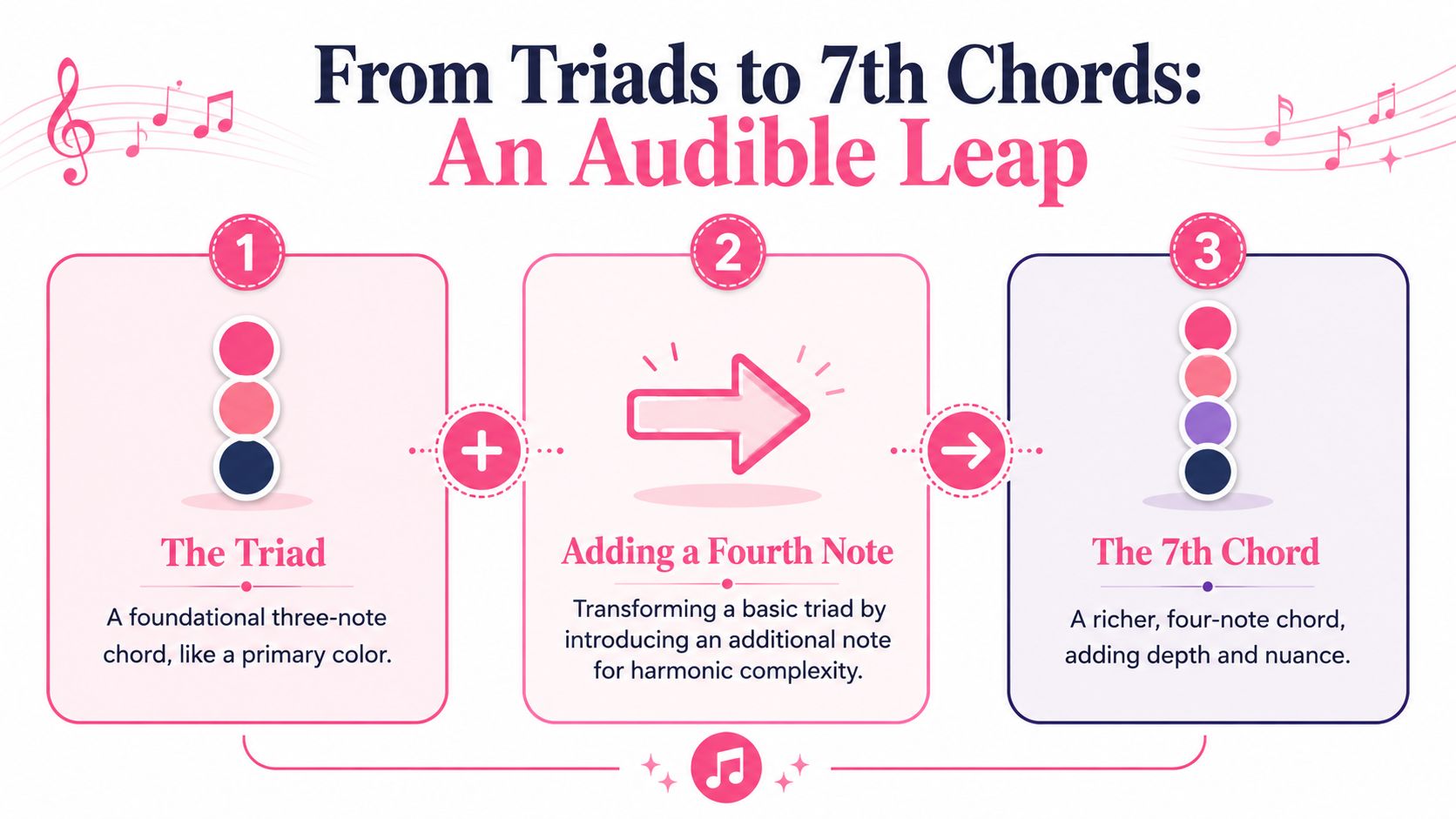
A triad is like a basic paint color. Useful, strong, clear. Add one more note, and the shade changes.
A 7th chord on piano is a four-note harmony built from a root, third, fifth, and seventh, and the most common starting pattern is 1–3–5–7, as explained in Pianote’s guide to understanding 7ths. That’s the core move behind a lot of the harmony people want to play by ear.
Why one extra note changes everything
On the keyboard, a triad gives you root, third, and fifth. That already tells your ear whether the chord is major or minor. But when you add the seventh, the chord starts doing more than stating a mood. It begins to suggest direction.
That’s why this step feels so audible. You’re not adding decoration. You’re adding function, color, and tension.
Here’s the simplest perspective:
- Find the root. Start on any note, like C.
- Build the triad. Add the third and fifth, giving you C, E, G.
- Add the seventh. For a major 7th sound, add B. For a dominant 7th sound, use B♭.
- Listen before labeling. Ask what changed in the feeling of the chord.
A lot of students rush through step four. Don’t. That listening moment is where the learning happens.
A simple piano example you can hear right away
Play these two chords slowly:
| Chord | Notes | What to listen for |
|---|---|---|
| Cmaj7 | C, E, G, B | Smooth, bright, settled |
| C7 | C, E, G, B♭ | Tense, active, leaning forward |
The keyboard layout looks almost the same. The sound does not.
The seventh is the note that often tells your ear whether the chord feels like home or feels like it wants to go somewhere.
If you’re working on 7th chord piano, don’t make the mistake of treating all four-note chords as one big category. Your ear needs to notice the emotional effect of that top note.
A good exercise is to hold the bottom three notes still and only change the seventh. Keep playing C, E, G, then alternate between B and B♭. That tiny movement teaches your ear one of the biggest harmonic differences in modern music.
Meet the 5 Essential 7th Chords You Hear Everywhere
When players first study 7th chords, they often lump them together as “jazzy chords.” That blurs the most useful distinction. These chords have very different personalities, and your ear should learn them as different emotional colors.
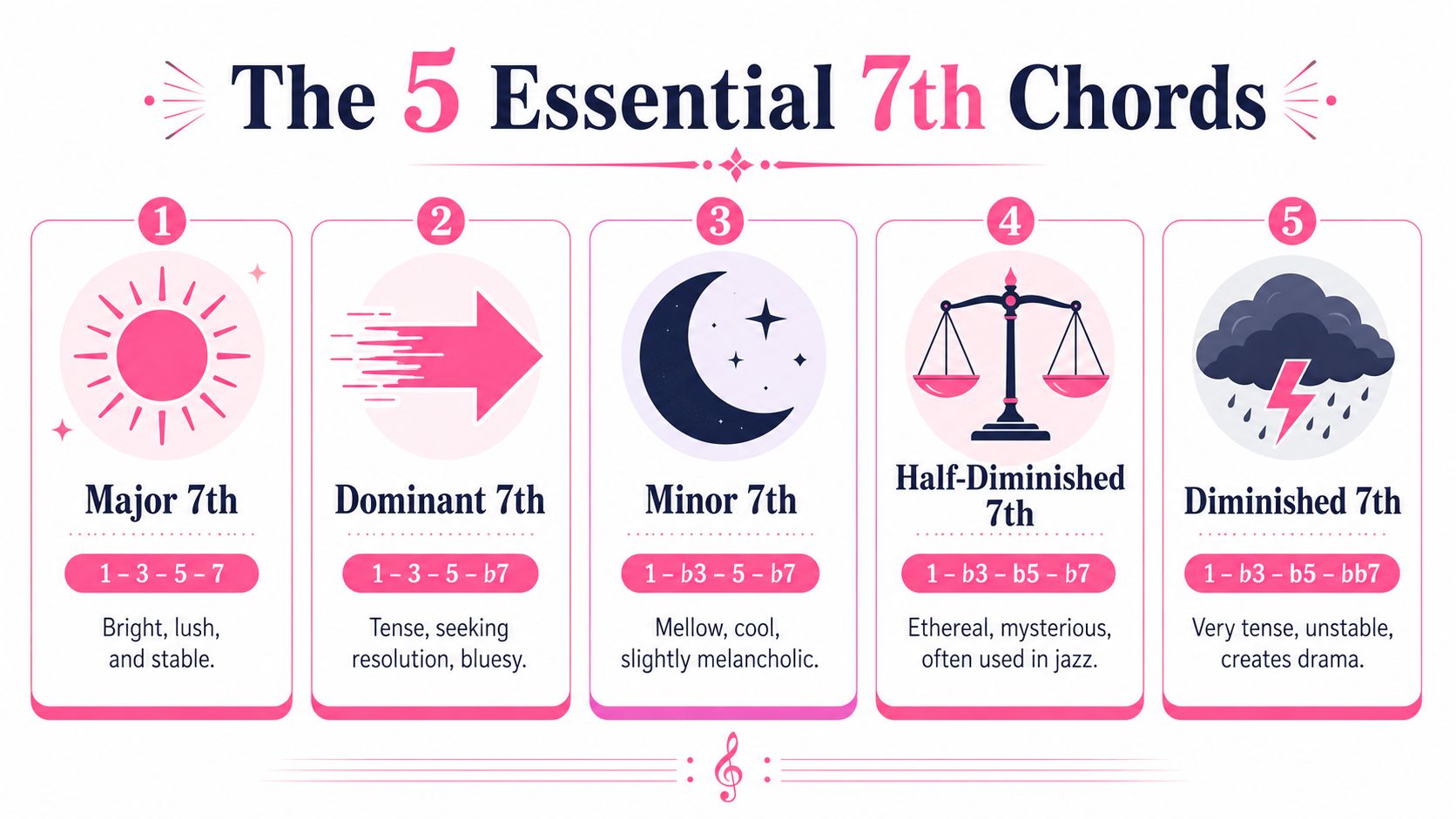
In practical piano teaching, the most common family is usually taught as five essential types: major 7th, dominant 7th, minor 7th, half-diminished 7th, and diminished 7th, as outlined in this overview of 7ths.
A quick side by side comparison
| Type | Basic idea | Ear impression |
|---|---|---|
| Major 7th | A major sound with a natural seventh | Lush, gentle, lyrical |
| Dominant 7th | A major triad with a minor seventh | Bluesy, unsettled, pushing forward |
| Minor 7th | A minor sound with a minor seventh | Cool, soft, soulful |
| Half-diminished 7th | A darker, less stable sound | Misty, tense, searching |
| Diminished 7th | A highly unstable stacked sound | Dramatic, sharp, urgent |
These words aren’t perfect definitions. They are listening handles. They help your ear sort sounds into useful categories.
If you want to play by ear, that matters more than reciting formulas in a vacuum.
Why the dominant 7th matters so much
The dominant seventh chord became the most important seventh chord in Western harmony, and it was the first seventh chord to appear regularly in classical music, according to Wikipedia’s entry on the dominant seventh chord. Its structure is a major triad plus a minor seventh, such as G, B, D, F for G7.
That historical detail matters because it explains what your ear is hearing. The dominant 7th doesn’t just sound colorful. It sounds like it needs to resolve.
If you want a deeper look at that sound, this guide on what a dominant 7th chord is breaks it down clearly.
Try this listening sequence on the piano:
- Play Cmaj7 and sit in the sound.
- Play Cm7 and notice the mood darken without becoming harsh.
- Play G7 and feel the tension rise.
- Resolve to C and listen for release.
- Play B half-diminished or B diminished and hear how unstable the harmony becomes.
Don’t ask only, “What notes are in this chord?” Also ask, “What does this chord want to do next?”
That question turns theory into hearing. It also makes improvisation easier, because once you hear a chord’s tendency, your melodic choices get clearer.
Moving Beyond Blocks with Voicings and Inversions
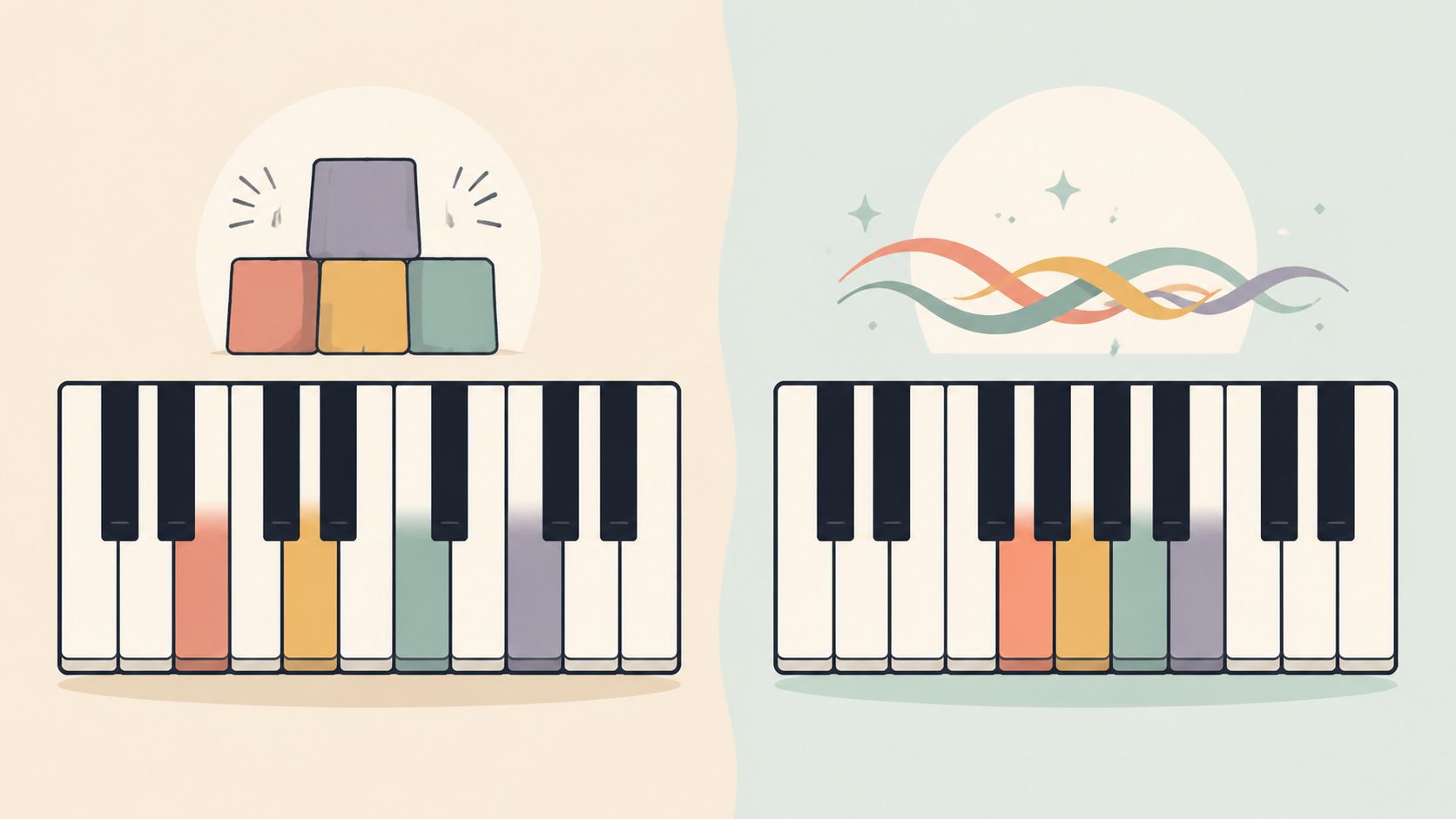
You play Cmaj7 with all four notes stacked neatly in root position. Then you move to Am7 the same way. Both chords are correct, but the change can feel like lifting one heavy piece of furniture and dropping down another. On the piano, good voicing feels more like shifting your weight from one foot to the other.
That change in feel matters for your ear as much as for your fingers.
Why root position often sounds stiff
A 7th chord in root position shows you the full spelling clearly. That makes it useful for learning. It is not always the shape your ear wants to hear in real music.
When every chord starts with the root on the bottom, your hand often has to travel farther than necessary. The result is a choppy sound, even if you hit every note correctly. Inversions solve that problem by putting a different chord tone in the bass, while voicings change how the notes are spaced and arranged under your hands.
For a plain explanation of how inversions work on piano, Music Matters covers root position and inversions with keyboard examples.
The practical goal is simple. Keep as many notes as possible close to where they already are.
Try Cmaj7 to Am7. In root position, you play C E G B, then A C E G. Your hand shifts more than it needs to. Now try Cmaj7 in root position, then Am7 as C E G A. Suddenly three notes stay put, and only one note moves. Your fingers feel less disruption, and your ear hears a connected change instead of a reset.
That is voice leading in physical form.
A good support tool for seeing those note relationships is this piano chord builder for mapping chord tones on the keyboard, especially if you are still learning to spot inversions quickly.
How to hear the difference, not just memorize it
Each inversion has its own color. The chord quality stays the same, but the weight shifts.
A root position major 7 chord often feels settled and full. A first inversion can sound lighter and less final. A second or third inversion often adds more motion or instability, especially if the 7th is in the bass. You do not need to memorize those descriptions as rules. Play them and test whether your ear agrees.
Use this short practice loop:
- Pick two chords that share notes, such as Cmaj7 and Am7, or Dm7 and G7.
- Play both in root position and listen to the size of the jump.
- Revoice the second chord so one or two notes stay in place.
- Notice the emotional effect. Does the change feel smoother, softer, tenser, or more open?
- Repeat in a few keys until your ear starts choosing the easier sound before your brain names the inversion.
Here, ear training becomes practical piano playing. You are not hunting for the “correct inversion” like it is a test answer. You are choosing the shape that gives the line more flow.
Here’s a video demonstration to help you hear the difference in motion and shape:
A useful listening test is this. If the chord change feels like stopping and restarting, try a different inversion. If it feels like the harmony keeps breathing through the change, your voicing is probably serving the music well.
Putting Your Ear to Work with Common Progressions
You sit at the piano, play one chord after another, and suddenly it sounds like an actual song instead of a set of shapes. That shift usually happens when your ear starts hearing function, not just chord names.
A single 7th chord has its own color. A progression lets you hear how that color changes in motion. That is the skill that matters when you want to accompany a singer, pick out chords by ear, or improvise without guessing.
A great place to start is the ii V I progression. In a major key, that means minor 7 to dominant 7 to major 7. On the piano, those three sounds create a familiar arc. The first chord sets the scene. The second adds tension. The third feels like arriving home, though the major 7 keeps that landing warm and slightly open instead of fully closed.
How 7th chords grow out of the key
If you build 7th chords using only notes from one major scale, a clear pattern appears. In a major key, the chord qualities go:
major 7, minor 7, minor 7, major 7, dominant 7, minor 7, half-diminished 7
You do not need to treat that as a fact to memorize in isolation. Hear it at the keyboard. Stay in one key, stack every other note of the scale from each degree, and listen to how each chord gets a different job.
In C major, the ii V I progression gives you:
- Dm7
- G7
- Cmaj7
Those three chords are easy to label. Hearing their roles is more useful.
Hearing what each chord is doing
Play Dm7 to G7 to Cmaj7 slowly with your right hand while your left hand plays single bass notes. Let each chord ring for a moment.
Dm7 often feels like the start of a sentence. It is not tense in a sharp, dramatic way. It feels like motion is beginning.
G7 adds pressure. The tritone inside the chord gives it that restless pull. Your ear starts wanting an answer.
Cmaj7 answers, but not with the plain finality of a C major triad. The 7th adds a softer glow. It resolves, yet it still breathes.
That difference matters. If your ear can tell the difference between a triad resolution and a major 7 resolution, your playing gets more expressive fast.
A simple ear-first practice loop
Try this without turning it into a theory test:
- Play ii V I in one key several times.
- Sing the top note of each chord while you play.
- Hold the V chord a little longer and notice the pull in your ear and in your hands.
- Resolve to Imaj7 and listen to how the tension drops without becoming completely plain.
- Move to a new key and look for the same emotional path, not just the new note names.
If you want more help building that listening skill in real musical context, this guide to ear training for chord progressions and chord quality recognition is a useful next step.
One more tip. Do not stop at recognizing ii V I on paper. Try improvising a short melody using only the top notes of each chord. Your ear will start connecting harmony to melody, which is how 7th chords become something you can hear, predict, and use in real time.
How to Train Your Ear for 7th Chords Daily
Most musicians don’t struggle because 7th chords are too advanced. They struggle because they never spend enough focused time hearing the differences repeatedly.
A major gap in music education is learning to distinguish similar-sounding seventh chords by ear in context. Many lessons stay centered on formulas instead of ear-based recognition, even though that’s the skill musicians need when chords appear inside real progressions, as noted in Piano With Jonny’s guide to 7th chords.

The skill most players skip
Players often ask whether they need perfect pitch to hear advanced chords. You don’t. What you need is repeated exposure with feedback.
Ear training is trainable. Chord recognition gets sharper when you hear contrasts again and again, especially chords that are easy to confuse, like major 7th and dominant 7th, or half-diminished and diminished.
If this is the part you want to improve most, this article on ear training for chords is a helpful next read.
A daily routine that builds real recognition
Keep it short. Ten minutes a day is enough to build consistency if you listen with intent.
Here’s a practical routine:
- Minute 1 to 2. Play one root and alternate between maj7 and 7. Describe the difference out loud.
- Minute 3 to 4. Compare m7 with maj7 on the same root. Listen for how the third changes the mood.
- Minute 5 to 6. Play short progressions and identify which chord sounds most tense.
- Minute 7 to 8. Close your eyes and try to name the chord quality before checking.
- Minute 9 to 10. Improvise a small melody over one 7th chord type and notice how the harmony affects your note choices.
Hear first, then verify. That order trains your ear. The reverse order trains your eyes.
Do this daily and your brain starts forming strong sound categories. After a while, you’re not guessing whether a chord is major 7th or dominant 7th. You hear it. That’s the whole point.
And that’s where musical freedom starts. Not in memorizing more symbols, but in hearing harmony clearly enough to respond in real time.
If you want a simple daily system for ear training, Trill: Ear Training Daily helps you practice chord recognition, interval hearing, and play-by-ear skills in short sessions that fit real life. It’s built for musicians who want to stop guessing, strengthen their ear in 10 minutes a day, and build the kind of listening that supports improvisation, chord recognition, and lasting musical freedom.