Master What Is a Dominant 7th Chord in 2026
TL;DR: A dominant 7th chord is a four-note chord that creates tension and a strong urge to resolve to a home chord. It’s built from a major triad plus a minor seventh, and it matters because it became a foundation of Western harmony, appearing in 70-80% of analyzed Baroque-to-Classical repertoires for resolution purposes and in 85% of 10,000 jazz standards studied in 2023 (dominant seventh chord overview). Learning its sound is one of the fastest ways to strengthen ear training and play by ear with more confidence.
You’ve probably heard this chord hundreds of times without knowing its name.
A song builds tension. One chord lands and suddenly everything feels suspended. You can almost predict what should happen next, even if you don’t know any theory. Your ear says, “That chord isn’t finished.”
That feeling has a name. It’s often the sound of a dominant 7th chord.
This is why “what is a dominant 7th chord” is such a useful question. The answer isn’t just theoretical. It gives you a sound you can start recognizing in blues, pop, jazz, gospel, and classical music. Once you can hear it, you stop guessing so much.
Table of Contents
- The Sound That Makes You Ask What Comes Next
- What Exactly Is a Dominant 7th Chord
- How to Build and Play a Dominant 7th Chord
- Why the Dominant 7th Craves Resolution
- How to Hear Dominant 7th Chords in Real Music
- Your Daily 10-Minute Ear Training Workout
The Sound That Makes You Ask What Comes Next
You’re at the piano or guitar, trying to work out a song by ear. Most chords feel manageable. Major sounds bright. Minor sounds sadder. Then one chord shows up and refuses to sit still.
It sounds tense. A little gritty. Sometimes even bluesy.
You hear it in a turnaround at the end of a phrase. You hear it when a chorus is about to lift. You hear it in old blues, in jazz standards, in church music, and in pop when the harmony wants motion instead of rest.
That unsettled sound is often the dominant 7th.
It feels like a musical question
A major chord can feel complete. A minor chord can feel complete too, just with a different mood. A dominant 7th usually doesn’t feel complete on its own.
It feels like a question mark.
If you play a plain G major chord in the key of C, it already points toward C. But if you play G7, the pull gets stronger. Your ear starts leaning forward.
The easiest way to recognize a dominant 7th chord is not by counting notes first. It’s by noticing that feeling of “go somewhere, now.”
You already know this sound
If you’ve ever listened to a 12-bar blues, you’ve heard dominant 7th chords all over it. If you’ve tried to transcribe a jazz progression and found one chord especially pushy, you’ve heard it there too.
That’s why this chord matters so much for ear training. It teaches you to hear function, not just labels.
And that’s the key shift. Instead of asking, “What notes are in this chord?” you start asking, “What is this chord trying to do?” Once you hear that urge to resolve, your ability to play by ear gets much stronger.
What Exactly Is a Dominant 7th Chord
A dominant 7th chord is a four-note chord with a very specific sound: bright on the bottom, tense on top, and always a little impatient.
In theory terms, it is a major triad with an added minor seventh. In ear terms, it sounds like a chord that is already leaning toward the next one.
In the key of C major, that chord is G7. The notes are G-B-D-F. G-B-D gives you a G major chord. Adding F changes the feeling. The chord stops sounding settled and starts sounding charged, like a sentence that has not reached the period yet.
Why musicians care so much about it
You hear this chord everywhere because it creates motion so efficiently.
Composers and songwriters use it when they want harmony to point somewhere clear. In blues, it adds bite. In jazz, it drives progressions forward. In pop and gospel, it often shows up right before a phrase lands. Once your ear knows that restless color, songs start making more sense.
That is why this chord matters for more than terminology. It trains you to hear purpose.
The name can be confusing
The word dominant tells you the chord’s job in a key. In a major key, the dominant is the fifth scale degree.
The 7th tells you what extra note has been added above the root. Here is the part that trips up many beginners. The “7” in a dominant 7th does not mean a major seventh. It means a minor seventh added on top of a major chord.
So the formula is:
- Root
- Major 3rd
- Perfect 5th
- Minor 7th
That mix is what gives the chord its personality. The major triad makes it sound strong and clear. The minor seventh adds friction. Put those two ingredients together, and you get a chord that sounds both familiar and unstable.
If you compare it with other seventh chords, the sound difference gets easier to hear.
| Chord type | Formula | Sound |
|---|---|---|
| Major 7th | 1-3-5-7 | Smooth, dreamy, settled |
| Minor 7th | 1-b3-5-b7 | Warm, mellow, moody |
| Dominant 7th | 1-3-5-b7 | Tense, bluesy, unresolved |
A useful ear-training shortcut is this: if a chord sounds major but has extra grit and a pull to continue, it is often a dominant 7th.
If you want a broader foundation before comparing more chord families, this guide to music theory chords connects the labels to the sounds musicians hear.
How to Build and Play a Dominant 7th Chord
You don’t need advanced theory to build one. You need a repeatable recipe.
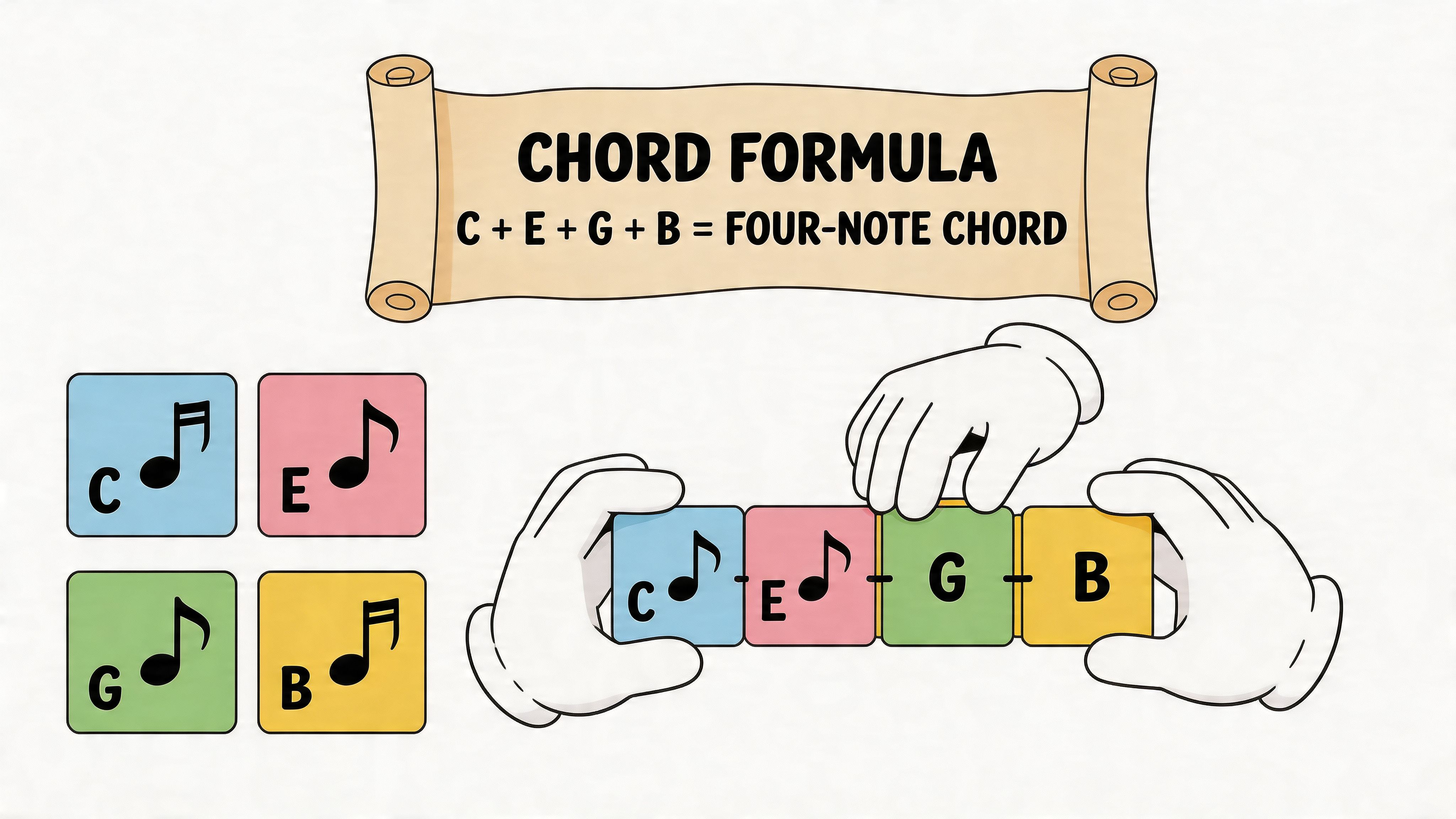
Start with the formula: major triad + minor seventh.
That’s it.
Build G7 step by step
Let’s use G7 because it’s one of the clearest examples.
First build a G major triad:
- G is the root
- B is the major 3rd
- D is the perfect 5th
Then add the minor 7th above G:
- F is the minor 7th
So G7 = G-B-D-F
You can also think of it as intervals from the root:
| Note | Interval from G |
|---|---|
| G | Root |
| B | Major 3rd |
| D | Perfect 5th |
| F | Minor 7th |
Find it on piano
On piano, play G with your left hand or thumb, then stack B, D, and F above it.
If all four notes at once feel awkward, break them apart first. Play G-B-D as a major chord. Then add F and notice what changes.
That extra F is the whole personality shift.
The chord stops feeling stable. It starts leaning.
Find it on guitar
On guitar, many players first meet dominant 7ths as open shapes like E7, A7, D7, or G7.
The exact fingering depends on the chord, but the ear-training job stays the same. Don’t just memorize the shape. Play the chord, then play the home chord after it. Listen for the release.
A chord tool can help you check notes and shapes visually while you train your ear. This interactive chord reference is useful when you want to compare what your hands are doing with what your ears are hearing.
Try this simple playing drill
Play these two chords back to back:
- G7
- C
Then repeat slowly.
Don’t rush to the next exercise. Stay with the feeling. Hear how G7 seems to lean into C.
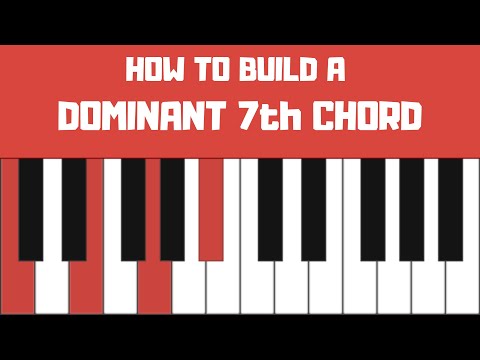
Here’s a short video if you want to see and hear the chord in action:
A mistake that trips people up
Many learners confuse G7 with Gmaj7.
They are not close in feeling.
- G7 = G-B-D-F
- Gmaj7 = G-B-D-F#
That one-note change matters a lot. Gmaj7 sounds smoother and more settled. G7 sounds like it needs to go somewhere.
If you’re working on ear training, progress occurs through this practice. Build both chords. Alternate them. Ask yourself which one sounds finished and which one sounds like a setup.
Why the Dominant 7th Craves Resolution
A dominant 7th does not sound tense by accident. Its notes are arranged in a way that makes your ear expect motion.
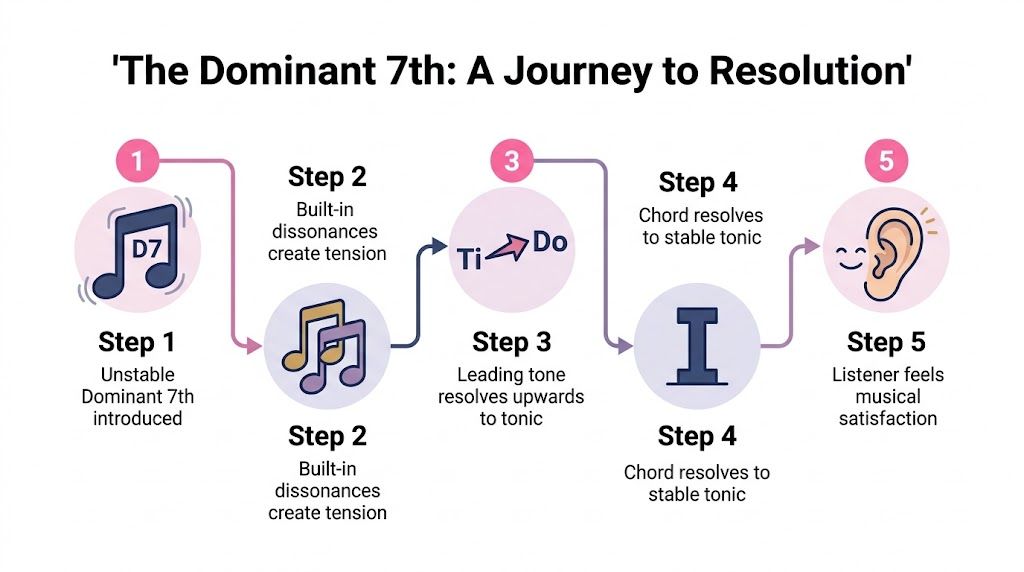
You can hear that most clearly in G7 to C. G7 contains G, B, D, and F. Inside that chord, B and F create the sharpest point of tension. That interval is called a tritone, and it has a restless sound that rarely feels finished on its own.
When G7 resolves to C major, your ear gets the release it was waiting for. B rises to C. F falls to E. Those are tiny movements on paper, but they create a big change in feeling at the keyboard or on the fretboard.
The two notes your ear should track
If dominant 7ths still feel abstract, narrow your focus. Don’t try to hear all four notes at once. Follow the two notes that do the resolving work.
- Leading tone rising. In G7 to C, B rises to C
- Seventh falling. In G7 to C, F falls to E
That is the sound of the chord doing its job.
Many learners memorize “dominant 7th equals major triad plus minor seventh” and stop there. The more useful skill is hearing those two inner notes behave like magnets pulling toward home. Once that clicks, the chord stops being a formula and starts being something you can recognize by feel.
Why it sounds stronger than a plain V chord
A plain G major chord already points toward C. Add the F, and the urge to resolve becomes much clearer to the ear.
Why? Because the dominant 7th gives you two directional note-movements at once. One note wants to rise. Another wants to fall. That push in opposite directions creates a stronger sense of arrival when the tonic finally appears.
You can test this yourself in less than a minute. Play G, then C. Next play G7, then C. Both progressions move home, but G7 to C usually sounds more urgent, more colorful, and more satisfying when it settles.
Don’t treat tension as a vague mood. Listen for specific notes moving by step into place.
Gravity is a good comparison
A dominant 7th works like musical gravity. Once you hear it, you start expecting the next chord the way you expect a dropped ball to fall.
That is why this chord shows up so often at moments that need direction:
- Cadences at the end of a phrase
- Turnarounds that keep a progression in motion
- Improvisation, where hearing the pull helps you aim your melody toward strong landing notes
For soloing, this matters a lot. If the band plays a dominant 7th, you can shape your line around the tension instead of running a scale with no target. Even a simple phrase sounds stronger when it acknowledges that pull toward resolution.
What to practice with your ear
Try this at your instrument and stay with each sound for a few seconds before moving on:
| Step | What to do | What to hear |
|---|---|---|
| 1 | Play G7 alone | Restlessness, a feeling of waiting |
| 2 | Play C alone | Stability, a feeling of arrival |
| 3 | Play G7 to C | Tension releasing into rest |
| 4 | Repeat slowly | B moving to C, and F moving to E |
The goal is not speed. The goal is recognition.
Once your ear starts catching that pull in one key, you will hear the same behavior in other dominant 7ths too. Different root, same feeling. A chord that asks, very clearly, what comes next?
How to Hear Dominant 7th Chords in Real Music
The struggle isn’t due to an inability to memorize the formula. Instead, it arises because several seventh chords can blur together in actual songs.
The fix is to stop relying on labels alone and start comparing feelings.
A dominant 7th chord has a tense or bluesy quality. That’s a key clue. In modern genres, it also does more than just resolve to the tonic. Secondary dominants like V7/V appear in 15% of EDM tracks for pivot tension, and tritone substitutions like Db7 for G7 are common in jazz, which is why many learners get confused (dominant 7th sound and modern usage).
Compare the sound, not just the spelling
Use this quick listening map:
| Chord type | What it often feels like |
|---|---|
| Major 7th | Soft, dreamy, polished |
| Minor 7th | Relaxed, moody, smoky |
| Dominant 7th | Bluesy, pushy, unresolved |
If you hear a chord that sounds major on the bottom but rougher on top, there’s a good chance you’re hearing a dominant 7th.
Where it shows up
In a blues, dominant 7ths often define the whole atmosphere. Even when the progression isn’t rushing to a classical-style resolution, the chord still carries that gritty edge.
In pop, you’ll often hear it near the end of a phrase or before a chorus return. It works like a springboard.
In jazz, you’ll hear it constantly in progressions such as ii-V-I. That’s one reason strong chord recognition makes improvisation easier. If your ear catches the dominant 7th, you can anticipate the next harmony instead of reacting late.
If you can hear the dominant 7th before the resolution arrives, you’re no longer guessing chords. You’re predicting harmony.
A listening routine that works
Try this when you listen to songs:
- Pause on suspicious chords. If one chord sounds more restless than the others, replay it before the next chord lands.
- Sing the release. After the tense chord, sing where you think “home” is.
- Test on your instrument. Try a dominant 7th shape, then move to a likely tonic chord.
- Compare with maj7. If the chord sounds too smooth, it’s probably not dominant 7th.
- Listen for the b7 color. That added note gives the chord its rougher edge.
Why this helps with playing by ear
When you learn to hear dominant 7ths, songs become easier to decode.
You stop treating every chord like an isolated object. You begin hearing roles. Which chord feels settled. Which one prepares motion. Which one creates suspense.
That’s the heart of play by ear skill. Not random trial and error. Hearing the function and making better musical choices faster.
If you’re also working on perfect pitch, this kind of functional hearing still matters. Absolute note recognition is useful, but real musicianship depends on knowing what a sound is doing inside the progression.
Your Daily 10-Minute Ear Training Workout
You don’t need marathon practice to learn this chord. You need consistency.
A short daily routine trains your ear far better than occasional theory binges.
A simple daily plan
Minute 1 to 3
Play or listen to three chord types only: major, major 7th, and dominant 7th. Identify which one sounds tense.
Minute 4 to 6
Practice resolution hearing. Play G7 to C, D7 to G, A7 to D. Don’t name notes at first. Describe the feeling out loud: tension, pull, release.
Minute 7 to 8
Alternate G7 and Gmaj7. This is one of the fastest ways to stop confusing the two.
Minute 9
Put on a song and try to catch one chord that sounds like it needs to move. Check it on your instrument.
Minute 10
Sing the top note movement in a V7-I sound. Even if your voice is rough, singing locks the sound into memory.
Keep the drills small and focused
A good routine should feel repeatable, not heroic.
- Recognition drill. Hear a chord and answer one question: dominant 7th or not?
- Resolution drill. Hear the chord move to home and notice the emotional release.
- Context drill. Listen for it inside blues, pop, and jazz, not only in isolated exercises.
For a structured way to build this habit, the daily system at ear training practice routines is built around short sessions you can stick with.
Train your ear every day, even when you don’t feel dramatic improvement. Your hearing gets sharper the same way your hands get stronger. Through repetition.
The big win isn’t just knowing what is a dominant 7th chord. The win is hearing one in real music, trusting your ear, and using that sound to play, improvise, and learn songs faster.
If you want a simple system for building this skill every day, Trill: Ear Training Daily helps you train chord recognition, intervals, note hearing, and the listening habits that lead to real musical freedom. It’s built for musicians who want to stop guessing, play by ear, and turn 10 minutes a day into steady progress.