Master Augmented 7th Chord: Theory & Practice
You hear a chord in a song and it doesn’t sound plainly major, minor, or bluesy. It feels bright, but also unstable. It hangs in the air like a question that hasn’t been answered yet.
A lot of players run into this sound before they know its name. They can feel the tension, but they can’t grab it. Then they look it up and find a formula, a few symbols, and a spelling rule. Useful, yes. But that still doesn’t help much when you’re trying to recognize it in real music or play by ear on the spot.
The augmented 7th chord is one of those sounds that makes much more sense when you learn it with your ears first. Once you hear what makes it special, the theory stops feeling abstract. It becomes a color you can recognize, sing, play, and use.
Table of Contents
- That Tense, Dreamy Chord You Keep Hearing in Songs
- Decoding the Sound What Is an Augmented 7th Chord
- How to Play Augmented 7th Chords on Piano and Guitar
- Where This Chord Wants to Go Harmonic Function and Resolution
- How to Train Your Ear to Instantly Recognize This Chord
- Your 10-Minute Daily Practice Plan for Mastery
That Tense, Dreamy Chord You Keep Hearing in Songs
Maybe you’ve had this happen at the piano. You land on a chord by accident and suddenly everything sounds more cinematic. Not sad exactly. Not happy either. It feels like the music leaned forward and is waiting for the next line.
Guitar players find it too, often while sliding a dominant shape and hearing one note twist the whole mood. The chord gets brighter and stranger at the same time. It has motion built into it.
That sound is often the augmented 7th chord.
Most lessons online tell you how to spell it, but they don’t spend much time on how to recognize it in real music or hear what it does in a progression. That’s a big reason learners confuse it with dominant 7ths, altered dominants, or nearby colors that feel similar in context, as noted in Fretjam’s discussion of augmented guitar chords.
You don’t need perfect pitch to catch this chord. You need a memory for its tension.
What makes this chord worth learning isn’t just the label. It’s what it makes possible. Once your ear starts catching this sound, you begin hearing when a song is pushing toward a resolution. Improvisation gets easier because you’re not reacting to symbols on a page. You’re reacting to the sound of harmonic pull.
And that’s the shift. You stop memorizing chord names and start noticing behavior. This chord doesn’t sit still. It wants to go somewhere.
Decoding the Sound What Is an Augmented 7th Chord
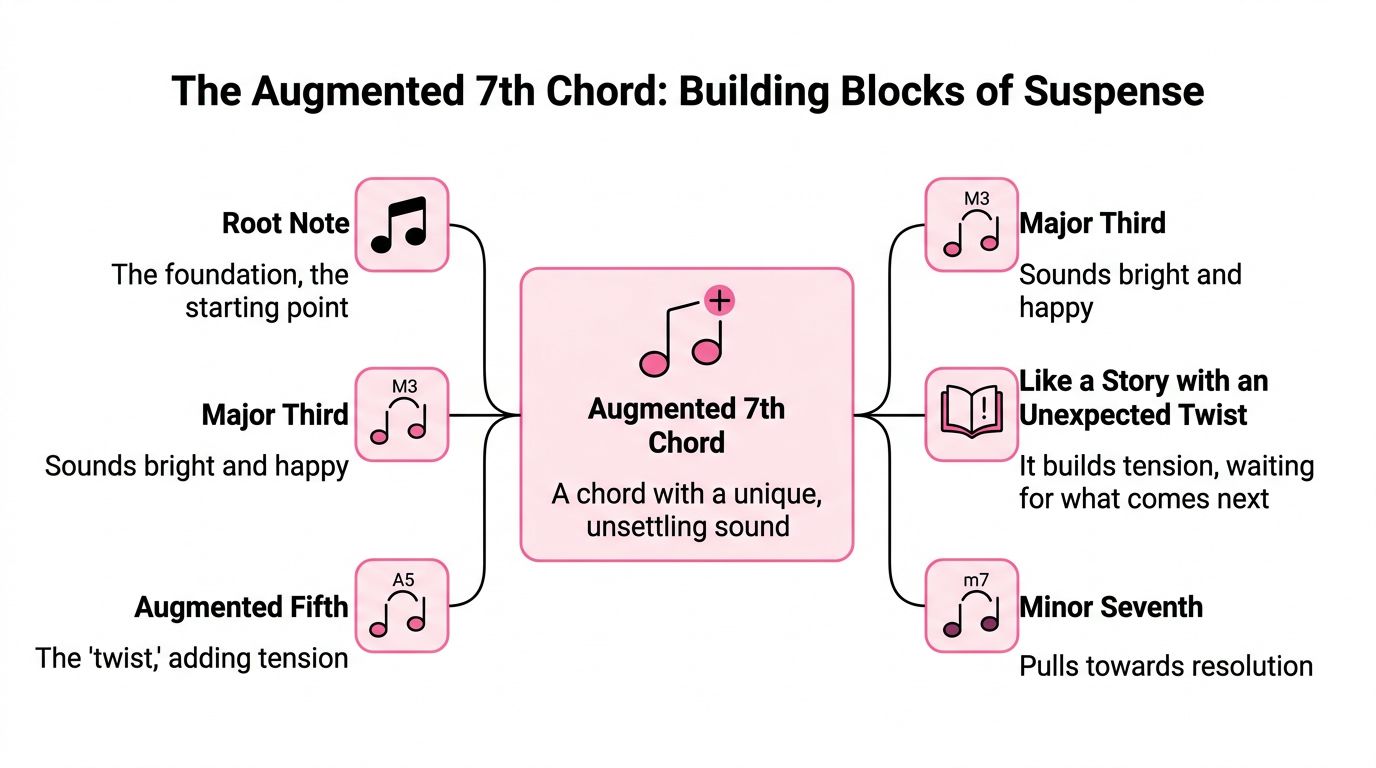
An augmented 7th chord is a four-note chord built from a root, major third, augmented fifth, and minor seventh. Another way to say that is 1–3–♯5–♭7. It combines an augmented triad with a minor seventh, and it usually behaves like a dominant chord that creates tension and resolves a fifth below. A common example is Gaug7 resolving to C major or C minor, as described in Wikipedia’s overview of the augmented seventh chord.
Think of it as a dominant chord with one strange light switched on
If you already know the sound of a dominant 7th chord, you’re close. The augmented 7th chord feels related because it shares that dominant pull. The difference is one altered note. The fifth is raised.
That single change matters a lot. It’s like taking a familiar room and changing one lightbulb to a different color. The furniture is the same. The mood isn’t.
Here’s a simple way to hear the build:
- Root: gives you home base
- Major third: adds brightness
- Augmented fifth: creates the unusual lift and tension
- Minor seventh: keeps the chord leaning forward
The sharpened fifth is the sound one needs to learn to hear. Once that note stands out in your ear, the chord stops sounding vague and starts sounding identifiable.
Practical rule: If a dominant-type chord suddenly sounds more slippery, more luminous, and less settled than usual, listen for the raised fifth.
There’s also a useful detail for listening. In chord theory, the root can be optional in practice because the augmented fifth is the defining altered tone. That’s one reason the chord can still sound clear even in lean voicings.
If you want a broader foundation in chord construction before returning to this sound, this guide to chord theory basics helps connect names on the page to what you hear.
The symbols that show up on chord charts
This chord appears under a few common labels. You might see:
- C+7
- Caug7
- C7♯5
Those are different spellings for the same basic harmonic idea.
Beginners often get stuck here because the symbols look more complicated than the sound. Don’t let the notation scare you. The symbol is just a shortcut telling you, “Play a dominant-flavored chord, but raise the fifth.”
When you think of it that way, the sound becomes easier to predict before you even play it.
How to Play Augmented 7th Chords on Piano and Guitar
Hearing comes first, but your hands matter too. The faster you can find this chord on your instrument, the faster your ear will connect the sound to a physical shape.
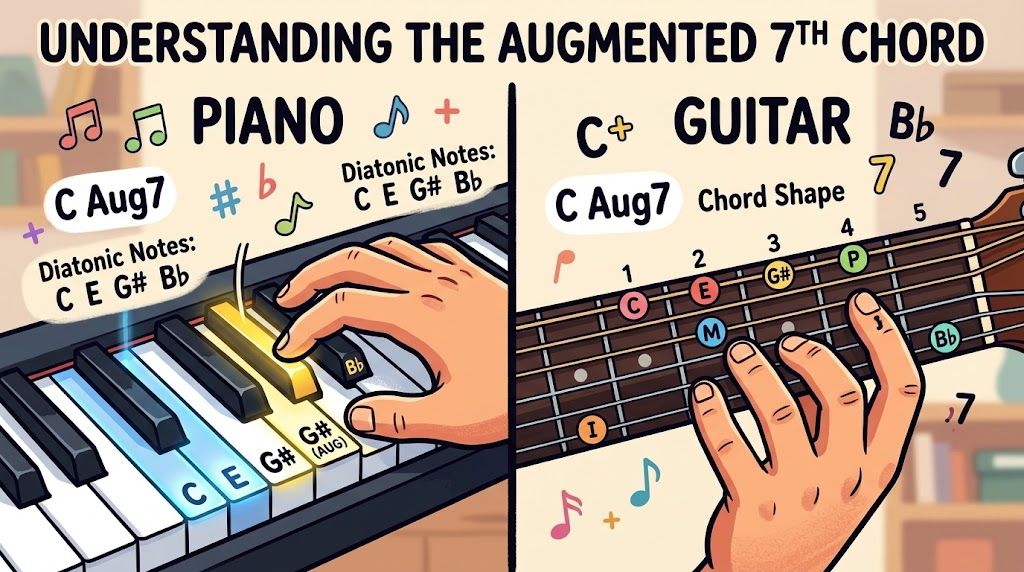
On piano, build it from one note at a time
Start with C+7. Use the formula you’ve already learned:
- C for the root
- E for the major third
- G♯ for the augmented fifth
- B♭ for the minor seventh
Play those notes slowly, bottom to top. Then play them together. Hold the chord and listen to the way the top of the sound seems to shimmer instead of settle.
Now try G+7:
- G
- B
- D♯
- F
Don’t rush to the next chord. Let your ear sit inside the sound first. Then resolve it to a C chord and notice the release.
A useful piano exercise is to move this shape around chromatically. Build one augmented 7th chord, then slide the whole idea up or down and listen for the same color in a new key.
On guitar, learn the sound before chasing fancy voicings
On guitar, many players first meet this chord as a variation of a dominant shape. That’s a good approach because it keeps the ear anchored to something familiar.
Start by doing this:
- Play a dominant 7th chord you know well.
- Keep the root, third, and seventh concept in your ear.
- Raise the fifth in the shape or in a simplified voicing.
- Strum and listen for the extra tension.
If the voicing feels awkward, that’s normal. On guitar, altered chords can be physically less comfortable at first. Don’t judge the chord by the first shape you try. Judge it by the sound.
A smart shortcut is to work with compact voicings on the middle strings. Four-note grips are useful, but even smaller voicings can train your ear if the altered fifth is present clearly.
If you’d like a visual way to test shapes in different keys, Trill’s chord tools make it easier to map notes and voicings without getting lost in fretboard guesswork.
Inversions change the flavor, not the identity
An inversion means a note other than the root appears on the bottom. On paper that can sound technical. In real playing, it just means the same chord can wear different shoes.
Why does that matter? Because sometimes the root-position chord sounds bulky or jumps too far in a progression. An inversion can smooth the movement.
Try this on either instrument:
- Root position: play the chord as built
- First inversion: put the major third in the bass
- Second inversion feel: let the altered fifth stand out lower in the voicing
- Third inversion color: put the minor seventh in the bass
The chord’s personality stays intact if the essential sound remains clear. Your ear should still catch that sharpened fifth and that push toward motion.
If a voicing sounds smoother but still feels unsettled, you’re probably still hearing the chord correctly.
Where This Chord Wants to Go Harmonic Function and Resolution
Some chords feel complete. This one usually doesn’t. The augmented 7th chord creates suspense, and that suspense makes more sense when you hear it as part of a journey.
The classic pull is dominant to tonic. In plain language, the chord sounds like it’s asking for an answer. The answer is usually a more stable chord.
Hear it as a setup, not a resting place
When you play G+7, your ear often expects C next. That expectation is part of the chord’s identity.
It helps to think of this less as theory and more as storytelling:
- The setup: the harmony starts to lean forward
- The twist: the raised fifth adds a sharper edge than a regular dominant
- The destination: the next chord releases the pressure
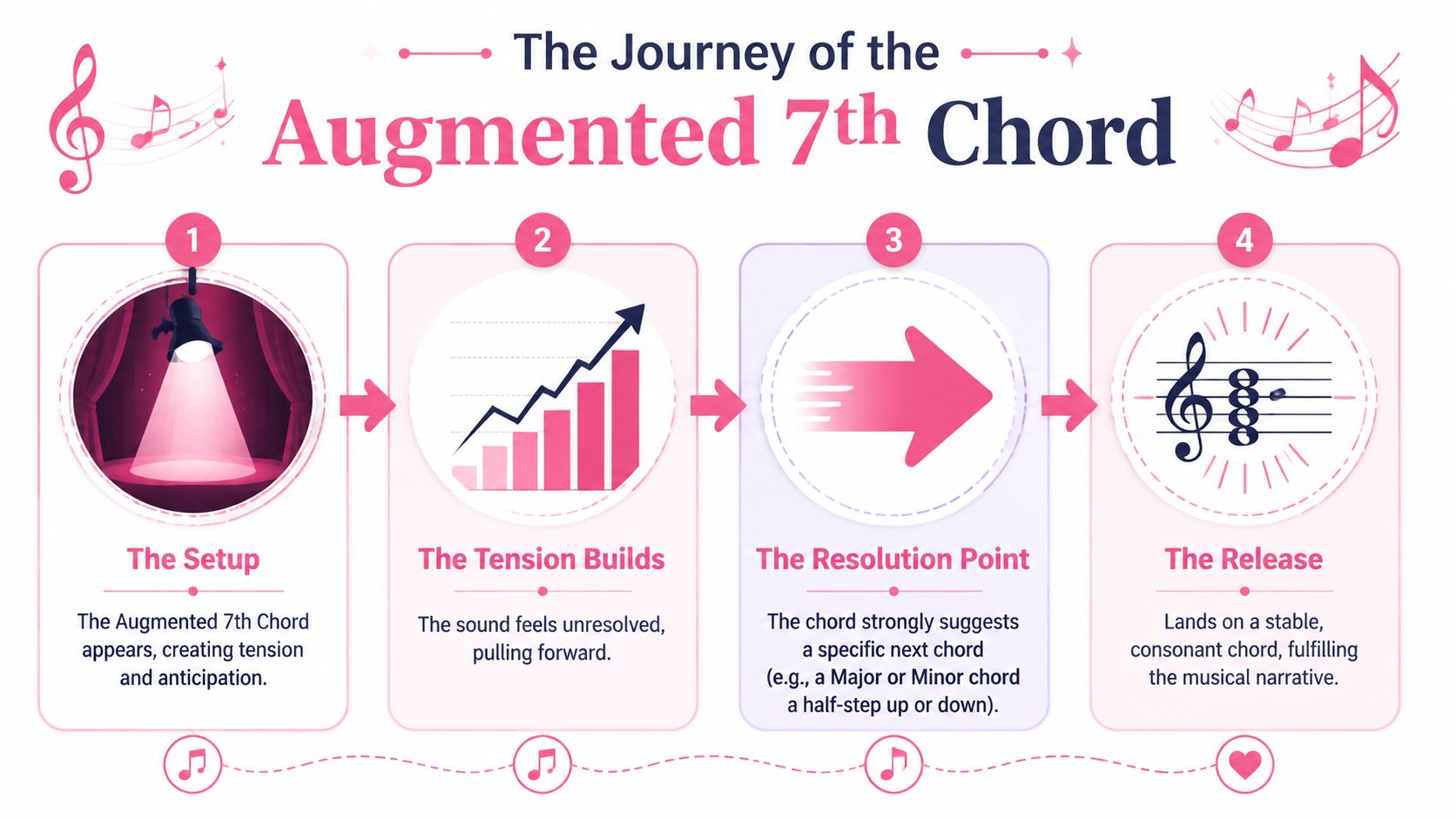
A good listening drill is to play a plain dominant 7th, then an augmented 7th, then the tonic after both. The regular dominant gives one kind of tension. The augmented 7th gives a more vivid, more unstable version of that same push.
That matters if you want to play by ear. You’re not only learning the sound of one chord. You’re learning to predict what comes next.
The fastest way to recognize function is to listen for direction. Ask, “Where does this chord want to land?”
Common Augmented 7th Resolutions V+7 to I
Here are a few practical examples you can play right away.
| Key | Augmented 7th Chord (V+7) | Resolves To (I) |
|---|---|---|
| C | G+7 | C major or C minor |
| G | D+7 | G major or G minor |
| D | A+7 | D major or D minor |
| A | E+7 | A major or A minor |
| F | C+7 | F major or F minor |
Don’t treat this like a chart to memorize mechanically. Play each pair and listen to the emotional effect of the release. In some songs, the chord may pass quickly. In others, a writer will hold it longer to heighten the drama before resolving.
If you’re improvising, this gives you a practical move. When the harmony reaches the V chord and you want extra color, try the augmented 7th sound and then resolve with intention. Even a simple progression becomes more expressive.
How to Train Your Ear to Instantly Recognize This Chord
Recognition gets easier when you stop trying to identify the whole chord at once. Train one contrast, one note, and one function at a time.

The word augmented seventh also refers to an interval that is a chromatic semitone wider than a major seventh. For example, C to B is a major seventh spanning 11 semitones, while C to B♯ is an augmented seventh spanning 12 semitones, according to Wikipedia’s explanation of the augmented seventh interval. That tiny expansion is part of why the sound feels so stretched and tense.
Start with one comparison
Your first job is not to identify augmented 7ths in the wild. Your first job is to hear the difference between two neighbors:
- Dominant 7th
- Augmented 7th
Play both from the same root. For example, play G7, then G+7. Go back and forth.
Ask yourself simple questions:
- Which one feels more familiar?
- Which one feels more unstable?
- Which one seems to glow or widen near the top?
- Which one makes the resolution feel more urgent?
This kind of A/B practice works because your ear learns by contrast. If you only hear the augmented 7th in isolation, it may blur into “some tense chord.” Put it next to a standard dominant, and the raised fifth starts revealing itself.
Sing the note that makes the chord glow
Now isolate the altered tone. Build a dominant 7th chord, then sing the regular fifth. After that, raise your sung note by a semitone and hear how the color changes against the chord.
This is one of the most effective exercises because it turns the chord from an object into a relationship. You’re no longer naming a shape. You’re hearing one note alter the whole emotional message.
Try it in a short loop:
- Play the root and third
- Add the fifth
- Raise the fifth
- Add the seventh
- Resolve to the tonic
Your voice doesn’t need to be polished. It just needs to participate. Singing slows the ear down in the right way.
For a guided progression from basic chord listening into more advanced recognition work, this ear training guide for chords gives you a useful path.
After you’ve done the singing drill, use a listening example to reinforce the sound in context.

Practice until you stop guessing
A lot of musicians think chord recognition is a talent issue. It isn’t. It’s repetition with feedback.
Use a routine that includes all three of these:
- Comparison drills: augmented 7th versus dominant 7th
- Resolution drills: hear the chord move to its target
- Real-audio quizzes: identify the sound without seeing the answer first
One option is Trill: Ear Training Daily, which includes short chord-recognition practice, audio-based exercises, and instant feedback designed for daily ear training. That kind of repeated listening is what helps a chord stop feeling rare and start feeling familiar.
The breakthrough usually sounds small. One day you hear a progression and think, “That wasn’t a plain dominant.” That’s a huge moment. It means your ear is no longer guessing from theory. It’s recognizing sound.
Your 10-Minute Daily Practice Plan for Mastery
If you want this chord in your actual playing, keep the practice short and repeatable. Long sessions are less important than daily contact with the sound.
Here’s a simple 10-minute routine:
- 2 minutes on your instrument: play one augmented 7th chord in a few keys, then resolve each one. Focus on the feeling of tension releasing.
- 3 minutes of active listening: pick a song you like and listen for moments where a dominant chord sounds brighter, stranger, or more urgent than usual.
- 5 minutes of ear training: do chord ID work with comparison drills, especially dominant 7th versus augmented 7th.
Don’t worry if you miss it at first. Ear training is trainable. The skill comes from exposure, attention, and repetition.
Small daily reps beat occasional theory binges.
The goal isn’t to become a walking dictionary of chord formulas. The goal is to hear a sound, know what it is, and use it musically. That’s what gives you more freedom to improvise, accompany singers, write stronger progressions, and play by ear with less hesitation.
If you want a simple daily system for chord recognition, intervals, and learning to play by ear, Trill: Ear Training Daily offers short practice sessions built around real listening. It’s made for musicians who want to stop guessing and start hearing music more clearly.