Chord Builder Piano: Master Chords by Ear
You sit at the piano, hear a song you love, and know the sound is simple enough to play. But when you try, your hands start guessing. You hunt for chord charts, tap notes into a reverse finder, and still don’t feel sure.
That’s where many individuals get stuck with the idea of a chord builder piano tool. They learn chord names, but they don’t learn to hear chords. So they can build a C major on paper, yet freeze when that same sound shows up in a real song.
The breakthrough comes when you stop treating chords like keyboard shapes alone and start treating them like sounds your ear can recognize. That’s how you begin to play by ear, improvise more freely, and depend less on charts. Ear training isn’t a talent some people are born with. It’s a trainable skill, and even 10 minutes a day can turn vague guessing into clear listening.
Table of Contents
- Why a Great Ear Is the Only Chord Builder You Need
- The Building Blocks From Intervals to Triads
- Adding Color With Sevenths and Inversions
- Connecting Chords into Common Progressions
- Train Your Ear to Hear Chords Instantly
- Your Daily 10-Minute Chord Building Workout
- Conclusion Stop Building Chords Start Hearing Music
Why a Great Ear Is the Only Chord Builder You Need
Those searching for a chord builder piano solution aren’t really asking for another chart. They’re asking a deeper question. They want to know how to hear a song and recognize what’s happening without guessing.
That gap is real. Many chord-related pages focus on static chord charts or reverse chord lookup, while beginners still struggle to identify chords in actual music by ear, as noted in Muted.io’s overview of piano chord tools. That’s why theory alone often feels incomplete.
A chart can tell you what notes belong in a chord. It can’t make your ear recognize that chord when it appears in a verse, under a melody, or in a progression that moves quickly.
Practical rule: If you can build a chord but can’t hear it in a song, the missing skill isn’t knowledge. It’s listening.
A trained ear changes everything. You hear a major chord and know it has a brighter pull. You hear a minor chord and feel the mood shift. You notice when a progression wants to resolve, and your hands start moving with more confidence because your ear is leading.
That’s the goal. Not memorizing endless labels. Not chasing perfect pitch as if it’s the only path. The goal is usable hearing.
What musical freedom actually feels like
When your ear gets stronger, everyday playing gets easier:
- Songs make more sense: You stop treating each track like a mystery.
- Improvising gets less scary: Your choices come from sound, not random trial and error.
- Chord recognition speeds up: You begin hearing patterns instead of isolated notes.
- Playing by ear becomes practical: You can sit down and find your way through real music.
You don’t need magic for that. You need repetition, attention, and a system that ties sound to action.
The Building Blocks From Intervals to Triads
A chord does not begin as a shape under your fingers. It begins as a sound your ear learns to recognize.
That is why intervals matter. An interval is the distance between two notes, and that distance changes the feeling. Some note pairs sound calm. Some sound tense. Some feel like they want to move. If you can hear those distances, building chords on piano stops feeling like memorizing diagrams and starts feeling like assembling familiar sounds.
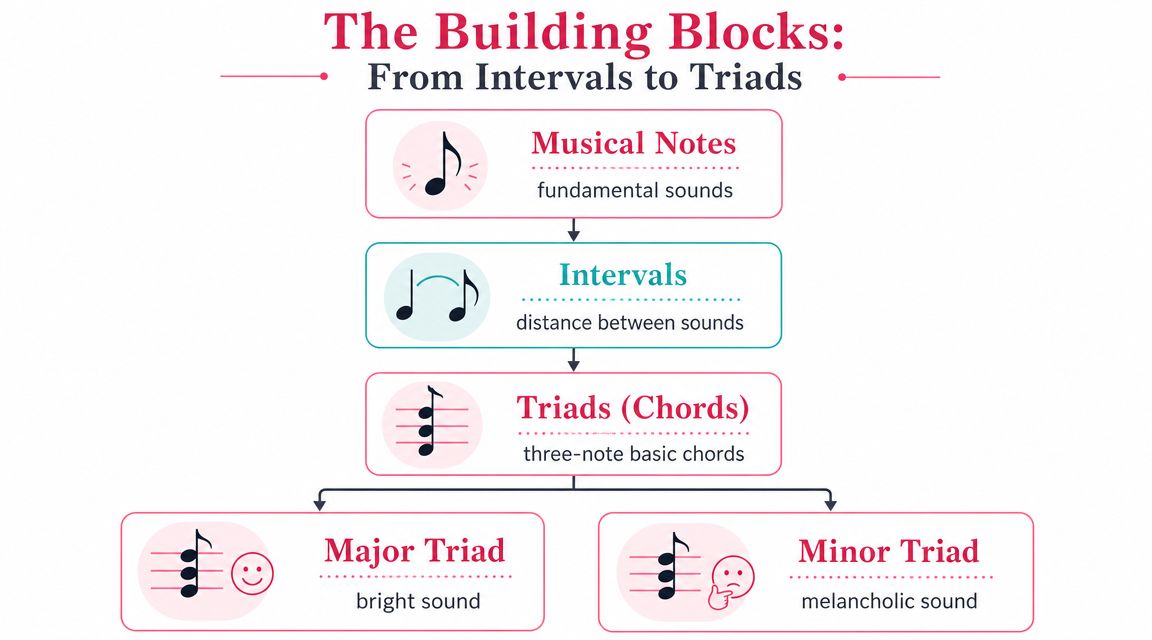
How notes become chords
The basic chord type on piano is the triad. It has three notes: the root, the third, and the fifth. Yamaha’s guide to the piano and its musical structure explains the keyboard clearly, but at the piano your ear needs a simpler job.
Hear each note’s role.
The root feels like home. The third gives the chord its mood. The fifth supports the sound and helps it feel complete, like the outer frame of a picture.
Start with C as the root and listen before you analyze:
- C, E, G creates a major triad.
- C, E-flat, G creates a minor triad.
Only one note changed. Your ear hears a new emotional color right away. That single shift is one of the most useful things a piano player can learn to spot in real songs.
If intervals still feel abstract, this guide to hearing intervals in music connects the keyboard to the sounds you are learning to notice.
What major and minor sound like
Here is the theory in plain language. A major triad uses a root, a note four semitones above it, and another note three semitones above that. A minor triad flips that order. The Royal Conservatory of Music’s explanation of major and minor triads lays out that pattern clearly.
Theory gives you the recipe. Your ear tells you what the recipe sounds like.
| Chord type | Example | What many players hear |
|---|---|---|
| Major triad | C E G | bright, open, settled |
| Minor triad | C E-flat G | darker, reflective, tender |
Those words are guides, not laws. A major chord can sound strong, warm, or triumphant depending on context. A minor chord can sound sad, intimate, or thoughtful. The useful skill is hearing that the middle note changes the character of the whole chord.
Try this slowly at the keyboard:
- Play C major.
- Play C minor.
- Alternate between them a few times.
- Sing the notes one at a time from bottom to top.
Singing helps because it forces your ear to lead your fingers. If you can sing the root, third, and fifth, you are building an inner version of the chord, not just pressing keys you memorized.
Major and minor become easier when you hear the third as the note that changes the mood.
That is the significant shift. A chord builder piano tool can show you the notes, but your ear learns the pattern that keeps showing up in actual music. Once you hear the sound of a major third and a minor third inside a triad, chords stop looking like separate facts. They start sounding like related families.
Adding Color With Sevenths and Inversions
A triad gives you the basic shape of a chord. Sevenths and inversions give that shape personality.
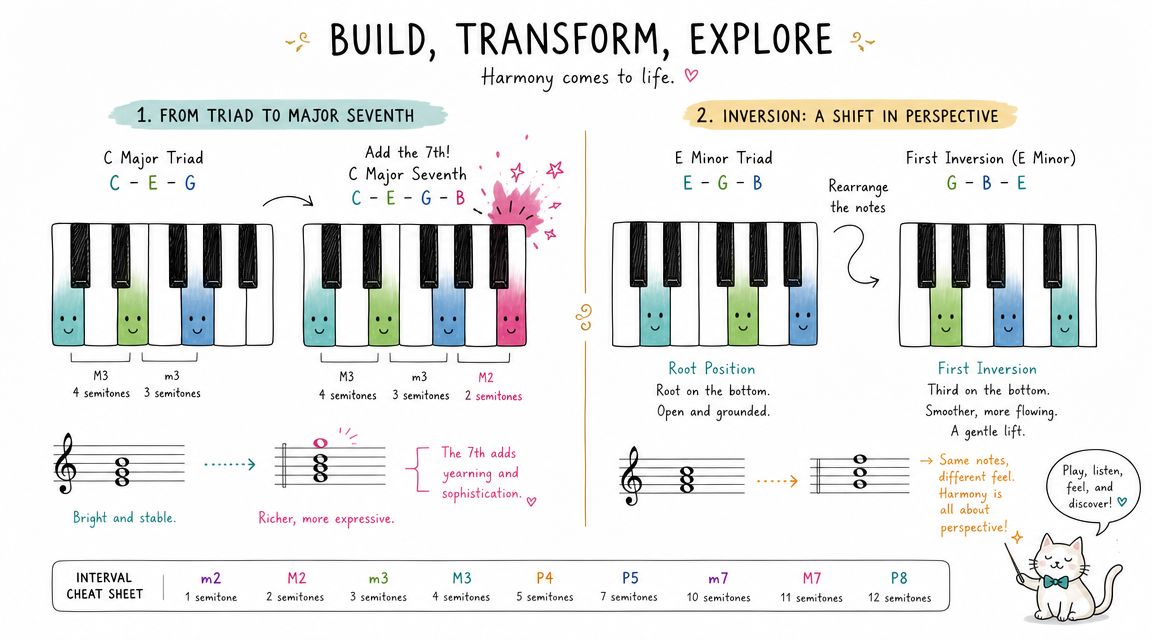
If you sit at the piano and play a plain C major chord, it feels clear and stable. Add one more note, B, and the sound changes right away. It becomes Cmaj7. The chord still feels major, but now it has a softer edge and more emotional detail. Many players hear it as warm, wistful, or floating.
That is an important ear-training moment. You are not learning a bigger chord just to memorize a formula. You are learning to hear how one note can change the emotional color without changing the chord’s basic identity.
A useful reference for naming these chord families is this guide to music theory chords.
One extra note changes the message
Start with C, E, G. Then play C, E, G, B. Listen for what the top note adds.
Then try a different seventh. Play C, E, G, B-flat. That chord has a stronger pull. It often sounds bluesier, jazzier, or more restless than Cmaj7.
The goal is to connect the label to the sound:
- C major: stable, plain, resolved
- Cmaj7: lush, reflective, open
- C7: tense, active, pulling forward
If those words do not match what you hear, that is fine. Your job is to notice the difference. Labels help later. First, train your ear to catch the color change.
Inversions change the balance, not the chord
Inversions confuse a lot of players at first because the notes look different under the hand. The harmony is still the same. Only the note on the bottom changes.
C major in root position is C E G. First inversion is E G C. Second inversion is G C E.
| Version | Notes |
|---|---|
| Root position | C E G |
| First inversion | E G C |
| Second inversion | G C E |
A good comparison is stacking the same books in a different order. The pile looks different from the outside, but you still have the same books.
On piano, inversions matter because they change how the chord feels in motion. Root position sounds grounded. First inversion often sounds lighter. Second inversion can feel more open or less settled, especially in a progression. The Associated Board’s explanation of inverted triads gives a clear overview of how those positions are built.
Train both your hands and your ear
Play C major in all three positions slowly. Hold each one for a moment and listen to the bass note. That bottom note is what your ear grabs first, so each inversion has a different flavor even though the chord name stays C major.
Then try this practical drill:
- Play C E G.
- Move to E G C.
- Move to G C E.
- Sing the lowest note each time.
- Ask yourself whether the chord still sounds like “home.”
That last question matters. A chord builder piano tool can list inversions on a screen. Your ear has to recognize that they still belong to the same harmonic family when they appear in real songs.
Good inversion practice teaches you to hear one chord wearing different shapes.
It also helps your hands. Chord changes become smoother because you can choose the nearest version instead of jumping back to root position every time. When your fingers move less, your ear can pay more attention to the sound of the progression itself.
Connecting Chords into Common Progressions
Single chords are useful. Progressions are where music starts talking.
When chords connect, they create expectation. One sounds settled. Another sounds like it wants to move. Another feels like a bridge. That push and pull is why a simple progression can tell a story without any words.
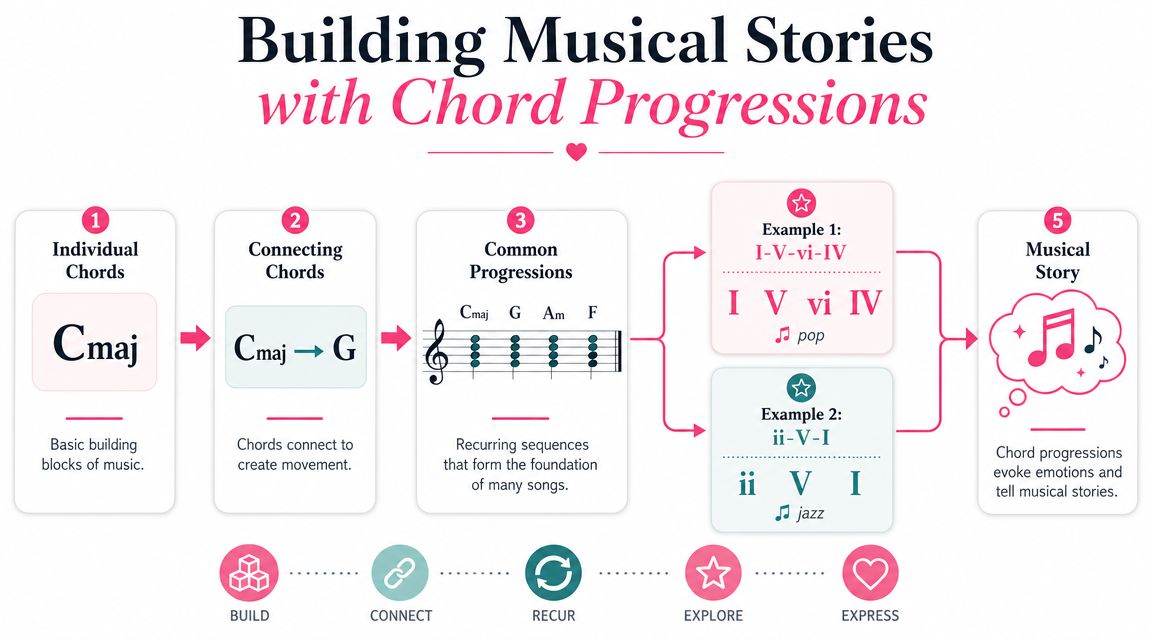
Chords work like musical sentences
In Western music, chord function is predictable. The tonic (I) gives resolution, the dominant (V) creates tension, and pre-dominant chords such as IV or ii help lead from one to the other, as explained in Skoove’s guide to chord progressions on piano.
You can think of that like grammar.
- I feels like a period.
- V feels like a question.
- IV or ii feels like the setup.
When your ear understands those roles, you stop hearing progressions as random chord names. You start hearing movement.
A few progressions teach your ear a lot
One of the most commonly practiced pop movements is I, V, vi, IV. Another strong ear-training pattern is ii, V, I, especially for hearing tension and release.
Try this in C major:
| Roman numerals | Chords in C |
|---|---|
| I V vi IV | C G Am F |
| ii V I | Dm G C |
Play the first progression slowly. Then listen for what each chord seems to do emotionally.
- C feels like home.
- G leans forward.
- Am changes the shade.
- F prepares the loop to begin again.
Now play Dm, G, C. That shorter pattern teaches your ear a strong sense of arrival.
A good exercise is to stop after the V chord and sing where you think the music wants to go. Over time, your ear starts predicting the next sound before your fingers play it.
That’s a big step toward playing by ear. You’re not reacting late. You’re hearing structure in real time.
Train Your Ear to Hear Chords Instantly
If you want real musical freedom, this is the work that matters most. You can know chord formulas and still feel lost in actual music. The missing piece is recognition.

Start with the sound you hear most
The most common chord type in Western harmony is the triad, and because it’s the simplest complete harmony, root, third, fifth, it’s the first sound you should learn to recognize by ear, as described in Wikipedia’s overview of chords in music).
That gives you a clear starting point. Don’t begin with the fanciest jazz voicings. Begin with the sound that shows up everywhere.
Your first ear training target is simple:
- Hear the difference between major and minor
- Recognize when a triad sounds stable
- Notice when the sound is played in a different order but still belongs to the same chord family
If you want structured practice around this, ear training for chords can give you a more focused path.
Train the ear before chasing labels. If you can hear the quality first, the name becomes easier to learn.
A simple daily ear training routine
Start with one root note. C is fine. Play C major, then C minor. Don’t analyze right away. Just listen.
Then use this sequence:
- Play one chord Close your eyes if that helps.
- Sing the notes upward Root, third, fifth.
- Name the quality Major or minor.
- Check yourself Play again and confirm what you heard.
The singing part is powerful because it turns hearing into active recall. You’re not just receiving sound. You’re rebuilding it with your voice.
A short demo can make that process easier to picture:

For app-based practice, some musicians use dedicated ear training tools instead of only working from the keyboard. Trill: Ear Training Daily offers exercises for chord recognition, intervals, notes, and scales through short listening sessions, which fits well if you’re trying to build a consistent daily habit around play-by-ear practice and even long-term goals like stronger pitch memory or perfect pitch development.
Here are three rules that help this stick:
- Keep it short: Daily practice beats occasional long sessions.
- Use real sound, not just diagrams: Your ear learns from hearing.
- Repeat familiar chord types often: Recognition grows from exposure.
Instant chord recognition won’t feel instant at first. That’s normal. Your ear is building categories. After enough repetition, you stop hearing a blur and start hearing identity.
Your Daily 10-Minute Chord Building Workout
You don’t need a huge practice block to improve. You need a repeatable routine you’ll follow. A focused 10-minute a day habit can strengthen both chord knowledge and ear training at the same time.
Minutes 1 to 3
Choose one root note. Build its major triad, then its minor triad.
Use one note as your anchor and compare the two sounds back to back. After that, play the chord in root position, first inversion, and second inversion.
- Listen for character: Does the chord sound bright or more reflective?
- Notice the middle note: That’s often where beginners start hearing the biggest difference.
- Stay on one root: Depth beats variety here.
Minutes 4 to 7
Use the same key and play a simple progression such as I, V, vi, IV. Move as smoothly as you can.
Hum the root notes while you play. Then play the progression again and hum the top note instead. This helps your ear track more than one layer at once.
A good checkpoint is whether your hands can move without large jumps. If they can’t, slow down and adjust the inversion choices.
Minutes 8 to 10
Do a short recognition drill without looking at your hands too much.
Try one of these:
- Self-test at the piano: Play a major or minor triad and identify it after the sound.
- Sing before you play: Hear the chord in your head, then check it on the keyboard.
- Use a listening app: Let random playback test whether you’re recognizing the sound.
Consistency beats intensity. Ears improve from regular contact with sound, the same way fingers improve from regular contact with keys.
This workout is short enough to survive busy days. That’s why it works. When you repeat it often, chord recognition gets faster, progressions feel more predictable, and playing by ear stops feeling like luck.
Conclusion Stop Building Chords Start Hearing Music
A chord builder piano approach becomes powerful when it stops being only a lookup system and becomes a listening skill. The notes matter, the formulas help, and the keyboard shapes are useful. But the significant shift happens when your ear starts recognizing what your hands are doing.
That’s why triads come first. That’s why inversions matter. That’s why progressions are worth hearing as movement, not just names. And that’s why ear training belongs at the center of your practice, not off to the side as an extra task.
You don’t need to wait until you have perfect pitch. You don’t need to memorize every chord type before you start. You need a daily habit that helps you connect sound, feeling, and structure.
Keep it simple. Hear major and minor clearly. Notice how chords pull toward each other. Sing what you play. Practice a little every day.
That’s how you stop guessing.
That’s how you start to play by ear.
If you want a simple daily system for building these skills, Trill: Ear Training Daily offers short ear training practice focused on chords, intervals, notes, and scales. It’s designed for musicians who want to stop guessing, improve chord recognition, and build stronger listening habits through brief daily sessions.