Perfect Intervals Music: Train Your Musical Ear

You sit down with your instrument, pull up a song you love, and try to figure it out by ear. The first note feels possible. The next one turns into trial and error. A few minutes later, you’re still hunting, replaying, guessing, and hoping your fingers land on the right sound.
That frustration is common. It doesn’t mean you’re not musical. It usually means nobody showed you how to hear the distance between notes in a practical way.
In perfect intervals music, that distance is where your ear starts to get organized. Once you can hear a few core intervals clearly, songs stop feeling like random notes and start feeling like recognizable patterns. That’s the shift that helps you play by ear, recognize chords faster, and build the listening skills people often confuse with natural talent or even perfect pitch.
Table of Contents
- Stop Guessing Notes and Start Hearing Music
- What Are Perfect Intervals and Why Do They Matter
- How to Hear Perfect Intervals in Real Songs
- The Inversion Secret for Faster Recognition
- Your Daily 10-Minute Ear Training Routine
- From Intervals to True Musical Freedom
Stop Guessing Notes and Start Hearing Music
A lot of players think ear training means trying harder. Usually, it means listening smarter.
If you’ve ever paused a song over and over, testing one note at a time, you’re not alone. Up to 40% of music students struggle with identifying intervals by ear, especially across genres or instruments, according to music theory for guitar’s discussion of interval hearing. That tells us the problem isn’t personal failure. It’s a skill gap.
Why guessing keeps you stuck
Guessing treats every note like a separate problem. Your ear has no landmarks, so every pitch feels isolated.
Hearing intervals changes that. Instead of asking, “What note is that?” you start asking, “How far did the melody move?” That question is much easier for the ear to learn.
Practical rule: Train the relationship between notes first. Exact note names can come later.
This is why interval work matters so much for anyone who wants to play by ear. Songs are built from note relationships. Chords are built from note relationships. Melodies are built from note relationships. When your ear starts recognizing those distances, music stops sounding like a blur.
The first sounds worth learning
Not every interval deserves equal attention at the start. Some are more stable, easier to hear, and more useful in real music.
The most helpful ones are the perfect intervals. They give you solid reference points. They show up in melodies, chord shapes, open strings, bass motion, and the kind of harmony you hear in rock, pop, folk, classical, and film music.
If your goal is to stop guessing and start hearing, you’ll find the work gets easier. You aren’t trying to master everything at once. You’re building a few reliable sounds you can come back to every day.
What Are Perfect Intervals and Why Do They Matter
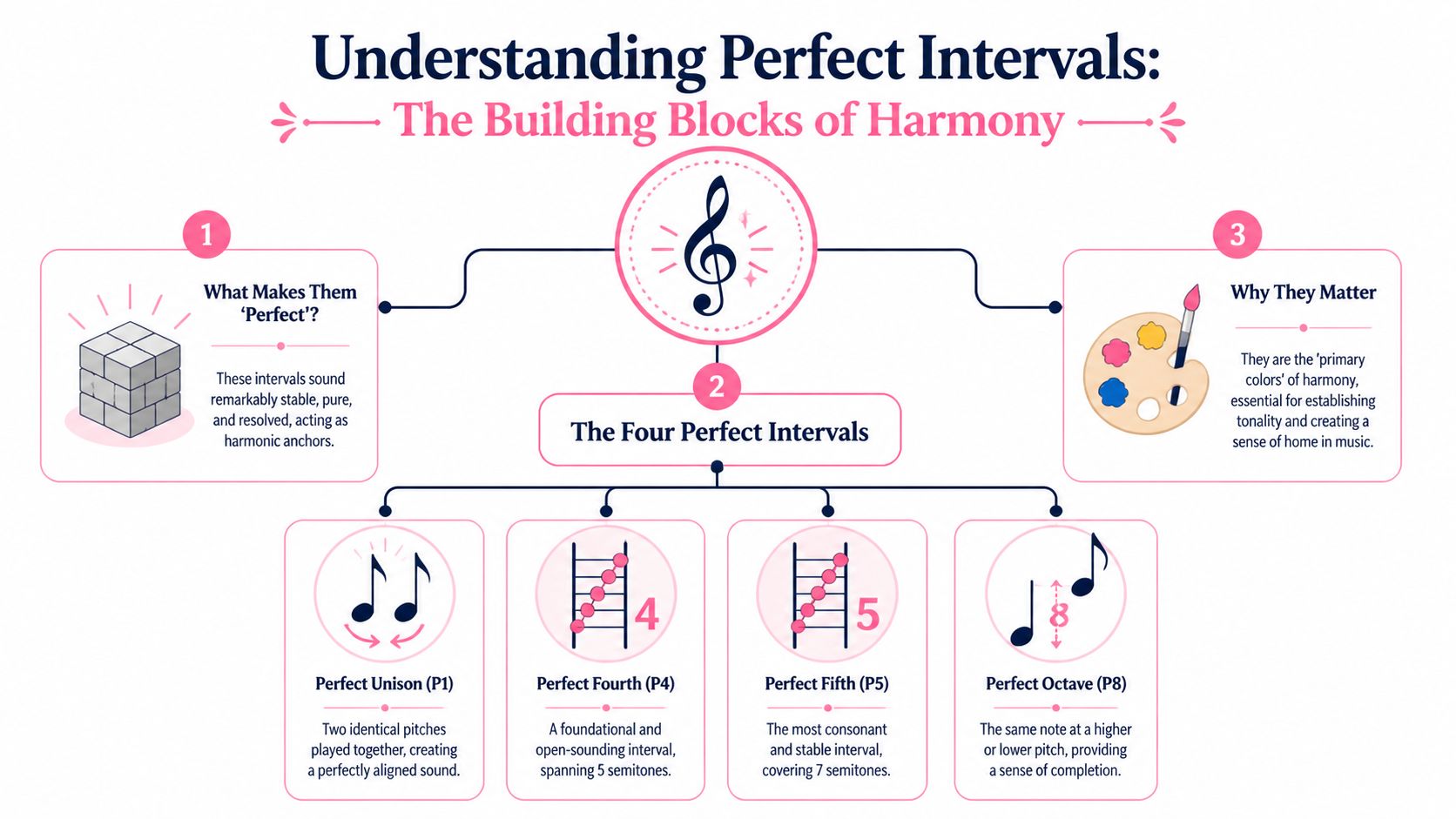
Perfect intervals are the intervals that sound especially steady and clear. In basic Western theory, there are four of them: unison, fourth, fifth, and octave.
They matter because they give your ear a dependable frame. Other intervals can feel more emotionally specific or more ambiguous. Perfect intervals tend to sound open, settled, and easy to latch onto.
Around 550 BCE, Pythagoras connected these sounds to simple frequency ratios such as 2:1 for the octave and 3:2 for the perfect fifth, as described in School of Composition’s history of music theory. That’s one reason these intervals have stayed central in music study for so long.
If you’re also trying to understand how interval hearing connects to note recognition, this guide on relative pitch vs absolute pitch helps clarify the difference.
The four sounds to know first
Perfect unison means both notes are the same pitch. If you sing a note and then match it exactly on your instrument, that’s unison. It feels fused, not spaced.
Perfect fourth spans 5 semitones. It has an open sound, but it often feels like it wants to move somewhere. Many beginners hear it as a call or a lift.
Perfect fifth spans 7 semitones. This is one of the most stable sounds in music. Guitarists know it from power chords. Pianists hear it in basic accompaniment patterns. Singers hear it as a strong, balanced leap.
Perfect octave spans 12 semitones. It sounds like the same note, just higher or lower. That’s why octaves feel familiar even when the pitch register changes.
Perfect intervals don’t switch between major and minor forms. That makes them dependable landmarks when your ear still feels shaky.
Perfect intervals at a glance
| Interval Name | Semitones | Common Song Example | Sound/Feeling |
|---|---|---|---|
| Perfect Unison | 0 | Same note repeated | Unified, locked-in |
| Perfect Fourth | 5 | “Here Comes the Bride” opening | Open, upward, slightly unfinished |
| Perfect Fifth | 7 | “Star Wars” opening | Strong, stable, heroic |
| Perfect Octave | 12 | “Somewhere Over the Rainbow” opening leap | Same note, higher, complete |
Why these intervals help your ear so much
When two notes relate through simple ratios, they create a smooth sound that we tend to hear as stable. That makes them easier to memorize.
For ear training, that’s a gift. You need a few sounds that are easy to return to when everything else feels uncertain. Perfect intervals do that job well. They become your mental home base.
And once you can hear those clearly, chord recognition starts getting easier too. You begin noticing the outer frame of harmony before you worry about finer details.
How to Hear Perfect Intervals in Real Songs
Theory becomes useful when it turns into a sound you already know.
The fastest way to hear perfect intervals is to attach each one to a musical memory. Then your brain doesn’t need to count semitones in real time. It can compare what it hears to a familiar sound shape.
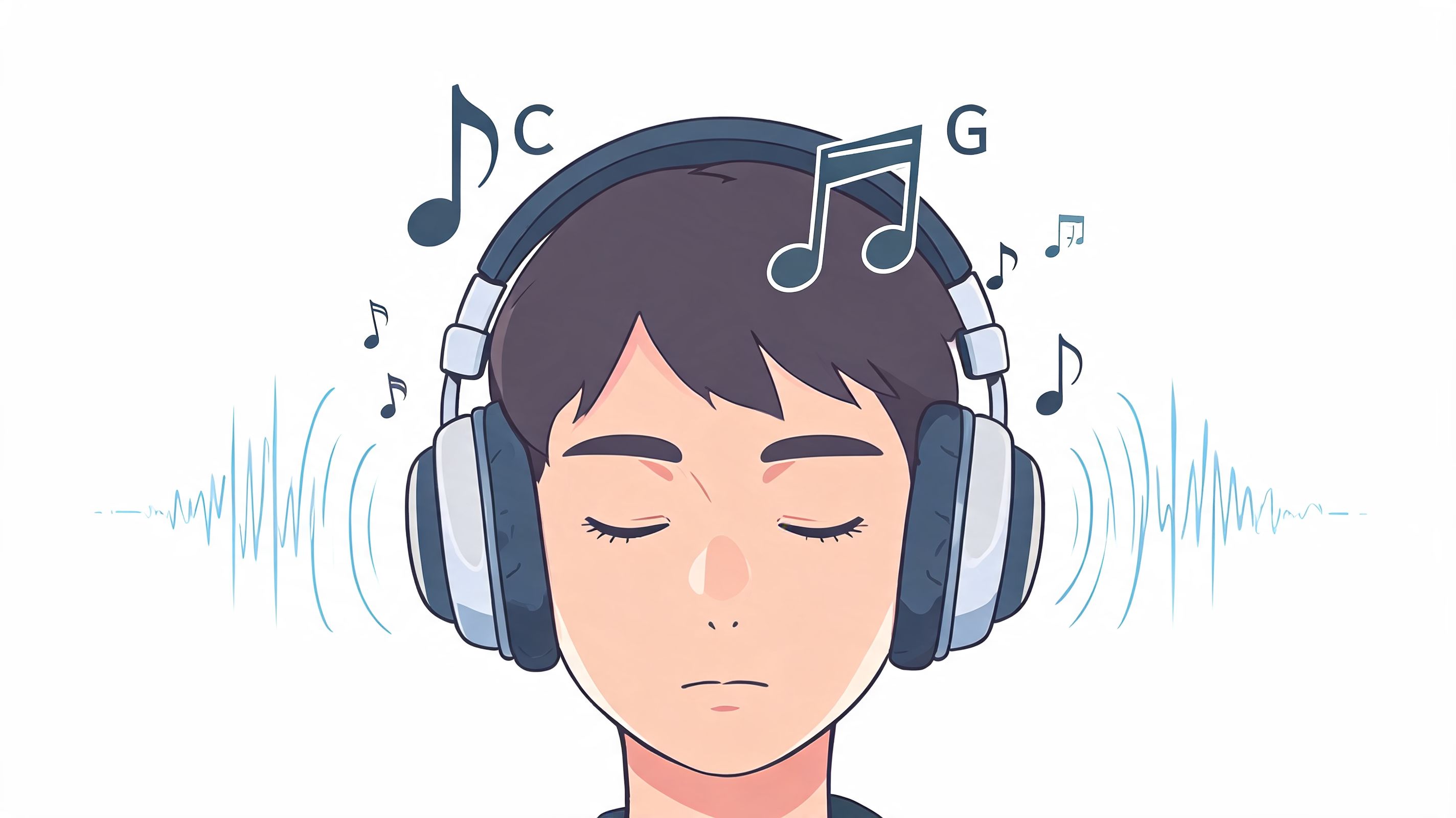
Perfect intervals are rooted in simple frequency ratios, such as 3:2 for a perfect fifth, which helps explain why they sound smooth and stable, as explained in Sonid’s overview of perfect intervals. That physical stability is exactly what your ear learns to recognize.
If you’re working on this skill in songs, this guide on ear training and how to play by ear fits naturally with interval practice.
Turn each interval into a memory
Start with the perfect fifth. Many players remember it through the opening of the Star Wars main theme. That leap sounds confident and grounded. If you sing the first note, then jump to the second, you can feel the width of the interval.
The perfect fourth is often linked to “Here Comes the Bride.” It sounds open too, but not in the same way. Compared with the fifth, it can feel like it leans forward more.
The perfect octave is easier for many beginners because it sounds like a note becoming a higher version of itself. The opening leap of “Somewhere Over the Rainbow” is a familiar reference. You’re hearing sameness across distance.
Perfect unison is different. There is no gap at all. You hear one pitch repeated or matched exactly. This matters more than people think, because a lot of singing and instrument practice falls apart when players can’t reliably match one note to the next.
Listen for feeling before theory
If you’re stuck between fourth and fifth, don’t start by counting. Listen for character.
- Perfect fifth: stronger, wider, more settled
- Perfect fourth: open, but with more pull
- Octave: same identity, different height
- Unison: no distance at all
That emotional cue matters because your ear often identifies contour and feeling before it identifies labels.
Here’s a quick listening drill you can do today:
- Sing one note and hold it.
- Play a second note on your instrument.
- Ask one question first: does it sound identical, open, wide, or like the same note higher?
- Only then name it as unison, fourth, fifth, or octave.
This video can help reinforce those sounds:
Don’t rush to be correct. First learn to notice what the interval feels like in your ear.
That habit is what moves you toward real musical hearing, not mechanical guessing.
The Inversion Secret for Faster Recognition
One of the best shortcuts in ear training is this. A perfect fourth and a perfect fifth are inversion partners.
That sounds technical, but the listening benefit is simple. If you already know one sound well, the other becomes much easier to learn.
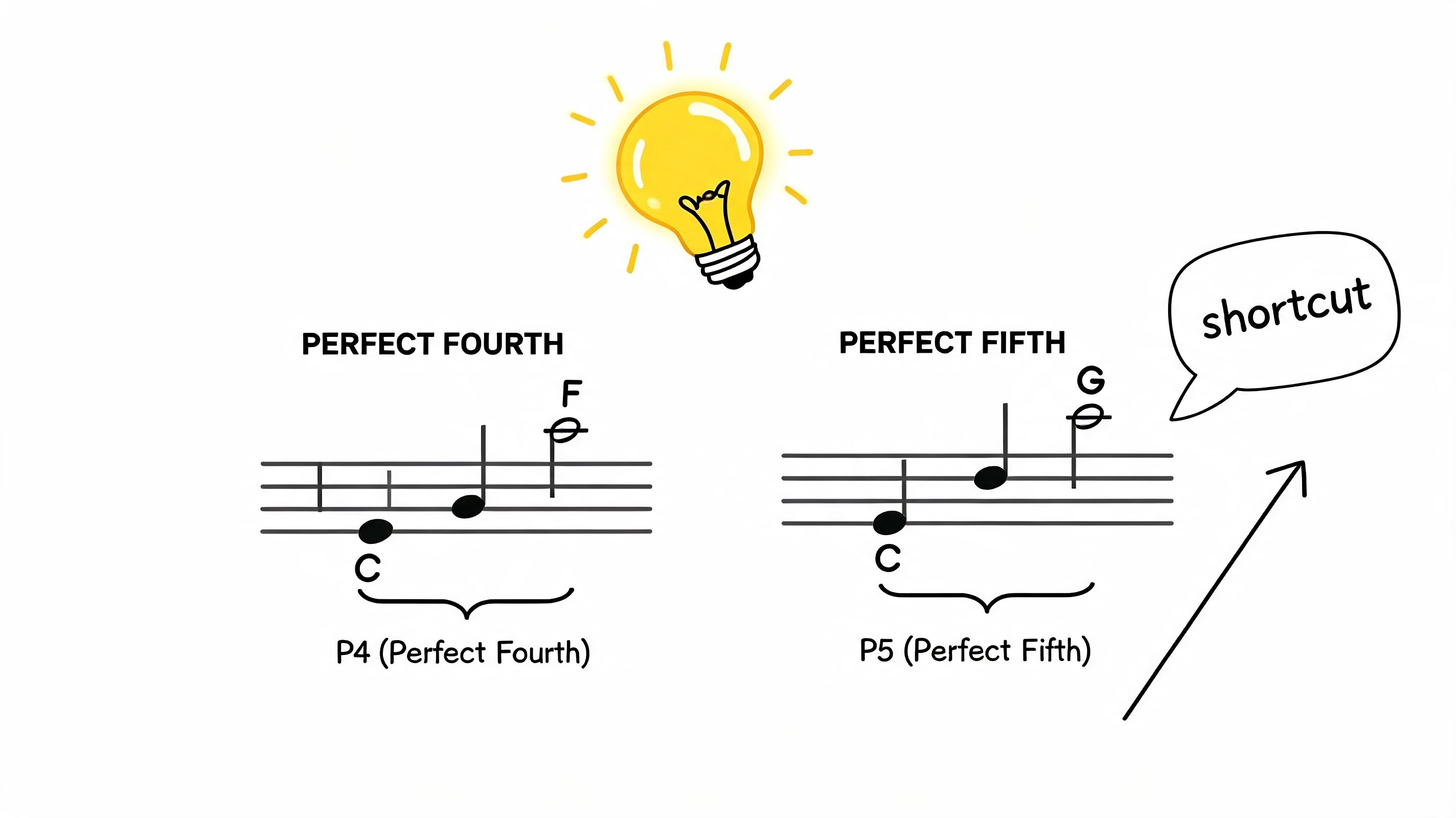
A key property of perfect intervals is that they stay perfect when inverted. A perfect fourth inverts to a perfect fifth, and a perfect fifth inverts to a perfect fourth, as outlined in Wikipedia’s interval article).
One sound family, two directions
Try this on your instrument. Play C up to G. That’s a perfect fifth. Now take the G and imagine it moved below the C. You get G up to C, which is a perfect fourth.
Your ear doesn’t need to treat those as two unrelated facts. They’re connected by shape and balance.
This helps because many players learn the fifth first. It tends to feel more obvious. Once that sound is stable in your ear, the fourth stops being mysterious. You start hearing it as the flipped version of something you already know.
Hear the fifth as “wide and settled.” Hear the fourth as that same shape turned around.
How to practice inversion on your instrument
A simple inversion drill works well on guitar, piano, voice, or any melodic instrument.
- Choose one root: Start with C, D, F, or G so your brain isn’t overloaded.
- Play the fifth first: From C, go to G. Sing it before you play it again.
- Reverse the shape: Now hear G to C as the fourth.
- Alternate slowly: Go back and forth until both sounds feel linked.
If you’re a guitarist, this gets practical fast. A lot of common shapes contain fourths and fifths. If you’re a singer, inversion helps you stop treating ascending and descending intervals like separate worlds. If you’re improvising, it helps you hear structure instead of isolated jumps.
This is one of those music theory ideas that immediately improves ear training because it reduces the number of sounds you think you have to memorize.
Your Daily 10-Minute Ear Training Routine
Ear training works best when it becomes ordinary. Short practice done every day beats occasional long sessions because your brain gets repeated exposure to the same sound patterns.
This matters for perfect intervals because they need to become familiar, not just understood. You want to hear them quickly enough that they show up while you’re learning songs, singing harmony, or trying to catch a chord progression in real time.
Benchmark data from aural exams shows that musicians who master perfect interval discrimination first achieve higher accuracy in harmonic dictation and transcription, because the perfect fourth and perfect fifth often reveal the root and fifth of a chord, even in inversions, according to Living Pianos on why perfect intervals matter.

If you want a structured system for this habit, Trill: Ear Training Daily offers short interval, chord, and note exercises designed for daily practice.
A simple routine you can repeat daily
Minute 1 to 2: sing your references
Don’t open with theory. Open with sound. Sing your perfect fifth reference, then your perfect fourth reference, then an octave leap. If singing feels uncomfortable, hum them.
This wakes up your listening before your fingers take over.
Minute 3 to 7: do active interval drills
Use an ear training app, a piano, a guitar, or a friend playing notes for you. Hear two notes and answer with one of four labels: unison, fourth, fifth, or octave.
Keep it narrow. Narrow focus is what makes progress happen.
- If you’re right: sing it back immediately.
- If you’re wrong: replay it and compare it to your song memory.
- If you’re unsure: choose between only two options first, usually fourth or fifth.
Minute 8 to 10: move it onto your instrument
At this point, ear training becomes musical.
Play a root note. Find its fifth. Then find its fourth. Then return to the root. Repeat in a few keys. If you’re learning a song, pause and ask whether the melody or bass motion contains one of those interval sounds.
What to focus on when you get stuck
Most players don’t fail because their ear can’t improve. They fail because they practice too broadly and stop before the sound settles in.
Use these checkpoints instead:
- Match before naming: If you can sing the interval back accurately, you’re making progress even if the label comes a second later.
- Compare, don’t panic: Ask whether the sound is closer to “Star Wars” or “Here Comes the Bride.”
- Stay with one family: A week of focused perfect interval work is more useful than bouncing between every interval in music.
- Finish by playing: Always connect the ear drill to your instrument so the sound becomes usable.
A trained ear doesn’t guess faster. It recognizes faster.
This is also where people start asking about perfect pitch. For most musicians, the practical win doesn’t come from naming isolated notes out of the air. It comes from building strong relative hearing. Perfect intervals are one of the clearest ways to start.
Keep the routine small. Keep it daily. Let repetition do the heavy lifting.
From Intervals to True Musical Freedom
When you can hear perfect intervals clearly, you start making faster musical decisions. You hear a melody jump and your hand already knows where to go. You hear the outer frame of a chord and can begin to fill in the rest.
That’s why this topic matters beyond theory. Perfect intervals help you catch bass movement, recognize power-chord shapes, follow melodies, and stay oriented when harmony moves quickly. That makes jamming less stressful and improvising less random.
What changes when your ear gets stronger
You begin to trust what you hear. That’s a huge shift.
A stronger ear helps you:
- Learn songs faster because you stop testing every note blindly
- Recognize chord movement with less dependence on charts
- Improvise with more control because your phrases connect to the harmony
- Sing more accurately because you can hear the target before you reach for it
This is what people usually mean when they talk about musical freedom. Not magic. Not talent. Not a mysterious gift you either have or don’t.
It’s trained listening.
And if you’re consistent with even 10 minutes a day, the effect compounds in a practical way. You start hearing music as relationships, not isolated events. That makes it easier to play by ear, easier to collaborate, and easier to enjoy the process of learning.
If you want a simple daily system for building these skills, Trill: Ear Training Daily gives you short, focused ear training exercises built around real listening. It’s designed for musicians who want to stop guessing, recognize intervals and chords more clearly, and build the kind of ear that translates directly to playing by ear.