Pitch Recognition App: How to Choose and Train Your Ear
Stop chasing perfect pitch first. That’s the popular advice, and it’s backwards for most players.
You don’t need to name a random note cold to play by ear. You need to hear how notes relate, spot a chord change, and find your way back home in a song. A good pitch recognition app trains that hearing in short daily sessions. A weak one only tests whether you can guess labels.
Use one test as you read. Does the app help you sing back, recognize chords, and play real songs sooner? If not, its badges don’t matter.
Table of Contents
- Relative Pitch Is the Real Target
- Features That Separate Useful Apps From Gimmicks
- Matching the App to Your Voice or Instrument
- Practice Changes What You Hear
- A 10-Minute Daily Routine That Builds Real Playing
- Six Mistakes That Stall Ear Training
- Pick the App That Moves Your Score
Relative Pitch Is the Real Target
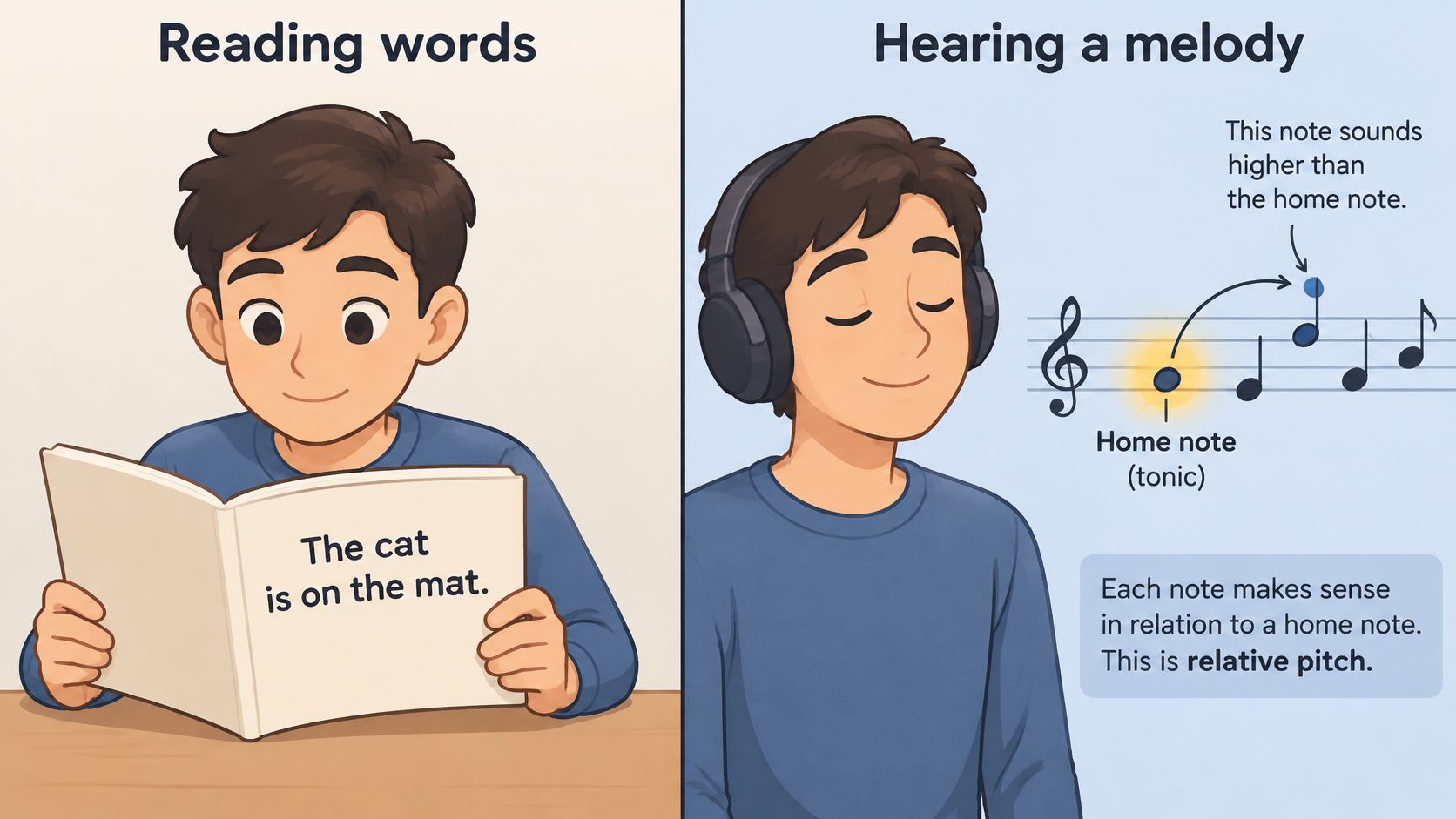
Reading works because letters relate to each other. Music works the same way. A note means more when you hear it against a home note.
That relationship is relative pitch. It’s how you hear that a melody has climbed, that a chord feels settled or tense, or that a song has moved away from home and needs to return.
Perfect pitch is the bonus, not the starting line
Absolute pitch means naming a note with no reference tone. It’s uncommon, even among music students.
In a 2016 study of 200 Brazilian music students, 35 participants, or 18%, met broader criteria for absolute-pitch ability. Only 8 participants, or 4%, achieved at least 85% exactly correct responses. The rest performed similarly to chance.
| Scoring benchmark | Students | Share |
|---|---|---|
| Broad absolute-pitch criteria | 35 of 200 | 18% |
| Strict benchmark of at least 85% exactly correct | 8 of 200 | 4% |
The gap matters. Change the scoring rule and the headline changes. So don’t judge yourself by a one time talent badge. Judge your ear training by whether accuracy improves over weeks.
There’s no universal timeline either. In an adult training study summarized in digital tool research, 12 musicians trained for eight weeks and at least 25 total hours. They identified an average of just over seven pitches at 90% accuracy, with substantial variation between participants.
That same research found technology-assisted training is most effective for pitch and interval perception. Teacher-led instruction remains important for harmonic skills. An app can build your foundations daily, but it shouldn’t promise instant perfect pitch or instant chord mastery.
Track transfer, not just quiz scores
Pick three simple markers and test them each week.
- Interval speed: How many seconds do you need to name an interval after hearing two notes?
- Song hearing: Can you name whether a chord on the radio is major or minor?
- Playback: Can you play back a four note melody after two listens?
Those markers connect practice to real playing. A quiz score can rise while your playing stays stuck. Transfer markers catch that problem early.
Sunday check: Pick one marker, test it every Sunday for four weeks, and write the result down. Keep the app that moves that marker.
Real wins sound ordinary, and that’s why they matter. You learn a chorus in one sitting without searching for tabs. You hear a chord loop at practice and join in instead of waiting to be told the chords. You improvise because you can hear where the next note wants to go.
Treat 10 minutes a day as the habit minimum, not magic. It gives your ear frequent chances to hear, answer, and correct itself. If you want a structured starting point, work through a guided relative pitch training path and keep your Sunday marker fixed while you do it.
Features That Separate Useful Apps From Gimmicks
Start with this checklist before you download anything. It tells you whether a pitch recognition app is a training system or a novelty quiz.
| Feature | What good looks like | Red flag |
|---|---|---|
| Real audio | Real instrument and voice sounds | Only sine-wave beeps |
| Immediate feedback | Right answer named within a second | Feedback only at the end of a session |
| Training modes | Intervals, chords, scales, melodies, progressions | One quiz type repeated |
| Progress tracking | Accuracy and response speed per session | Only a single overall score |
| Gradual difficulty | Two notes first, then chords and progressions | Same difficulty forever |
| Short sessions | Structured practice finished in about 10 minutes | Long, unstructured quizzes |
Real sound teaches real hearing
Real audio comes first because songs don’t sound like beeps. A piano note, a guitar chord, and a sung note each carry color and attack. Your ear has to learn the pitch inside those real sounds.
If every exercise uses a clean sine wave, you may get good at the test and stay lost in a recording. That’s a transfer problem. Look for varied instruments and voices as soon as the basics feel steady.
Fast feedback turns mistakes into learning
Immediate feedback is the second non negotiable. You hear a sound, you answer, and the app names the right answer right away. Your brain can still hold the sound you just heard, so the correction sticks.
Delayed feedback breaks that link. By the end of a long quiz, you’ve forgotten what the third chord sounded like. You remember the score, not the sound.
If you can’t replay your mistake and hear why it was wrong, you’re guessing faster, not hearing better.
The other four features protect your time. Training modes should cover intervals, chords, scales, melodies, and progressions because songs use all of them. Progress tracking should show accuracy and response speed per session, so slower but correct answers don’t hide weak hearing.
Gradual difficulty matters for confidence. Two notes first, then three note chords, then progressions. If the app throws full progressions at a beginner on day one, it isn’t teaching. It’s filtering.
Short sessions make daily practice possible. A focused 10 minutes a day beats a long session you’ll skip. If you’re unsure whether app practice can work at all, read this breakdown of whether ear training apps work before you score your options.
Now score any app out of six. Four or more ticks means it’s worth a trial. Fewer than four means keep looking, no matter how polished the home screen looks.
Matching the App to Your Voice or Instrument
The right features depend on what you play. A singer and a producer don’t need the same first exercise, even if both want better hearing.
| Musician | Priority features | Skip if |
|---|---|---|
| Singers | Live pitch feedback and microphone-based analysis | Piano-only quizzes |
| Guitarists and instrumentalists | Interval naming, chord quality and bass-note spotting | Vocal-only modules |
| Producers and songwriters | Progressions such as I-V-vi-IV and melodic dictation | Single-note quizzes only |
| Beginners learning by ear | Guided path from single notes to progressions | Advanced modes with no hints |
| Students and educators | Scales, modes and progress reports | Unlimited random quizzes |
Singers need to hear themselves
If you sing, look for live pitch feedback while you sing. Hearing a target note isn’t enough. You need to know whether your voice landed on it, drifted flat, or overshot.
Trill’s vocal training has users sing a note while seeing their pitch live. That feature requires microphone access to enable pitch analysis in vocal training, so check that permission before you assume the app is broken.
Instrument players need chords without tabs
Guitarists and other musicians should prioritize interval naming and chord quality. Those skills let you find a song’s chords by ear instead of searching for tabs every time.
Trill’s interval training asks users to name any two notes by ear. Add bass note spotting to that and you have the core of figuring out songs at rehearsal. First the lowest note, then whether the chord sounds major, minor, or something tenser.
Producers and songwriters should look higher up the chain. You need progressions and melodic dictation. Recognize a loop like I-V-vi-IV in a track, then play back a short phrase on a keyboard without stopping to hunt note by note.
Beginners need the opposite of a giant menu. You need a guided path from single notes to full progressions, with the app asking your level and adjusting. Random advanced quizzes teach beginners to guess, then reward lucky taps.
Students and teachers need scales, modes, and progress reports. Reports make practice visible between lessons. A teacher can see whether accuracy improved, not just whether the student opened the app.
Find the row that matches you. Build that core skill until it feels steady, and leave the Skip column alone until then.
Practice Changes What You Hear
Your ear isn’t fixed at birth. Ear training is trainable, and the gains show up in musical tasks first.
In a British Psychological Society review of music training research, trained participants performed better on pitch-processing speed and relative pitch. They also showed superior frequency discrimination for tones at 400 Hz, a frequency within the typical musical range.
They didn’t do better at 4,000 Hz. The groups did not differ significantly on those very high tones, and they performed similarly on a general intelligence measure. Training sharpened musical listening. It didn’t make every sound clearer.
Long term practice leaves a mark
Brain imaging points the same way. In a functional MRI study published in Cerebral Cortex, the musician group included 14 students aged 20 to 27. Each had more than 12 years of musical training, practicing approximately 4 to 8 hours per day.
Those musicians showed different activity in auditory and prefrontal regions while listening to music. Activity in the left planum temporale correlated with the age training began and with absolute-pitch ability.
Don’t read that as a demand to practice for hours. Read it as proof that repeated musical listening changes how you process sound. Your daily ten minutes is a smaller, steadier version of the same principle.
You’re not trying to become a different person. You’re giving your brain more chances to sort pitch quickly and correctly.
Run this drill tonight
Use a piano, guitar, or your voice. Keep it to ten minutes.
- Play a reference note. Sing it back before you do anything else.
- Sing a second note. Start with a familiar distance, like the jump at the start of a song you know well.
- Name the interval aloud. Commit to an answer before you check.
- Test it on your instrument. Replay any miss and sing both notes again.
- Move to a less familiar interval. Then sing both notes over a major or minor chord.
Count how many you named before looking. That number is your baseline. It will feel clumsy at first, and that’s normal. Clumsy and honest beats fast and guessed.
A 10-Minute Daily Routine That Builds Real Playing
A daily routine should mirror how you figure out a real song. First the home base, then the building blocks, then playback.
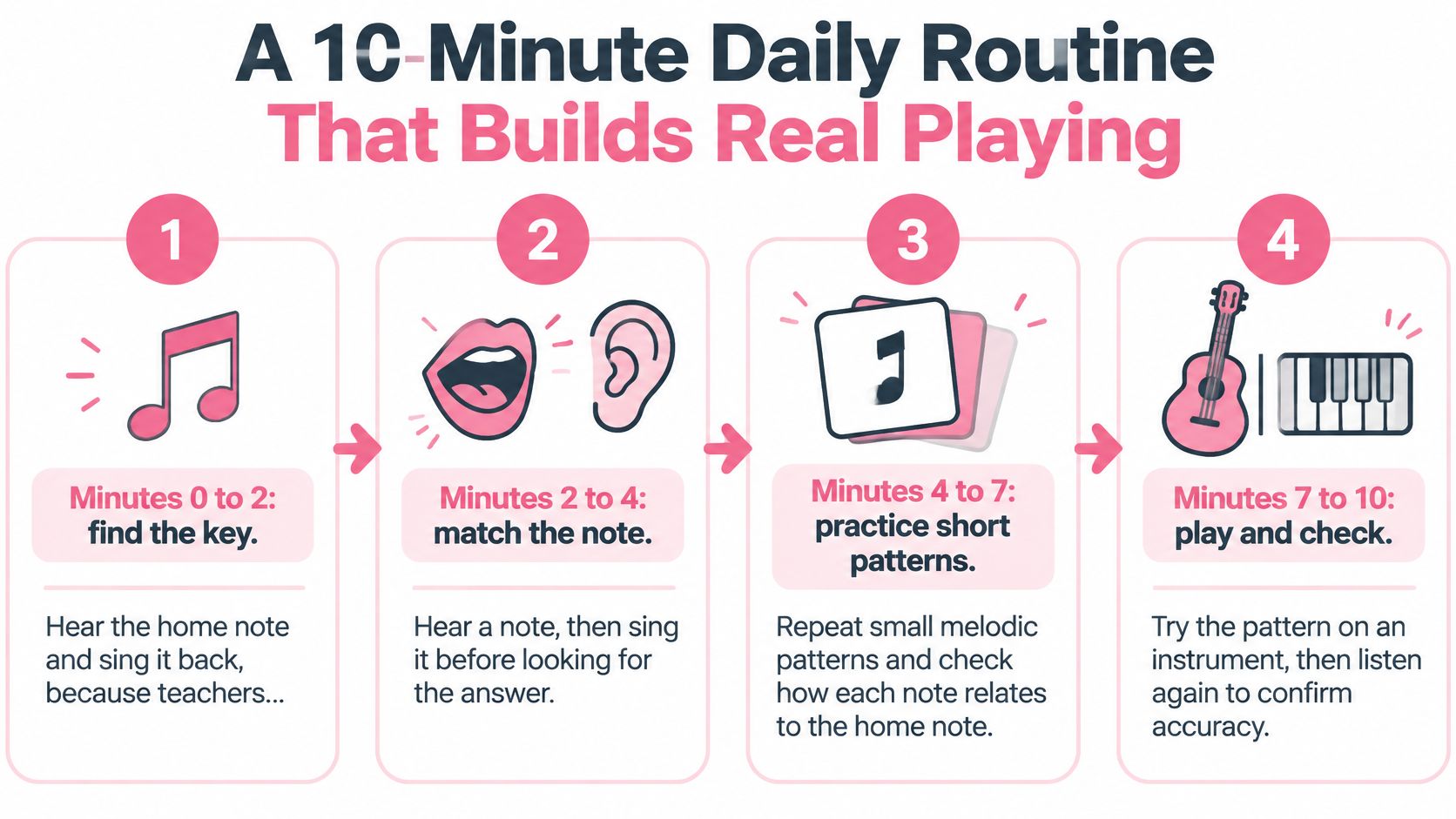
The five steps
- Minutes 0 to 2, find the key. Hear the home note and sing it back. In a 2025 analysis of video lessons for popular musicians, teachers most often recommended identifying the song’s key first.
- Minutes 2 to 4, intervals. Play a reference note, sing a second note, name the interval, then check it on your instrument. Start with familiar distances and move to less familiar ones.
- Minutes 4 to 6, chord quality. Find the bass note first, then decide whether the chord is major, minor, or diminished. That order stops you guessing from the full sound.
- Minutes 6 to 8, progressions. Listen to a loop such as I-V-vi-IV and name each chord as it passes. You’re training the skill you need when a band starts playing and nobody hands you a chart.
- Minutes 8 to 10, play it back. Find the melody on your instrument or sing it. Log your accuracy before you close the app.
That research also found guitarists commonly identify chords before melodies or solos. It makes sense. Chords give you the map of the song, and the melody sits inside that map.
Watch the routine in motion before your first session, then copy the order exactly for two weeks.

Why short and daily wins
Ten daily minutes beat one long weekly session because your ear needs frequent correction. In Trill, training sessions are short and focused. You hear a sound, answer, and get instant feedback, so every attempt teaches something while the sound is still fresh.
Consistency also protects motivation. A ten minute session fits before school, after work, or while your instrument warms up. A one hour session becomes a negotiation, and negotiations get postponed.
If singing back is your weak point, pair this routine with targeted matching pitch exercises for a few minutes inside step one. Don’t add a second routine on top. Replace, don’t stack.
Repeat the same session for two weeks before adding difficulty. Steady answers at one level matter more than one lucky run at the next. When naming feels calm instead of rushed, you’re ready to move up.
Six Mistakes That Stall Ear Training
Most stalls aren’t talent problems. They’re habit problems, and each one has a plain fix.
The six fixes
- Watching before listening: You look at the keyboard or screen before answering. Look away or close your eyes, because you need to hear the sound, not read the picture.
- Guessing from the answer list: You scan options and pick what looks likely. Name the sound in your head first, then tap to check.
- Skipping feedback: You miss and move on. Replay the example and say the right answer aloud before the next question.
- One quiz type only: You drill intervals for weeks and wonder why chords still blur. Mix intervals, chords, and melodies so each skill transfers to songs.
- Jumping ahead too fast: One good round sends you up a level. Stay until answers feel steady, not just correct once.
- Missing whole weeks: One missed day is minor. A week of gaps breaks the hearing habit you’re building.
A 2023 study of ear-training applications in music education surveyed 125 students and interviewed eight teachers and four developers in France. It defined ear training as recognizing and reproducing pitches, intervals, chords, and rhythms solely by listening.
It also reported that applications were underused despite student willingness to engage with them. Willingness isn’t the bottleneck. Routine and feedback are.
That’s why knowing a chord is called minor isn’t the goal. The goal is hearing that sound quickly enough to use it while playing. Labels help after hearing. They can’t replace it.
Self-check: If you can’t recall the last three answers you gave, slow down and repeat the level. Speed built on guessing collapses in a real song.
Pick the App That Moves Your Score
Choose the app that helps you use what you hear. A feature checklist is the verdict: keep the one that supports singing, chord recognition, and playing by ear. Treat perfect pitch as a bonus, not the score you chase.
Your four week test
Start using the app tomorrow. Keep the same 10 minute session for four weeks, then decide whether it is worth a subscription. A steady routine makes it easier to judge progress than changing your practice every few days.
Each Sunday, check one marker tied to your goal: how quickly you identify an interval, whether you can name a chord from a recording, or how accurately you play back a short melody. Record the result in the same place each week. A clear record helps you notice small changes without relying on memory.
Trill is designed for 10-minute daily ear training across chords, intervals, perfect pitch, and melodies. Its vocal training shows your pitch live as you sing, while interval exercises ask you to name two notes by ear. Trill is available on the App Store and Google Play, and your progress, streak, and journey are tied to your account so you can switch devices.
Subscriptions are offered through Apple and Google, which handle billing according to the platform. Pricing and promotions may change, and Trill will notify users of pricing changes that may affect their subscriptions.
A feature list can show what an app offers, but your weekly marker shows whether the practice is helping you sing, recognize chords, or play by ear. Ten focused minutes can build a habit and give you regular practice. Progress takes consistency; no app can promise instant results.
Start your four-week test with Trill: Ear Training Daily. Its short sessions use listening exercises and instant feedback to train intervals, chords, melodies, and singing. Record your first marker, then check it again each Sunday.