What Is a Chord? A Guide to Hearing Music, Not Guessing
A chord is three or more notes played together to create a single harmony. In most of the music you hear every day, that sound starts with the triad, the basic chord shape that underpins over 85% of Western pop and rock progressions.
If you’ve ever sat with a guitar, piano, or app and thought, “I can hear that the song changed, but I have no idea what changed,” you’re already closer than you think. You’re hearing chords at work. The missing piece isn’t talent. It’s learning how to connect that sound to a pattern your ear can recognize.
That’s what makes “what is a chord” such an important question for ear training. A chord isn’t just a theory term on a worksheet. It’s the sound of tension, release, brightness, sadness, motion, and arrival. When you start hearing chords clearly, you stop guessing. You start to play by ear with much more confidence.
The good news is that this skill is trainable. You don’t need perfect pitch to recognize harmony. You need repetition, a few simple listening targets, and a daily habit that teaches your brain what these sounds feel like in real music.
Table of Contents
- Go Beyond the Textbook Definition of a Chord
- The Simple Building Blocks of Every Chord
- Adding Flavor with 7ths Extensions and Inversions
- How to Finally Start Hearing Chords in Songs
- Your First Chord Recognition Workout
- Turn Chord Recognition into an Instinct in 10 Minutes a Day
Go Beyond the Textbook Definition of a Chord
Most beginners meet chords on paper first. They see letter names, chord charts, and finger diagrams. That helps, but it can also make chords feel more complicated than they are.
A better starting point is sound. When a song suddenly feels warm, tense, calm, hopeful, or heavy, you’re usually hearing a chord change. Harmony is one of the main reasons music feels like it’s going somewhere.
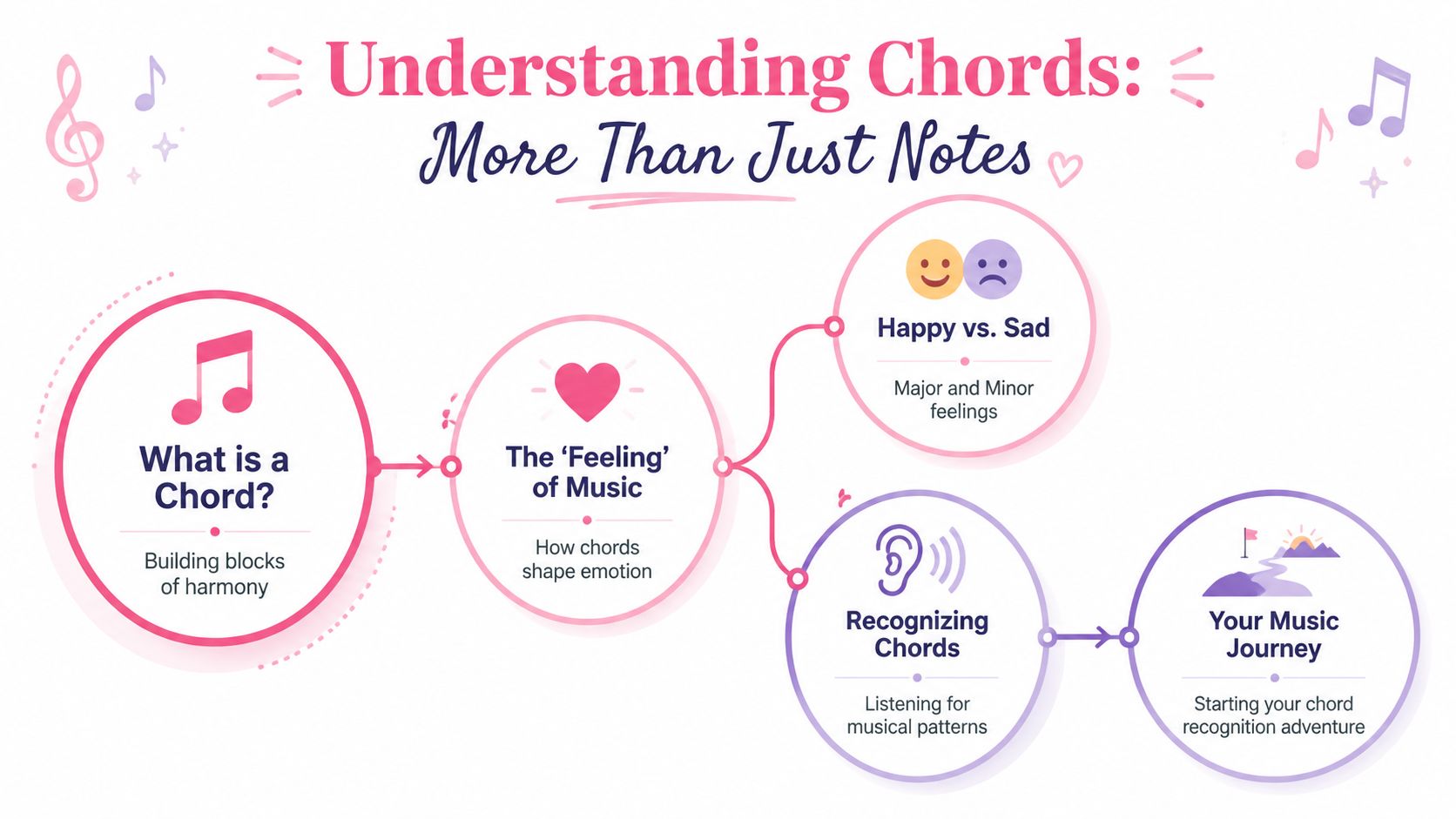
A chord is one sound made from several notes
A simple definition works best. A chord is three or more notes sounding together. Even though several notes are present, your ear often hears them as one combined event, one harmonic color.
That’s the first big aha moment. You’re not trying to identify random notes floating around. You’re learning to hear one blended shape.
Practical rule: Don’t ask, “What are all the notes?” first. Ask, “What does this harmony feel like?”
That shift matters if your goal is ear training. When you listen for feeling first, you stop treating music like a spelling test. You start hearing patterns.
Why this matters for playing by ear
If you want to stop hunting around your instrument, chord hearing is one of the fastest skills to build. Songs become easier to follow because you can hear when the harmony settles, when it leans away from home, and when it pulls back.
If you’re tired of trial and error, this guide on how to stop guessing chords and start hearing them is a useful next step.
A textbook may define a chord correctly. Your ear gives that definition a job. Once you hear chords as emotional signals instead of abstract labels, learning to play by ear starts feeling possible.
The Simple Building Blocks of Every Chord
Letters form words. Notes form chords.
That’s the simplest way to think about harmony. A single note can feel clear and direct, but when you combine notes in a deliberate way, you get a bigger meaning. You get mood.
Why three notes matter so much
The most important chord type to learn first is the triad. A triad is built from three notes stacked in a particular way: a root, a third, and a fifth. According to Wikipedia’s overview of chords in music), the triad is the most fundamental chord form and underpins over 85% of all Western pop and rock progressions.
That matters because it means you don’t need to hear every possible chord right away. If you can hear triads, you’re already training for a huge amount of real music.
The same source also notes that intervals inside the triad, especially the major third, are perceived as stable and bright because of simple frequency relationships. You don’t need the math to use that idea. You just need to notice that some chord sounds feel naturally settled and easy for the ear to accept.
| Chord Type | Feeling / Character | Interval Formula |
|---|---|---|
| Major triad | Bright, stable, open | Root, major 3rd, perfect 5th |
| Minor triad | Darker, sadder, softer | Root, minor 3rd, perfect 5th |
| Diminished triad | Unsettled, tense | Root, minor 3rd, diminished 5th |
| Augmented triad | Lifted, unusual, floating | Root, major 3rd, augmented 5th |
Major and minor are the first sounds to learn
If you’re new, focus on two sounds first: major and minor.
A C major triad is C, E, G.
A C minor triad is C, E-flat, G.
Only one note changes. But your ear hears a very different emotional color.
Major often feels more open. Minor often feels more inward.
Those aren’t perfect labels for every song, but they’re useful. They give your ear something concrete to latch onto.
If you want a better handle on why changing one note changes the whole chord, this guide to intervals in music and how they shape what you hear helps connect the dots.
For anyone chasing perfect pitch, this is also a good reminder that you don’t need it to make progress. Relative hearing comes first. Learn the shape of the sound. Learn the character. Then connect it to your instrument.
Adding Flavor with 7ths Extensions and Inversions
Once you can hear basic major and minor triads, songs start sounding less flat. Then you notice something else. Some chords feel richer, jazzier, softer, more tense, or more cinematic, even when they still seem related to a basic triad.
That’s where added notes and different bass notes come in.
One extra note changes the story
A seventh chord starts as a triad and adds one more note on top. That single change can make the chord feel smoother, dreamier, or more urgent.
A great example is the V7 chord in a progression. In the common I-V-vi-IV progression, the V chord often carries the strongest push forward. According to this explanation of the I-V-vi-IV progression and the V chord’s tritone tension, that progression appears in an estimated 25% of Spotify’s top 10,000 tracks, and much of its emotional pull comes from the V chord creating tension your brain wants to hear resolved.
You can hear this even if you don’t know the theory words yet. The V7 chord sounds like a question that wants an answer. The tonic sounds like the answer.
Try this on any keyboard:
- Play a home chord: Start on C major.
- Move to tension: Play G7.
- Return to rest: Go back to C major.
- Listen for the pull: The middle chord should feel less settled than the first and last one.
That pull is one of the clearest ear training targets in all of harmony.
The same chord can wear different shoes
Now take the same chord and change the note on the bottom. That’s an inversion.
C major in root position is C-E-G, with C at the bottom.
First inversion is E-G-C.
Second inversion is G-C-E.
The chord is still C major. Its identity hasn’t changed. But the feel of the bass motion does change, and your ear notices.
Consider the same actor viewed from a different camera angle. The character remains identical, yet the presentation shifts.
Here’s what beginners often miss:
- Root position feels most grounded: It usually sounds more final.
- Inversions feel smoother in motion: They help chords connect without big jumps in the bass.
- Slash chords point your ear to the bass: G/B means “a G chord with B in the bass.”
Don’t panic when the bass note changes. First ask whether the chord quality stayed the same.
That question helps you hear beyond the surface. Instead of treating every new bass note as a brand new mystery, you begin to hear continuity. That’s a huge step toward musical freedom and stronger chord recognition.
How to Finally Start Hearing Chords in Songs
Hearing chords in isolation is useful. Hearing them inside real songs is where your ear starts becoming practical.
Most pop songs aren’t built from endless harmonic surprises. They repeat familiar sounds. That’s good news for anyone learning to play by ear.
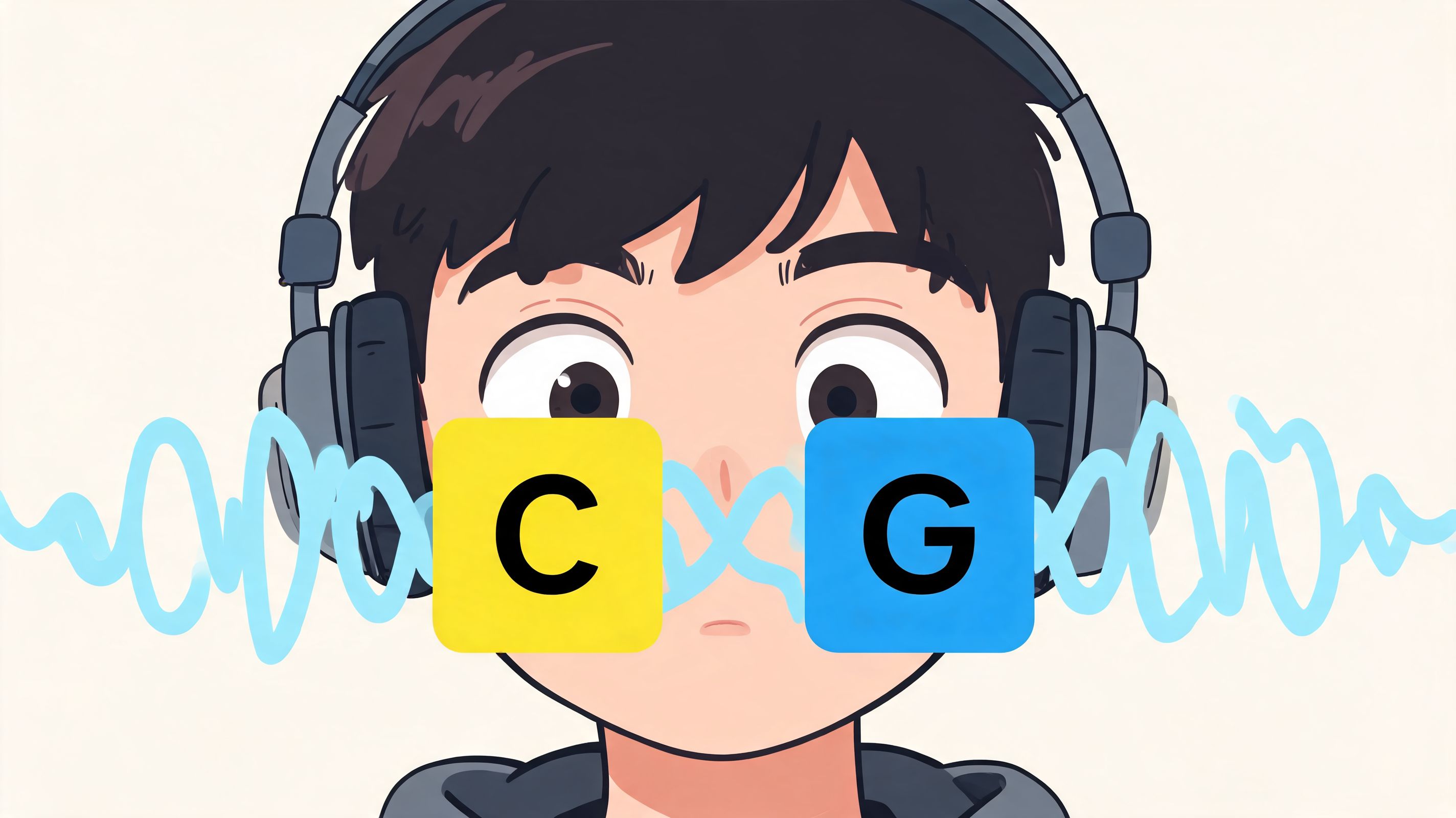
Most songs give you a smaller puzzle than you think
Every major or minor key has seven naturally occurring diatonic chords. According to this songwriting analysis of chord progression patterns in popular music, progressions built from those seven chords form the harmonic foundation for over 90% of all hit songs.
That changes how you should listen.
You are not trying to identify any chord that has ever existed. In many songs, you’re listening for a smaller family of likely options. Your ear can learn that family.
The more songs you hear in one key, the more “normal” certain chord moves start to sound.
What to listen for first
Start with the bass. The lowest note often gives away the root or at least points you toward the chord’s function.
Then listen for emotional direction:
- Home base: Which chord feels like rest?
- Lift away: Which chord makes the song feel like it has moved outward?
- Tension: Which chord sounds like it wants to continue?
- Color shift: Does the mood turn brighter or darker?
Hum along with the bass if you can. Then pause the song and search for that note on your instrument. Even if you miss the full chord at first, finding the bottom note gives your ear a foothold.
This short video is useful when you’re starting to connect chord changes to actual listening:

Another helpful move is to listen for repetition. If the verse loops the same four-chord pattern, you get multiple tries to test your guess. That repetition is your teacher. Ear training works because songs give your brain repeated examples.
Your First Chord Recognition Workout
You don’t need a long practice session to begin hearing chords better. You need one clean exercise and full attention.
Start with the most useful first contrast in harmony: major versus minor.
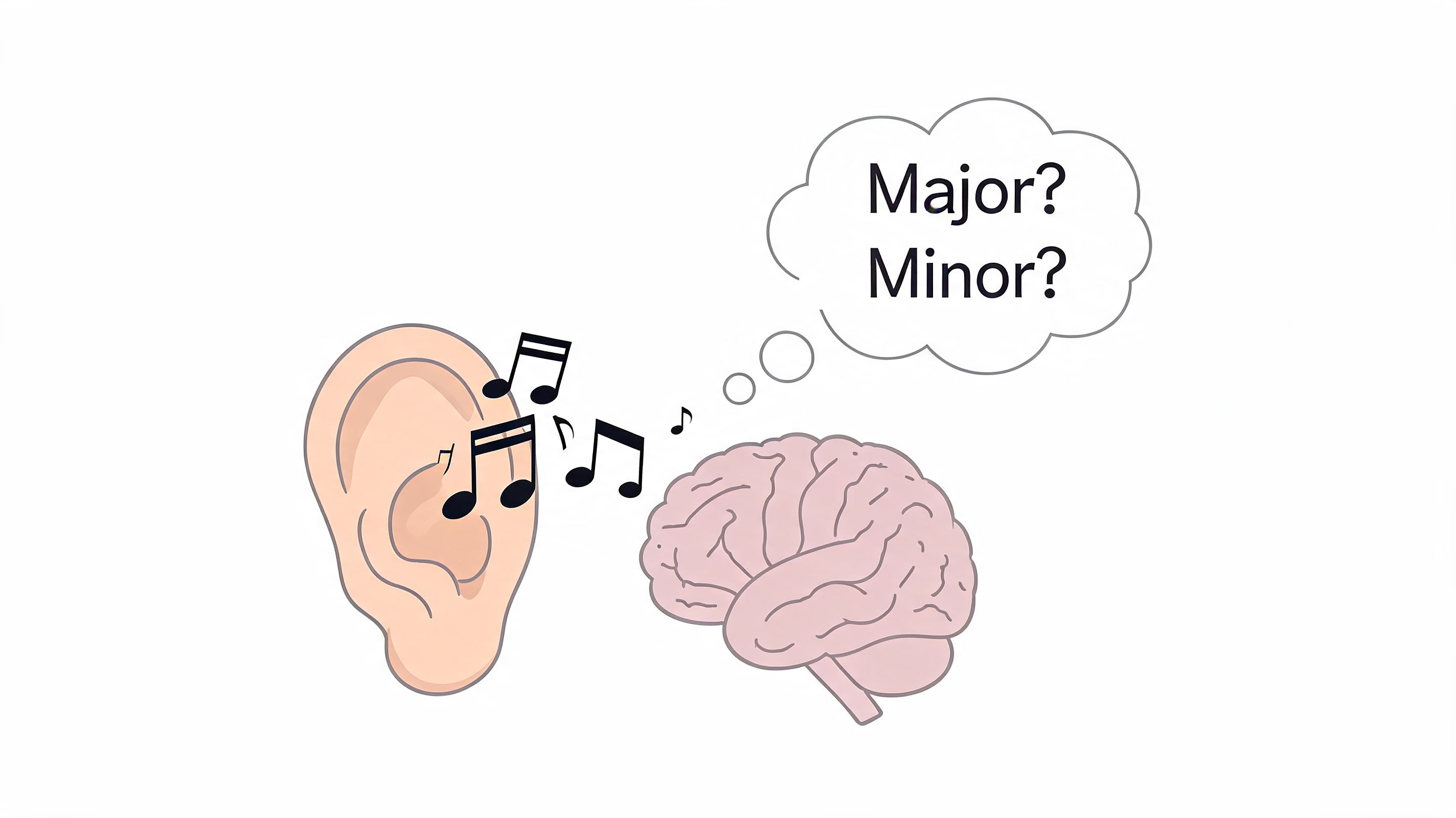
A five minute major versus minor drill
Use a piano, guitar, or digital keyboard. If you use a keyboard app, that works too.
-
Play C major
Play C, E, and G together. Let it ring. Don’t judge it yet. Just listen. -
Name the feeling
Use simple words. Bright. Open. Stable. Pick one that makes sense to you. -
Play C minor
Now play C, E-flat, and G. Same root. Same fifth. One changed note. -
Compare, don’t analyze
Ask yourself what changed in the emotional color. Don’t worry about getting fancy language right. -
Alternate slowly
Go back and forth several times. Leave a little silence between each chord so your ear resets. -
Test yourself
Close your eyes. Play one of them at random. Try to name it by sound alone.
This is basic, but it works. If you repeat this daily, your brain starts building a reliable category for each sound.
For more focused drills, this guide to ear training for chords and better harmonic recognition gives you more ways to practice without overcomplicating it.
How to know the exercise is working
You’ll notice progress before you can explain every theory term. That’s normal.
Look for signs like these:
- Songs become easier to sort emotionally: You start noticing whether a section sounds more major or more minor.
- Your guesses become faster: You hesitate less before trying a chord on your instrument.
- You correct yourself sooner: Even when you’re wrong, your ear catches the mismatch more quickly.
“Play less. Listen longer.” That’s often the fastest path to better chord recognition.
If you’re practicing for perfect pitch, keep your expectations realistic. Chord hearing usually improves through repeated comparison, not magic. Relative hearing is a skill you build one sound at a time.
Turn Chord Recognition into an Instinct in 10 Minutes a Day
Chord recognition gets easier when practice is short enough to repeat. That’s why 10 minutes a day matters. It’s long enough to train, short enough to sustain.
You don’t need marathon sessions. You need consistency. A daily habit teaches your ear what major, minor, tension, release, bass movement, and harmonic “home” sound like over and over until the response becomes faster and more automatic.
A simple routine works well:
- Minute 1 to 3: Compare major and minor triads
- Minute 4 to 6: Hear one progression and identify the home chord
- Minute 7 to 8: Follow the bass note under each chord change
- Minute 9 to 10: Test yourself without looking
Do that often enough and the goal changes. You stop trying to memorize labels. You start recognizing sound in real time.
That’s what musicians usually mean when they say someone can really play by ear. They’re not guessing better. They’re hearing better.
If you want a daily system for building that skill, Trill: Ear Training Daily is designed for exactly this kind of practice. It helps you train chord recognition, intervals, notes, and musical hearing through short sessions built for consistency, so you can stop guessing and start hearing music clearly.