A Major Chord Progression: A Guide to Hearing and Playing
You hear a song, grab your guitar or sit at the piano, and try to find the chords. For a minute, it feels possible. Then everything turns into trial and error. You bounce between shapes, second-guess every change, and wonder if people who can play by ear were just born with something you don’t have.
They weren’t.
Hearing a major chord progression is a skill you can train. The shift happens when you stop treating chords like random names to memorize and start hearing them as roles inside a key. Once your ear knows what “home” sounds like, what “moving away” sounds like, and what “pulling back” sounds like, songs stop feeling mysterious.
That matters if you want to build real musical freedom. Not just passing a theory quiz. Not just knowing chord charts. Real freedom means joining in faster, recognizing patterns sooner, improvising with more confidence, and relying less on guesswork. If you’re interested in ear training, play by ear skills, or even long-term goals like perfect pitch, this is the kind of foundation that pays off every day.
Table of Contents
- Stop Memorizing Chords and Start Hearing Music
- The 7 Building Blocks of the Key of A Major
- The Most Famous Progression The I IV V
- Adding Emotion with Minor Chords and Variations
- How to Train Your Ear to Hear Progressions
- Using These Progressions in Your Own Music
Stop Memorizing Chords and Start Hearing Music
A lot of musicians learn chords the hard way. They memorize shapes, copy charts, and hope recognition comes later. It often doesn’t. The problem isn’t effort. The problem is that memorizing chord names alone doesn’t teach your ear what the harmony is doing.
One of the most useful teaching ideas in ear training is to think in scale degrees and function rather than fixed chord labels. Educational material on this topic points out that many explanations stop at chord names, but players improve faster when they hear the underlying structure first, because that lets them recognize the same progression in different keys instead of relearning it chord by chord in each one. You can hear that idea discussed in this lesson on hearing degrees instead of memorizing labels.
Practical rule: If you only know the names A, D, and E, you’re stuck in one key. If you hear I, IV, and V, you can move that sound anywhere.
That single shift changes how you listen.
When you hear a progression as function, the music starts behaving more like a story than a puzzle. One chord feels settled. Another sounds like it opens the door. Another creates tension that wants resolution. Your ear can learn those roles the same way it learns the sound of a question versus an answer in speech.
Why this matters for playing by ear
If you’re trying to play by ear, the goal isn’t to guess faster. The goal is to recognize sound patterns on purpose.
That means listening for things like:
- Home base: The chord that feels finished and stable.
- Departure: The chord that gives motion and lifts the music forward.
- Tension: The chord that makes you expect a return.
This is why ear training is trainable. You’re not chasing rare talent. You’re building pattern recognition through repetition.
The ear doesn’t need a hundred unrelated tricks. It needs repeated contact with the same core sounds until they become familiar.
A major chord progression in the key of A is a great place to start because the sounds are clear, common, and useful in real songs. Once you can hear how those chords behave in A major, you’re building a skill that transfers far beyond one key.
The 7 Building Blocks of the Key of A Major
The key of A major gives you a full set of seven diatonic chords. Think of them as one musical family. Each member has a different personality, but they all belong to the same world.
The chord family in A major
Here are the seven basic chords in the key:
| Scale degree | Chord | Quality | Simple role |
|---|---|---|---|
| I | A | Major | Home |
| ii | Bm | Minor | Gentle push forward |
| iii | C#m | Minor | Color and extension |
| IV | D | Major | Movement away from home |
| V | E | Major | Strong tension |
| vi | F#m | Minor | Emotional shift |
| vii° | G#dim | Diminished | Instability and drama |
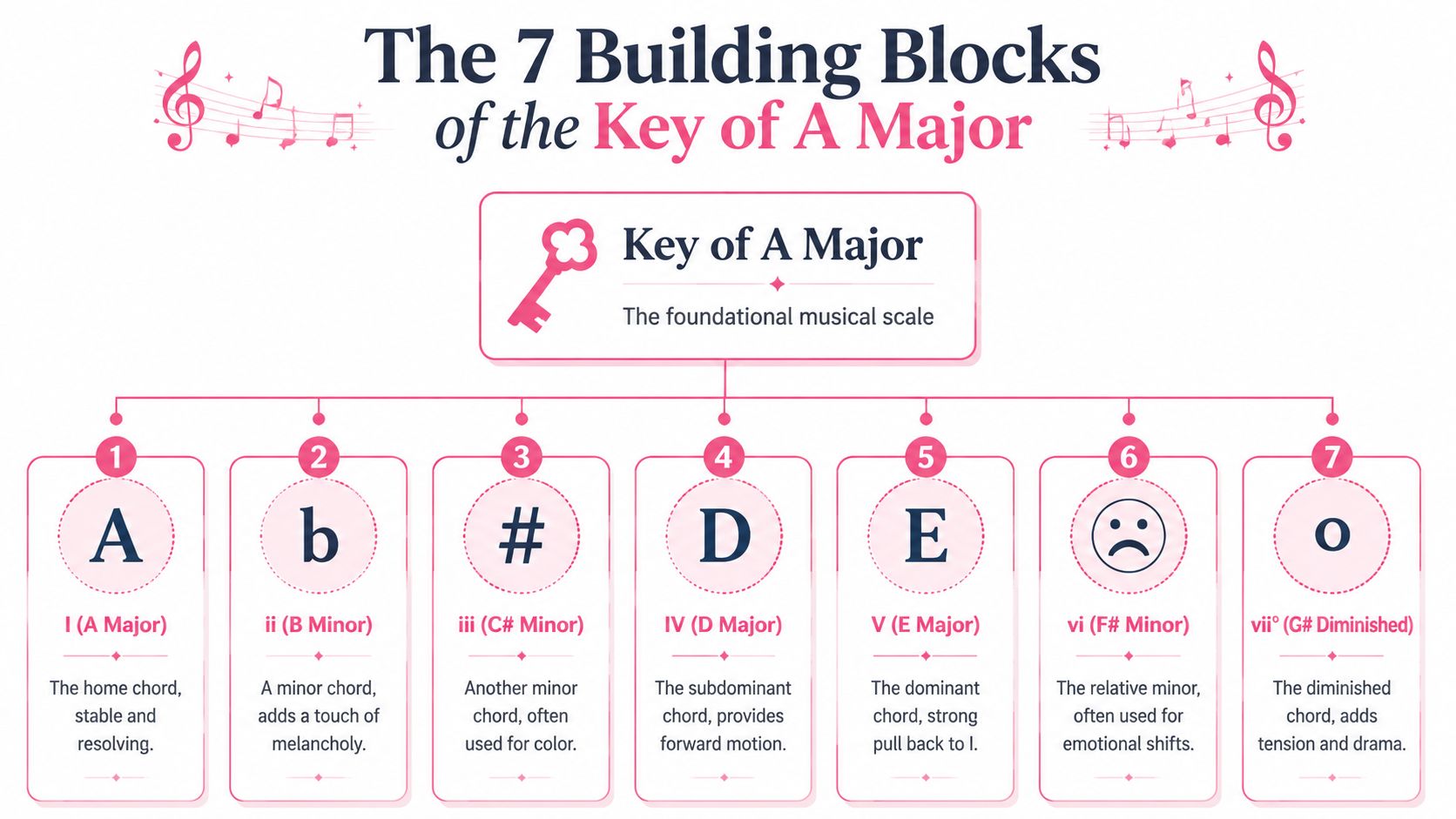
In major-key harmony, the most stable chords are I, IV, and V, which are major. The ii, iii, and vi chords are minor, and functional progressions often grow out of the tension and release between these roles, including patterns like I-IV-V-I and ii-V-I, as explained in this overview of major scale chord functions.
That sounds theoretical, but your ear already feels it.
A major feels settled. D major feels like the music has stepped out of the house. E major feels like it wants to go somewhere specific. F# minor adds a more reflective color. G# diminished sounds unstable enough that most beginners can hear it as “not home” almost immediately.
Why function matters more than names
If you only memorize the chord names, you’ll know that A major contains A, Bm, C#m, D, E, F#m, and G#dim. That’s useful, but incomplete.
If you hear the roles, you’ll know something more powerful:
- I is rest
- IV is motion
- V is pull
- vi is emotional contrast
That’s why Roman numerals matter. They tell you what the chord does, not just what it’s called.
For ear training, that difference is huge. When you hear a song move from A to D, you don’t want your brain saying, “That’s A, then D.” You want it saying, “That’s I moving to IV.” Then if the same sound shows up in G major or C major, you still recognize the pattern.
If you need a clearer picture of how scale steps create these relationships, this guide to intervals in the major scale helps connect the notes you hear to the harmony you build from them.
Teacher’s shortcut: Learn the key like a neighborhood, not a list. Know which chord feels like home, which one feels like the road, and which one feels like the turn back toward the house.
That approach makes a major chord progression easier to hear, easier to remember, and much easier to use in real music.
The Most Famous Progression The I IV V
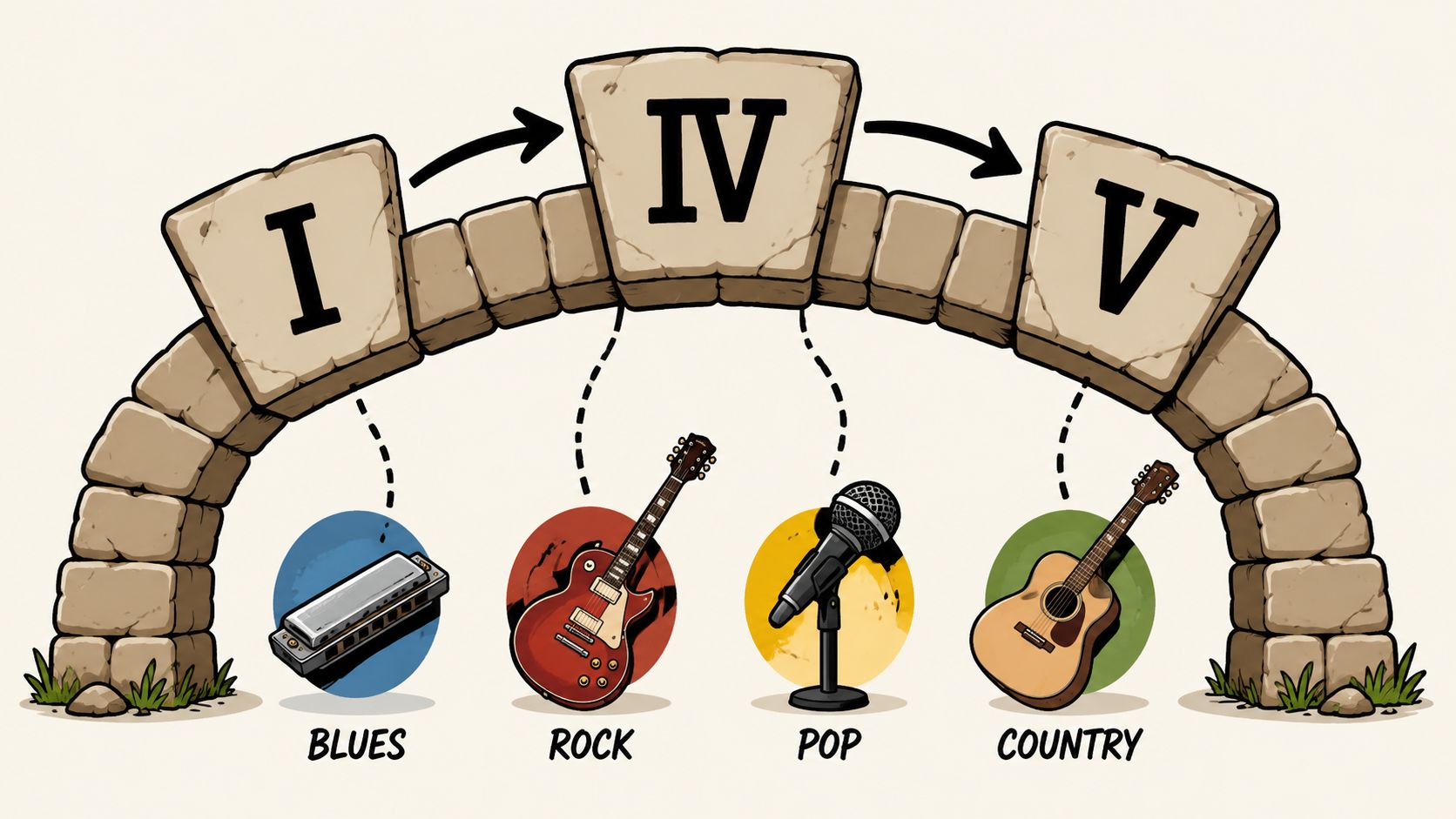
If you only trained your ear on one progression for a while, I-IV-V would be the right choice. It’s direct, memorable, and all over real music.
In A major, that progression is A, D, and E.
The sound of home away and back
The easiest way to hear I-IV-V is as a three-part motion.
You begin on A major, which feels settled. Then you move to D major, which gives the song forward energy. Then E major increases tension and strongly suggests a return to A. Even before you learn the terms tonic, subdominant, and dominant, your ear can feel the sequence as home, away, and back.
That’s why this progression is such a good ear training target. Each step has a distinct job.
Try this on your instrument. Play A for four beats, D for four, E for four, then return to A. Don’t think about finger positions first. Listen for the emotional shape. The arrival back on A should feel more complete than the first three chords.
Simple ways to play it
If you’re on guitar, start with open shapes if you know them. If you’re on piano, use basic triads in root position.
A very simple version looks like this:
- Guitar: A major, D major, E major
- Piano: A-C#-E, D-F#-A, E-G#-B
You don’t need fancy voicings yet. Clean recognition comes before decoration.
If you’d like a broader foundation for how chords are built and grouped, this overview of music theory chords is a good companion.
A quick demonstration can help lock in the sound before you start hunting for it in songs:

When students first learn I-IV-V, they often treat it like a formula. It works better when they treat it like a feeling they can recognize on command.
One useful exercise is to randomize the order after you’ve learned the basic cycle. Play A-D-E-A, then try A-E-D-A, then D-A-E-A. Your ear starts separating the sound of each chord function instead of only memorizing one route through the progression.
That is where playing by ear starts to become practical. You stop reacting only to a practiced sequence and begin hearing individual harmonic roles in real time.
Adding Emotion with Minor Chords and Variations
Major chords give clarity. Minor chords give contrast. Once you add them, a major chord progression starts sounding less like an exercise and more like a song.
Why the vi chord changes everything
In A major, the vi chord is F# minor. This chord matters because it shares notes with the key but changes the emotional color right away. If A major feels open and stable, F# minor often feels more inward and reflective.
That one chord introduces one of the most familiar sounds in modern songwriting: I-V-vi-IV. In A major, that’s A-E-F#m-D.
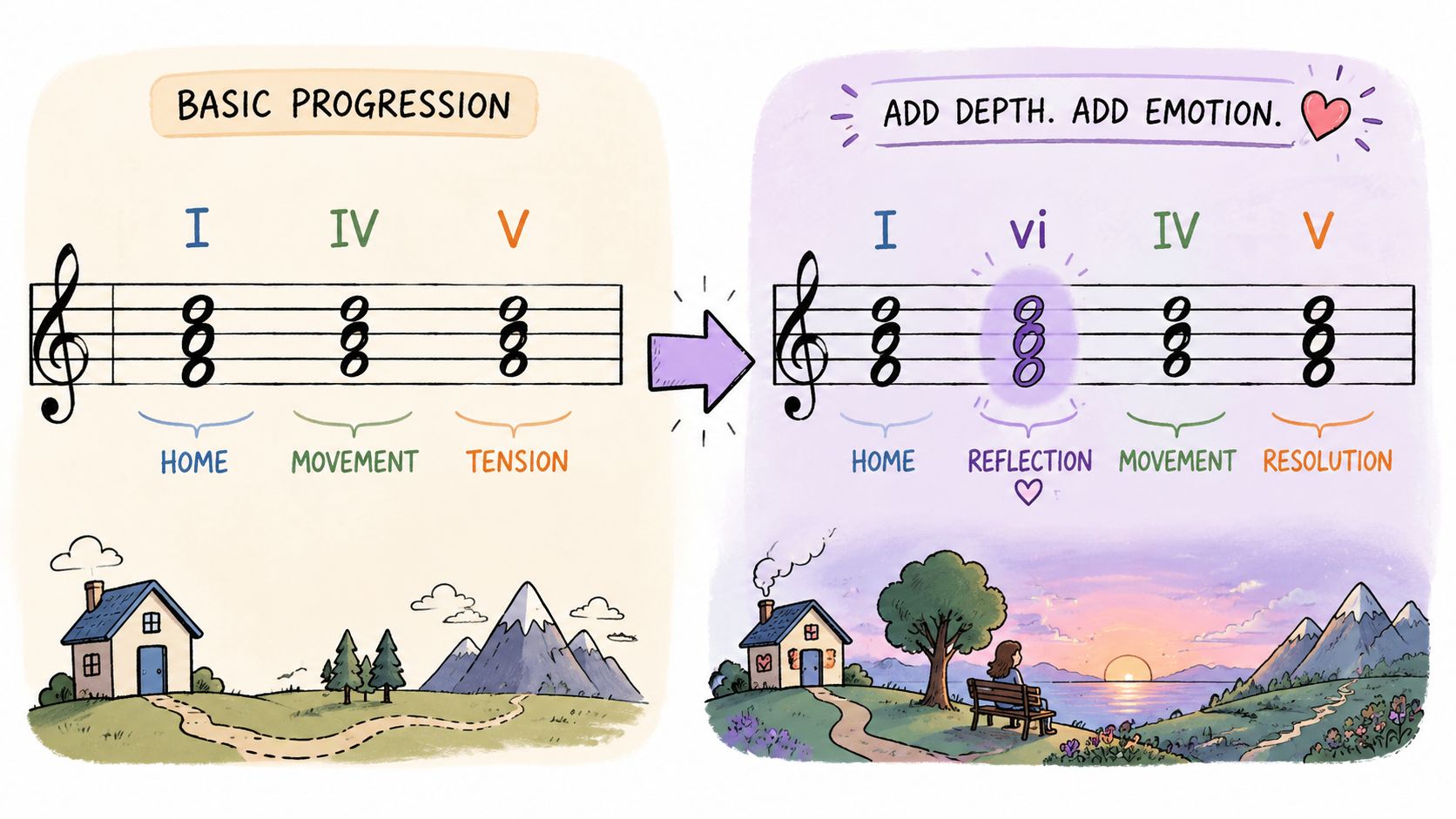
A large-scale progression analysis of more than 10,000 songs found that C-G-Am-F was among the most frequent four-chord sequences, and that pattern is the same functional motion as I-V-vi-IV when transposed to another key, as described in this HookTheory-based chord progression analysis.
That matters for your ear because it tells you this isn’t some niche pattern. It’s a core sound worth knowing completely.
Try these two progressions back to back:
| Progression | Chords in A major | What it often feels like |
|---|---|---|
| I-IV-V | A-D-E | Direct, bright, grounded |
| I-V-vi-IV | A-E-F#m-D | Bright with a touch of ache |
If you’re training by ear, listen for the emotional dip when the vi chord arrives. It doesn’t sound unstable in the same way V does. It sounds more like the light got softer.
The smoother pull of ii V I
Another important sound is ii-V-I. In A major, that’s Bm-E-A.
This progression feels smoother and more directed than a lot of beginner patterns because the chords line up neatly in function. Bm starts the motion. E increases the pull. A resolves it. If you’ve listened to jazz, R&B, gospel, or more harmonically rich pop, you’ve heard versions of this movement many times.
Try hearing the difference between these two endings:
- D to E to A
- Bm to E to A
Both return home, but they don’t take the same road. The second one often sounds more connected and more deliberate.
Listening cue: The V chord creates urgency. The vi chord creates mood. The ii chord creates setup.
Here are simple starting voicings:
- Bm: B-D-F#
- F#m: F#-A-C#
- E: E-G#-B
- A: A-C#-E
You don’t need to memorize all possible inversions yet. First learn the basic sound of each function inside the key. Once your ear knows those roles, variations become much easier to follow.
How to Train Your Ear to Hear Progressions
Knowing the theory and hearing the sound aren’t the same thing. A lot of musicians understand progressions on paper but still freeze when they try to identify them in songs. That’s normal. Ear training closes that gap.
A short daily practice loop
Use a short loop you can repeat every day. Ten minutes is enough if you stay focused.
-
Play one progression slowly
Start with A-D-E-A or A-E-F#m-D. Play each chord long enough to hear the function, not just the shape. -
Sing the degrees out loud
Don’t just play A and say “A.” Say “one.” Then “four.” Then “five.” This ties the sound to the role in the key. -
Pause and predict the next chord
After I or IV, stop for a second and ask what would sound natural next. Prediction is where real listening starts. -
Check yourself with your instrument
If you guessed wrong, that’s useful. You’re training discrimination, not chasing perfection.

For more direct practice on hearing harmony, this article on how to recognize chords by ear pairs well with progression work.
What to listen for in real songs
When you’re listening to recordings, don’t ask, “What chord is that?” first. Ask simpler questions.
- Does this chord feel settled or unfinished?
- Did the energy open up or tighten?
- Did the mood darken when the chord changed?
- Do I expect a return to the starting point?
Those questions are practical because they match function.
You can also isolate one target progression per week. Spend several days listening only for I-IV-V. Then spend several days listening only for I-V-vi-IV. Your ear improves faster when it compares repeated examples of the same pattern.
If you want a structured way to do that, one option is Trill: Ear Training Daily. It includes chord and progression listening exercises built around short daily sessions, so you can practice recognition with immediate feedback instead of only guessing at songs on your own.
Your ear learns the way your hands do. Short, accurate repetitions beat occasional marathon sessions.
If perfect pitch interests you, keep it in the right place mentally. Perfect pitch isn’t the starting point for playing by ear. Relative hearing is. When you can hear how chords relate to the key and to each other, you gain far more real-world musical use than you’d get from trying to name isolated notes without context.
Using These Progressions in Your Own Music
The fastest way to understand a progression is to use it.
Start small and make musical decisions by ear
Write a verse with just A and D. Alternate them until one feels more stable than the other. Then bring in E when you want the line to feel unfinished and ready to move forward.
Try another sketch that starts on F#m instead of A. You’ll hear the mood shift right away, even though you’re still inside the same key. Then move to D, then A, then E and notice how the progression feels more reflective before it opens up.
If you play piano, loop the left-hand roots first and keep the right hand simple. If you play guitar, strum evenly and sing over the top. If you sing, hold one note across chord changes and listen to how the same pitch feels different against each harmony. That exercise builds ear training and songwriting instinct at the same time.
Consistency creates freedom
A major chord progression becomes useful when it stops being information and starts becoming sound you recognize instantly.
That’s where daily work matters. Ten minutes a day is enough to strengthen chord recognition, improve improvisation, and help you play by ear with more confidence. Not because theory suddenly becomes magical, but because repeated listening teaches your brain what these harmonic moves feel like.
You don’t need to master every progression at once. Learn the pull of I-IV-V. Learn the color of vi. Learn the smooth return of ii-V-I. Then use them in songs, in warmups, in improvisation, and in listening practice until they sound familiar enough that your hands can follow your ear.
If you want a simple daily system for this, Trill: Ear Training Daily helps you practice chord recognition, intervals, notes, and progressions in short sessions built for consistency. It’s designed for musicians who want to stop guessing, build stronger ear training habits, and play by ear with more confidence.