Major Scale Notes: Your Guide to Playing by Ear
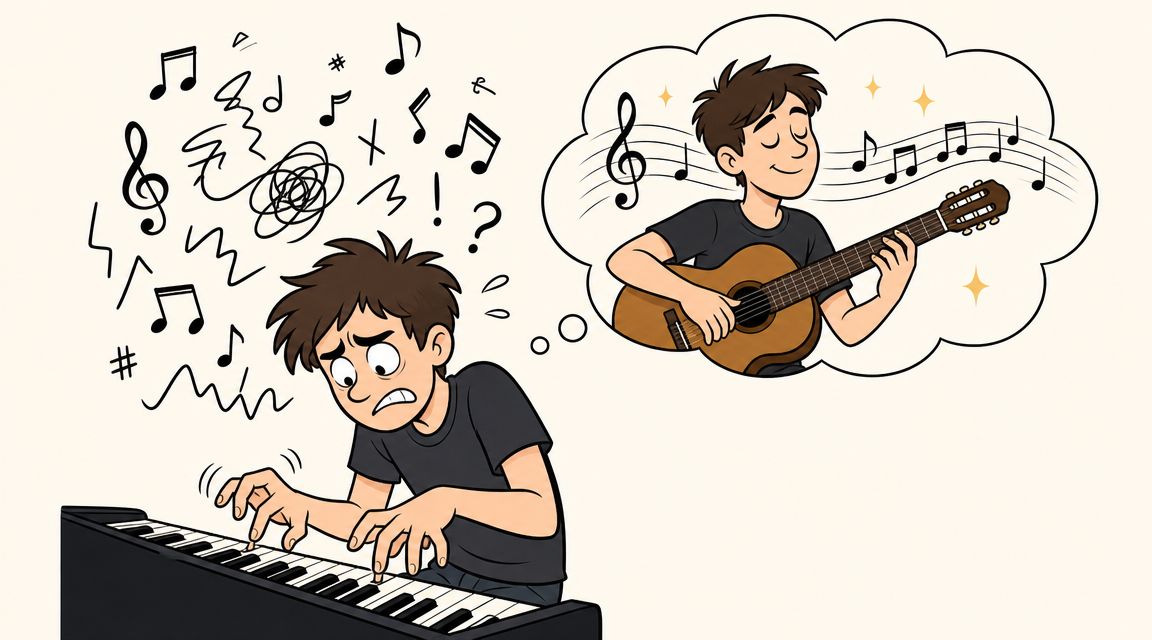
You know the feeling. A song comes on, and you can already hear the melody in your head. You might even know where the tune rises, where it settles, and where the chorus feels like it finally lands. But the moment you sit at the piano, pick up your guitar, or try to sing it back accurately, everything gets foggy.
That gap is where a lot of musicians get stuck.
It’s easy to think the problem is talent, or that people who can play by ear were born with better ears. They weren’t. Most of the time, they built a clearer map between what they hear and what they play. A big part of that map is learning the major scale notes in a way that connects directly to sound, not just finger patterns or theory terms.
If you want stronger ear training, better chord recognition, and more confidence to play by ear, the major scale is one of the best places to start. Not because it’s a rule to memorize, but because it helps your ear organize what music is doing.
Table of Contents
- Why You Can Hear a Song But Cant Play It
- The Secret Formula for Happy Sounding Music
- How to Build All 12 Major Scales
- From Scale Notes to Your Favorite Songs
- Stop Memorizing Start Hearing the Music
- Your Daily Path to Musical Freedom
Why You Can Hear a Song But Cant Play It
A beginner hears a chorus and thinks, “I know that sound.” Then they go to the instrument and start hunting. One note is too low. Another is close but not right. A third sounds good until the next note arrives and the whole thing falls apart.
That doesn’t mean they’re bad at music. It usually means they don’t yet have a reliable sound map.
The major scale gives you that map. It became a central organizing principle in Western music by the Renaissance, and modern theory still defines it with the same W-W-H-W-W-W-H pattern and key-signature logic across transpositions, as explained in this history and overview of the piano major scale. That matters because a huge amount of melody and harmony still grows out of this one sound pattern.
You’re not missing talent
When people say, “I can hear music, but I can’t find it,” they’re often hearing the shape of the melody but not the note relationships inside it.
That’s a trainable skill.
Practical rule: If you can notice that one note feels higher, lower, more settled, or more tense than another, your ear is already working. It just needs structure.
Why the major scale helps so much
The major scale is one of the first places musicians learn how notes relate to a home note, often called the tonic. Once your ear starts hearing that home base, melodies stop feeling random.
You begin to notice things like:
- Home and away: Some notes feel settled, while others feel like they want to move.
- Brightness: Some melodies sound open and clear because they lean on major scale notes.
- Recognition: Familiar songs often use the same note relationships in different keys.
That’s why learning major scale notes isn’t just about passing a theory class. It’s about turning vague musical instinct into something you can use on command. That’s the first real step toward improvisation, chord recognition, and the freedom to play by ear without guessing.
The Secret Formula for Happy Sounding Music
The major scale isn’t a random list of notes. It’s a pattern.
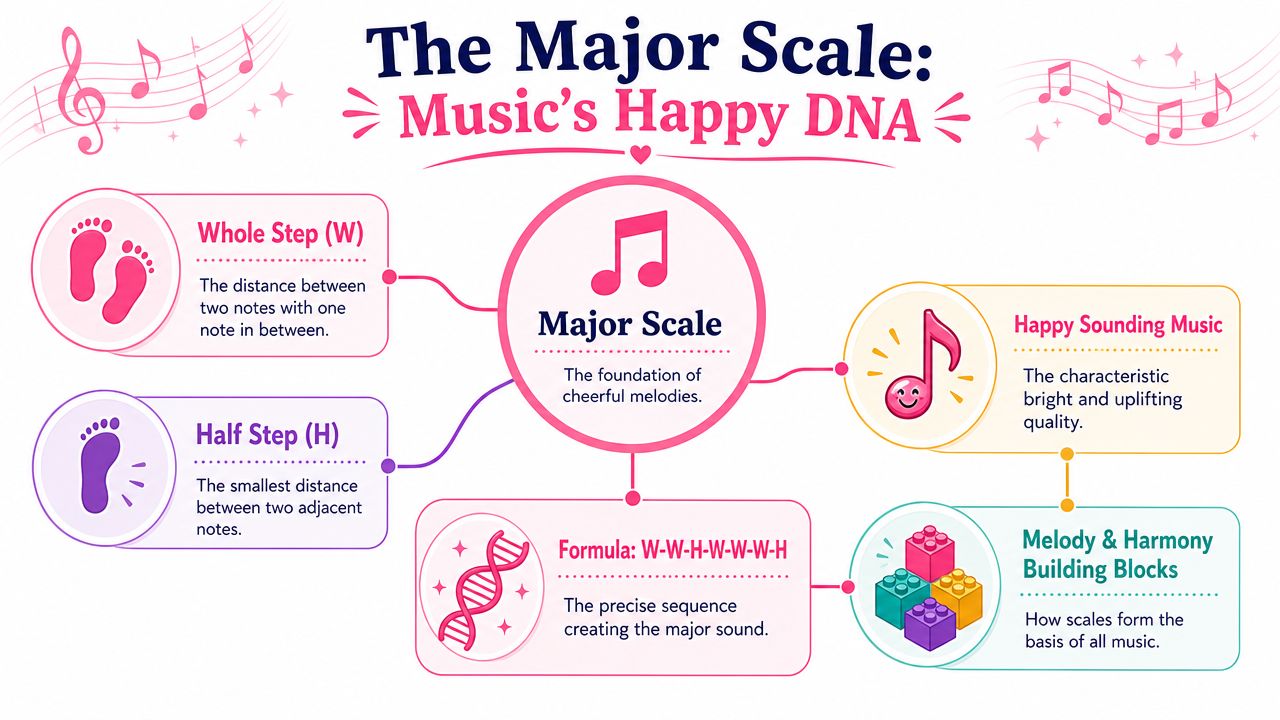
Its pattern is whole, whole, half, whole, whole, whole, half, and the scale contains 7 distinct notes before the octave repeats the first note. In standard Western tuning, that means the major scale uses 7 of the 12 tones available, as outlined in this major scale reference.
What whole and half steps actually mean
A half step is the smallest move to the next adjacent note. On piano, that’s moving to the very next key, whether it’s white or black. On guitar, it’s moving by one fret.
A whole step is two half steps.
If that sounds abstract, hear it physically:
- Half step: tight, close, almost rubbing
- Whole step: a little more open
- The full major pattern: balanced, bright, finished
Try C major first
C major is the cleanest example because it uses only natural note names:
C, D, E, F, G, A, B, C
If you play those notes in order, you’re hearing the major scale in its simplest form.
The pattern matters more than the letter names. Your ear is learning the spacing between notes, not just a list.
That’s why G major sounds like the same kind of scale even though it starts somewhere else. The sound quality comes from the interval layout, not from starting on C.
If you want a simple way to connect the sound of the scale to the space between notes, this guide to intervals in the major scale is useful.
Why this pattern sounds so familiar
Your ear probably already knows the major scale sound. It shows up in melodies that feel stable, singable, and resolved. When people describe music as bright or happy-sounding, they’re often reacting to this interval pattern.
That doesn’t mean every major-key song sounds cheerful. Music is more flexible than that. But the major scale gives composers and players a common palette that listeners recognize fast.
Here’s the important part for play by ear practice:
- Don’t just say the formula. Play it and sing it.
- Don’t just memorize C major. Move the pattern to other starting notes.
- Don’t chase perfect pitch. First learn to hear how notes relate inside one key.
That last point matters. A lot of musicians think they need perfect pitch before they can identify notes confidently. Most of the time, they need stronger relative hearing instead. The major scale is one of the best ways to build it.
How to Build All 12 Major Scales
Once you understand the pattern, building major scale notes gets much easier. You don’t need to memorize separate facts with no connection. You apply one sound recipe from a different starting note.
A major scale follows W-W-H-W-W-W-H. The note you start on is your tonic. From there, you move through the pattern step by step.
Build C major first
Start on C.
Move up a whole step to D. Another whole step to E. Then a half step to F. Keep following the pattern and you get:
C, D, E, F, G, A, B, C
That’s the clean version many beginners learn first.
Build G major and hear why F changes
Now start on G and keep the same pattern. A whole step gives you A. Another whole step gives you B. A half step gives you C. Then D, E, and now you need another whole step.
From E, a whole step is F#, not F.
So G major becomes:
G, A, B, C, D, E, F#, G
This isn’t a random theory rule. It’s the pattern doing its job. If you used F natural, the sound would change and the scale wouldn’t feel major in the same way.
Build F major and watch B move the other way
Start on F and follow the same pattern. You get:
F, G, A, Bb, C, D, E, F
B has to become Bb so the interval layout stays correct.
When a note changes to sharp or flat, it’s not there to make music harder. It’s there to preserve the sound.
For practice, it helps to build scales yourself before looking them up. Then check your work with a visual reference like this interactive scales tool.
The 12 major scales
| Key | Notes | Sharps/Flats |
|---|---|---|
| C | C, D, E, F, G, A, B | none |
| G | G, A, B, C, D, E, F# | F# |
| D | D, E, F#, G, A, B, C# | F#, C# |
| A | A, B, C#, D, E, F#, G# | F#, C#, G# |
| E | E, F#, G#, A, B, C#, D# | F#, C#, G#, D# |
| B | B, C#, D#, E, F#, G#, A# | F#, C#, G#, D#, A# |
| F# | F#, G#, A#, B, C#, D#, E# | F#, C#, G#, D#, A#, E# |
| Db | Db, Eb, F, Gb, Ab, Bb, C | Bb, Eb, Ab, Db, Gb |
| Ab | Ab, Bb, C, Db, Eb, F, G | Bb, Eb, Ab, Db |
| Eb | Eb, F, G, Ab, Bb, C, D | Bb, Eb, Ab |
| Bb | Bb, C, D, Eb, F, G, A | Bb, Eb |
| F | F, G, A, Bb, C, D, E | Bb |
Where learners usually get tripped up
Many people don’t struggle with the formula. They struggle with spelling.
A scale isn’t just a sound pattern. It’s also an ordered set of note names. That’s why keys with heavy sharps or flats can feel awkward at first. You’re not only hearing the pattern. You’re also learning how music names each step in the pattern.
A good test is this: can you say the notes of a major scale, then sing them, then find them on your instrument without staring at a chart? If not, you don’t need more theory. You need slower repetition with listening attached.
From Scale Notes to Your Favorite Songs
A scale becomes useful when you stop treating it like an exercise and start hearing it as a pool of musical choices.
Melodies often pull their notes from the major scale of the key. Chords do too. That’s why songs can sound connected even when the melody and accompaniment are doing different things.
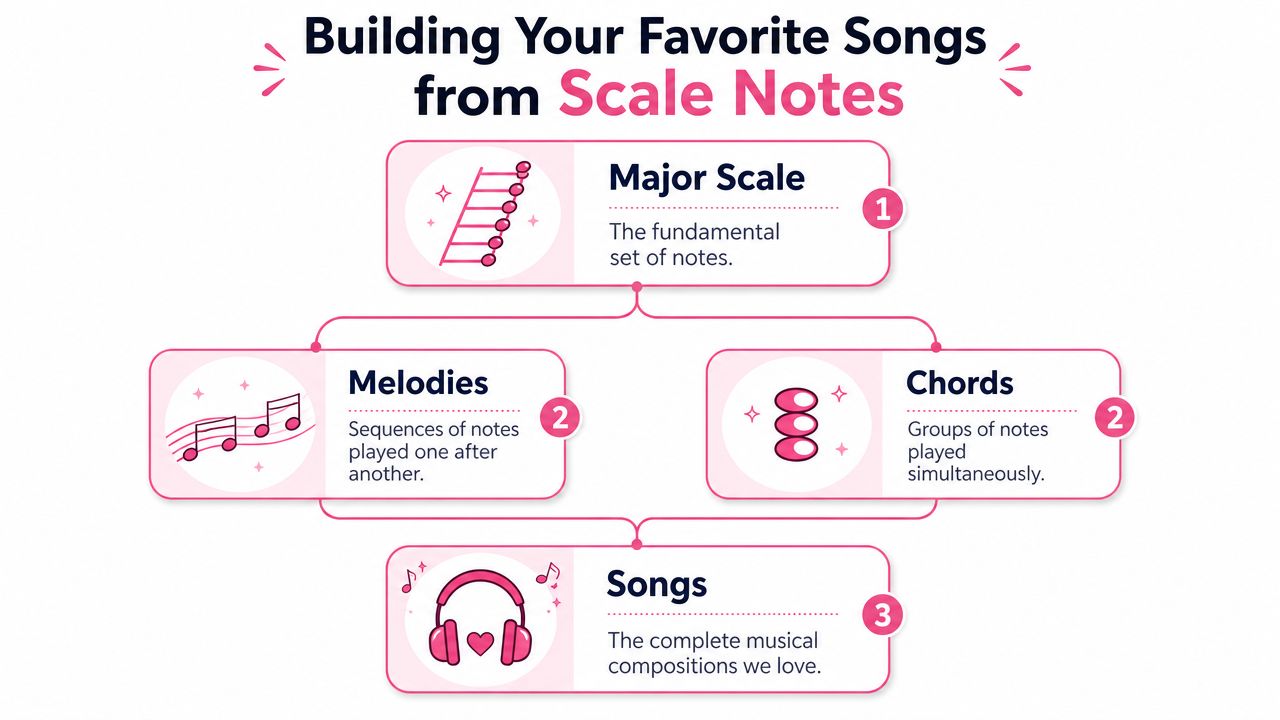
In tonal theory, each scale degree has a job. The major scale is often understood as two connected tetrachords, and the semitone between the 7th degree and the tonic creates a strong pull toward resolution, while the 3rd degree helps define the major quality, as described in this major scale lesson from the University of Puget Sound.
The home chord comes from the scale
Take C major:
C, D, E, F, G, A, B
If you stack the 1st, 3rd, and 5th notes, you get:
C, E, G
That’s a C major chord. It sounds like home because it comes straight from the key’s note family.
Other common chords live in the same family
Stay inside those same notes and build from other starting points:
- F, A, C gives you F major
- G, B, D gives you G major
Those chords are often called the I, IV, and V chords in a major key. Even if you don’t use the Roman numerals yet, your ear has probably heard this relationship many times.
A chord progression often sounds natural because the chords share the same pool of scale notes.
Why this matters for ear training
When you hear a song move away from home and come back, your ear is tracking function, not just pitch names.
That helps with real musical tasks:
- Chord recognition: You start noticing which chord feels settled and which one creates motion.
- Improvisation: You can choose notes that match the harmony instead of wandering.
- Melody learning: You can test likely notes from the key before trying random ones.
Major scale notes evolve from classroom theory into practical hearing tools. A singer can use them to stay oriented in a key. A guitarist can use them to improvise without leaning only on shapes. A producer can use them to hear why a topline works over a progression.
If your goal is to play by ear, this is the shift. You stop hearing isolated notes and start hearing relationships inside one musical home.
Stop Memorizing Start Hearing the Music
Most musicians don’t need more note lists. They need stronger listening habits.
One of the biggest problems in learning major scale notes is that knowing them on paper doesn’t guarantee you can hear or use them. Many lessons stop at note names and never connect them to tonic, dominant, and leading-tone function, which is exactly what ear training needs, as explained in this Open Music Theory discussion of major scales.

If you’ve ever said, “I know the scale, but I still can’t pick out songs,” that’s the gap. You learned information, but your ear didn’t get enough reps turning sound into action.
Sing before you search
Before you touch your instrument, sing the scale.
Use syllables if they help. Do, re, mi works well because it keeps your focus on sound function instead of letter names. Then stop on one note and ask yourself how it feels.
Does it sound finished? Does it sound suspended? Does it want to rise or fall?
Try this simple routine for 10 minutes a day:
- Sing the scale up and down: Keep the tonic steady in your mind.
- Pause on random degrees: Notice which notes feel stable and which feel tense.
- Return to home: Sing back to the tonic and hear the release.
If you can sing a scale degree and feel where it wants to go, you’re building the skill that supports improvisation and chord recognition.
Train the distance between notes
A lot of ear training starts with intervals for a reason. If your ear can hear the difference between a whole step and a half step, the major scale stops being a formula and starts becoming a sound shape you recognize.
Here are a few drills that work:
- Play two nearby notes. Ask whether they’re a half step or whole step apart.
- Sing one note, then another. Check yourself on your instrument.
- Play a major scale slowly. Listen for where the close spaces happen.
- Start melodies on different scale degrees. Hear how each one changes the mood.
This kind of work is much more useful than racing up and down finger patterns. It teaches you to hear before you react.
Use tools that give sound first
Some musicians do this with a piano, some with a teacher, and some with an app. What matters is that the training starts from listening, not guessing visually.
One option is Trill: Ear Training Daily, which focuses on short ear training sessions for intervals, chords, notes, and scales. Used consistently, a system like that can support daily listening practice instead of turning theory into a once-a-week reading task.
This video is a helpful companion if you want to hear the concept in action:

A lot of people chase perfect pitch because it sounds like the shortcut. For most learners, it isn’t. Relative hearing is what helps you recognize the note’s role inside the key, and that’s what lets you learn songs, hear progressions, and improvise with confidence.
The goal isn’t to name random pitches in isolation. The goal is to hear where you are in the music.
Your Daily Path to Musical Freedom
Learning major scale notes starts with a pattern, but it only becomes useful when your ear joins in.
You hear more when you practice hearing the tonic. You play more confidently when you notice how melodies lean on scale degrees. You improvise better when chords stop feeling random and start sounding like members of the same family.
That’s why short daily work beats occasional cramming. 10 minutes a day spent singing, listening, checking intervals, and finding notes by ear will do more for your musicianship than passive theory review. The habit matters because your ear improves through repetition.
A simple daily routine can look like this:
- Start with the tonic: Play or sing home, then hold that sound in your mind.
- Run one major scale slowly: Don’t rush. Hear every step.
- Test a melody fragment: Pick out a simple tune without looking up notes.
- Check one chord family: Hear home, away, and return.
If you want more structure around that habit, this guide on music theory scales and ear training connects scale study to practical listening work.
The payoff is musical freedom. You recognize chords faster. You hear melodies more clearly. You stop relying on charts for every move. And little by little, you stop guessing and start playing by ear.
Start your daily training with Trill: Ear Training Daily if you want a simple way to practice ear training in short sessions. The goal isn’t to collect more theory facts. It’s to build the listening skills that help you recognize chords, hear scale movement, and play by ear with more confidence every day.