
What Is the Pitch of a Sound: Your Guide to Music Theory
You hear a note on a piano, a singer holds a melody, or a guitar string rings out, and you know it sounds either higher or lower than another sound. That basic experience is pitch.
If you’ve ever tried to play a song by ear and felt stuck, this is usually where the confusion begins. You can hear that one note is different from another, but you can’t quite tell what that difference means, how to name it, or how to find it on your instrument.
You’re not missing some inborn gift. You’re missing a clear mental model and a repeatable way to train your ear.
That’s what this guide is for. You’ll learn what the pitch of a sound is, why people mix it up with loudness, how pitch turns into notes and intervals, and how to train yourself to hear it in real music so you can stop guessing and start to play by ear.
Table of Contents
- Why Hearing Pitch Is Your Musical Superpower
- What Is Pitch From a Physical Standpoint
- Pitch Loudness and Timbre Explained
- How Pitch Becomes Music Notes and Intervals
- A Daily Workout to Train Your Ear for Pitch
- Stop Guessing Start Hearing Your Music
Why Hearing Pitch Is Your Musical Superpower
A lot of musicians ask some version of the same question. “Why can’t I just hear a melody and find it?” The short answer is that playing by ear starts with hearing pitch clearly.
Pitch is what lets you notice that one note sits above another, that your voice matched the note or missed it, and that the melody moved up, down, or stayed put. Without that skill, music feels blurry. With it, songs start to make sense.
Why this matters when you play by ear
When you play by ear, you’re not guessing randomly. You’re listening for relationships between sounds.
That means hearing things like:
- Melody direction: Did the note go up or down?
- Same note recognition: Did the singer repeat the pitch?
- Interval shape: Was that jump small and smooth or wide and dramatic?
- Pitch matching: Can you sing or play back the note you just heard?
Those are trainable ear training skills. They aren’t reserved for people with perfect pitch.
If you’ve ever wondered about the difference between hearing notes by reference versus naming them instantly, this guide on relative pitch and absolute pitch helps clarify the distinction. For most musicians, relative pitch is the skill that creates musical freedom.
Practical rule: You don’t need perfect pitch to play by ear well. You need to hear note relationships accurately and consistently.
The frustration most beginners feel
Many players think their ear is “bad” because they can’t immediately name notes. But naming notes is only one small part of musicianship.
A stronger goal is this: hear a sound, compare it to another sound, and respond on your instrument. That’s how you recognize melodies, catch wrong notes faster, sing in tune, and improvise with more confidence.
Here’s the shift that helps:
| Old mindset | Better mindset |
|---|---|
| “I’m trying to guess the note” | “I’m trying to hear where the note moved” |
| “Good ears are a talent” | “Good ears are built through repetition” |
| “I need perfect pitch” | “I need reliable relative pitch” |
When you understand what is the pitch of a sound, music stops feeling like a code you were never taught. It starts feeling learnable.
And once your ear begins to lock onto pitch, a lot opens up fast. Chord recognition gets easier. Improvisation gets less scary. Singing and tuning improve. You stop hunting and start hearing.
What Is Pitch From a Physical Standpoint
You press one piano key and then the key to its right. The second note sounds higher right away, even if you do not know either note name. Your ear is already tracking pitch.
At the physical level, that difference starts with vibration. A sound source moves, the air pressure changes in a repeating pattern, and your ears receive those changes. Pitch is your hearing system’s way of organizing that pattern as high or low.
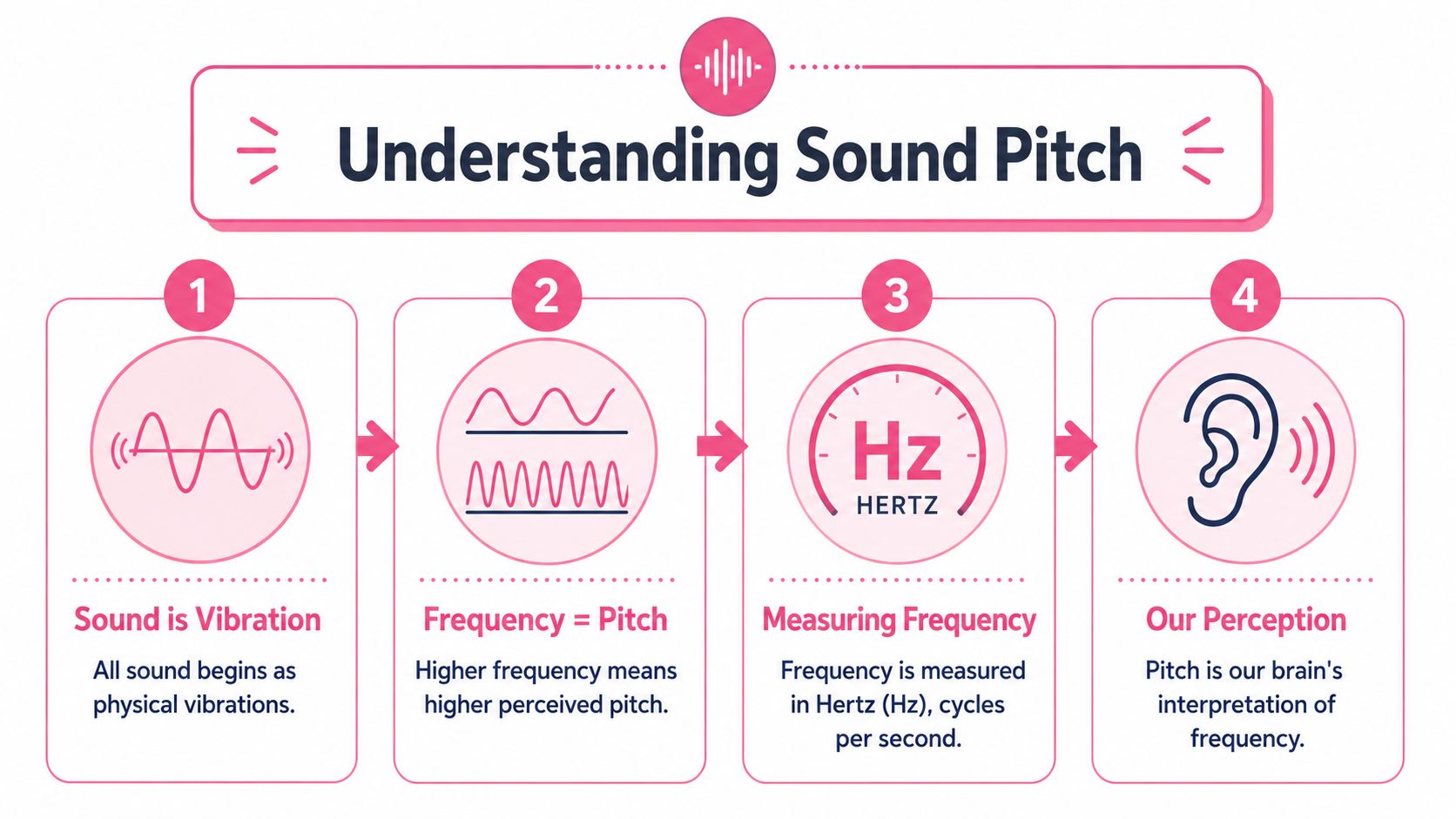
A guitar string makes this easier to feel. A long, loose string swings back and forth more slowly, so you hear a lower note. A shorter or tighter string swings faster, so you hear a higher note.
The same pattern shows up across instruments. Shorter air columns on a flute produce higher notes. Shorter strings on a violin produce higher notes. On a piano, the higher keys connect to strings designed to vibrate faster.
Musicians measure vibration rate in hertz, written as Hz. One hertz means one cycle per second. If a sound vibrates at 440 Hz, it completes 440 cycles each second. If another sound vibrates at 110 Hz, it completes fewer cycles in the same time, so it is heard as lower.
That is the physics part. Your musical ear uses that physical difference in a practical way. It notices direction, distance, and stability. Did the note go up or down? Did it move a little or a lot? Does it match the note you meant to sing or play?
That is where many beginners get stuck. They hear a definition like “pitch equals frequency,” understand it for a moment, and still feel lost at their instrument. The missing piece is that musicians do not perform with numbers in their heads. They perform with comparisons.
So it helps to hold two ideas at once:
- Physical layer: sound vibrates at a certain rate
- Listening layer: your ear hears that rate as a note being higher or lower than another note
Those two layers connect every time you play. Move up the keyboard and frequency rises. Shorten a string on a fretboard and frequency rises. If you want to see how note names line up with exact frequency values, this guide to tuning instruments and frequencies makes that connection clear.
A simple anchor can help here. More vibrations per second means a higher-sounding note.
Human hearing covers a wide range of frequencies, from very low to very high. But in music, the useful question is usually much simpler than the physics textbook version. Can you hear whether one note is above, below, or matching another? That is the skill you build when you train pitch, and that is the skill that starts to give you freedom on your instrument.
Pitch Loudness and Timbre Explained
A loud note is not automatically a high note.
That mix-up causes a lot of trouble in ear training because beginners often react to the most obvious part of the sound. If one note feels stronger, brighter, or more intense, they may assume the pitch changed. Sometimes it didn’t.
Three different things you hear at once
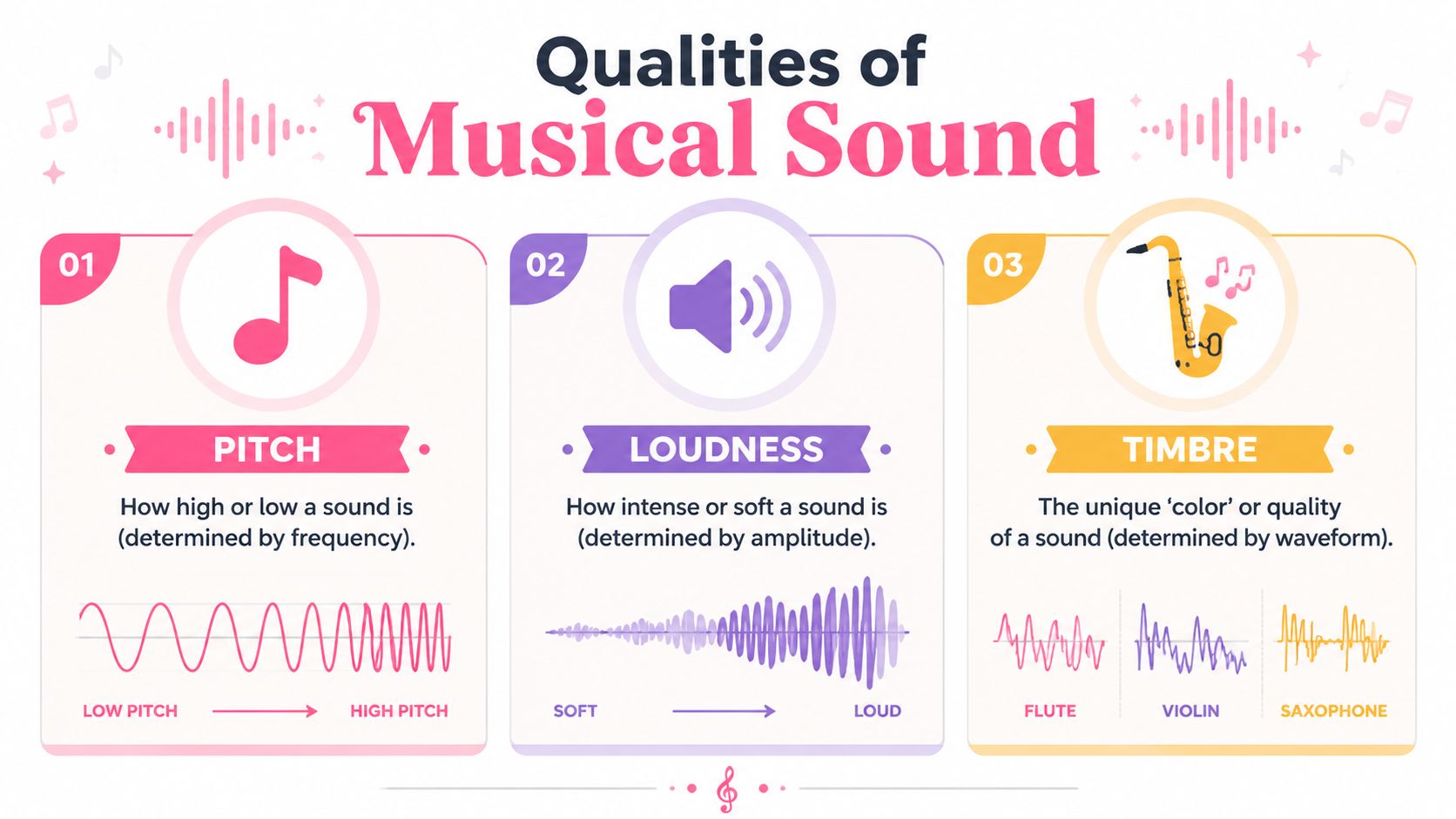
When you hear one musical sound, you’re usually hearing at least these three qualities together:
| Sound quality | What you notice | What it relates to |
|---|---|---|
| Pitch | How high or low it sounds | Frequency |
| Loudness | How soft or strong it sounds | Amplitude |
| Timbre | The color or character of the sound | Waveform and overtones |
Pitch is the perceptual correlate of frequency. Higher-frequency vibrations are heard as higher pitch, and lower-frequency vibrations are heard as lower pitch. But pitch itself is a subjective auditory attribute, not a directly measurable physical quantity, as described in this overview of pitch in music).
That last part matters. The frequency can be measured. Pitch is how a person hears it.
One note, different sound
A flute and a guitar can play the same note. If the pitch matches, the note height is the same. But they still sound different.
That difference is timbre.
Timbre is why your friend’s voice sounds different from yours, even when you sing the same note. It’s why a piano melody has a different color than the same melody on saxophone. Your ear has to learn to hear past the sound color and notice the pitch underneath it.
If you’re trying to play by ear, don’t ask only “What instrument is that?” Ask “Is the note itself going up, down, or staying the same?”
The most common listening mistakes
Here are the traps beginners fall into:
- Mistaking loudness for pitch: A stronger note can feel “higher” emotionally even when the pitch stayed the same.
- Mistaking timbre for pitch: A brighter instrument can seem higher because of its tone color.
- Listening with your eyes: On an instrument, you may assume a note should sound a certain way before you really hear it.
A good correction is to strip the task down. Listen to two notes and ask only one question first. Which one is higher?
Then ask a second question. Did the sound also get louder, or did only the pitch change?
Why this matters for ear training
When you train your ear, you’re training attention. You’re learning which part of the sound to focus on.
For pitch work, that means hearing through distractions:
- volume changes
- instrument color
- recording quality
- vocal tone
This is one reason ear training sometimes feels slow at first. Your brain is sorting layers of sound that used to arrive as one messy bundle. Once those layers separate, your musical hearing gets much clearer.
How Pitch Becomes Music Notes and Intervals
Music takes the raw experience of higher and lower sounds and organizes it into a system. That system gives us notes, scales, melodies, and intervals.
For musicians, pitch then becomes usable.
Notes are named pitch points
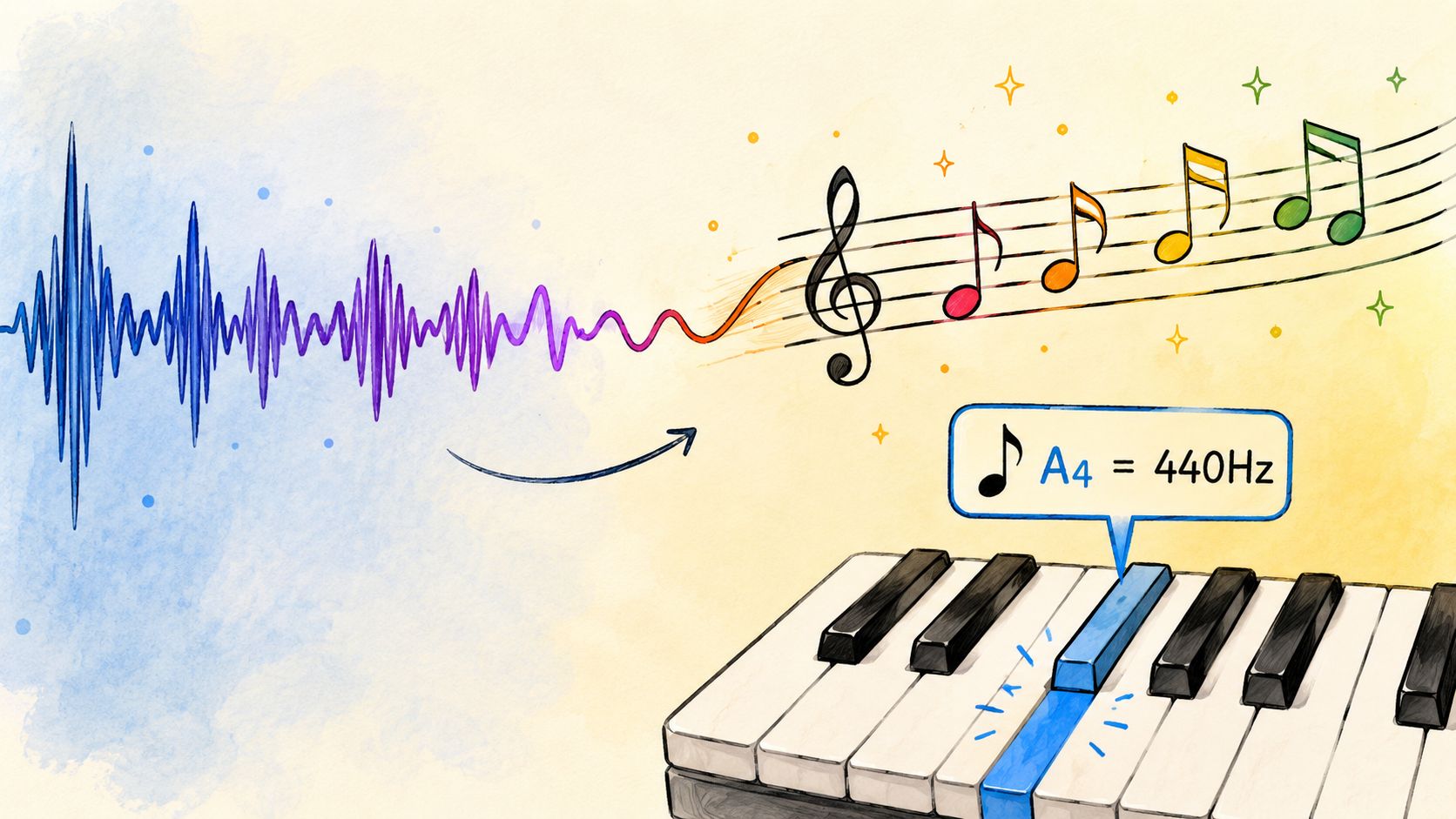
On a piano, each key gives you a different pitch. We name those pitches with note names like A, B, C, and so on.
A widely used benchmark is A4 = 440 Hz, which means that note corresponds to 440 cycles per second. In that same explanation, amplitude is separated from pitch, because amplitude affects loudness rather than note height, as shown in this University of Connecticut physics note on frequency and sound.
That standard matters because it helps instruments tune to the same musical map.
Intervals are what your ear actually uses
When you play by ear, you usually aren’t hearing isolated note labels first. You’re hearing the distance between notes.
That distance is called an interval.
If one note moves to another note nearby, that feels different from a leap across a larger space. Your ear can learn those shapes. That’s one of the most important skills in ear training.
Try thinking of intervals as movement patterns:
- Repeated note: no movement
- Step: a small move
- Leap: a bigger jump
- Octave: same note name, heard higher or lower
This is why relative pitch matters so much. Relative pitch is the ability to hear how notes relate to one another. That skill helps you recognize melodies, figure out bass movement, catch chord tones, and improvise more musically.
Listening cue: Most real-world playing by ear starts with interval hearing, not with naming random isolated notes.
Perfect pitch versus useful pitch
A lot of beginners get distracted by the idea of perfect pitch. It sounds like the ultimate musical superpower.
But for most working musicians, the practical goal is not instant note naming without reference. The practical goal is hearing relationships well enough to respond musically.
That means being able to:
- sing back a starting note
- hear whether the next note went up or down
- recognize familiar interval shapes
- find those notes on your instrument
Here’s the truth that helps many students relax:
| Skill | What it means in practice |
|---|---|
| Absolute or perfect pitch | Naming a pitch without any reference |
| Relative pitch | Hearing one pitch in relation to another |
Relative pitch is the skill that turns listening into action. It’s the skill behind playing melodies by ear, hearing chord roots, and recovering quickly when you miss a note.
So when people ask what is the pitch of a sound, the musician’s follow-up question should be this. “Can I hear where that pitch sits compared to the one before it?” That’s the question that changes your playing.
A Daily Workout to Train Your Ear for Pitch
Understanding pitch on paper is useful. Hearing it in real time is a different skill.
That second skill comes from repetition. Not endless repetition. Focused repetition.
If you train for 10 minutes a day, your ear starts building the habit of noticing pitch before your fingers start guessing.

Start with the smallest possible task
Most players make ear training too hard too fast. They jump straight into chord progressions or try to identify every note name instantly.
Start smaller.
Use this sequence:
-
Higher or lower drills
Play two notes. Ask only which one is higher. Don’t name them yet. -
Same or different drills
Play two notes again. Ask whether they matched or changed. -
Pitch matching
Play one note, then sing it or hum it back. After that, find it on your instrument.
Those drills build the foundation for stronger relative pitch. They also help if singing in tune feels difficult, because they connect hearing and producing sound.
A simple daily routine
Try this for a short daily practice block:
- First few minutes: Listen to pairs of notes and identify higher or lower
- Next few minutes: Match single notes with your voice
- Last few minutes: Find those notes on piano, guitar, or your main instrument
If you want more structure, these ear training exercises for daily practice give you more ways to build the habit.
You can do this with a piano, a tuner, a teacher, recorded note exercises, or an app. Trill: Ear Training Daily is one option designed for short daily sessions focused on note, interval, and chord recognition, plus pitch-matching work and practice tools for musicians.
Use your voice even if you’re not a singer
Your voice is the fastest bridge between hearing and playing. You don’t need to sound polished. You need to match.
When you sing a note back, even softly, you force your ear and body to cooperate. That makes pitch less abstract.
A helpful demonstration of pitch matching and listening practice is below.
What to listen for while you practice
Don’t judge yourself by how fast you get everything right. Judge yourself by whether you’re listening more precisely than before.
Pay attention to these signs of progress:
- You notice mistakes sooner: Wrong notes stand out faster.
- You correct yourself mid-phrase: Your ear catches drift before the phrase ends.
- Melodies feel less random: You begin to hear shape, not isolated sounds.
- Your hands search less: You move toward notes with more intention.
Some days your ear will feel sharp. Some days it won’t. Daily practice matters more than having a “good ear day.”
That’s how ear training works in real life. Small sessions. Clear tasks. Consistent repetition. Over time, pitch stops being a theory word and becomes something you can hear, match, and use.
Stop Guessing Start Hearing Your Music
You play a note, pause, and wonder, “Was that right?” Then you try another. And another. For many musicians, that is what weak pitch awareness feels like. Playing turns into guessing, checking, and hoping.
Pitch is the skill that changes that experience. Yes, it means hearing a sound as high or low. But for a musician, the useful question is simpler: can you recognize what you are hearing quickly enough to respond to it? That ability shows up everywhere, from singing in tune to finding a melody on your instrument to noticing that one note in a chord does not belong.
Music happens in real time, presenting a challenge for your fingers if your ear cannot identify where the sound is going. But when your ear starts catching pitch more clearly, your instrument feels less like a puzzle and more like a voice. You begin to hear direction. Up. Down. Same note. Small change. Bigger jump. Those are the early signs that your ear is organizing sound instead of reacting to it.
If ear training has felt frustrating, treat that as a training problem, not a talent verdict. A strong ear is built the same way steady rhythm, clean technique, and better timing are built. Through short, repeated practice that teaches your brain what to listen for and gives your hands a sound to aim at.
Keep the target small. Hear one thing more accurately today than you heard yesterday.
That is how musicians stop depending on tabs, charts, and trial-and-error as their only safety net. They still use those tools, but they are no longer trapped without them. They can hear a melody rise and follow it. They can catch an out-of-tune note sooner. They can recognize a familiar interval shape before their fingers start searching. Less guessing and more hearing is what creates real control, and if you want a simple daily system for building that skill, Trill: Ear Training Daily gives musicians short practice sessions for note recognition, intervals, chords, pitch matching, and play-by-ear work that fit into regular practice.



