Best Apps for Interval Training in 2026
You downloaded one of the many apps for interval training, opened it, and immediately hit a weird problem. It’s talking about sprints, rest timers, and workout phases. But you’re not trying to shave time off a run. You’re trying to hear two notes and know what they are doing.
That confusion is common. In fitness, interval training means alternating effort and recovery. In music, interval training means learning the sound-distance between notes so you can recognize melodies, chords, and progressions by ear. Same phrase. Completely different job.
If you’ve ever heard a song and wished you could sit down at your instrument and find it without hunting note by note, this is the skill you’re looking for. And the right app can turn that from a vague goal into a daily habit you can stick with.
Table of Contents
- What Is Interval Training for Musicians?
- Why Your Ear Needs a Digital Training Partner
- The Five Must-Have Features in an Ear Training App
- Your 10-Minute Daily Plan to Start Playing by Ear
- Common Pitfalls That Keep Musicians Guessing
- How to Choose Your Perfect Ear Training Partner
What Is Interval Training for Musicians?
A musical interval is the distance between two notes.
If one note goes to another and you can hear whether that move feels small, wide, bright, tense, stable, or unresolved, you’re already starting to hear intervals. You don’t need to begin with heavy theory language. You need to begin with sound.
For musicians, interval training means learning to recognize those note distances by ear. Not by counting keys. Not by staring at notation. By hearing them clearly enough that your hands or voice can respond. If you want a simple foundation, this guide to musical intervals is a useful starting point.
Hearing instead of guessing
A lot of players think they’re bad at ear training because they can’t name an interval on command. That’s not the actual test. The actual test is more practical.
Can you hear that the second note jumped farther than you expected?
Can you tell that one chord tone changed the mood?
Can you sing back a note that feels like home versus one that wants to move?
Those are the beginnings of playing by ear.
Practical rule: Don’t treat interval training as a theory quiz. Treat it as listening practice that helps you find notes faster in real music.
Why this skill changes everything
When your ear improves, several musical doors open at once:
- You catch melodies faster because note movement stops feeling random.
- You recognize chord color sooner because inner note relationships become familiar.
- You improvise with more confidence because you’re hearing possibilities, not throwing guesses.
- You rely less on tabs and charts because your ear starts guiding your choices.
That’s why interval training matters so much. It sits underneath chord recognition, melodic transcription, harmony, improvisation, and even the long-term dream many players have of building stronger pitch memory or working toward perfect pitch skills.
You don’t need talent for this. You need repetition. A few focused minutes a day teaches your brain to hear patterns that used to blur together.
Why Your Ear Needs a Digital Training Partner
Old-school ear training often looks noble but works badly in practice. You play two notes on a piano, pause, think too long, second-guess yourself, then move on without knowing whether you heard the sound or just remembered the answer.
That’s not training. That’s drift.
A good app gives your ear structure. That matters because interval apps in other fields became useful when they moved beyond a single countdown and into structured phase timing, with clear sequences and cues rather than one vague timer, as seen in timer apps that let users set full sessions with high and low phases and run them in the foreground, background, or even with the device locked via this Google Play listing for an interval timer app. For musicians, the lesson is simple. Structured sessions beat random attempts.
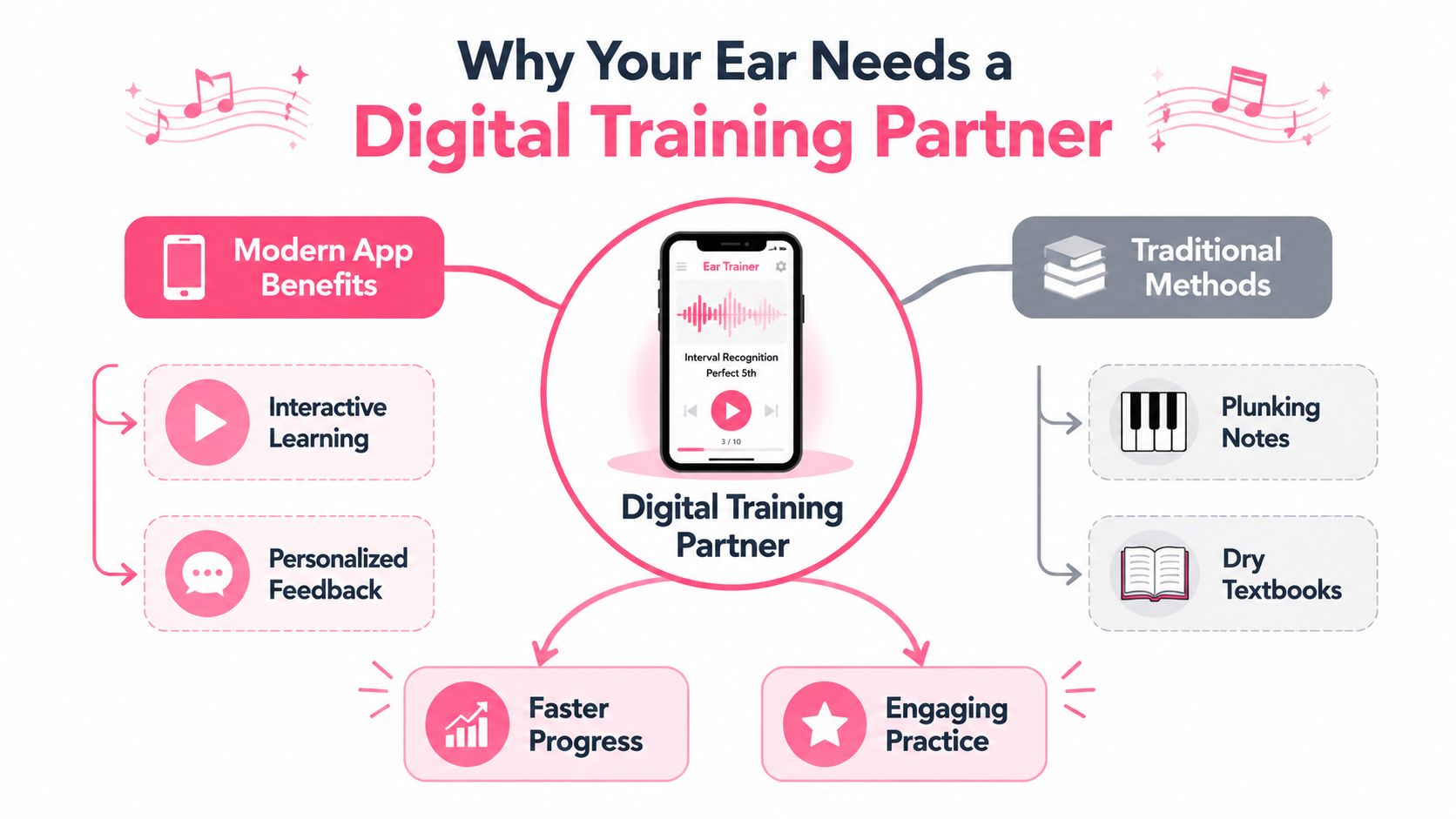
Your ear learns best with short cycles
Think of your ear like timing in rhythm practice. If the repetitions are clear and regular, improvement starts to stick. If practice is inconsistent and messy, your brain gets mixed signals.
An app creates tight learning loops:
- Hear a sound
- Choose an answer
- Get corrected immediately
- Hear it again
- Repeat tomorrow
That loop is why app-based ear training feels more like a daily system and less like a classroom chore.
Feedback beats self-deception
When you practice alone, it’s easy to accept a fuzzy answer. “I was close” becomes your default. But hearing music clearly isn’t about being close. It’s about building trustworthy recognition.
Independent running guidance notes that audio or vibration cues help users stay focused without staring at the screen, and that real-time metrics make transitions more precise in interval work, according to this runner guide to interval training apps. In ear training, the musical version of that principle is instant response and clear correction. Your ear needs fast signals so it can connect sound to meaning.
A digital training partner doesn’t replace musicianship. It makes repeatable listening possible.
The habit side matters more than people admit
Most musicians don’t fail because interval training is too hard. They fail because they don’t return to it often enough. A phone app lives where your distractions live, but it also lives where your habit can live.
That’s why the best apps for interval training in music should feel lightweight. Open, train, finish. Ten minutes is enough if you do it consistently. Small daily efforts lead to big musical breakthroughs because the ear changes through accumulation, not through one heroic weekend session.
The Five Must-Have Features in an Ear Training App
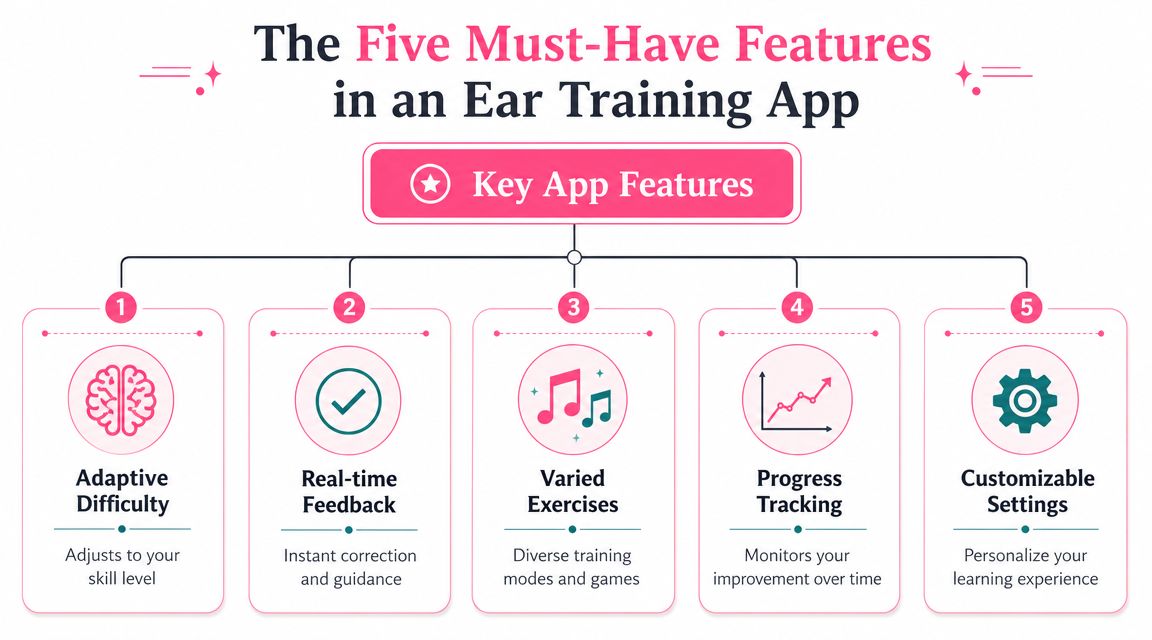
Not every app that says “ear training” will help you play by ear. Some are basically flashcards with beeps. Some bury the useful exercises under clutter. Some make you better at passing the app, not better at hearing music.
Here’s the checklist that matters.
Real sound beats sterile sound
If an app only trains you on thin synthetic tones, your ear may improve inside the exercise but struggle in real songs. Music in the wild is messy. Instruments have tone, attack, resonance, and context.
That’s why real audio matters. It trains the ear you use when singing, jamming, transcribing, or writing. If you want to compare interval shapes visually while you practice, tools like the Trill interval visualizer can support the listening work, but the listening still has to lead.
A quick comparison helps:
| Training style | What it helps with | What it misses |
|---|---|---|
| Synthetic single tones | Basic contrast between intervals | Real musical texture |
| Real instrument audio | Transfer to songs and live playing | Less “clean,” but more useful |
| Mixed approach | Controlled drills plus realism | Best when the app balances both |
Control matters when your ear has weak spots
Most learners have a few intervals that blur together. Minor 3rds and Major 3rds. Perfect 4ths and Perfect 5ths. Sixths that feel vague. If the app forces the same fixed sequence on everyone, progress slows down.
Look for customization such as:
- Interval selection so you can isolate two or three sounds at a time.
- Exercise mode choices so you can train melodic, harmonic, or contextual listening.
- Difficulty control so you’re stretched, not flooded.
That’s how you stop practicing what you already know and start fixing what’s in your way.
Feedback turns practice into learning
A good ear training app tells you quickly whether you heard correctly. It doesn’t leave you floating.
This matters for a simple reason. Repetition helps only when the repetition is accurate. If you keep labeling the wrong sound with the wrong name, you build confusion faster.
A useful app should catch the mistake before it becomes a habit.
Scoring can help too, but only if it supports learning. The point isn’t collecting stars. The point is making your ear more reliable when a bandmate calls out a progression or when you try to lift a melody off a recording.
Tracking keeps small effort alive
Most musical growth feels invisible day to day. That’s why progress tracking matters. Not because charts are magical, but because visible progress keeps you coming back.
Look for signs like streaks, review history, saved weak areas, or level progression. These features don’t create musicianship on their own. They support consistency, and consistency is what trains the ear.
A short list of outcomes matters more than a giant list of features:
- Daily return means your ear stays warm.
- Weak-area review means confusion gets targeted.
- Visible progress means motivation doesn’t depend on mood.
Tempo and instrument control make skills transferable
Musicians learn at different speeds, and different sounds click for different people. A singer may want a vocal tone. A guitarist may hear things better on guitar. A pianist may prefer clean keyboard attacks at first.
When an app lets you slow exercises down, change instruments, or adjust presentation, it becomes more personal and more practical. That makes it easier to connect theory to hearing instead of keeping theory abstract.
The best apps for interval training don’t just ask, “Can you name this?” They help you answer a better question. Can you hear this clearly enough to use it in real music?
Your 10-Minute Daily Plan to Start Playing by Ear
You don’t need an hour. You need a routine simple enough that you’ll still do it on a tired Tuesday.
This plan is built around 10 minutes a day. Keep it short. Keep it focused. Keep it daily.
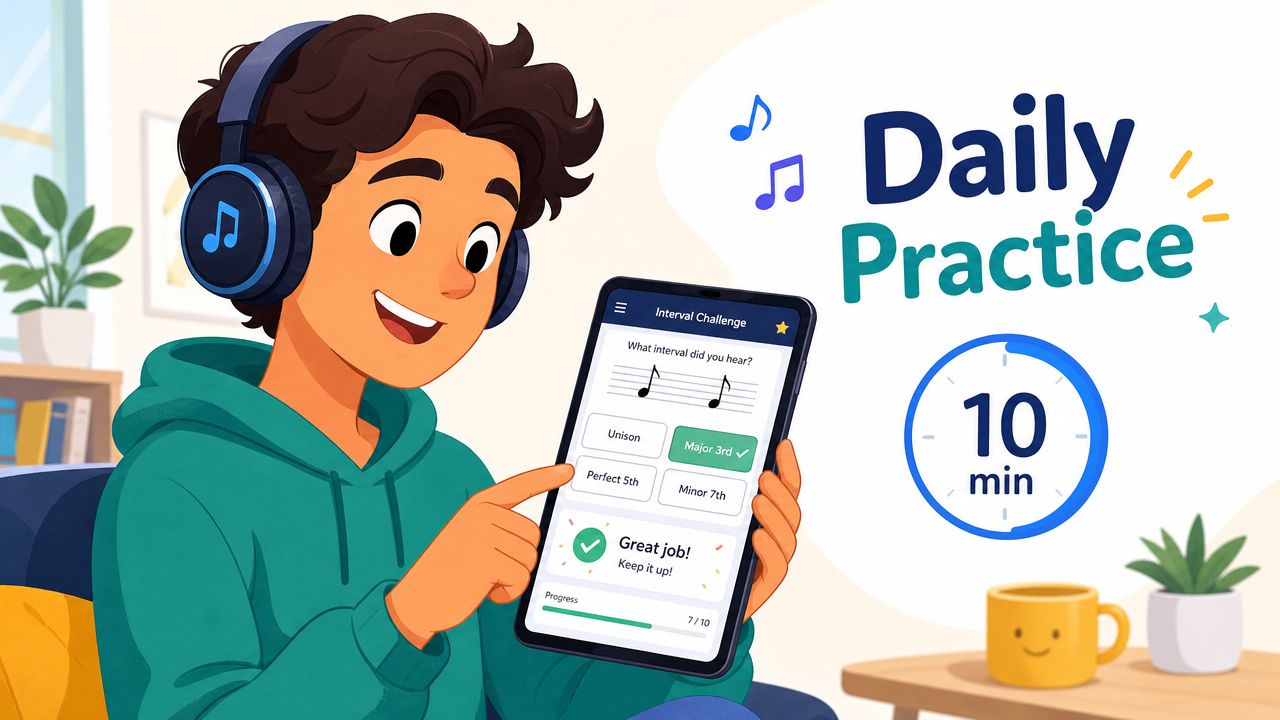
Week one with just a few core sounds
Start with a small set. Don’t train every interval at once.
Minutes 1 to 2
Listen to one interval category only. For example, Major 3rd. Hear several examples. Sing them back if you can.
Minutes 3 to 4
Contrast Major 3rd and Minor 3rd. Don’t count semitones. Ask what each one feels like. One may sound more open or bright to you. The other may sound more inward or darker.
Minutes 5 to 6
Add Perfect 5th. This interval often feels stable and familiar. Many beginners grab it more quickly than they expect.
Minutes 7 to 8
Do a short quiz using only those three intervals. Limit the pool so your brain starts sorting clearly.
Minutes 9 to 10
Apply it to music. Play a simple chord or melody fragment and ask yourself what you hear. If a melody jumps in a way that resembles a 5th, notice that sound before you touch your instrument.
A few practical anchors:
- Major 3rd often helps you hear the brighter quality in a major chord.
- Minor 3rd helps you hear the darker shift inside a minor chord.
- Perfect 5th helps with stable melodic leaps and chord roots.
Sing before you answer when possible. Your voice exposes whether you heard the interval or only recognized the label.
Week two adds range without overload
Keep the first week’s intervals in rotation, then add two more.
Try Perfect 4th and Major 6th.
The goal isn’t speed yet. The goal is contrast. Can you hear that a 4th has a different pull than a 5th? Can you hear that a 6th feels wider than a 3rd, even when both sound warm or melodic?
Here’s a clean daily shape for week two:
- Warm up with review of the earlier intervals.
- Introduce one new sound and hear several examples.
- Mix old and new intervals in short quizzes.
- Play back what you hear on your instrument.
- End with one real musical moment, like a melody fragment from a song you know.
Keep notes if it helps. Not pages of notes. Just one line such as, “Today I kept confusing 4th and 5th.” That kind of awareness sharpens tomorrow’s practice.
If you stay with this for two weeks, you won’t have mastered ear training. But you will have done something more important. You’ll have started trusting that hearing is trainable.
Common Pitfalls That Keep Musicians Guessing
Many musicians say they’re doing ear training when they are, in fact, doing survival tactics. The answers may look right sometimes, but the ear isn’t getting stronger.
Counting is not hearing
The biggest trap is counting note distances like math homework. You hear two notes, then mentally climb key by key until you land on a label. That may help on paper. It won’t help much in live music.
Real playing by ear happens too quickly for that. You need the sound quality to become familiar on contact.
Try this instead:
- Use contrast pairs like Minor 3rd versus Major 3rd.
- Repeat the same pair for several days instead of changing constantly.
- Sing each interval so the sound lives in your body, not just in your head.
One direction is not enough
Some learners only practice ascending intervals. They know the sound going up, then freeze when the same interval appears descending or stacked harmonically.
Music doesn’t ask your permission before changing format.
A stronger routine includes:
| Interval practice type | What it trains |
|---|---|
| Ascending melodic | Hearing upward motion |
| Descending melodic | Recognizing return and drop |
| Harmonic | Hearing notes at the same time |
If your app only gives one direction, your recognition may stay narrow.
Random practice breaks trust in your ear
Another problem is inconsistency. One long session on Sunday, then nothing for days. Your ear never gets enough regular contact to stabilize the sounds.
Short practice works better because it keeps yesterday’s sound memory alive. That’s one reason digital training systems are useful. They make repetition easier to revisit than old methods. Interval apps became mainstream consumer tools by the mid-2010s, with flexible timing, presets like Tabata, and broad use across running, HIIT, boxing, yoga, and breathing work, as described in this overview of mainstream interval training apps. The musical parallel is clear. Flexible tools spread when they support many real habits, not one narrow task.
If you only train when you feel motivated, you’ll keep testing your ear instead of developing it.
How to Choose Your Perfect Ear Training Partner
A useful app should fit your musical life, not just look polished in the app store. The right choice makes you more attentive, more consistent, and more capable of hearing music without guessing.
There’s also a practical angle many people overlook. In the wider interval-app world, privacy, data ownership, syncing, and portability matter because users care what happens to their training history across devices and ecosystems. Intervals Pro, for example, emphasizes saving workout data to Apple Health and support across Apple devices in its App Store listing. For music learners, the lesson is similar. Don’t only ask what the app can do today. Ask how it fits your routine and whether you’ll keep using it.
A quick decision checklist
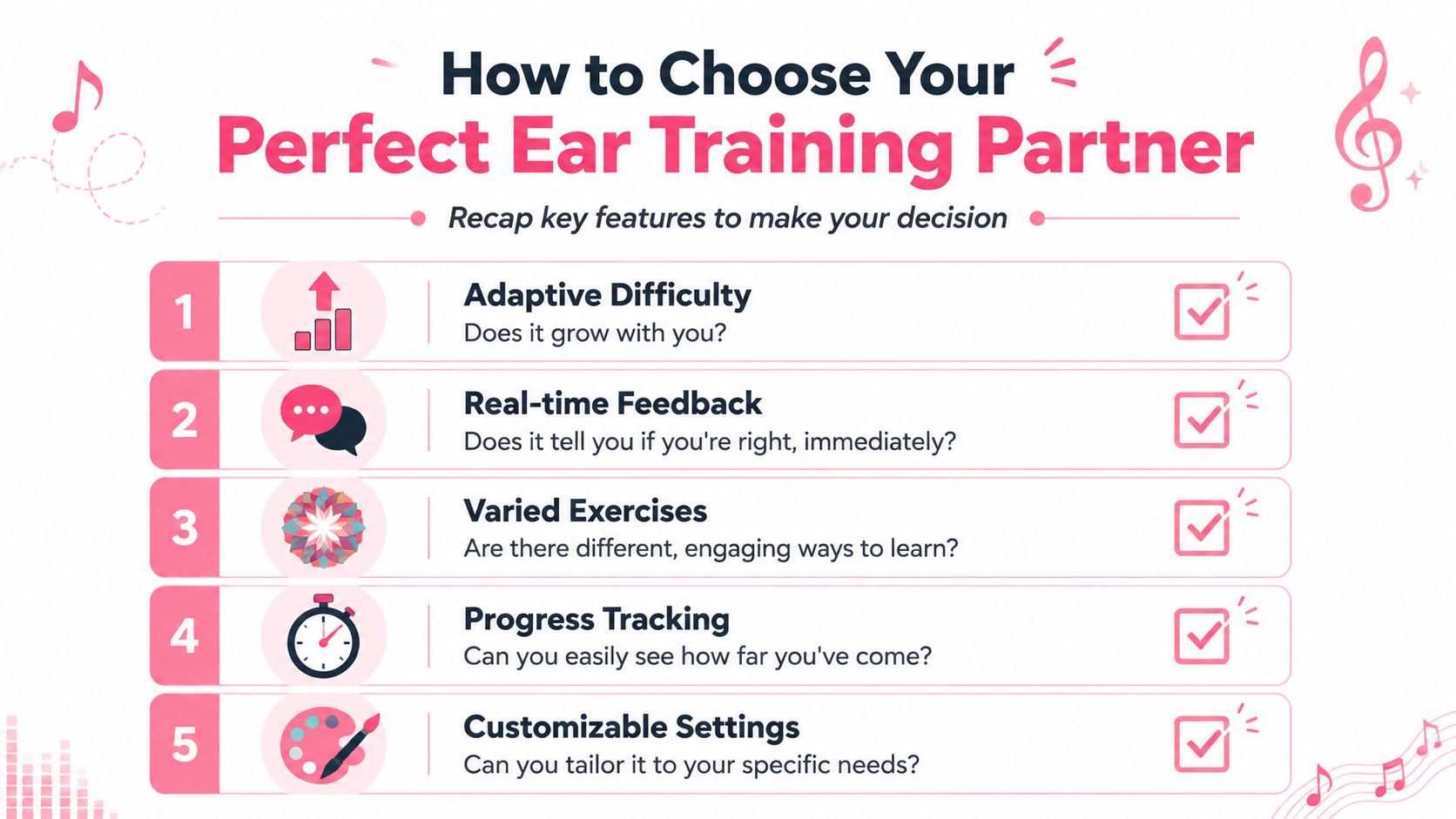
Use this when comparing apps:
- Does it train listening with real musical sound? If not, your results may stay trapped inside the app.
- Can you narrow the exercise set? You need to isolate weak intervals, not drown in all of them.
- Does it correct you immediately? Delayed feedback slows learning.
- Can you see your progress? Daily return matters more than novelty.
- Does it support your practice style? Instrument sound, speed, and exercise format should feel workable.
You can also compare options against a dedicated ear training app for daily practice if you want a reference point for what a daily system looks like.
One example of a daily system
One option in this category is Trill: Ear Training Daily. It focuses on short ear training sessions built around recognizing intervals, chords, notes, and scales using real audio. It also includes streaks, instant feedback, and a Focus Lock feature designed to reduce distraction during practice.
That matters if your real goal isn’t collecting theory terms. It’s being able to hear a progression, sing the next note, recognize chord quality faster, and play by ear with more freedom.
The strongest choice is usually the app you’ll keep opening tomorrow. And the day after that. And next week, when the novelty has worn off.
If you want a simple place to begin, Trill: Ear Training Daily is built around short, repeatable sessions that help musicians train their ear, recognize intervals and chords, and build the listening habits that support playing by ear. Start small, stay consistent, and let your ear learn the way musicianship actually grows.