Bass Guitar Ear Training: Play by Ear in 10 Minutes a Day
Can you hear a bass line in your head and then find it on the neck without a tab in front of you? Most bassists can’t, and the usual advice doesn’t help. It either treats a good ear as a gift you were born with, or it hands you a stack of theory to memorize before you’re allowed to play anything.
Neither is right. Hearing music is a skill, built the same way you built your finger strength, through short sessions that repeat. And the bass happens to be the best instrument for building it, because the low end carries two things at once: the harmony and the beat.
What follows is the working method. No perfect pitch, no guesswork, no abstract theory. Ten minutes a day, one bass, and a clear idea of what you’re listening for.
Table of Contents
- Why Bassists Can Train Their Ear Without Perfect Pitch
- Your 10-Minute Daily Ear Training Routine
- Hearing Bass Intervals by Their Sound
- How to Transcribe a Bass Line by Ear
- Hearing Chords and Progressions from the Low End
- Why Right Notes Can Still Sound Wrong
- Playing by Ear in a Jam and Improvisation
- Start Your First Week of Bass Ear Training
Why Bassists Can Train Their Ear Without Perfect Pitch
A student sits down with a song he loves, opens the tab, and plays it clean. Two weeks later the tab is gone and so is the song. He can’t find the first note. This isn’t a talent problem. It’s a missing link between the sound and his hands.
Ear training is that link, and it has nothing to do with guessing note names from thin air. It’s hearing relationships. Did the bass move up a fourth or a fifth? Did the chord turn darker when the singer hit the chorus? Was the note you played the root, or the fifth sitting above it? Those are hearable, learnable events, and they repeat across thousands of songs.
You don’t need perfect pitch. Berklee’s ear-training handbook states that learners don’t need perfect pitch or absolute pitch to begin. Its starting exercise is beautifully plain: play one reference note, call it Do, sing up and down the major scale from memory, then check your singing against the instrument.
Sing first. Check second. That order is the whole engine.
The loop that builds the ear: predict the sound, produce it with your voice, then verify it on the bass.
On bass, this pays off faster than on most instruments. The bass usually plays the root of each chord and it also marks the rhythm, so every low note tells you where the harmony sits and exactly when it changes. Learn to hear one bass line and you’ve learned both the chord and the groove.
The outcomes are concrete. You find a song’s bass line without tab. You name the root of a chord in a band rehearsal. You sit in on a jam with no chart and no panic. None of that comes from occasional marathon practice. It comes from ten focused minutes a day, which is what the rest of this routine builds.
Your 10-Minute Daily Ear Training Routine
Ten minutes, four blocks, bass in hand. Each block builds a different piece of the same skill, so the session stays short without becoming shallow.
| Block | Minutes | Task | Skill built |
|---|---|---|---|
| Root and octave orientation | 2 | Sing the home note, then find it on the E string and one octave higher | Tonal anchor |
| Randomized interval identification | 3 | Name intervals from random starting notes, then check each answer on the bass | Interval recognition |
| Two- to four-note bass-line reproduction | 3 | Copy a short pattern from a recording, sing it first, then play it | Transcription |
| Chord-function or progression check | 2 | Identify the root movement of a short loop, then test it on the bass | Harmonic hearing |
Root and octave orientation settles your ear on one home note before anything harder begins. Interval identification from random starts stops you memorizing a single position and forces you to hear distance. Bass-line reproduction is where the ear reaches into real music. Progression checks turn single notes into movement.
The target level matters as much as the clock. A published ear-training guide recommends 10 to 15 minutes a day and says short daily quizzes work best when accuracy sits around 80 percent. That’s hard enough to expose real mistakes, easy enough that you’re not throwing darts.
Three habits hold the routine together.
- Same time every day: the routine becomes automatic before motivation shows up.
- Bass in hand: every answer gets checked on the instrument, not just in your head.
- A timer: ten honest minutes beat an untimed hour that drifts into noodling.
If you’ve started and stopped before, you’re in the majority. In our onboarding survey of about 60,000 musicians, 78% said focus, consistency, structure or time is what blocks their progress. The routine answers that directly, because there’s nothing to plan each day.
A finished week looks unremarkable, which is the point. All four blocks, every day, seven short sessions you can keep. The proof arrives in the log: first-attempt accuracy climbing toward that 80 percent mark over several weeks. Not corrected accuracy after you’ve fished around. First attempt, before the fingers help.
Hearing Bass Intervals by Their Sound
Intervals are the steps a bass line walks on. Learn each one as a sound with a name attached, and the guessing stops.
| Interval | Half steps | Song cue to memorize |
|---|---|---|
| Minor 2nd | 1 | Opening of the Jaws theme |
| Major 2nd | 2 | First two notes of Happy Birthday |
| Minor 3rd | 3 | Opening riff of Smoke on the Water |
| Major 3rd | 4 | Opening of When the Saints Go Marching In |
| Perfect 4th | 5 | Opening of Here Comes the Bride |
| Perfect 5th | 7 | Opening of the Star Wars main theme |
| Octave | 12 | Opening of Somewhere Over the Rainbow |
Group them by feel rather than by number. Minor seconds sound tense and grinding. Major thirds sound bright and settled. Perfect fifths sound open and steady, which is why they survive in almost any band context. An octave sounds like the same note in a different suit.
How to hear one interval at a time
Pick a root on the E string. Play a second note somewhere on the neck. Sing the cue song from the table, then name the interval, then check on the bass. One interval, three passes through the ear, thirty seconds of work.
Pitch perception responds to training, and quickly. Adults without formal musical training needed roughly four to eight hours of practice on a pitch-discrimination task to match the performance of classical musicians, as reported in this guide to training your musical ear. Four hours is a couple of weeks of ten-minute sessions, not a childhood of lessons.
A good warm-up for the same muscle: play two nearby notes, decide which is higher, sing the direction, then check. If you want a broader walkthrough of interval names, this guide to intervals in music covers the full set beyond the seven here.
Bassists hit one specific snag. The same interval lives in several places on the neck, and the same note played an octave lower can sound like a different distance entirely. Practice each interval in at least three registers, low on the E string, mid-neck, and high, so your ear learns the sound and not the fret.
Name the interval in under two seconds from a random start. That’s the target, and it’s a playing skill, not a party trick.
How to Transcribe a Bass Line by Ear
Transcription is where ear training stops being an exercise and starts being music. The steps below keep the memory load small, which is the part most players skip.
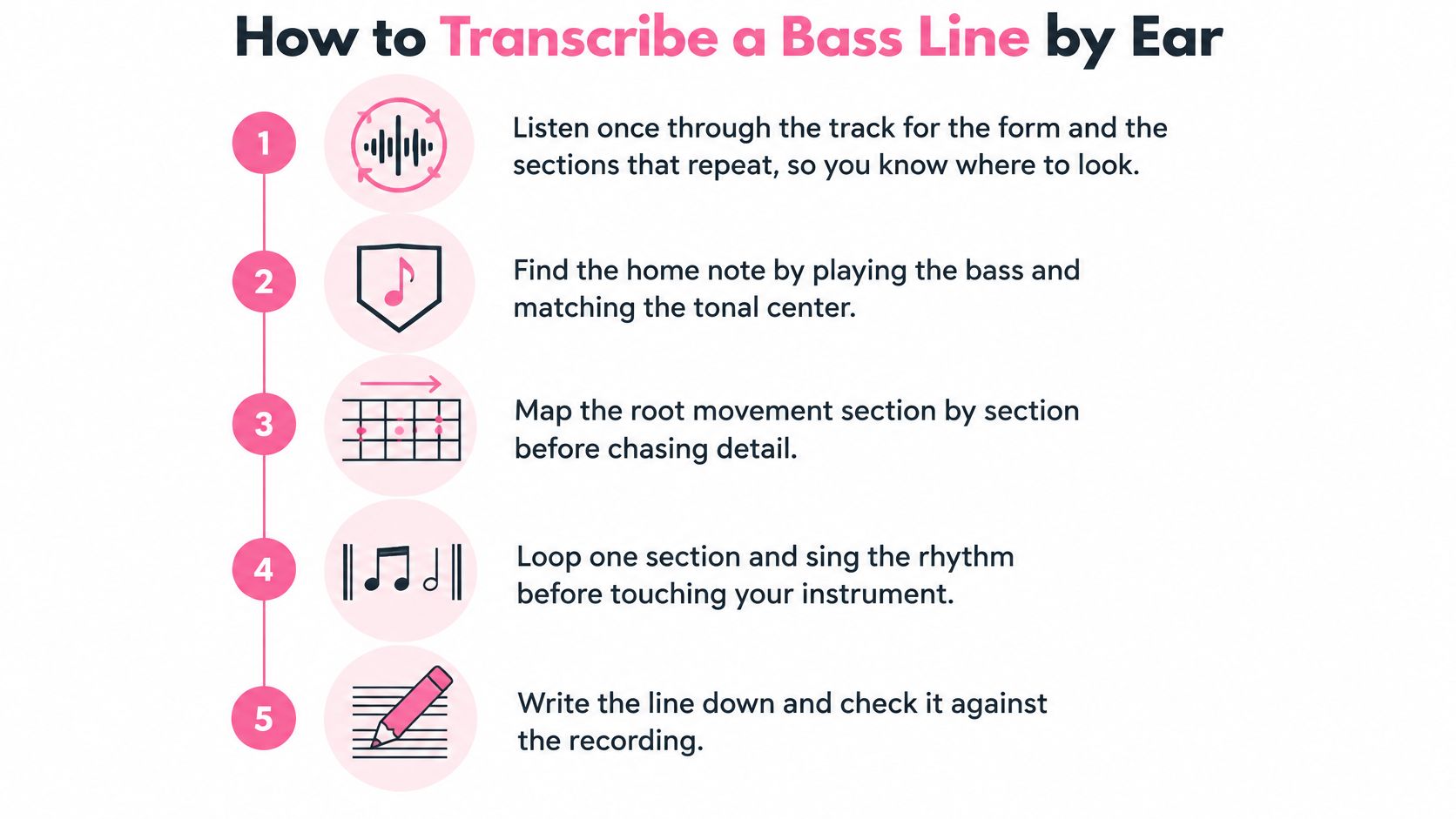
- Listen once through for form. Note the intro, the verse, the chorus, and which sections repeat. You’re mapping where to look before you look.
- Find the home note. Play the root under the song’s main chord, or sing the note that feels like rest and match it on the E string. Everything else is measured from here.
- Loop two bars at about 75 percent speed. A short loop keeps the phrase inside your working memory. A whole song does not.
- Sing the line before you play it. Predict the next note out loud. Auditory imagery forms through that prediction.
- Find the sung note on the bass. Compare it with the recording. Correct, then repeat that bar until it’s clean.
- Write down only the rhythm and the first note of each bar. Keep the page light so your ear carries the rest.
- Hum the line with the recording muted. If it holds together without the track, it has moved into memory.
Sing first, play second, verify third. That sequence links what you hear to what your fingers do, and it weans you off copying shapes. Guidance on bass ear-training protocol frames it the same way, combining a clearly bounded task, immediate corrective feedback, repetition of corrected material, and gradual difficulty. The same source reports a meta-analysis of 13 musical-performance studies involving 788 participants that found a moderate-to-strong link between task-relevant practice and achievement (r = 0.61, 95% CI [0.54, 0.67]).
Log first-attempt accuracy separately from corrected accuracy. A high corrected score sitting on weak first attempts means recognition isn’t automatic yet, only your fishing technique is improving.
The trap is learning everything from tab, or always in the same key. That builds finger memory with no transferable hearing. Randomize starting notes, keys and registers. Trill’s training sessions are short and focused: you hear a sound, answer, and get instant feedback, which is exactly the loop this procedure needs. A deeper walkthrough lives in this guide on how to transcribe music by ear.
The finish line is a four- to eight-note line you can play in a different key, from memory, without the recording.
Hearing Chords and Progressions from the Low End
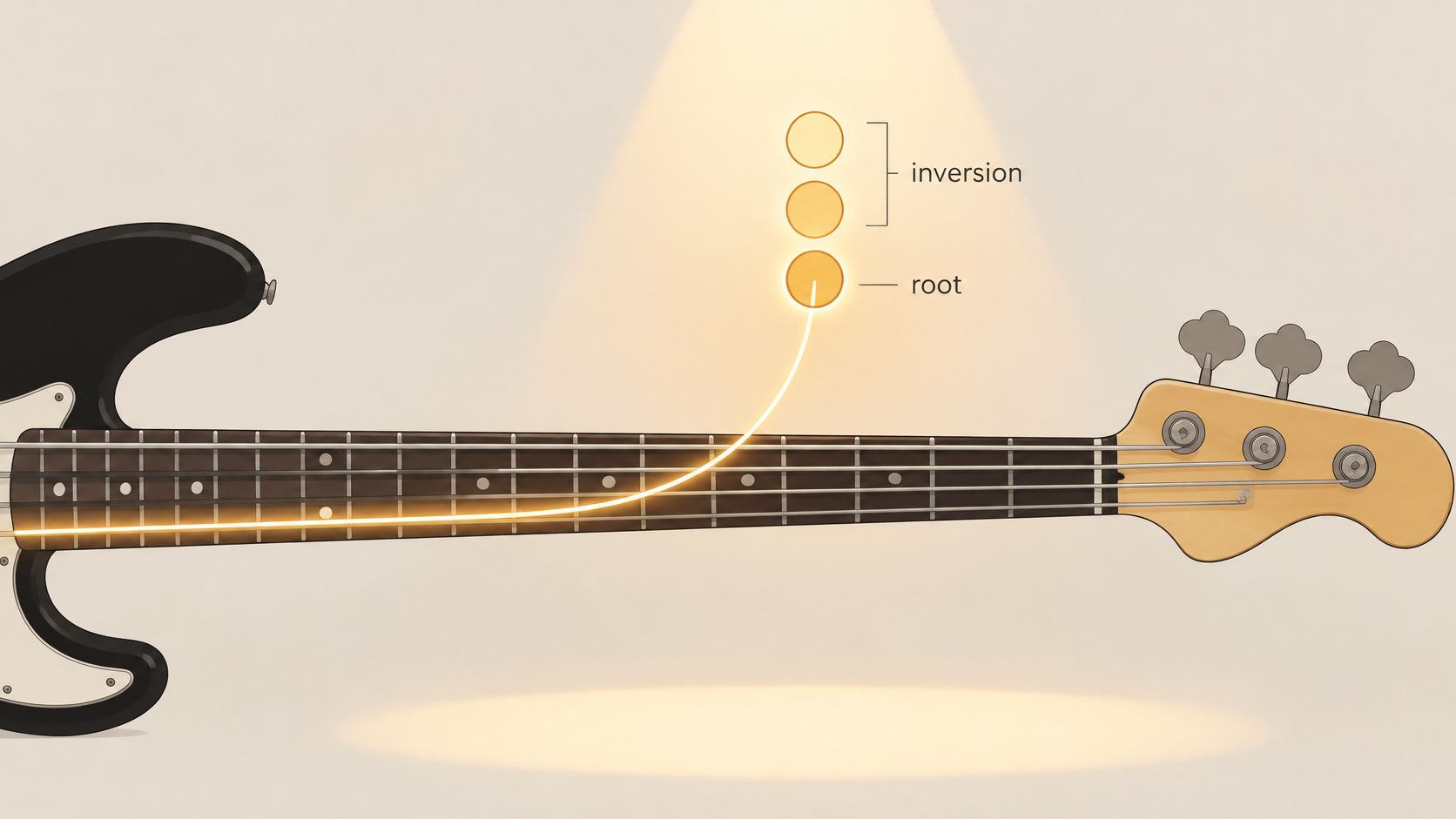
The lowest voice is the most informative one. On bass, the note you play usually reveals the chord’s root, whether the chord is an inversion, and which way the harmony is heading. That makes chord recognition a bass skill before it’s anyone else’s.
Train it in one direction, from the simplest cue to the most realistic. First the tonal center. Then the shape of the bass motion. Then chord quality and function. Finally the full progression inside a real recording. Listeners do work this way: in a survey summarized by Chenette’s article on aural-skills pedagogy, 5 of the 10 respondents who identified a chord correctly said they listened first for the bass or outer voices, and 2 more included the bass in their strategy.
Chord qualities are easier to hear as feelings than as definitions. Major sounds bright and settled. Minor sounds darker. A dominant seventh pulls toward home. Suspended chords sound open, like the question hasn’t been answered yet.
Take I–V–vi–IV, the progression behind a thousand pop songs. The bass walks from the root to the fifth, then to the sixth, then to the fourth. You can hear all four steps in the low end before you can name a single chord.
Turning drills into harmonic hearing
Play the same loop in at least three keys and compare where you went wrong. Was the error an interval, a chord quality, or a register confusion? Errors by category tell you what to practice next.
Measure with a short pre and post test rather than a streak. The validated Musical Ear Training Assessment offers 10- and 25-item versions designed to measure analytical hearing, which fits a weekly check, as described in research on compact ear-training assessment. The same work flags the common pitfalls: confusing a fret location with a harmonic function, treating one lucky guess as mastery, and mixing up root recognition with full chord-quality recognition.
The question isn’t “did I get the chord?” It’s “could I hear the moment it changed?”
In a jam, following the bass tells you when the chord turns. That is playing by ear, in public, with no chart. For more on hearing movement rather than single chords, see this guide to ear training for chord progressions.
Why Right Notes Can Still Sound Wrong
You matched the recording note for note and the line still feels rushed, or thin, or just wrong. Pitch isn’t the whole target. It’s one of three, and the other two carry the groove.
- Rhythmic placement: where each note lands relative to the beat.
- Pitch contour: the shape of the line, up and down, before exact names.
- Articulation: attack, note length, muting, and how cleanly each note ends.
Separate them on purpose. Play the rhythm alone on one open string. Then the contour on a steady beat with no concern for tone. Then add articulation. Finally recombine all three against a drum loop.
Low notes carry timing information more strongly than high ones, which makes rhythm a smart first target on bass. A 2014 EEG and behavioral study of 17 listeners found superior temporal processing for lower musical pitches, linking that advantage to why bass-range instruments anchor rhythm. Move a note a few milliseconds late and the groove breaks even though every pitch is right.
| Symptom | Likely cause | Fix |
|---|---|---|
| Notes correct but line feels rushed | Rhythm placement not heard | Tap the rhythm on one open string against a drum loop before adding any pitch |
| Right notes, wrong note lengths | Durations not copied | Loop two bars and match where each note ends, not only where it starts |
| Line sounds thin in the mix | Octave or register mismatch | Check the octave against the kick drum and move the line up or down an octave |
| Works alone, fails with drums | Pitch learned without the beat | Play the line along with a drum loop, then remove the recording |
Groove is part of the material, not decoration. MusicMark’s bass guitar curriculum includes working out short phrases and patterns by ear, because copying a line means copying its timing too.
Record your fixed line, play it back against the original, and listen for the single difference that still stands out. Then fix only that.
Playing by Ear in a Jam and Improvisation
Here’s the moment all of this is for. A band starts a groove in a key you know, and there’s no chart on the floor.
Start the loop and listen only to the bass for the next chord change. Before you play, sing the root you expect. When the chord turns, put the new root on the beat. If you’re wrong, you hear it immediately, which is the feedback you want.
Build improvisation in three steps.
- Roots only, on strong beats. Landing the right note at the right moment is already playing by ear.
- Add the fifth. It sounds open and steady in almost any key, so it buys you time while your ear catches up.
- Add short passing notes. Use the scale you sang in the daily routine. Two notes between roots is plenty.
A wrong note often sounds wrong before you can explain why. That instant reaction is the skill.
Test it: play twelve bars with a drummer or a loop, and count how many chord changes you followed without looking down. That number is your real playing-by-ear score.
The pieces connect here. Interval drills give you the sound of each step. Progression checks tell you when the harmony moves. Transcription hands you phrases worth borrowing. Musical freedom starts when you stop watching the fretboard and start following the music.
Start Your First Week of Bass Ear Training
Seven days, one routine, one measurable result.
- Day 1: test yourself on three intervals from the table and log your first-attempt accuracy.
- Days 2 to 5: run the ten-minute routine at the same time each day, bass in hand.
- Day 6: transcribe a four- to eight-note bass line from a song you already know, using the seven steps.
- Day 7: review the log and compare first-attempt accuracy against Day 1.
Then apply the decision rule. Below about 80 percent first-attempt accuracy, repeat the same intervals next week with the same material. Above it, add a new key or move to a progression.
Trill is an ear-training app covering chords, intervals, perfect pitch and melodies, designed as a 10-minute daily practice. When you start, you tell the app your goal and your level, and the journey adapts from single notes to full chord progressions. If distraction is your pattern, Focus Lock blocks apps like TikTok, Instagram and YouTube until your daily session is done.
Use it in the shape of the routine. Run the interval and chord blocks in the app where repetition and instant feedback matter. Keep the bass in hand for the sing-and-play blocks. Watch the visualizers early in the week, then hide them as your ear takes over.
Tonight, pick one song, one interval set and one loop. Start the first session before you close the laptop.
Trill: Ear Training Daily turns ten minutes into a habit you can measure, with short drills for intervals, chords, perfect pitch and melodies, instant feedback on every answer, and a path that adapts as your ear improves. The bass rewards players who hear the harmony and the groove at once, and daily practice is how that hearing gets built. Start tonight at Trill: Ear Training Daily and give your ear its first week.