Transform Your Sound: Exercises For Bass Guitar Mastery
You hear a song once, pick up your bass, and still end up hunting for notes.
That’s where a lot of players get stuck. You can follow tabs, memorize shapes, and even get through songs, but the moment the chart disappears, confidence disappears with it. The problem usually isn’t your hands. It’s that your ears haven’t been trained to lead.
Playing by ear isn’t a gift some people got and you didn’t. It’s a trainable skill. The right exercises for bass guitar can connect what you hear to what you play, so your fingers stop guessing and start responding.
The eight drills below are built for that exact job. They’ll help you hear intervals, recognize chord movement, lock your time, and find notes faster on the fretboard. Keep the sessions short, stay consistent, and aim for real musical outcomes. Better grooves, faster learning, stronger improvisation, and more freedom when you play with other people.
Table of Contents
- 1. Interval Recognition and Ear Training
- 2. Chord Progression Recognition Drills
- 3. Chromatic Scale and Linear Fingering Drills
- 4. Root Note Identification and Navigation
- 5. Rhythmic Subdivision and Timing Precision Exercises
- 6. Transcription and Ear-to-Instrument Practice
- 7. Scale Modes and Harmonic Context Recognition
- 8. Groove Lock and Feel Development Through Listening
- 8-Point Comparison: Bass Guitar Exercises
- Your Daily Path to Bass Mastery
1. Interval Recognition and Ear Training
If you can hear the distance between two notes, you stop feeling lost on bass. You hear a jump, know what it sounds like, and your hand has a much better chance of finding it quickly. That’s the foundation of ear training.
Start with the intervals that show up constantly in bass playing. Root to fifth. Root to octave. Root to fourth. Then add major and minor thirds, because those sounds tell you a lot about whether a chord feels bright or dark. For a simple breakdown, this guide to intervals in music is a useful companion.
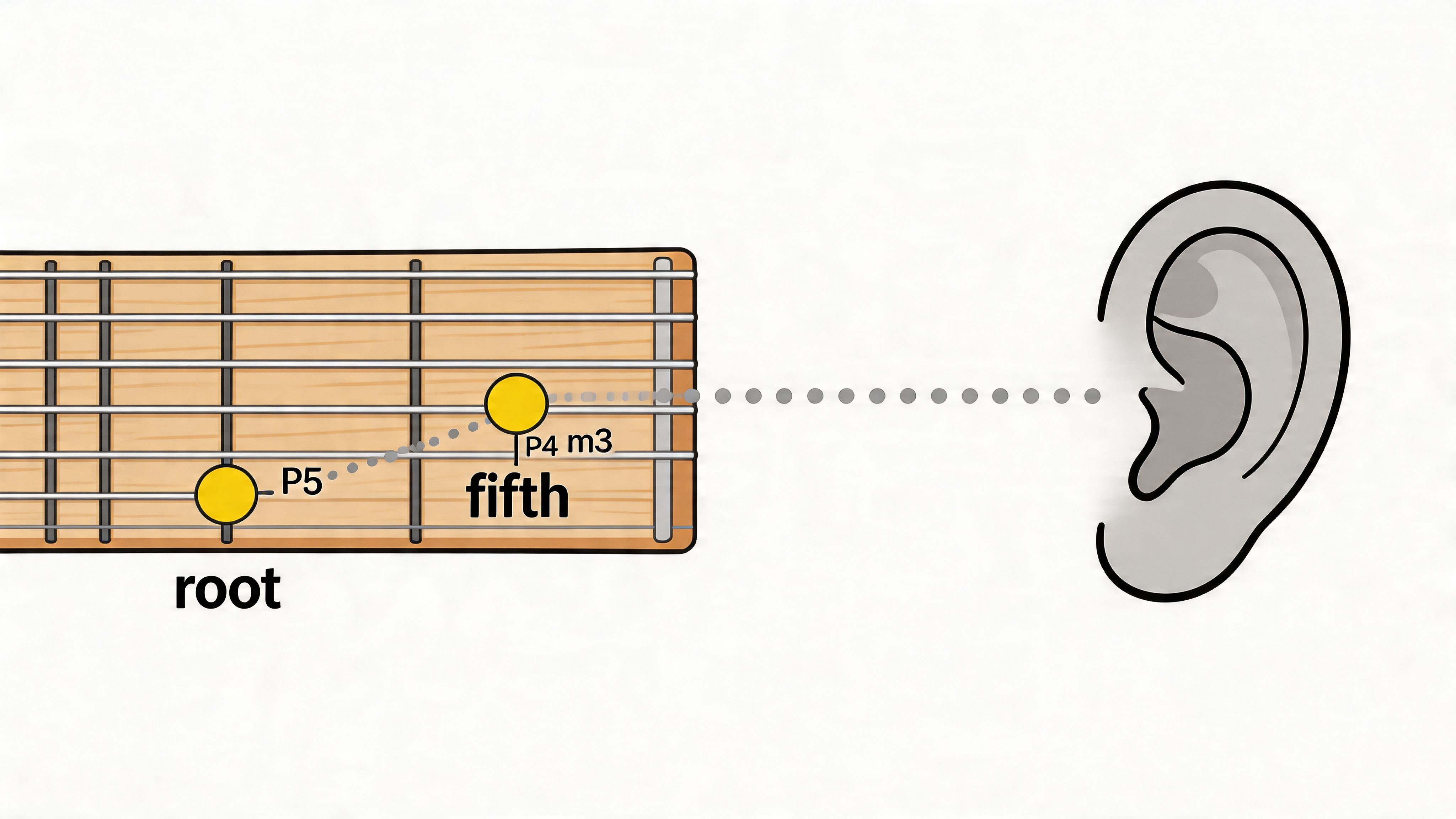
Start with the sounds bass players use most
Sing first, then play. That order matters. If you always look at the fretboard before listening, your eyes take over and your ear stays weak.
Try this for 10 minutes:
- Pick one reference note: Play a low G, then sing the octave above before checking it on the bass.
- Drill one interval at a time: Spend a few minutes only on fifths, then switch to fourths.
- Practice both directions: Ascending is easier for most players. Descending exposes the weak spots.
- Remove visual help: Close your eyes or look away when the second note sounds.
One reason this matters so much is that advanced bass vocabulary depends on hearing structure, not memorizing random shapes. TalkingBass highlights a demanding arpeggio exercise where less than 1% of bass players can proficiently play fully extended diatonic 13th arpeggios through the major scale, which shows how often ear, harmony, and fretboard knowledge fail to connect in practice (TalkingBass on extended diatonic 13th arpeggios).
Practical rule: If you can’t sing an interval clearly, you probably don’t hear it clearly yet.
Real-world payoff is immediate. A session player hears the singer move up to a new chord root and follows it. A church bassist catches a last-second key change. A beginner starts learning songs without waiting for tabs. That’s how you start to play by ear instead of hoping you guessed right.
2. Chord Progression Recognition Drills
Most bass lines make more sense when you stop hearing single notes and start hearing movement between chords. That’s what progression training does. It teaches your ear to recognize the path the harmony is taking.
Bass players especially need this because your note choices usually define the harmony for everyone else. If you hear the progression early, you can land on stronger notes, recover faster, and build lines that sound intentional. This article on stopping chord guessing by ear fits naturally into that practice.
Train your ear to hear movement, not isolated notes
Start with short progressions you’ve heard a thousand times in real music. Three chords are enough. Listen for the bass movement first, then sing the roots before you touch the instrument.
A simple routine works well:
- Use common patterns: Try I to IV to V, then back home.
- Sing the root motion: Don’t worry about fancy note names at first. Hear whether it goes up, down, or stays put.
- Move through several keys: If you only practice in one key, you’re memorizing, not hearing.
- Test yourself later: Record a few progressions and come back the next day without looking.
This area matters because bass-specific ear training for harmonic context is still largely missing from mainstream bass exercise content. The gap is especially clear around root-note hearing, chord-tone awareness, and harmonic function in the bass register, which is exactly why this kind of drill helps players move beyond mechanical practice and into musical listening (bass-specific aural training gap analysis).
You don’t need perfect pitch to hear a progression. You need repetition, comparison, and honest listening.
In real playing, this skill changes everything. A blues bassist can hear when the band moves to the IV chord without waiting for a nod. A pop player can predict the return to the home chord. A jazz student starts hearing ii-V-I movement as a sound, not just a theory label.
3. Chromatic Scale and Linear Fingering Drills
Not every useful exercise sounds musical at first. Chromatic work is one of those. It can feel plain, but it teaches control, consistency, and fretboard awareness in a way flashy licks don’t.
The value isn’t just finger strength. It’s learning to move one note at a time with even tone and steady timing, while hearing every half-step clearly. That makes your passing notes cleaner and your lines more connected.
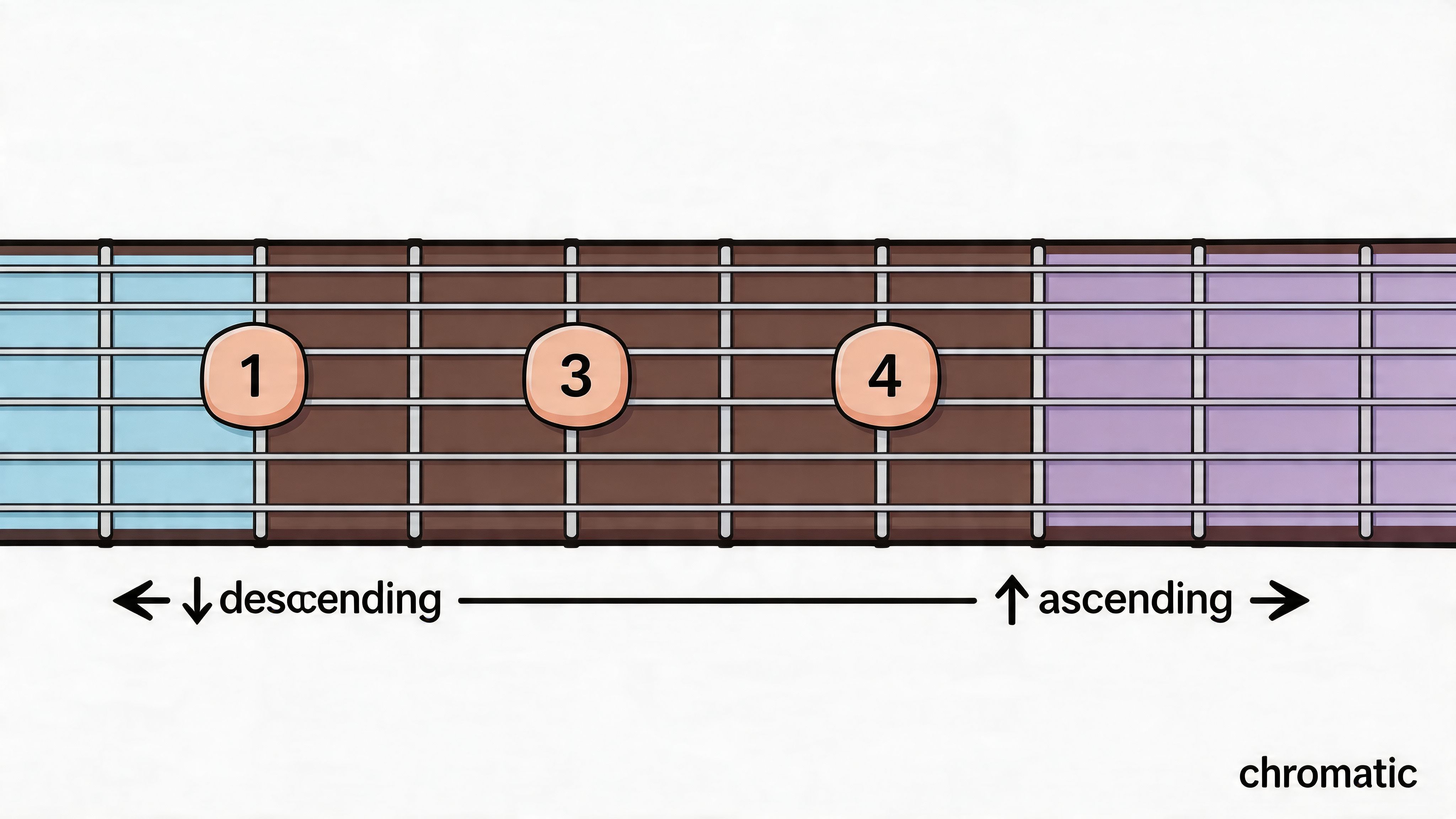
Make every note sound deliberate
Play four frets in one position on one string. Then move to the next string. Keep the notes even. Keep the hands relaxed. Listen for whether one finger hits harder than the others.
Use a metronome at a comfortable speed and pay attention to sound, not just motion. If the notes are technically correct but one is late, buzzy, or too loud, fix that before speeding up.
Try this sequence:
- Ascend first: Don’t mix directions until the hand feels settled.
- Descend separately: Most players rush on the way down.
- Name the notes aloud: That strengthens your neck map.
- Listen for smoothness: The ear should hear one connected line, not four disconnected finger presses.
This kind of line-by-line discipline becomes far more useful when it ties into hearing. Mainstream bass content usually treats finger exercises as pure mechanics and rarely connects them to interval recognition or musical listening, which leaves a lot of players technically busier but not more musical (finger exercises that build ear recognition).
A funk player uses this control when sliding into a ghost-note groove. A rock bassist uses it when connecting roots with chromatic approach notes. A student uses it to stop every scale from sounding lumpy and uneven.
4. Root Note Identification and Navigation
The band starts a song you do not know. You do not have charts. You do not have time to test five scale shapes. You need one thing first. Where is home?
That home note is the root. On bass, hearing it quickly gives you a safe landing spot and a clear job. You start supporting the song instead of guessing through it. Great bass playing by ear often begins here. Not with flashy fills, but with finding the note that makes the harmony feel settled.
Hear home, then find it everywhere
Many newer players listen for motion before they listen for gravity. They chase passing notes, little fills, and surface details. The root is the floor under all of that. If you hear the floor, the rest of the room makes more sense.
Start with songs that have a clear tonal center. Listen for the note the music keeps wanting to return to. Pause the track. Sing that note. Then match it on your bass. If singing feels awkward, that is normal. Your voice is the shortest path between your ear and your hands.
Now do the part many players skip. Find that same root in more than one place. Play it on a lower string. Find it again in a higher octave. Then locate another version nearby on the neck. This is how root-note practice turns into real navigation instead of one lucky guess.
Try the drill like this:
- Pick simple recordings: Start with songs where the harmony feels steady and easy to hear.
- Sing the root first: Let your ear make the decision before your fingers move.
- Locate three versions of the same note: Same pitch class, different string sets or octaves.
- Play only roots with the track: Make them steady and confident before adding anything else.
A good checkpoint is this. If the chord changes and you lose your place, return to the root instead of forcing a busier line. That habit saves gigs. It also trains your ear to hear harmony in larger chunks, which matters much more than memorizing isolated fretboard patterns.
Ear-training apps can help with this, especially for quick daily reps on pitch matching and tonal center recognition. They work best as support, not as the main event. The main event is still hearing a real song, identifying the root, and placing that note on the instrument with confidence. If you want your time to stay solid while you do this, this guide on why practicing with a metronome sharpens your internal pulse pairs well with root-note drills.
Here is a practical test. A singer counts off in a new key, the guitarist plays a loose intro, and you catch the tonal center by ear within a bar or two. You put the right roots in the right register, and the whole band sounds more grounded. That is not a small skill. It is one of the building blocks of musical freedom on bass.
5. Rhythmic Subdivision and Timing Precision Exercises
The band counts off. Everyone starts together. Two bars later, nothing is wildly wrong, but the groove still feels shaky. That usually comes from subdivision, not note choice.
Bass players do more than mark the pulse. We show everyone else where the pulse sits inside the beat. If your quarter notes are steady but your eighths rush, or your sixteenths bunch up, the whole line feels less convincing. This matters even more when you are learning by ear, because hearing a rhythm clearly is what lets you place it on the fretboard with confidence.
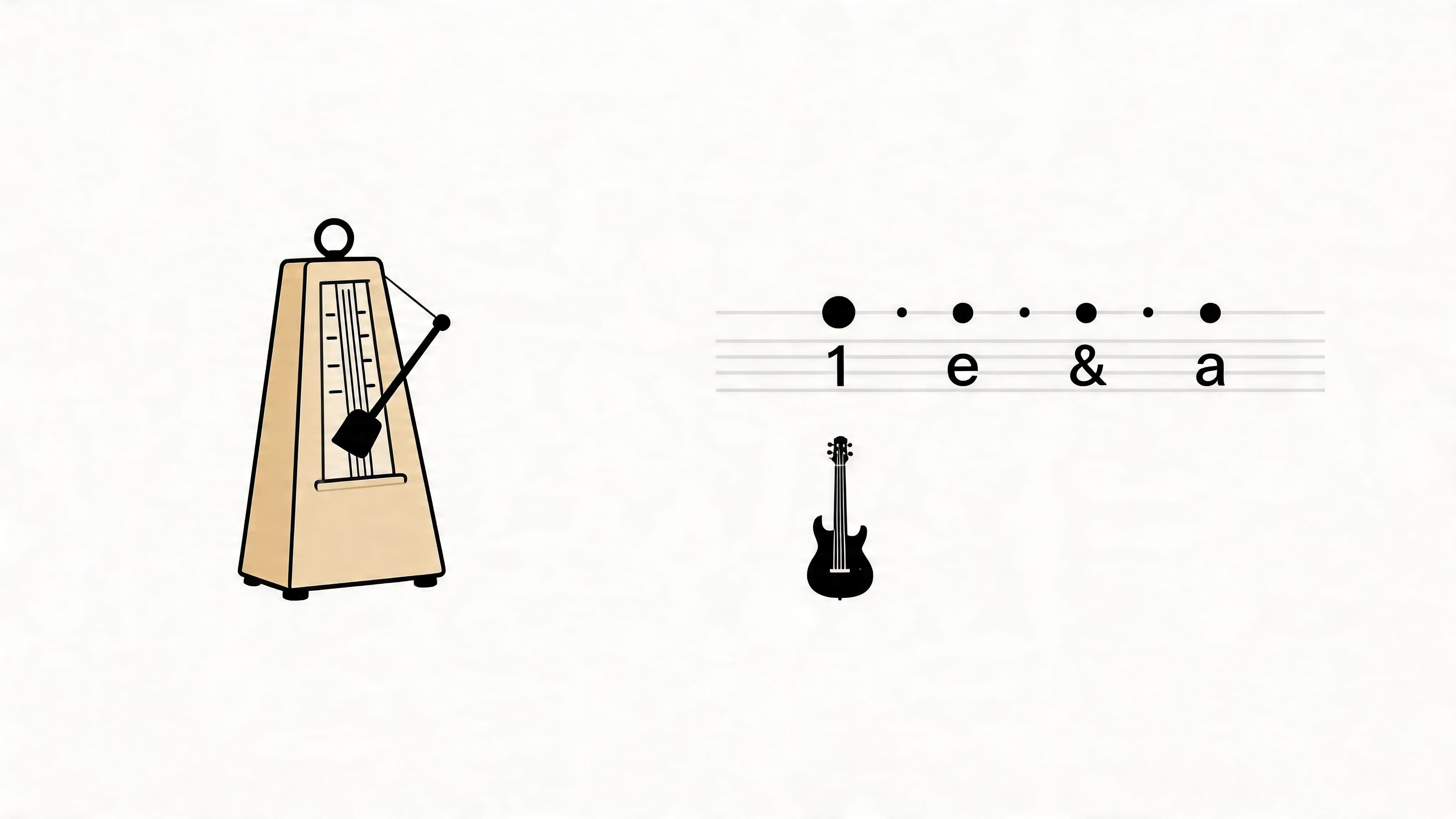
Build a clock you can trust
Start with one pitch so rhythm gets your full attention. A muted string works too. The point is to remove extra decisions and train your hands and ears to agree on where the beat lives.
Use this sequence:
- Play quarter notes: Line each note up with the click and let it settle.
- Split into eighth notes: Keep both notes evenly spaced, like two equal steps between clicks.
- Split into sixteenth notes: Stay loose and make all four notes the same size.
- Add rests: Leave space for part of the beat, then re-enter exactly where you intended.
Say the counts out loud while you play. Your voice works like a flashlight. It shows where your internal pulse gets blurry.
If the metronome feels annoying, that is useful information. It usually means the click is revealing a habit you could not hear before. This guide on why practicing with a metronome strengthens your internal pulse explains how to use it as a listening tool, not just a timekeeper.
Count out loud when you practice rhythm. If you can’t say it steadily, you probably can’t play it steadily.
Here is the practical test. Put on a simple drum loop and play one note for a minute. First in quarters, then eighths, then sixteenths. Then leave beat 1 silent and come in on the “and” of 1. Then on beat 2. Then on the last sixteenth before beat 3. You are training more than accuracy. You are training the ability to hear empty space and place a note on purpose.
That skill shows up on every gig. Funk lines need clean sixteenth-note spacing. Rock lines need even eighths that do not speed up with adrenaline. Walking lines need patience when the drummer lays back. Strong time is one of the most useful exercises for bass guitar because listeners feel it immediately, even if they cannot explain why.
6. Transcription and Ear-to-Instrument Practice
If you want one exercise that pulls everything together, this is it. You listen to a real bass line, figure it out without tabs, and play it back on your instrument. Ear, memory, rhythm, pitch, and technique all have to cooperate.
Start small. Don’t transcribe a whole song because you feel ambitious. Take one phrase. Four notes are enough if they’re heard clearly.
A good visual reminder helps keep the purpose in view.
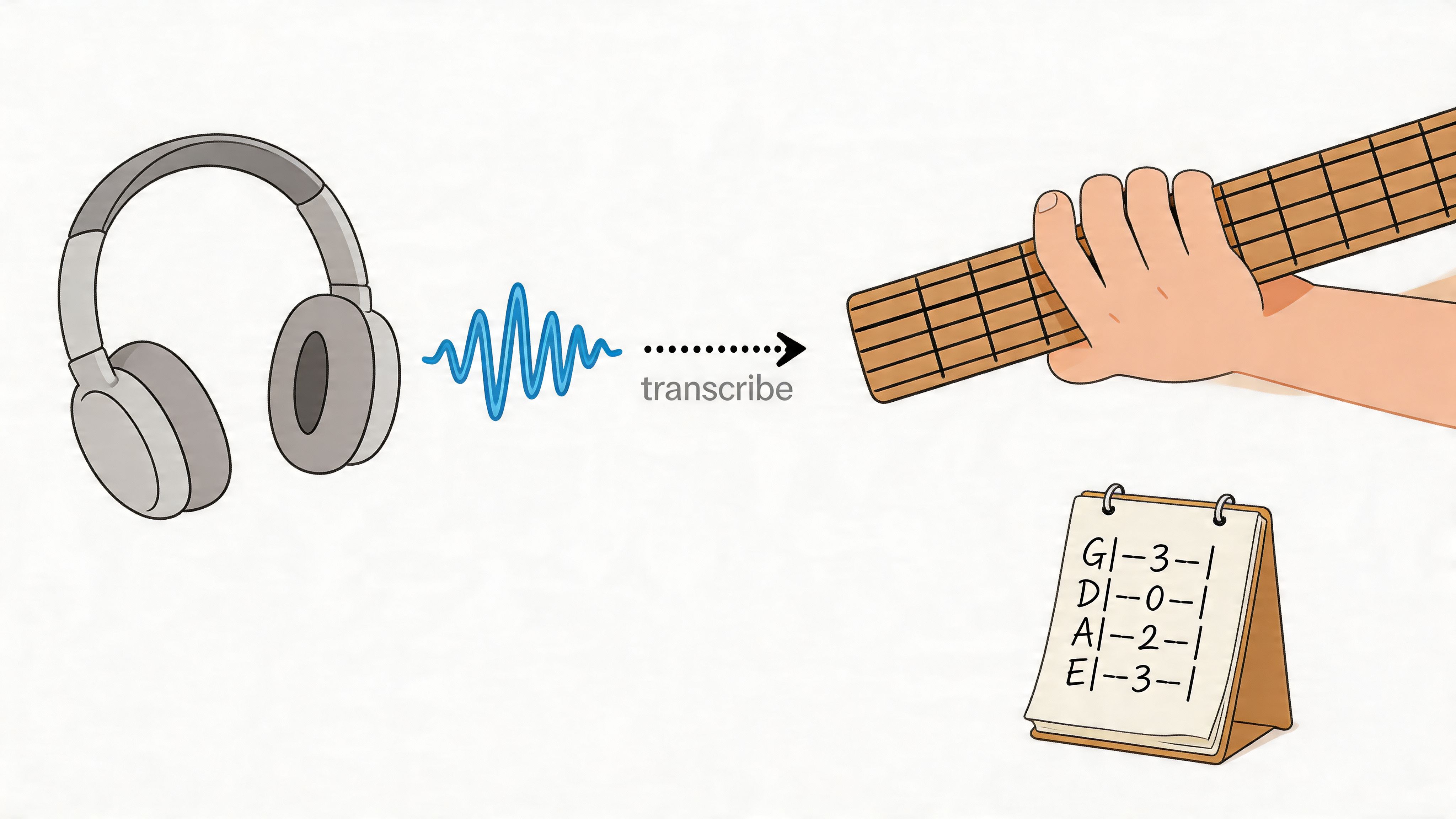
Steal the language the right way
Pick recordings where the bass is easy to hear. Slow the audio if needed. Loop one short phrase and sing it until it sticks. Then search for it on the neck.
Writing it down can help, but don’t rush there. The main point is to build a direct line from hearing to playing. That’s the heart of learning to play by ear.
Use this process:
- Choose clear lines: Simple soul, pop, and classic rock often work well.
- Loop tiny phrases: One bar is enough.
- Sing before playing: Your voice keeps you honest.
- Check your work last: Compare with published material only after you’ve tried.
One of the strongest all-in-one bass practice routines takes a similar integrated approach. The exercise described by Online Bass Courses combines a mode, a 7th arpeggio, a pentatonic, and a 7th chord on each degree of the major scale, and it’s described as a professional routine used for more than 30 years (the “greatest ever” bass guitar exercise). Transcription works for the same reason. It forces technical patterns, theory, and hearing to meet in one place.
Later in your session, watch a player break the process down and then try it yourself.

A bassist learning Motown by ear gains more than one song. You start absorbing note choice, phrasing, articulation, and feel. That’s how vocabulary enters your playing without sounding memorized.
7. Scale Modes and Harmonic Context Recognition
Modes confuse a lot of bassists because they’re often taught as patterns before they’re taught as sounds. That’s backwards if your goal is musical freedom.
You don’t need to recite mode names at speed. You need to hear that one minor sound feels smoother, another darker, another brighter, and then match that sound on the instrument. Ear training comes first, labels second.
Hear the color before you name it
Begin with major and natural minor if those sounds still feel shaky. Once those are steady, compare one mode at a time against something familiar. Dorian is a good first choice because it sounds minor but not as dark as natural minor.
Play a drone or simple backing chord and sing the scale slowly. Listen for the note that gives the mode its personality. Then improvise with just a few notes instead of racing up and down the full shape.
A useful way to practice:
- Work one mode for several days: Don’t pile all seven together.
- Use one backing sound: Let your ear settle into the color.
- Sing the important notes: Especially the notes that make the mode distinct.
- Build short grooves, not long solos: Bass playing is about function and feel.
Because bassists often separate theory from hearing, the best exercises for bass guitar don’t leave modes as diagrams. They turn them into recognizable sounds you can use in real songs. When you hear Dorian over a minor vamp or Mixolydian over a dominant groove, improvisation gets much easier.
Hear the mood first. Name it after.
That’s how a fusion player chooses color over a static vamp. It’s how a church bassist reacts when the harmony shifts but the groove stays open. And it’s how scales stop being homework and start becoming sound.
8. Groove Lock and Feel Development Through Listening
Great bass playing isn’t just correct. It feels good.
Two players can hit the same notes and the same tempo, but only one makes the band relax and lock in. That difference usually lives in note length, attack, dynamics, tiny placement choices, and how well the bassist listens.
Match the pocket, not just the notes
Put on a record you love and play along softly enough that you can still hear the original bass. Don’t try to dominate the track. Try to disappear inside it.
Listen for where the note sits. Is it right on top of the beat? Slightly behind? Short and dry? Long and supportive? That’s the stuff players miss when they only practice with isolated exercises.
Use a focused routine:
- Pick one style at a time: Funk, reggae, soul, rock, or jazz.
- Copy note length carefully: Short notes and long notes create feel.
- Record yourself: Compare your groove to the track, not just your memory.
- Study articulation: Fingerstyle attack, muting, and accents matter.
This kind of listening-based groove work is still underrated in bass education. Plenty of players can explain scales but can’t settle into a pocket that supports a singer or drummer. Daily listening fixes that if you stay honest about what you hear.
A working bassist needs this on stage. The drummer leans back a little in the chorus. The guitarist starts pushing. You don’t panic. You listen harder, shape the notes, and keep the groove balanced. That’s musical maturity, and it can be trained.
8-Point Comparison: Bass Guitar Exercises
| Exercise | 🔄 Implementation Complexity | ⚡ Resource Requirements | ⭐ Expected Outcomes | 📊 Ideal Use Cases | 💡 Key Advantages / Tips |
|---|---|---|---|---|---|
| Interval Recognition and Ear Training | Moderate, structured daily drills, progressive difficulty | Low, apps (e.g., Trill), recordings, 5–10 min/day | ⭐⭐⭐⭐, strong interval ID and relative pitch | Learning songs by ear, improvisation, transcription | Start with perfect intervals; sing ascending/descending intervals before playing |
| Chord Progression Recognition Drills | Moderate, pattern training plus basic theory | Low–Medium, songs, chord visualizers, practice time | ⭐⭐⭐⭐, rapid recognition of common progressions | Jam sessions, live adaptation, multi-genre playing | Learn progressions in multiple keys; sing chord roots while listening |
| Chromatic Scale and Linear Fingering Drills | Moderate, repetitive technical focus, metronome use | Low, bass, metronome, consistent practice blocks | ⭐⭐⭐, improved dexterity and fingerboard mapping | Fast scalar passages, technical accuracy, studio work | Use slow metronome, increase tempo gradually, record to check consistency |
| Root Note Identification and Navigation | Low–Moderate, simple concept, requires ear accuracy | Low, recordings, instrument, focused drills | ⭐⭐⭐⭐, quicker song learning and bass-line construction | Session work, live key changes, quick song learning | Sing roots, practice in different octaves, focus on obvious linear songs first |
| Rhythmic Subdivision and Timing Precision Exercises | Moderate, disciplined metronome and counting practice | Low, metronome or click, backing tracks, recording tools | ⭐⭐⭐⭐, solid pocket and precise subdivision control | Funk, studio sessions, ensemble playing | Count subdivisions aloud; practice with click and record yourself |
| Transcription and Ear-to-Instrument Practice | High, integrates intervals, rhythm, pitch and technique | Medium, clear recordings, slow-down software, time investment | ⭐⭐⭐⭐⭐, comprehensive play-by-ear and repertoire building | Deep stylistic study, professional transcription, learning classics | Transcribe phrase-by-phrase; use slow-down tools and verify with published sources |
| Scale Modes and Harmonic Context Recognition | High, advanced theory and subtle listening distinctions | Medium, theory resources, modal backing tracks, focused listening | ⭐⭐⭐, enhanced modal awareness for improvisation | Jazz, fusion, progressive composition and solos | Learn one mode at a time; sing modes and improvise over backing tracks |
| Groove Lock and Feel Development Through Listening | Moderate, subjective, requires sustained listening + practice | Low, extensive listening, play-alongs, feedback from players | ⭐⭐⭐⭐, deep groove, band cohesion, more in-demand players | Funk, R&B, soul, live band pocket development | Actively compare recordings, study placement ahead/behind the beat, seek feedback |
Your Daily Path to Bass Mastery
The biggest mistake bass players make is thinking improvement comes from doing more. More exercises. More videos. More random practice. Most of the time, progress comes from doing less, but doing it with better attention.
These eight exercises for bass guitar work because they connect your ears to your hands. That connection is the whole game. Once you can hear intervals, follow roots, recognize progressions, feel subdivisions, and copy real lines by ear, your playing stops feeling fragile. You’re no longer dependent on tabs, charts, or luck.
Keep the daily plan simple. Spend 10 minutes a day on one ear-focused exercise and one playing exercise. For example, sing and identify intervals for a few minutes, then play root notes over a song. The next day, do rhythm work and a short transcription phrase. Short sessions done consistently beat long sessions you avoid.
If you’ve ever thought you just weren’t born with a strong ear, drop that idea. Ear training is trainable. Perfect pitch gets a lot of attention, but most real-world bass playing doesn’t depend on perfect pitch. It depends on recognizing relationships, hearing movement, and reacting quickly with confidence.
That’s also why a daily system helps more than occasional motivation. You need repetition. You need feedback. You need a routine that makes listening practice automatic instead of optional.
Trill fits that role well because it’s built around short daily ear training. Instead of vaguely hoping your ear improves, you can work on intervals, chords, scales, and listening skills in a structured way that supports real playing by ear. For bassists, that matters because the instrument lives at the center of harmony and groove. The better you hear, the better you play.
Use the app as part of your regular bass practice, not separate from it. Train an interval, then find it on the neck. Work on chord recognition, then play roots and fifths over a backing track. Use the metronome and visual tools to support what your ears are learning. That’s how practice turns into usable musicianship.
You don’t need a giant practice schedule. You need consistency, honest listening, and a few drills that make music feel clearer every week. Stick with that, and your bass will start feeling less like a puzzle and more like a voice.
If you want a daily system for ear training, chord recognition, interval practice, and learning to play by ear with confidence, try Trill: Ear Training Daily. It’s built for short, focused sessions that help musicians stop guessing and start hearing, with tools like a metronome, tuner, chord visualizer, interval visualizer, and scale visualizer all supporting real musical growth.