C Major Scale Trumpet: Fingerings & Exercises
You’ve probably done this already. You put the music on the stand, learned the valve pattern, and played a C major scale on trumpet from bottom to top without missing a note. But when someone asks you to play by ear, match a melody, or join another musician, the scale suddenly doesn’t feel solid at all.
That gap is common. Your fingers may know a pattern, but your ear may not yet know the sound. And if your ear doesn’t know the sound, you’re still guessing.
The good news is that ear training is trainable. You don’t need perfect pitch to make a c major scale trumpet exercise useful. You need a repeatable way to hear the notes, connect them to your horn, and practice them consistently. That’s where real musical freedom starts.
Table of Contents
- Why Your Fingers Know the Scale but Your Ears Don’t
- Train Your Ear Before You Touch the Trumpet
- Trumpet Fingerings for the C Major Scale
- How to Make Your Scale Sound Like Music
- Smarter Practice That Builds Real Skill
- From Scales to Songs Your Path to Musical Freedom
Why Your Fingers Know the Scale but Your Ears Don’t
A lot of trumpet players learn C major as a hand pattern first. They remember which valves go down, run the scale up and down, then move on. That works well enough for passing a quick warmup, but it often falls apart when music stops being predictable.
You hear this in lessons all the time. A student can play the scale cleanly from the page, but if the teacher starts on a note and says, “Finish the rest by ear,” the player hesitates. Not because they lack talent. Because they learned sequence before sound.
Mechanical accuracy isn’t musical understanding
If you only memorize fingerings, you’re building a motion pattern, not a listening skill. That’s why some players can perform a c major scale trumpet exercise but still struggle to:
- Match a melody they just heard
- Recognize scale steps by sound
- Adjust pitch on open notes
- Improvise simple phrases in a key
The scale should give you a sound map. Instead, many players end up with a valve map.
Practical rule: If you can’t sing the next note before you play it, your ear is still catching up to your fingers.
What musical freedom actually feels like
When your ear leads, the scale stops feeling like an exam item. It starts feeling usable. You can hear whether the line is rising smoothly, whether the top note is settled, and whether the note you’re aiming for belongs in the key.
That changes everyday playing. You stop treating each note like an isolated target and start hearing relationships. C wants to move to D. G feels stable. B pulls upward toward C.
That kind of awareness is what helps you play by ear, phrase melodies naturally, and understand what you’re hearing in real music. The valves still matter. They just stop being the main event.
Train Your Ear Before You Touch the Trumpet
You hear a piano play a simple C major scale. It sounds obvious. Then you lift the trumpet and suddenly the notes feel less obvious than they did a second ago. That gap matters. Your ear recognized the shape, but your body has not connected that sound to the horn yet.
Good scale practice starts before the first breath. If the sound is clear in your mind, your fingers have something to follow. If the sound is fuzzy, the horn turns into a guessing game.
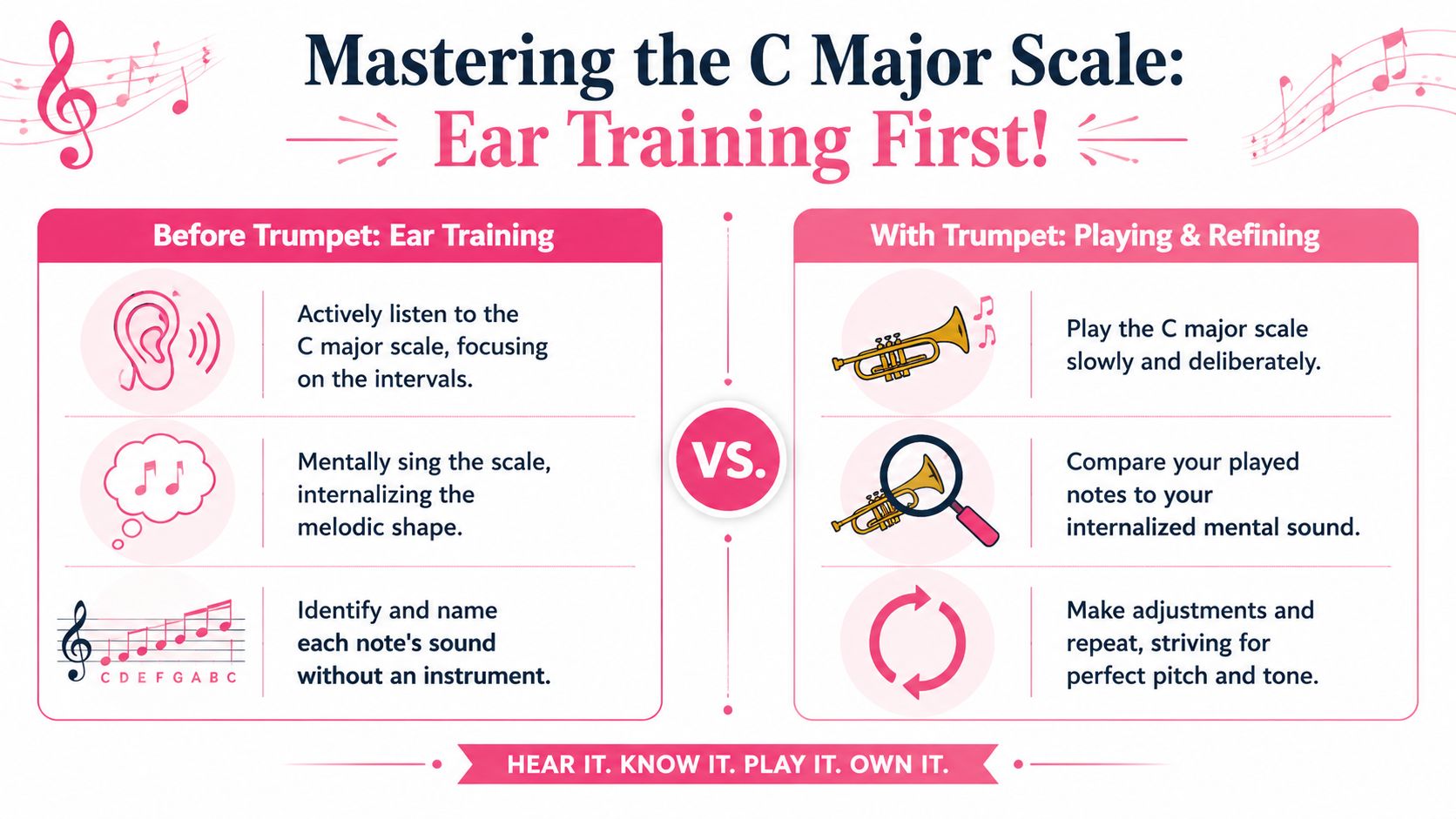
Start with your voice
Your voice is the shortest path between hearing and playing. It does not need to sound polished. It needs to tell the truth about whether you hear the next note.
Try this before you pick up the trumpet:
-
Hum the scale slowly
Start on a comfortable pitch and go up, then back down. Keep the motion steady, like walking up eight stairs and back. -
Count the scale degrees out loud
Say “1, 2, 3, 4, 5, 6, 7, 1” as you sing. Numbers help you hear the job of each note, not just its label. -
Use solfege if it feels clearer
Do, Re, Mi, Fa, Sol, La, Ti, Do gives each step its own sound identity. -
Stop on B for a moment
Listen to the tension. It wants to rise to C. Hearing that pull is more useful than memorizing that B comes before C on a chart. -
Check single notes without sliding
Sing 1, then jump straight to 3, 5, or 7. If you have to scoop around to find it, your ear is still searching.
This work trains accuracy in a musical way. You are learning the scale as a set of relationships, the same way you recognize the shape of a familiar melody.
If you want short daily drills away from the horn, ear training exercises for notes, intervals, and scales can help you build that habit.
Sing the note you want. Then let the trumpet confirm it.
Hear the shape, not just the order
A scale is more than eight notes in sequence. It has weight and direction. C feels settled. F feels like the line is opening up. B feels unfinished until it reaches C.
That is why singing first works so well. You are not memorizing a password. You are learning how each note behaves inside the key.
A simple test helps. Sing C to G. Then sing C to B. Those jumps feel different for a reason. G sounds stable. B sounds like it is leaning forward. If you can hear that difference before you play, your scale starts sounding musical the moment the horn comes up.
Written pitch and concert pitch
Beginners often get tripped up here because the note name on the page is not always the pitch the audience hears.
On a B♭ trumpet, a written C major scale sounds as concert B♭ major. So if a piano plays in concert B♭ major, your written C major scale will line up with it. Once that clicks, rehearsals make a lot more sense.
A C trumpet is different. It sounds at written pitch, which is one reason orchestral players often use it.
This can feel confusing at first, but the idea is simple. Your ear should learn two connections. First, hear how the scale sounds in the key. Second, know what that sound is called on your instrument. That is how note names, valve patterns, and real musical hearing start working together.
Trumpet Fingerings for the C Major Scale
Once the sound is in your head, fingerings become much easier to remember. Instead of recalling a random pattern, you’re attaching each valve choice to a note you already recognize.
For this section, think of the c major scale trumpet fingering chart as a translation tool. You hear the pitch in your mind, then your hand learns where it lives on the horn.
The one octave map
Here’s the standard one-octave written C major scale on B♭ trumpet.
| Note | Fingering (Valves) | Description |
|---|---|---|
| C | Open | Home note. Start with a centered, steady sound. |
| D | 1 and 3 | Often feels less natural at first, so listen carefully. |
| E | 1 and 2 | Keep the tone even as the pitch rises. |
| F | 1 | Don’t pinch. Let the air do the lift. |
| G | Open | Another open note. Match it to the quality of your low C. |
| A | 1 and 2 | Same fingering as E, different slot and sound goal. |
| B | 2 | Listen for the pull upward into high C. |
| High C | Open | Aim for resonance, not force. |
If you want a visual reference while practicing, this scale tool for trumpet practice can help you keep the note order and layout clear.
How to connect fingerings to sound
The trap is memorizing the chart and stopping there. A better way is to pair every note with a hearing task.
Try this note-by-note routine:
-
C open
Sing it first, then play it. Check whether the played note matches the note you imagined. -
D with 1 and 3
Hear it as “step 2,” not just a new fingering. It should feel like motion away from home. -
E with 1 and 2 Listen for brightness. The major quality starts to become obvious here.
-
F with 1
Keep the sound connected. Many players let the tone thin out here. -
G open
Hear it as scale degree 5. It should sound stable and confident. -
A, B, high C
Don’t rush the top. Hear the climb, especially the tension of B resolving to C.
If two notes share a fingering, your ear has to do more of the work. That’s not a problem. That’s the skill.
One more useful thought: fingerings are not music. They’re a physical response to music. The more clearly you hear the scale before playing it, the more dependable those fingerings become under pressure.
How to Make Your Scale Sound Like Music
A scale can sound flat and nervous, or it can sound like a phrase someone would want to hear. The notes are the same. The difference is how you support and shape them.
Start by listening to your sound, not just your accuracy.
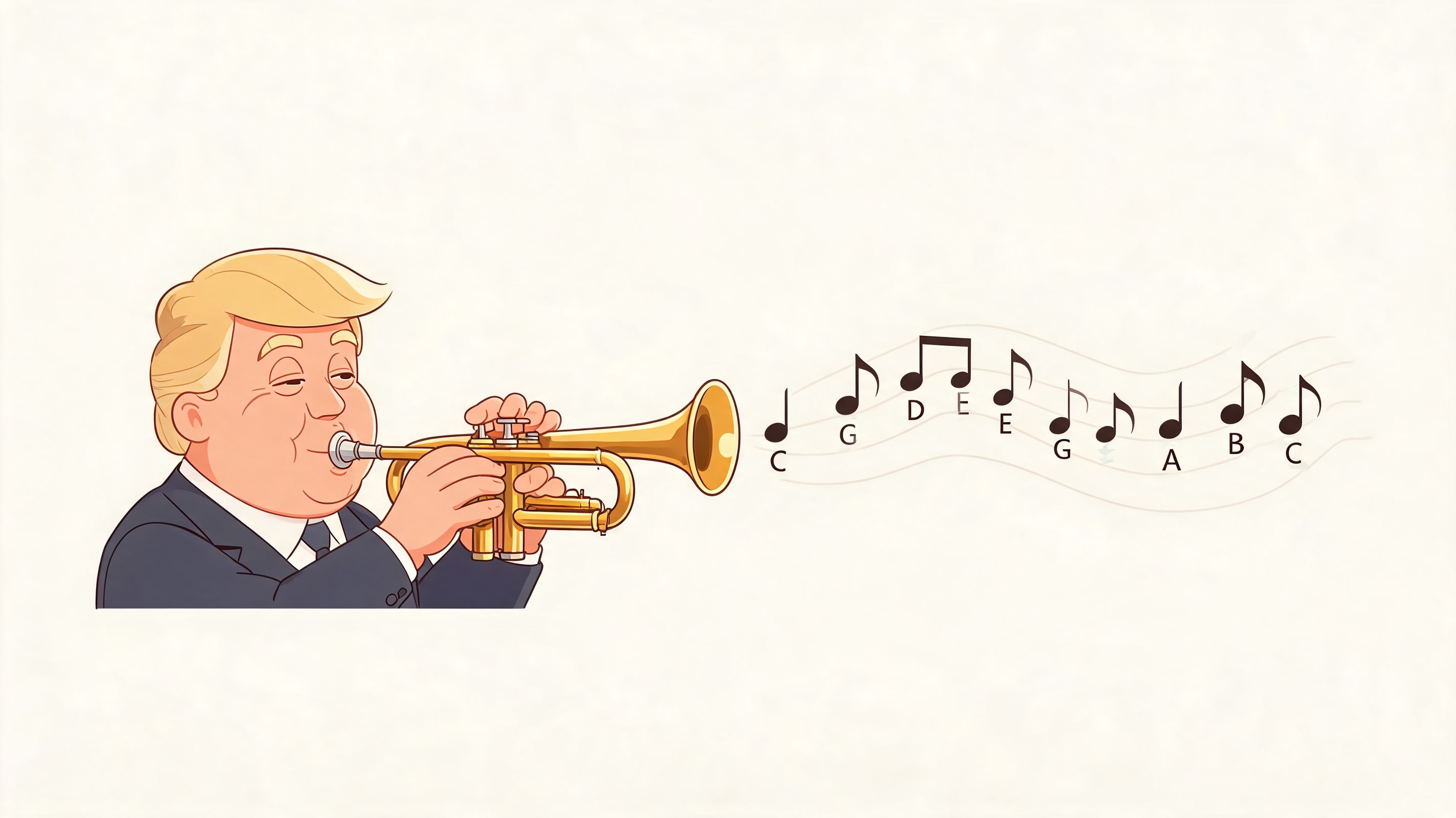
Use air to shape the line
Most scale problems start with air, not fingers. If the airstream is weak, notes start late, tone gets thin, and the top of the scale feels harder than it needs to.
Try these simple cues:
- Breathe low and full so the sound starts supported
- Blow through the note, not at it
- Keep the air moving when changing fingerings
- Crescendo slightly upward if that helps the line stay alive
Think of the scale as one sentence, not eight separate events.
Keep the setup stable
Your embouchure doesn’t need to freeze, but it does need consistency. Many players over-adjust with the lips on every note, especially when they get nervous around high C.
Focus on these checkpoints:
| Area | What to feel | Common mistake |
|---|---|---|
| Lips | Firm but flexible | Pinching on ascent |
| Jaw | Stable and relaxed | Excess movement between notes |
| Corners | Set and supportive | Collapsing on open notes |
Open notes can be deceptive because they feel easy. They often expose the most ear-related issues because there’s no valve change to guide you.
Good tone comes from steady air and a stable setup. Not from squeezing harder.
Add clean starts and clear direction
Tonguing matters, but it shouldn’t sound like hammering. Use a light, clear attack so each pitch starts cleanly without breaking the line.
A simple daily test is to play the scale two ways:
- Slurred, to check air and connection
- Lightly tongued, to check clarity and timing
After that, listen to a model and compare your version.

If your scale still sounds like an exercise, sing it again away from the horn. Very often the phrase improves the moment the ear gets clearer.
Smarter Practice That Builds Real Skill
You play the C major scale a few times, your fingers behave, and it feels done. Then a teacher asks for the third note by ear, or asks you to start on G and keep the scale in time, and the whole thing suddenly feels less secure.
That gap matters. Real scale practice should connect sound, timing, and touch, so the notes live in your ear before they show up in your valves.
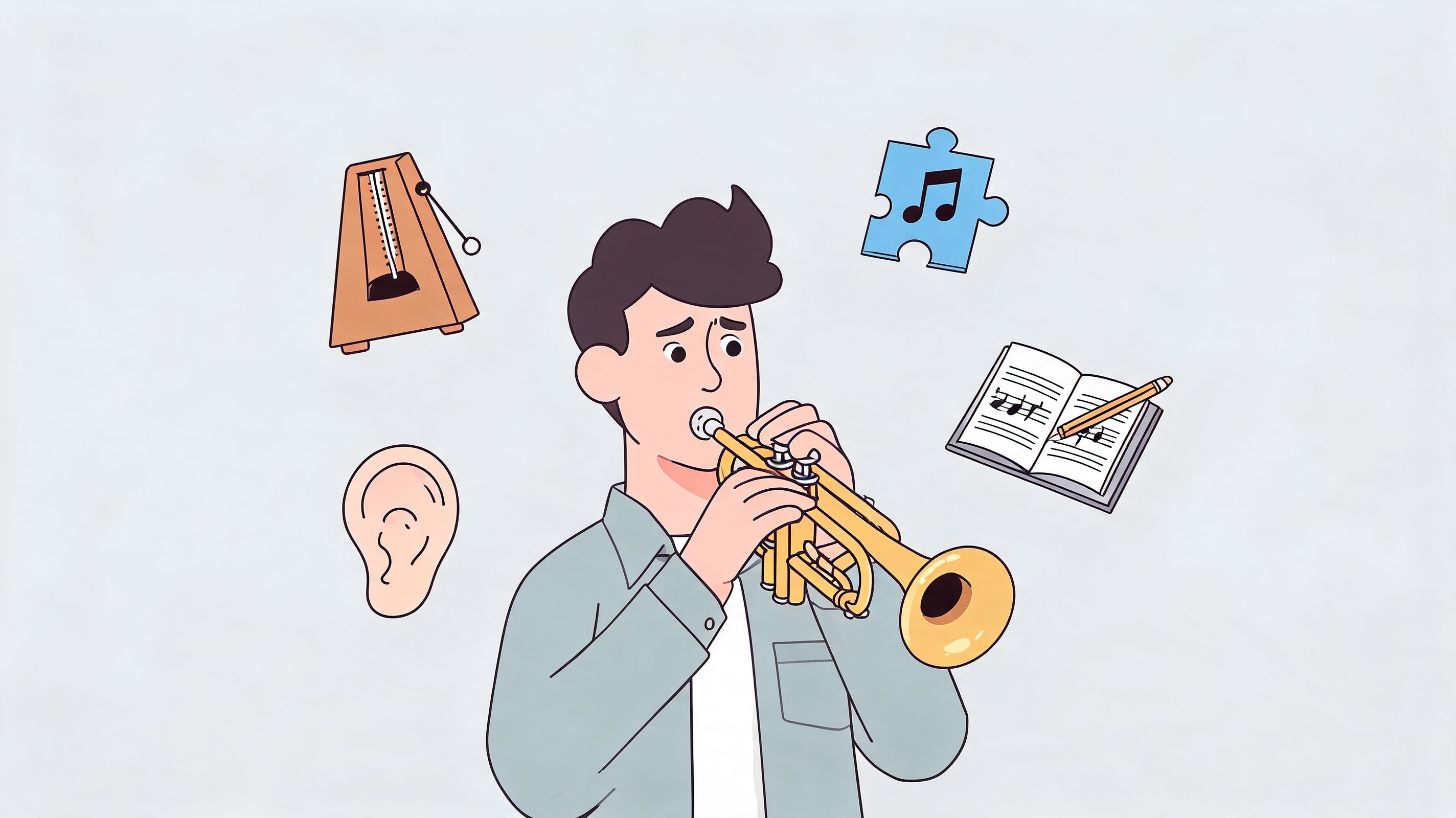
A better ten minute routine
If you only have 10 minutes, give each minute a job. Short practice works well when every step trains both hearing and playing.
Try this loop:
-
One minute of singing
Sing the scale slowly on “doo” or hum it. Hear each note before the next one arrives. -
Two minutes of slow one-octave playing
Play one octave only. Let each note settle so you can judge pitch, tone, and air support. -
Two minutes of rhythm changes
Keep the notes the same, but change the rhythm. Use long-short, short-long, or groups of three so the scale stops feeling automatic. -
Two minutes of pattern work
Play simple skips such as C-E-D-F-E-G. This teaches your ear to track scale degrees instead of relying on straight up and down motion. -
Two minutes with time support
Use a metronome for steady scale practice and keep every note evenly placed. Steady time exposes rushing much faster than guesswork does. -
One minute by ear
Start on C. Then sing and play scale degree 3, 5, or 7 without looking at music or a chart.
That routine trains recognition, not just repetition.
What to watch for in C major
C major can fool trumpet players because several notes feel physically simple. Easy fingerings often tempt you to stop listening closely.
Listen for these trouble spots:
-
Open-note drift
C, G, and high C have no valve change to guide you, so your ear has to lead. -
Uneven note length
Many players shave time off the middle notes on the way up. The scale starts to tilt forward instead of staying grounded. -
Tension before high C
The top note is rarely the first problem. Pressure usually starts building earlier, often around A or B. -
Pattern confusion
If the scale sounds fine straight up and down but falls apart in thirds, the ear has not fully mapped the key yet.
Slow practice works like a flashlight. It shows where the connection breaks between what you intend, what you hear, and what comes out of the bell.
A smart routine builds more than a cleaner C major scale. It gives you steadier time, clearer pitch memory, and faster note recognition. Those are the skills that help you learn tunes by ear, play more confidently with other musicians, and feel less tied to the page.
From Scales to Songs Your Path to Musical Freedom
You hear a simple melody across the room. Instead of hunting for notes one by one, you can tell it starts on C, climbs to E, then settles on G. That is when a scale starts doing useful work.
C major gives you a map of how melodies and chords behave. Once those sounds are familiar in your ear, songs stop feeling like isolated notes you have to chase with your fingers. You begin to recognize common shapes. Up to 3 feels different from up to 5. A note that wants to resolve back to C has its own pull. Even basic improvisation gets easier because you are choosing sounds you recognize, not pressing valves and hoping they fit.
This article has taken the opposite approach from the usual fingering-chart lesson for a reason. Fingerings matter, but hearing comes first. If you can sing scale degrees, hear where a phrase is headed, and then connect that sound to the horn, your playing becomes more musical and much less mechanical.
A useful sequence is simple. Sing the scale. Sing short patterns from it. Hear a scale degree in your mind. Then play it on the trumpet and check whether the sound in the room matches the sound in your head. That process builds a bridge between ear, air, and fingers.
The goal
The goal is to reach a point where you can say:
- I can hear where a melody is going
- I can find notes with less guessing
- I can join simple tunes by ear with more confidence
- I can use the scale to shape a phrase, not just recite it
That is how a basic c major scale trumpet exercise grows into something larger. It supports better intonation, clearer chord hearing, more flexible improvisation, and less dependence on written music.
Keep it simple and consistent. Sing first. Play second. Listen the whole time.
Ten focused minutes a day can change a lot over time, especially if you stay honest about what you hear. Ear training is not a rare talent. It is a learned skill, much like building a reliable embouchure. At first it feels slow. Then one day a melody makes sense before your fingers move, and that is where musical freedom starts.
If you want a daily system for that process, Trill: Ear Training Daily gives you short ear training practice focused on recognizing notes, intervals, chords, and scales so you can play by ear with more confidence and stop relying on guesswork.