Chord Progression Quiz: Test Your Ear in 10 Minutes
You hear a familiar song, reach for your instrument, and lose the chord changes before you can play them. Try this chord progression quiz to find out what you’re hearing clearly, then use every missed answer as a clue about what to practice next.
Table of Contents
- Six Chord Progression Questions to Try Right Now
- Hear the Bass First, Then Name the Chord
- Answer Key and Why Each Progression Sounds Right
- When More Than One Answer Fits
- Ear Training Is Trainable, Not a Talent
- Start Your First Ten-Minute Quiz Session Today
Six Chord Progression Questions to Try Right Now
Have a friend or teacher play a four-chord clip, identify the progression using Roman numerals, then check the answer key below. For the shorter ii–V–I example, repeat the final chord to keep the same listening length.
These are playable prompts, not embedded recordings. Ask your helper to use the progression column while you look away. If you’re practicing alone, record the examples beforehand and shuffle their playback order, though knowing what you recorded makes this a practice exercise rather than a blind test.
Your Listening Prompts
Six chord progression quiz questions
| Question | Progression and key | Listen for | Level |
|---|---|---|---|
| Q1 | I–V–vi–IV in G major | Bass rising to D, then settling on E minor | Beginner |
| Q2 | ii–V–I in C major | Tension on the V chord that releases on the final chord | Beginner |
| Q3 | vi–IV–I–V in D major | Starts minor, lands bright on the I | Beginner |
| Q4 | I–vi–IV–V in F major | Three major chords and one minor chord | Intermediate |
| Q5 | I–IV–V–I in A major | Strong pull back home at the end | Beginner |
| Q6 | I–V–vi–IV in E major with inversions | Same chords, different lowest note on each chord | Advanced |
For Q1, the suggested rising bass assumes your helper plays D above the opening G. A different octave placement can reverse that direction without changing the progression.
Roman numerals describe a chord’s place in the key. Capital letters indicate major chords here; lowercase letters indicate minor chords. You don’t need to identify an exact note name before hearing that a chord sounds settled, tense, or like a minor detour.
Keep the performance simple at first. Use an even pulse and clear chord changes, without a melody covering the bass. The chord progression examples can help your helper prepare additional practice material.
For each response, write the progression you heard and a short listening observation. Something like “minor opening, then brighter” is useful even if you can’t yet name every chord.
Quiz rule: Write your guess before reading the answer key. Test what you hear, not what you remember seeing.
Hear the Bass First, Then Name the Chord
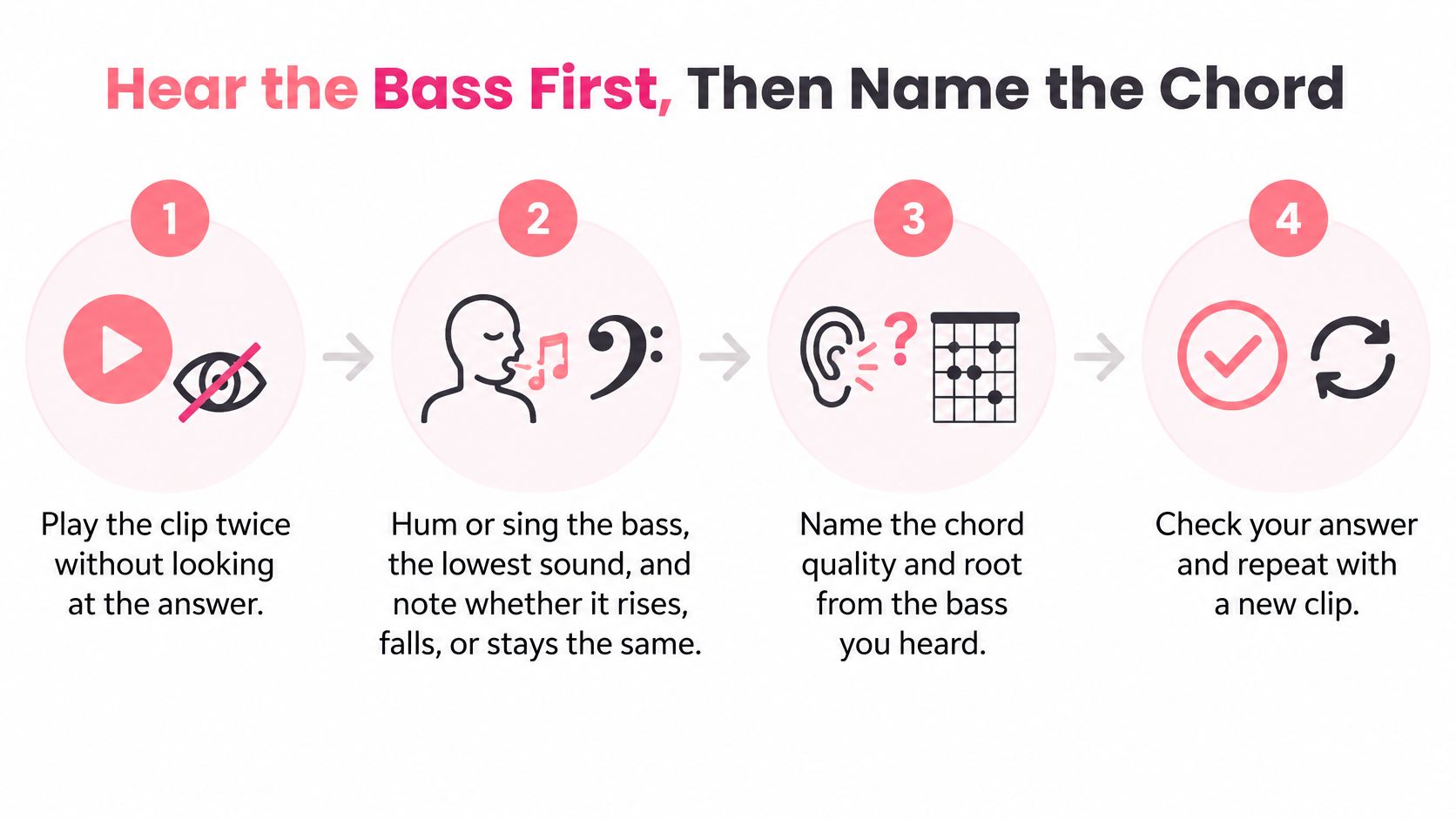
Start each answer with the same listening routine. This gives you something concrete to do when a progression sounds familiar but you can’t quite name it.
- Play the clip twice without looking. First hear the whole phrase; then focus on the changes. Don’t interrupt the first hearing to hunt for a label.
- Hum or sing the bass. Follow the lowest sound and notice whether it rises, falls, or stays still. Your voice doesn’t need to sound polished.
- Find the home chord. Listen for the chord that would make a convincing stopping point. It’s often the last chord in a complete phrase, but loops can stop somewhere unsettled.
- Describe the opening and ending roles. Does the opening feel like home or somewhere away from home? Does the ending settle or leave you waiting?
- Choose the progression and check the key. Match the complete route, not just its first chord. Check that your proposed home chord agrees with the key.
- Find the bass on your instrument and play back the progression. This tests whether your answer connects to sound and movement, rather than only to a written symbol.
Use this visual reminder when you catch yourself reaching for an answer too quickly.
The Lowest Note Is a Clue, Not the Whole Answer
A chord’s root is the note it’s named after. Its bass note is whichever note sounds lowest. Those aren’t always the same.
Play C major with C underneath E and G. Then put E underneath G and C. You’ve kept the same chord tones but changed the bass, creating an inversion.
That distinction matters to hearing. In experiments on chord inversions and bass patterns published in Music Perception, listeners rated an expected target chord above its other inversions, and rated a mismatched triad sharing its bass pitch lowest.
So don’t turn “hear the bass first” into “name every chord after the bass.” Listen upward as well. Does the complete chord sound major or minor? Does it fit the route you’ve been following?
Turn a Miss Into a Specific Exercise
Listening cues and what to practice
| Cue | What to listen for | Practice step |
|---|---|---|
| Bass movement | Which note sits lowest and where it moves | Sing the bottom note before naming any chord |
| Inversion | Same chord, different lowest note | Play the chord with the root in the bass, then with the third in the bass |
| Expected ending | Whether the last chord feels like a natural arrival | Compare a home-chord ending with one that stops on a surprise |
| Voice leading | Shared notes between neighbouring chords | Hum the top note that stays put as the chords change |
Voice leading means how individual notes move between chords. For example, C major and A minor share C and E. Hold one of those notes while changing the other notes, and hear how the connection becomes smoother.
If root-position examples feel easy but inversions confuse you, keep the chord order unchanged and alter only the bass. If you follow the bass correctly but choose the wrong chord quality, hold the bass steady and compare different upper notes.
Avoid guessing from the opening chord alone. Also resist checking the answer before you’ve sung anything. A useful result is being able to describe the bass movement, hear the chord quality, and reproduce the phrase without written notes.
Answer Key and Why Each Progression Sounds Right
Match your written responses to the key, including your listening observations. A correct label with no audible reason is less useful than a near miss you can explain.
Answer key with chord function and typical sound
| Progression | Function heard | Typical sound | Where you hear it |
|---|---|---|---|
| I–V–vi–IV | Home, pull, detour, lift | Open, emotional lift | Pop anthems |
| ii–V–I | Setup, pull, home | Smooth resolution | Jazz standards |
| vi–IV–I–V | Detour, lift, home, pull | Starts sad, ends bright | Pop ballads |
| I–vi–IV–V | Home, detour, lift, pull | Bouncy and familiar | Doo-wop and rock |
| I–IV–V–I | Home, lift, pull, home | Strong and direct | Blues and rock |
These descriptions are listening guides, not fixed emotional rules. Tempo, rhythm, melody, and performance can change the mood.
Match the Pattern to Your Instrument
- Q1: G, D, E minor, C. Listen for the minor detour after the opening major chords.
- Q2: D minor, G, C. The arrival on C answers the tension of G.
- Q3: B minor, G, D, A. The home chord arrives after a minor opening rather than starting the phrase.
- Q4: F, D minor, B-flat, C. Notice where the minor chord interrupts the major sound.
- Q5: A, D, E, A. Compare the opening home chord with its return.
- Q6: E, B, C-sharp minor, A, with inversions. The harmonic order matches Q1 even though the bass arrangement changes.
Function means the job a chord seems to do. I feels like home. V often feels like a question awaiting an answer; IV offers a lift or prepares another move, while vi can provide a softer detour. The guide to understanding chord progressions connects these roles to practical playing.
In a 2020 study by Ivan Jimenez, Tuire Kuusi, and Christopher Doll, 231 listeners with different levels of musical training judged whether they’d previously heard six diatonic four-chord progressions; the authors argue that recurring patterns can be stored as familiar harmonic shapes.
That gives you a useful practice direction: hear the same relationship in unfamiliar keys. A missed answer identifies a role you haven’t reliably recognized yet, not a permanent limit on your musical ear.
When More Than One Answer Fits
Sometimes you can hear the notes clearly but aren’t certain which chord feels like home. Other times, you’ve identified the home chord but mixed up the middle of the phrase.
Compare I–IV–V–I with I–V–IV–I. Both begin and end at home. The difference is the route between those points, so recognizing only the opening and ending won’t settle the answer.
Compare the Middle, Not Just the Edges
Try this listening test:
- Establish home. Hum the note that feels settled after the phrase.
- Isolate the middle chords. Hear which one creates the stronger expectation of returning home.
- Check the bass route. Play your candidate sequence and compare it with the clip rather than accepting the first plausible match.
Don’t rely on a rule such as “the bass rises, so this must be IV.” Inversions and octave choices can make that shortcut unreliable. Compare the chord’s sound and its position in the phrase.
In a 2020 study of 94 undergraduate and graduate music majors, 28.73% rated their progression-identification ability as weak or very weak, despite having completed at least two semesters of ear-training courses. Those were self-ratings, not quiz scores, but they show that trained musicians don’t all feel confident hearing harmony.
When you’re unsure, write what you heard clearly and what remains uncertain. Don’t replace uncertainty with a random answer.
If both interpretations still sound convincing, listen to a longer phrase. A melody or later arrival may clarify the key. Learning when you need more musical context is part of learning to play by ear.
Ear Training Is Trainable, Not a Talent
A 12-year longitudinal study of musicians and nonmusicians found that musical training positively influenced basic auditory skills, including frequency discrimination, rhythm recognition, and subjective pitch-pattern recognition. The authors attributed development to both maturation and training-induced changes, not talent alone.
You don’t need perfect pitch to recognize relationships between chords. You can practice hearing where a phrase goes without naming every note from memory.
Make attentive listening the center of your session.

Build a Week You Can Repeat
Use 10 minutes a day as a manageable practice schedule, not a promise of instant mastery. From Monday to Friday, try the quiz and sing the bass of missed examples; on Saturday, play those examples on your instrument.
Keep a simple practice log:
- Accuracy: Record which examples you identified correctly.
- Response speed: Note whether you answered promptly or needed repeated listening.
- Transfer: Record whether you could play the phrase without the answer sheet.
On Sunday, compare with your first attempt. Include basic ear training exercises: hear whether a second note goes higher or lower, recognize a repeated rhythm, then distinguish a major chord from a minor one.
Use the video as an additional listening resource.
In our 2026 onboarding survey of about 60,000 musicians, 78% said focus, consistency, structure, or time blocked their progress. That’s why we organize Trill as a daily training system: our ear training app covers chords, intervals, perfect pitch, and melodies in a 10-minute daily practice, with a progress dashboard showing accuracy and response speed improving session by session.
Judge progress by musical actions, too. Can you follow a song’s changes, accompany a singer, or improvise a phrase that fits? Those are more meaningful outcomes than a score alone.
Start Your First Ten-Minute Quiz Session Today
Set your instrument beside you before starting. Have a pencil or notes app ready, hide the progression column, and ask your helper to prepare the examples.
Keep the session small enough to finish. You’re practicing a repeatable listening action, not trying to solve every kind of harmony at once.
Your First Practice Block
| Time | What to do | What to record |
|---|---|---|
| 2 minutes | Warm up with a quiz clip. Listen once to the whole phrase, then follow the lowest notes. | Whether you can sing the bass |
| 5 minutes | Answer all six questions before checking the key. | Your answer and confidence |
| 2 minutes | Sing the bass of each missed question, then try it on your instrument. | The point where your hearing became uncertain |
| 1 minute | Log your score and the cue you’ll practice tomorrow. | A specific next action |
If a question takes too long, mark it uncertain and continue. Spending the entire session on a single puzzle makes it harder to compare how you hear different patterns.
Make Tomorrow’s Task Clear
Write a useful practice note rather than a judgment about yourself. “I confused the minor opening with home” tells you what to compare tomorrow. “I have a bad ear” doesn’t.
When starting with us, you tell us your goal and level, and we adapt the journey from single notes to full chord progressions. You don’t have to begin with dense harmony if you’re still learning to match a bass note.
Keep the promise realistic: Finish with one clearer listening cue, not an expectation that every song will suddenly become obvious.
Repeat the routine each day for a week. At the seven-day check, use a fresh performance or different key so you’re not testing only your memory of the recording.
Compare accuracy and response speed, then put the screen aside. Try to play a progression back, describe the bass before naming the chords, and add a short melody of your own. That’s how a quiz becomes practice for chord recognition, improvisation, and greater musical freedom.
Trill: Ear Training Daily offers structured listening practice, including I–V–vi–IV and similar chord progressions, to help you connect quiz answers with playing by ear. Visit Trill: Ear Training Daily, choose your goal and level, and start your first ten-minute session with one task: hear the bass before choosing the answer.