Voice Deepness Test: Find Your Vocal Pitch in Minutes
You record your voice, play it back, and immediately think, “That can’t be me.”
Almost everyone has had that moment. Your speaking voice feels different inside your head than it does through a phone speaker, and that gap can make you curious, insecure, or both. A voice deepness test gives you a way to replace that vague feeling with something useful.
For musicians, that matters a lot more than people think. Your voice is your most direct instrument. If you can understand its pitch, hear it clearly, and control it on purpose, you build skills that spill into ear training, singing in tune, improvisation, and learning to play by ear. The test isn’t the finish line. It’s the first honest measurement of where you’re starting.
Table of Contents
- Why Your Vocal Pitch Is Your Musical Starting Point
- How to Record Your Voice for an Accurate Test
- Free Apps and Tools to Measure Your Vocal Pitch
- Reading the Results What Do the Numbers Mean
- Safe Exercises to Strengthen Your Vocal Range
- Beyond Deepness How Ear Training Gives You Real Control
Why Your Vocal Pitch Is Your Musical Starting Point
A lot of people take a voice deepness test because they want reassurance. They want to know if their voice is deep, light, strong, or “normal.” But the more useful question is simpler. What pitch does your voice naturally sit on when you’re relaxed?
That starting point matters because pitch affects how people hear you. In one political analysis, a male candidate whose voice was 40 Hz lower than his male opponent’s had a 13.9% higher likelihood of winning, but that same lower voice decreased his chance of winning against a female opponent by 25.8 percentage points. The point isn’t politics. It’s that listeners respond to vocal pitch quickly and often unconsciously, as noted in American Scientist’s discussion of voice pitch and leadership.
Your voice is an instrument, not a label
If you treat the result like a judgment, you’ll miss its true value. A voice deepness test gives you a baseline, the same way a tuner gives a guitarist a reference note.
Once you know your baseline, you can start asking musical questions:
- Can you match that pitch on purpose?
- Can you hear when you drift sharp or flat?
- Can you speak or sing there comfortably without forcing?
- Can you move away from it and come back accurately?
Those are ear training questions. They’re also confidence questions.
Practical rule: Don’t chase a “better” voice before you understand the voice you already have.
What beginners often get wrong
Many singers think a lower voice automatically means a stronger voice. It doesn’t. A voice can sound deep and still be unstable, breathy, or hard to control.
For real musical growth, the first win is awareness. When you know your natural vocal center, you stop guessing. You begin to hear your own habits the way you’d hear a wrong note on piano or guitar. That shift from guessing to hearing is where musical freedom starts.
How to Record Your Voice for an Accurate Test
A voice deepness test is only as good as the recording you feed into it. If the room is noisy, if you move the phone around, or if you speak in an unnatural “radio voice,” the result gets less trustworthy.
Poor audio quality can lead to 20-30% inaccuracy in voice analysis, and a clear, natural speech sample of 10-30 seconds in a quiet environment is recommended, according to the voice depth analyzer recording guide.
Use your normal voice
Don’t try to sound deeper. Don’t try to sound more polished. Just speak the way you speak when you’re calm.
If you fake a lower tone, the app may measure that performance instead of your true speaking pitch. That’s like tuning your guitar while bending the string.
A simple recording setup that works
You don’t need studio gear. A phone is enough if you keep things consistent.
-
Find the quietest room you can
Turn off fans, TVs, and anything humming in the background. Small noises can confuse pitch detection.
-
Hold the phone in one steady position
Keep it consistent while you record. Moving it around changes the sound the mic captures.
-
Record enough material
A short burst can be misleading. Give the tool a natural sample long enough to hear your real speaking pattern.
-
Speak naturally, then add one sustained sound
First, say a few normal sentences. Then hold a comfortable “ah” for a moment. Speech shows your everyday pitch. The sustained vowel helps the software find a stable tone.
Here’s a good workflow. Read a few lines from any book, then say your name, then sustain “ah” comfortably. That gives you both real speech and a cleaner musical tone.
Two mistakes that ruin the result
A lot of first recordings fail for very ordinary reasons.
- Background noise: Traffic, room echo, and laptop fans can interfere with the analysis.
- Inconsistent delivery: Whispering, laughing, or exaggerating your low end gives the tool mixed signals.
Record once for honesty, not for impressing yourself.
If you want extra help checking the quality of your file before you test it, simple browser-based audio tools for musicians can help you listen back and catch obvious problems.
Free Apps and Tools to Measure Your Vocal Pitch
You don’t need a studio, a vocal coach in the room, or expensive software to run a useful voice deepness test. A handful of apps can do enough to give you a strong starting point.
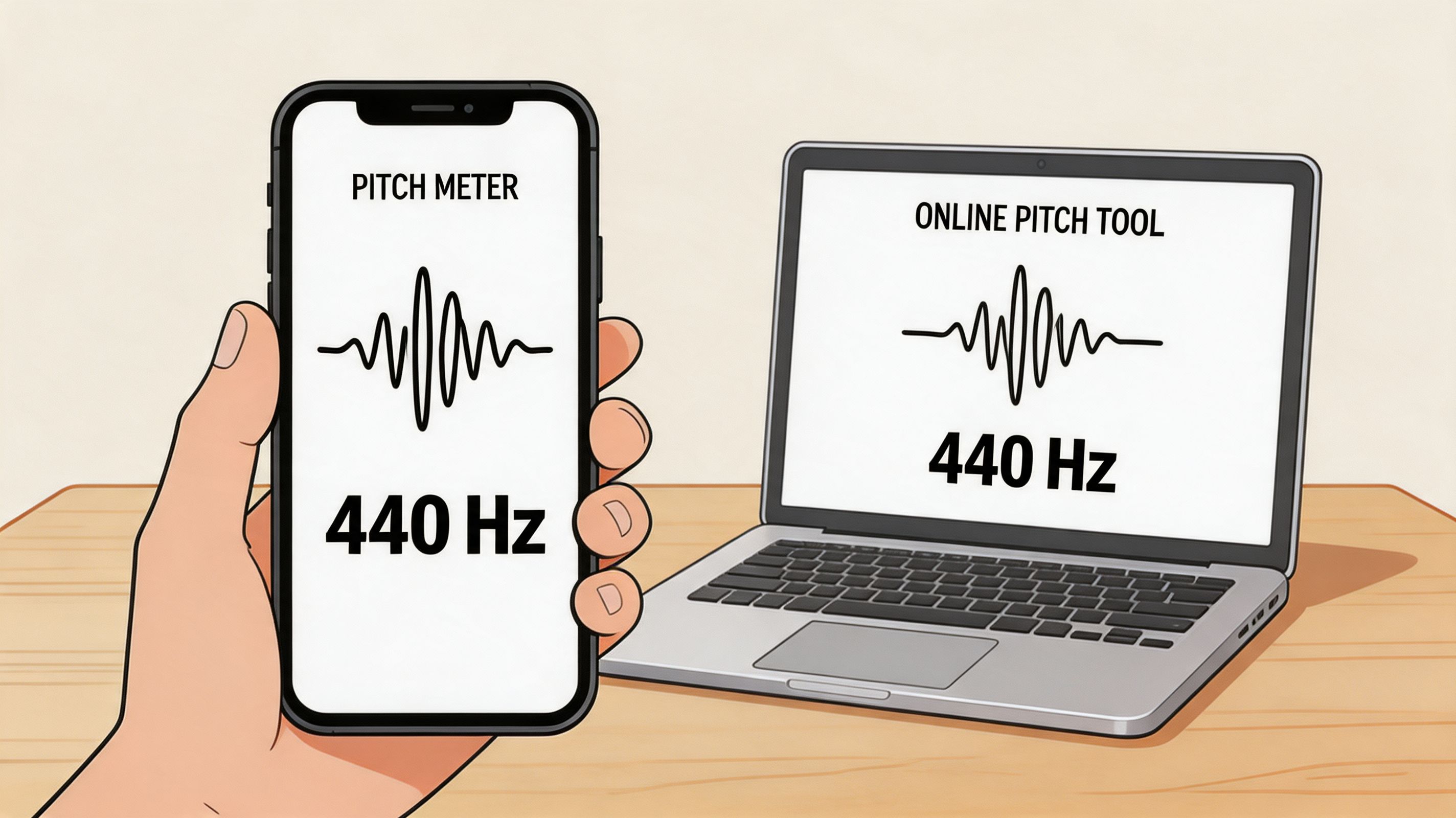
The easiest way to think about these tools is this. They work like tuners for your voice. They listen for your fundamental frequency, often written as F0, which is the main pitch your voice produces.
What different tools are good at
Some apps are built for quick curiosity. Others are better for singers who want feedback they can use in practice.
Here’s the practical difference:
- Simple pitch analyzers: Good for finding your average speaking pitch in Hz.
- Singing testers: Better if you want to see whether your pitch stays steady.
- AI voice raters: Useful when you want broader feedback on control, consistency, and tone.
One example is SingerVoiceTester-style analysis. AI-powered analyzers can compare recordings against over 10,000 professional vocal samples, return a rating in about 15 seconds, and report 85-95% accuracy on measures like pitch accuracy and tonal consistency, according to the Google Play listing for SingerVoiceTester.
What to look for in an app
Don’t choose a tool just because it looks flashy. Choose one that tells you something you can use in practice.
A good app should help you answer at least one of these questions:
- What is my average pitch?
- Does my voice stay stable or wobble?
- Can I match a target note?
- Do I drift when I sustain a tone?
If you also want to compare your spoken note against an instrument, a basic online tuner for pitch matching is useful. Sing a note, check it, then try again until your ear and voice line up.
One useful way to compare tools
The best tool depends on what you need today, not what sounds most advanced.
| Tool style | Best for | Less helpful for |
|---|---|---|
| Voice pitch analyzer | Quick speaking-pitch check | Detailed singing feedback |
| Singing test app | Steady notes and vocal control | Casual spoken samples |
| Tuner-style tool | Matching notes by ear | Broader voice scoring |
This short demonstration helps if you’ve never used a pitch app before.

The core idea isn’t collecting apps. It’s finding one tool you’ll use repeatedly. Consistency beats novelty, especially if your goal is better intonation, stronger ear training, and more confidence when you sing or play by ear.
Reading the Results What Do the Numbers Mean
Once your voice deepness test gives you a number in Hz, the next question is obvious. Is that low, high, or somewhere in the middle?
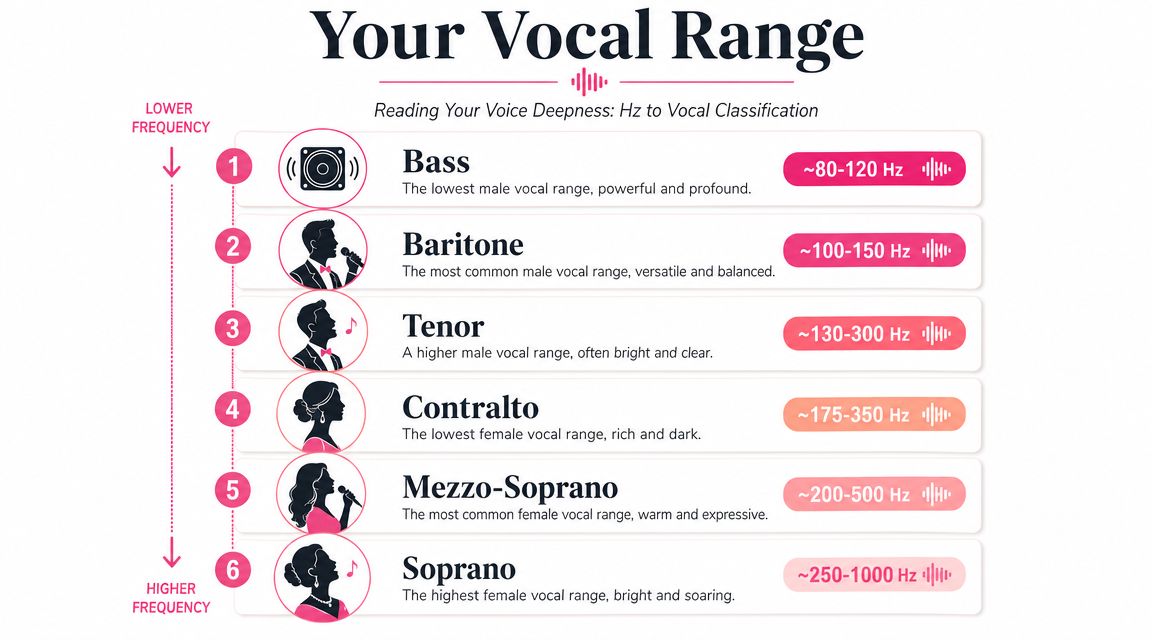
For everyday speaking pitch, typical male voices range from 85 Hz to 180 Hz, while typical female voices range from 165 Hz to 255 Hz. Those differences mainly come from the size of the larynx and vocal folds. Longer and thicker folds tend to vibrate more slowly, which produces a lower pitch.
A number is useful, but hearing is better
Here’s where many people get stuck. They get a result, maybe 110 Hz or 190 Hz, and then stop there.
But musicians need to go one step further. You should ask, can I hear that pitch relationship, not just read it? If your app says your voice centers lower today than yesterday, can you hear the difference? That’s where a measurement turns into ear training.
If you can hear your own pitch clearly, you can start adjusting it on purpose.
A simple reference table
You’ll often see broader vocal labels attached to pitch. These labels are helpful as rough orientation, not as strict identity tags.
| Voice Type | Typical Range (Hz) |
|---|---|
| Bass | Lower general range |
| Baritone | Low to middle general range |
| Tenor | Higher general male range |
| Contralto | Lower general female range |
| Mezzo-Soprano | Middle general female range |
| Soprano | Higher general female range |
The exact boundaries vary by person, training, and whether you’re measuring speech or singing. That’s why the result should start a listening process, not end it.
Turn the reading into a musical exercise
Try this at a piano, guitar, or tuner app:
- Match your speaking pitch: Say a relaxed sentence, then find that note on an instrument.
- Hold and check: Sustain the note softly and see if you drift.
- Return to center: Sing a note above it, then come back to your starting pitch without looking.
- Name what you hear: Was the return clean, sharp, or flat?
This is the bridge between a voice deepness test and real musicianship. You’re not just collecting data. You’re teaching your ear to recognize your own instrument in real time.
Safe Exercises to Strengthen Your Vocal Range
Once you know where your voice sits, you can train it more intelligently. Not lower by force. Better by control.
That distinction matters. Safe work builds stability, resonance, and flexibility. Forced work usually creates tension.
Start with breath support
Place one hand on your ribs and one on your belly. Inhale, then exhale on a soft “sss” or “vvv.” You want steady airflow, not a shove.
That steadiness gives your pitch something stable to sit on. If the breath is jumpy, the note usually is too.
Use humming to find resonance
A gentle hum helps many beginners feel where the sound vibrates without pushing the throat. Start in a comfortable part of your voice and keep the volume easy.
If the hum feels buzzy and relaxed, you’re in a good place. If your neck tightens, back off.
Add lip trills for coordination
Lip trills, sometimes called lip bubbles, connect breath and pitch with very little throat pressure. Slide smoothly from a comfortable low note to a higher one and back down.
Try them daily for a few minutes:
- Low glide: Move slowly through your lower register without pressing.
- Middle glide: Keep the sound even through the center of your range.
- Short patterns: Copy small three-note shapes like you would in ear training.
A healthy voice usually grows through repetition and ease, not through strain.
These exercises also help with a skill many players overlook. When your voice becomes steadier, your ear gets better feedback. That makes pitch matching, interval recognition, and even early perfect pitch style note memory feel less random.
Beyond Deepness How Ear Training Gives You Real Control
A voice deepness test can tell you where your voice starts. It can’t teach you how to use that voice musically.
That part comes from listening. If you can hear when you’re off pitch, hear when your tone changes, and hear where a note wants to resolve, you stop singing and playing by guesswork. You start making choices.
This is why ear training matters so much for vocal confidence. A trained ear helps you match notes faster, hold harmony more securely, recognize chord movement, and improvise with less hesitation. It also helps you trust your own sound. That trust is what many individuals are really after when they search for a voice deepness test.
Daily practice matters more than intensity. Ten minutes a day of focused listening, pitch matching, interval work, and chord recognition will do more for your musical life than obsessing over whether your voice is deep enough. The true benefit is being able to hear music clearly and respond in the moment.
If you want a structured way to build that skill, a functional ear training app for daily practice gives you a repeatable system. That’s how you learn to play by ear, sing with confidence, and build practical listening skills that carry into every rehearsal, jam, and performance.
If you want a daily system for building real listening skills, Trill: Ear Training Daily is designed for exactly that. It helps musicians practice ear training in short sessions, improve chord recognition, work toward perfect pitch, and learn to play by ear with more confidence. If you’ve used a voice deepness test and want to turn that awareness into usable musical skill, this is the next step.