What Voice Type Am I? a Guide to Finding Your Vocal Range
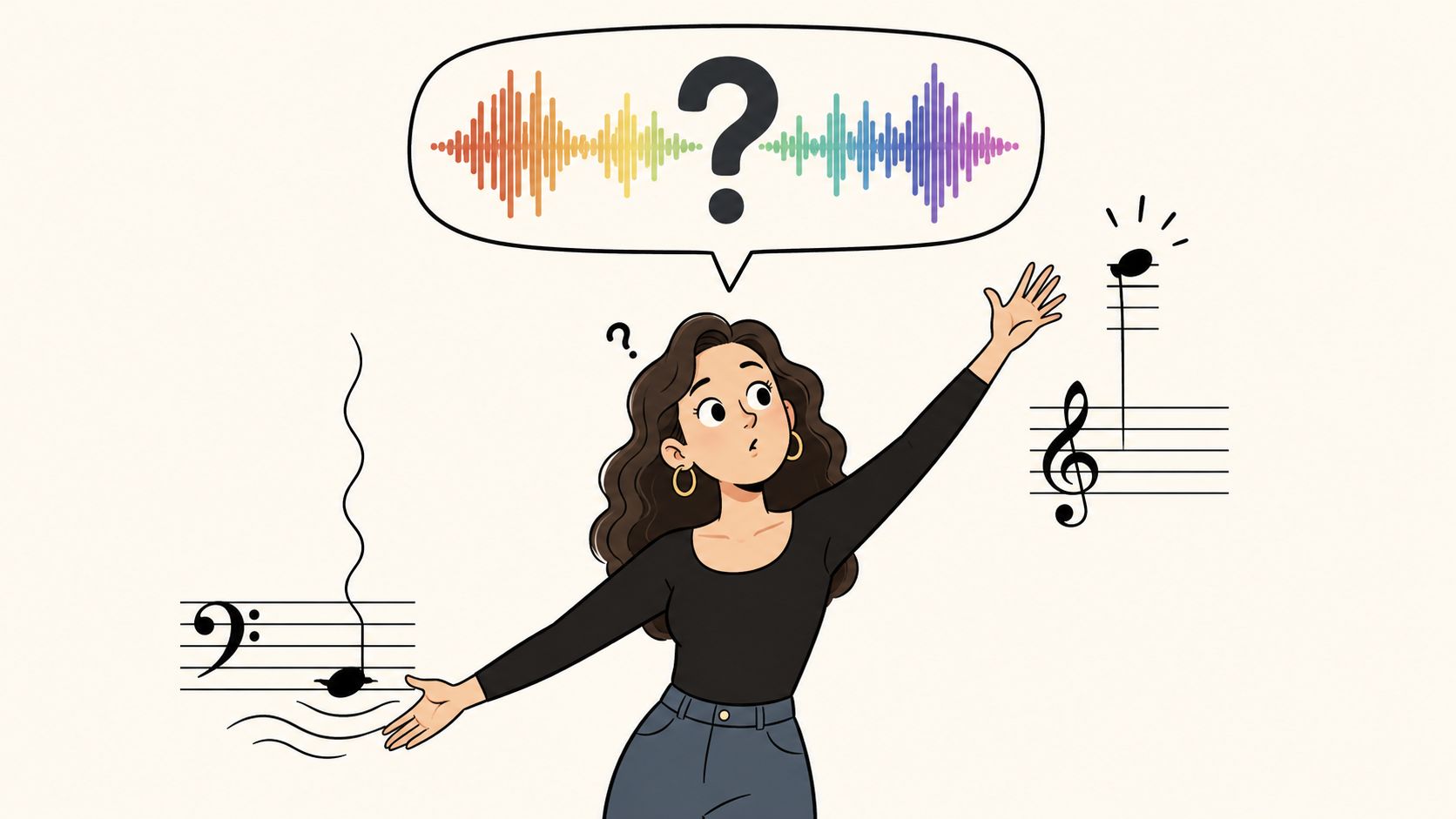
You’re singing along to a song you love, you hit a few notes comfortably, miss a few others, and then the question pops up: What voice type am I?
A common first step involves going straight to an online range test. They look for the highest note, the lowest note, and hope a label will settle it. But your voice doesn’t work like a personality quiz. A useful answer comes from listening closely to how your instrument behaves, where it feels easy, where it shifts, and what your ear notices in real time.
That’s good news, because it means voice type isn’t just something you’re born knowing. It’s something you can uncover by learning to hear yourself better. If you can train your ear to notice pitch, register changes, resonance, and comfort, you can get much closer to the truth than any guess based on extremes alone.
Table of Contents
- What Your Voice Type Really Means
- Why Your Vocal Range Isn’t the Whole Story
- Find Your True Vocal Range and Tessitura
- Listen for Your Vocal Break or Passaggio
- Interpreting Your Results The Common Voice Types
- From Label to Skill Train Your Ear Daily
What Your Voice Type Really Means
If you’re asking what voice type am I, you’re probably looking for a name. Soprano. Alto. Tenor. Baritone. Bass. Maybe mezzo-soprano or contralto. Those labels can help, but they matter most when they describe how your voice works.
Historically, voice classification in Western classical singing has never been based on one magic note. It has been built from multiple clues, including range, tessitura, timbre, and passaggio. Research also supports the idea that classification can be informed by measurement rather than pure opinion. A 2012 PubMed study on female voice classification found that objective measurements from voice range profiles could discriminate between soprano, mezzo-soprano, and contralto.
A label is less important than a pattern
Your voice type is better understood as a pattern than a badge.
Two singers might both reach the same top note. One gets there with ease, clarity, and a bright ring. The other strains, spreads, or only touches it briefly. On paper, they may look similar. In sound and function, they may be very different.
That’s why hearing matters so much. You’re not only asking, “What notes can I hit?” You’re asking:
- Where does my voice settle naturally
- Which notes sound full and easy
- Where do I start to push
- When does the voice change gear
Practical rule: If a note is only available on a good day with tension, it tells you less about your type than a note you can sing cleanly and repeatably.
Ear training helps you answer the right question
Many singers chase a category before they’ve learned to hear themselves clearly. That usually leads to forcing high notes, dragging heavy sounds upward, or choosing songs that don’t fit.
A better approach is to train your ear alongside your voice. When you get better at hearing pitch accurately, noticing tone changes, and recognizing where your voice feels stable, voice typing stops being guesswork. It becomes observation.
And that skill carries beyond labels. It helps you sing in tune, harmonize more confidently, improvise with less fear, and play by ear with more freedom.
Why Your Vocal Range Isn’t the Whole Story
People often think voice type means range. It doesn’t. Range is useful, but by itself it can mislead you.
Common guides often show overlapping ranges. For example, basses are often shown as C2 to F4 and baritones as E2 to A4, which means they share a large part of the keyboard. That overlap is one reason range-only tests fail, because true classification also depends on tessitura, timbre, and passaggi, as noted in this discussion of overlapping voice ranges and range-only tests.
Tessitura matters more than bragging notes
Tessitura means the part of your range where your voice likes to live. It’s the area where you sound steady, expressive, and comfortable.
Think of it this way. Your full range is the entire house. Your tessitura is the room you enjoy spending time in.
You may be able to touch a very low note or a high note. That doesn’t mean your voice belongs there for whole phrases, repeated practice, or real songs. If a melody sits in a part of your voice that always feels tight or dull, that’s a clue.
Timbre changes the picture
Timbre is the color of your voice. Some voices sound lighter, warmer, brighter, darker, heavier, or more agile. Two singers can sing the same pitch and still sound completely different.
That’s why a tenor and a baritone can overlap for several notes without being the same type. One may feel at home higher up with a lighter, more ringing color. The other may sound richer and more settled lower down.
Here’s where beginners get confused:
- They count possible notes, not repeatable notes
- They confuse strained highs with natural highs
- They ignore where the voice sounds best
- They choose a label based on one song
A voice type should explain your easiest singing, not your most extreme moment.
What your ear should notice
When you sing simple scales or familiar melodies, listen for the notes that feel centered. Those are often more revealing than your extremes.
Ask yourself:
- Does this note ring without pushing
- Can I repeat it several times without fatigue
- Does the tone stay consistent
- Would I want to sing a whole phrase here
Those questions train the ear and the body together. That’s a far better path than trying to win a range contest.
Find Your True Vocal Range and Tessitura
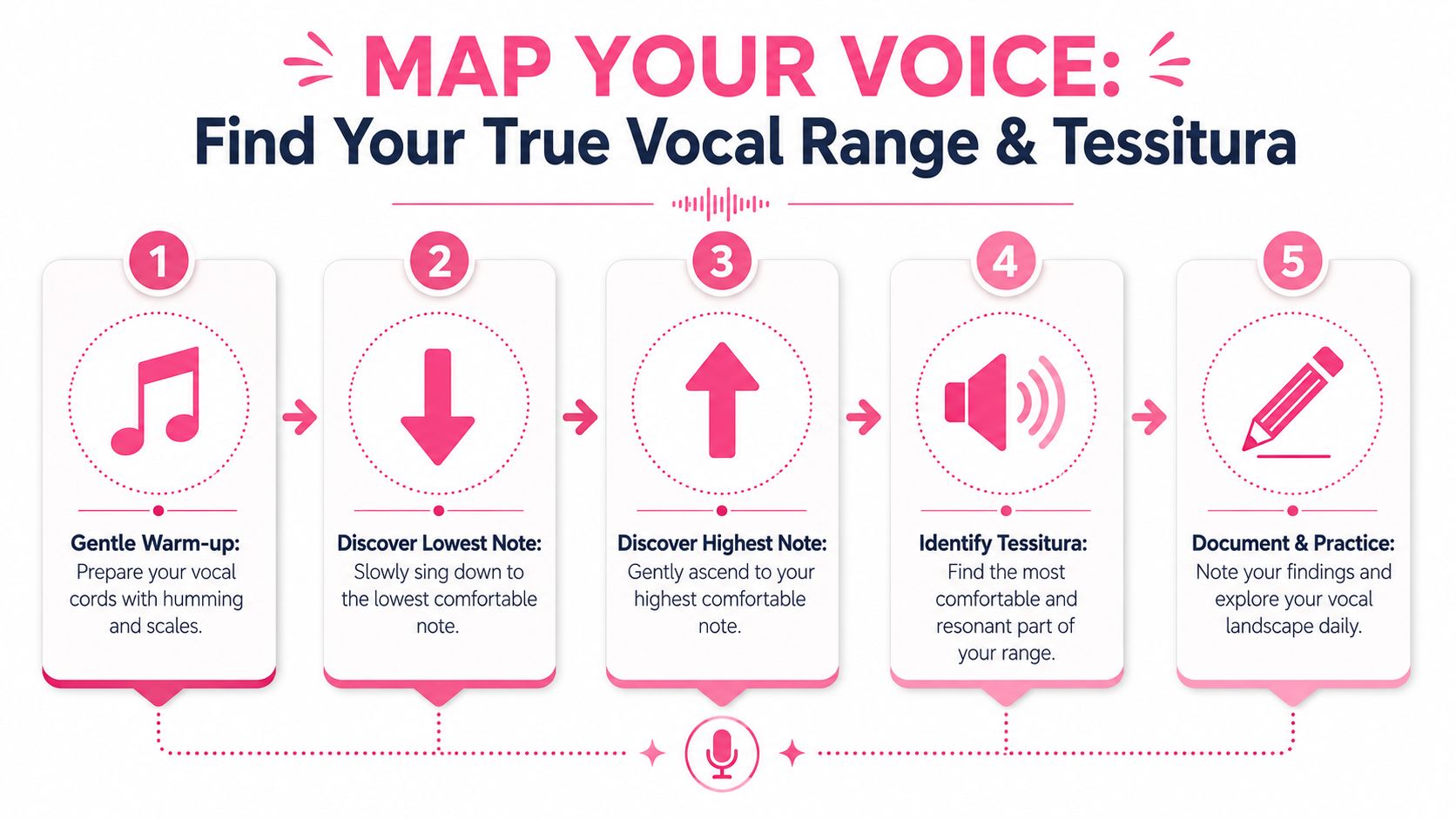
The best way to start is simple. Use a piano, keyboard app, or another reliable pitch source and map your voice gently. Don’t hunt for heroic notes. Look for notes you can sing with control.
Start with the edges, but stay honest
Voice pedagogy recommends a multi-factor process. A reliable method includes recording your lowest and highest singable notes, identifying register shifts with scales, and comparing those points to your comfortable singing center, or tessitura, as explained in this guide to determining singing range and vocal fach.
Try this sequence:
- Warm up gently with humming, lip trills, or very easy five-note patterns.
- Go downward slowly on a comfortable vowel like “ah” or “oo” until the tone loses clarity.
- Go upward slowly until the sound stops feeling free.
- Write down the last comfortable note on each end, not the most forced one.
- Repeat on another day to see whether the notes are consistent.
If you’re also curious about vocal depth, this voice deepness test guide can help you think about how your lower sound behaves without reducing everything to one label.
Find the part of your voice that feels like home
After you’ve found the edges, shift your attention to the middle. The useful information usually appears here.
Sing a very familiar melody, something simple enough that you don’t have to think about words or rhythm. Move it slightly lower, then slightly higher. Notice where your voice becomes easier, clearer, and more expressive.
Look for these signs of tessitura:
- Steady tone. The sound doesn’t wobble or spread.
- Easy breath flow. You don’t feel like you’re pushing air to make the note happen.
- Reliable pitch. You land closer to the center of the note without sliding around.
- Good endurance. You could sing several phrases there without fatigue.
Listening cue: The right area often feels less exciting than your extremes. It sounds normal, balanced, and easy. That’s usually a strong sign.
A short demonstration can help you hear this process more clearly:

Use your ear, not your ego
Many singers overshoot because they’re trying to prove something. They want the higher identity or the lower identity. That mindset blocks useful listening.
Instead, keep a small practice note with three columns:
| What I sang | How it felt | What I heard |
|---|---|---|
| Lower notes | Easy or heavy | Clear or breathy |
| Middle notes | Relaxed or effortful | Centered or unstable |
| Higher notes | Free or tight | Ringing or pushed |
That little habit trains perception. Over time, your answer to “What voice type am I?” gets less fuzzy because you’re building evidence from repeated listening.
Listen for Your Vocal Break or Passaggio
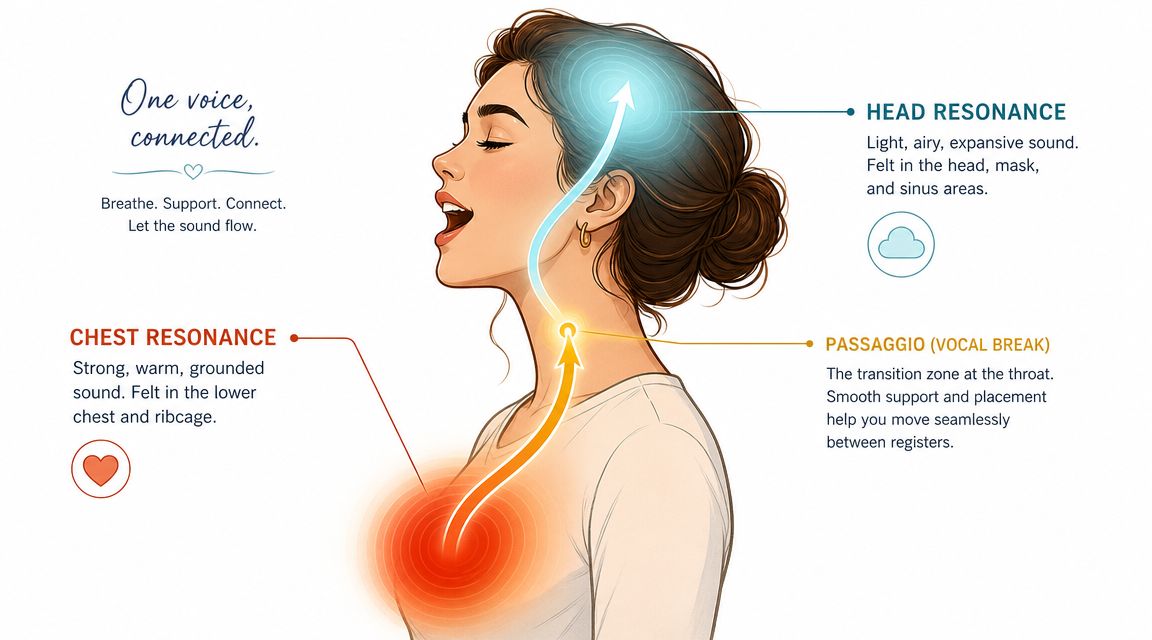
One of the clearest clues in voice typing is the passaggio. That’s the area where your voice transitions between registers. Many singers call it a break, a flip, a lift, or a place where things suddenly feel different.
A simple way to think about it is a gear shift. Your voice can’t stay in the same setup forever as pitch rises or falls. At some point, it needs to reorganize.
What a passaggio can sound like
You may notice one or more of these:
- A sudden change in tone color
- A note that wants to crack
- Extra effort on one specific part of a scale
- A shift from chest-heavy feeling to a lighter setup
Some singers hear it immediately. Others only notice it after several days of careful listening. That’s normal.
If your voice feels clumsy around this area, don’t force it. A passaggio is not a problem to beat into submission. It’s information.
A simple exercise for hearing the shift
Choose one vowel, such as “oo” or “ah.” Sing a slow ascending five-note scale, then come back down. Keep the volume moderate. Repeat several times, each time starting one note higher.
Listen for where the voice begins to reorganize. You’re not chasing a perfect sound. You’re trying to hear the moment where the setup changes.
A few reminders make this easier:
- Stay light. Loud singing can hide the transition.
- Use one vowel consistently. That makes the change easier to detect.
- Notice both sound and sensation. Your ear and your body should work together.
- Stop before strain. If you’re pushing, you’re no longer observing clearly.
If your voice feels stiff before this exercise, use a good vocal warm-up routine first so you’re listening to your voice in a more natural state.
Don’t ask, “Can I muscle through this note?” Ask, “What changed right there?”
Why this matters
Your passaggio helps explain why one singer feels comfortable where another struggles. It also helps explain why range charts alone can’t solve the puzzle. The notes where your voice shifts can reveal more than the notes you can briefly touch.
For ear training, this is a great exercise because it teaches you to hear subtle change. That same listening skill improves tuning, phrasing, and the ability to play by ear more accurately.
Interpreting Your Results The Common Voice Types
Once you’ve gathered clues from your range, your comfortable center, and your register shifts, you can start looking for a best fit. Not a prison. Not a final identity. Just a useful category that helps you choose music and train intelligently.
Historically, Western classical voice classification uses several criteria together, including range, tessitura, timbre, and passaggio. It has never been only about highest and lowest notes, as summarized in this overview of voice type and standard reference ranges.
Common Voice Types at a Glance
| Voice Type | Typical Range | Description |
|---|---|---|
| Soprano | C4–A5 | Usually the highest common female category. Often comfortable in a higher tessitura. |
| Mezzo-Soprano | A3–F5 | Often sits slightly lower than soprano, with a different vocal color and center. |
| Alto or Contralto | F3–D5 | Typically the lowest common female category, often with a deeper comfortable center. |
| Tenor | C3–C5 | Usually the highest common male category, often more comfortable in higher melodies. |
| Baritone | A2–A4 | Often sits between tenor and bass, with a middle-centered comfort zone. |
| Bass | E2–E4 | Typically the lowest common male category, often most comfortable in lower singing. |
These ranges come from the same broad system that also lists female choral ranges such as soprano C4–A5, mezzo-soprano A3–F5, alto F3–D5, and male ranges such as tenor C3–C5, baritone A2–A4, and bass E2–E4 in common references linked above.
How to use the table without boxing yourself in
Start with the range that overlaps most with your repeatable, comfortable notes. Then compare that to where your voice sounded strongest and where your passaggio showed up.
If your top notes exist but your middle voice feels fuller lower down, you may not be the higher type you first assumed. If your lower notes exist but your songs feel alive higher up, your label may shift upward.
A few useful considerations:
- Soprano and tenor often feel more at home higher.
- Mezzo-soprano and baritone often center in the middle.
- Contralto and bass often settle lower.
That’s simplified, but it helps as a first pass.
Common mistakes when naming your type
Reality check: Most beginners don’t mishear one note. They misread the overall pattern.
Watch out for these traps:
- Choosing the rarest label because it sounds special
- Using one song as proof
- Ignoring fatigue
- Confusing undeveloped technique with fixed voice type
Your voice may also change as coordination improves. A beginner voice often hides its best qualities under tension, breathiness, or imitation. That’s why patient listening matters more than fast labeling.
From Label to Skill Train Your Ear Daily
Finding your voice type is helpful. It tells you where your voice may work best right now. But the bigger win is learning to hear your instrument clearly enough to use it well.
That’s where real musical freedom begins.
If you can hear pitch more accurately, notice when a note sits too high or too low, and recognize when your tone changes, you’ll make smarter choices in songs, warm-ups, harmonies, and improvisation. You won’t just know your label. You’ll know how to sing.

The skill that connects voice and ear
A lot of singers separate vocal practice from ear training. That’s a mistake. Your ear tells your voice where to go, how to tune, and when something is off.
Daily ear work helps with:
- Pitch accuracy so you stop sliding around notes
- Interval recognition so jumps feel more predictable
- Chord hearing so harmonies make more sense
- Playing by ear so you can follow music without always needing sheet music
- Improvisation so your ideas sound intentional instead of random
If singing in tune is a struggle, this guide on how to improve pitch accuracy in singing is a strong next step.
A simple 10 minute daily routine
You don’t need a massive routine. You need a consistent one.
Try this:
-
Two minutes of matching single notes
Hear a pitch. Sing it back. Check whether you landed above, below, or right in the center. -
Three minutes of short interval practice
Sing small note jumps, then wider ones. Listen for whether the second note feels placed or guessed. -
Three minutes of melody recall
Hear a short phrase and sing it back without overthinking. This builds practical musical memory. -
Two minutes of song transfer
Take a real melody you know and move it into the part of your voice that feels best. That connects ear training directly to your tessitura.
Why consistency beats intensity
You’ll get more from 10 minutes a day than from one huge session you don’t repeat. Ear training is trainable. It’s not reserved for people with perfect pitch, and it isn’t some mysterious gift.
The same goes for playing by ear. People who seem naturally good at it often spent a lot of time listening closely, matching sounds, correcting themselves, and repeating the process until it became instinctive.
Your ear is your main instrument. Your voice follows it.
Once you start hearing your own habits more clearly, the question changes. Instead of only asking what voice type am I, you start asking better questions. Where is my pitch most reliable? Where does my tone open up? How can I shape this phrase more musically? Those are the questions that lead to progress.
If you want a simple daily system for ear training, Trill: Ear Training Daily helps you build the listening skills that make everything easier: matching pitch, recognizing intervals, hearing chords, developing perfect pitch habits, and learning to play by ear with more confidence. Just 10 minutes a day can turn vague guessing into clear musical hearing.