8 Country Song Chord Progressions: Master Them by Ear
Stop Guessing Chords: Hear Country Music Like a Pro
You’re sitting with your guitar, someone starts a country tune, and you know this feeling. Your hand hovers over the strings while your brain tries to guess the next chord before the song moves on without you. You might know a few shapes, maybe even a few songs, but hearing the change in real time still feels slippery.
That gap isn’t about talent. It’s about ear training.
If you want to play by ear, jam with other musicians, or stop relying on tabs for every song, country music is a great place to start. Country song chord progressions are often built from a small, reusable set of patterns. That makes them easier to hear, easier to memorize, and easier to practice in a way that turns theory into instinct.
One teaching source notes that country music leans heavily on major chords, often with dominant 7th color, and points to practical progressions like G-C-D and C-F-G as common starting points in the genre. It also cites a large analysis of 680,000 songs where the country subset leaned strongly on G, C, D, A, and F, which made up 61% of all chords played in that subset, a useful sign of how concentrated the harmonic language can be for learners listening by ear (country chord progression lesson).
That’s good news. It means you don’t need to hear everything at once. You need to hear a few patterns clearly, then practice them daily until they become familiar.
Table of Contents
- 1. I-IV-V-I The Classic Country Foundation
- 2. I-IV-I-V The Shuffle Variation Country Swing
- 3. vi-IV-I-V The Emotional Country Ballad
- 4. I-V-vi-IV The Modern Pop-Country Cycle
- 5. IV-I-V-I The Bluegrass and Traditional Country Pattern
- 6. I-vi-IV-V The Emotional Country Story
- 7. I-IV-vi-IV The Soft Country Ballad Variation
- 8. I-ii-IV-V The Gospel and Traditional Country Progression
- 8 Country Chord Progressions Compared
- Your Daily System for Playing by Ear
1. I-IV-V-I The Classic Country Foundation
If you only learn one progression first, make it this one. I-IV-V-I is the core sound of classic country. It feels direct, stable, and familiar because your ear hears a clear beginning, movement, tension, and return.
In the key of G, that’s G-C-D-G. In the key of C, it’s C-F-G-C. You’ll hear versions of this all over country, especially in songs built for singing, strumming, and joining in fast.
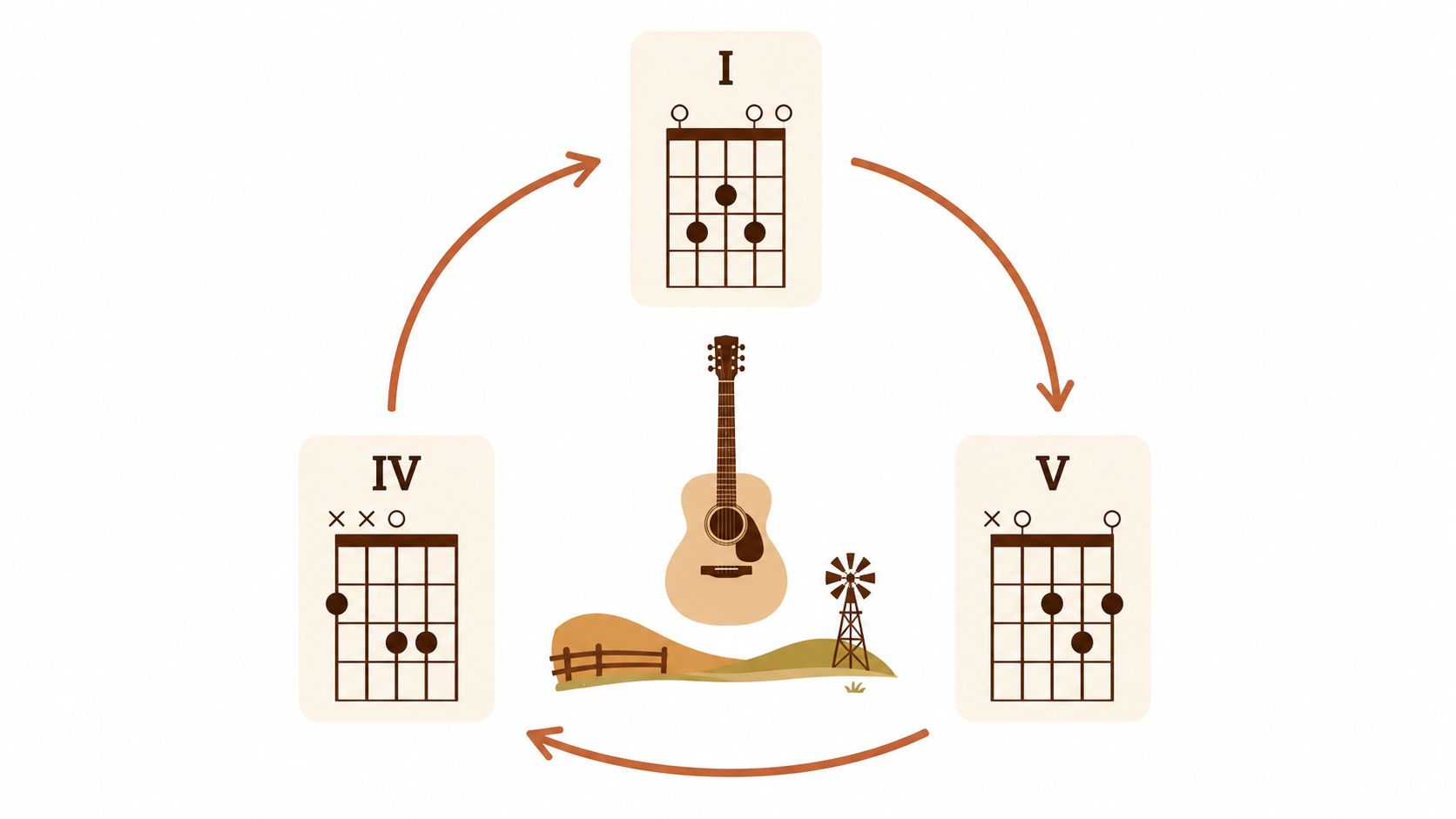
The reason this progression matters for ear training is simple. It teaches your ear where “home” is. The I chord sounds settled. The IV sounds like the song is moving outward. The V sounds tense and ready to come back. Once you can hear that V-to-I pull, you’ll stop guessing so much.
Johnny Cash, Hank Williams, Willie Nelson, and Dolly Parton all have songs or song sections that live close to this sound world. Even when a song adds a twist, the ear often still tracks this basic foundation.
Hear the pull of home
Start by strumming only one bar of each chord and singing a simple note over the top. Don’t worry about sounding polished. The point is to hear how each chord feels against the same sung note.
A simple guide to what a chord is can help if the number system still feels abstract, but your main job is to connect sound to function, not memorize labels.
Practical rule: The V chord should feel like it wants to go somewhere. When you hear that urge to resolve, listen for I next.
Try these short drills:
- Sing the root note: Play G-C-D-G and sing “home, away, tense, home.”
- Pause before the last chord: Stop after the V chord and predict the return before you play it.
- Change keys often: Move the same pattern through G, D, and A so your ear learns the shape, not just one finger position.
Playing by ear begins to feel real. Not because you know the theory name, but because your ear begins to expect the next move.
2. I-IV-I-V The Shuffle Variation Country Swing
This progression sounds close to the classic pattern, but it behaves differently enough to trip people up. Instead of moving from IV straight to V, it returns to I first. That little detour changes the feel. It adds bounce, swing, and a rolling motion that fits honky-tonk, country shuffle, and train-beat playing.
In G, you’d hear G-C-G-D. That middle return to G can feel like the song is settling, but it hasn’t finished. That’s why this pattern is useful for ear training. It teaches you not to mistake a temporary return for the final answer.
Chet Atkins, Jerry Lee Lewis, Hank Williams, and Merle Haggard all point you toward this kind of movement in different ways. The rhythm matters as much as the harmony here. If you strum it stiffly, you’ll miss the character.
Listen for the fake finish
The hardest part is hearing the I chord in the third slot and not assuming the phrase is over. Your ear says, “we’re back home,” but then the V arrives and pushes the song forward again.
That makes this progression perfect for learning musical patience. You hear a return, but not the ending.
Don’t just identify the chord. Identify whether the phrase still feels open or closed.
Use a shuffle groove when you practice. Tap your foot and count evenly, but let the strum lilt. The groove will help your ear separate the temporary resting point from the true cadence.
A useful routine:
- Loop only four chords: Play I-IV-I-V again and again until the shape feels conversational.
- Mute and predict: Have a friend or backing track mute the fourth chord. Sing whether you expect I or V.
- Practice fast and slow: This pattern can feel obvious at one tempo and blurry at another.
If you want stronger chord recognition, don’t only practice still examples. Practice moving examples. Country swing teaches your ear that timing changes perception.
3. vi-IV-I-V The Emotional Country Ballad
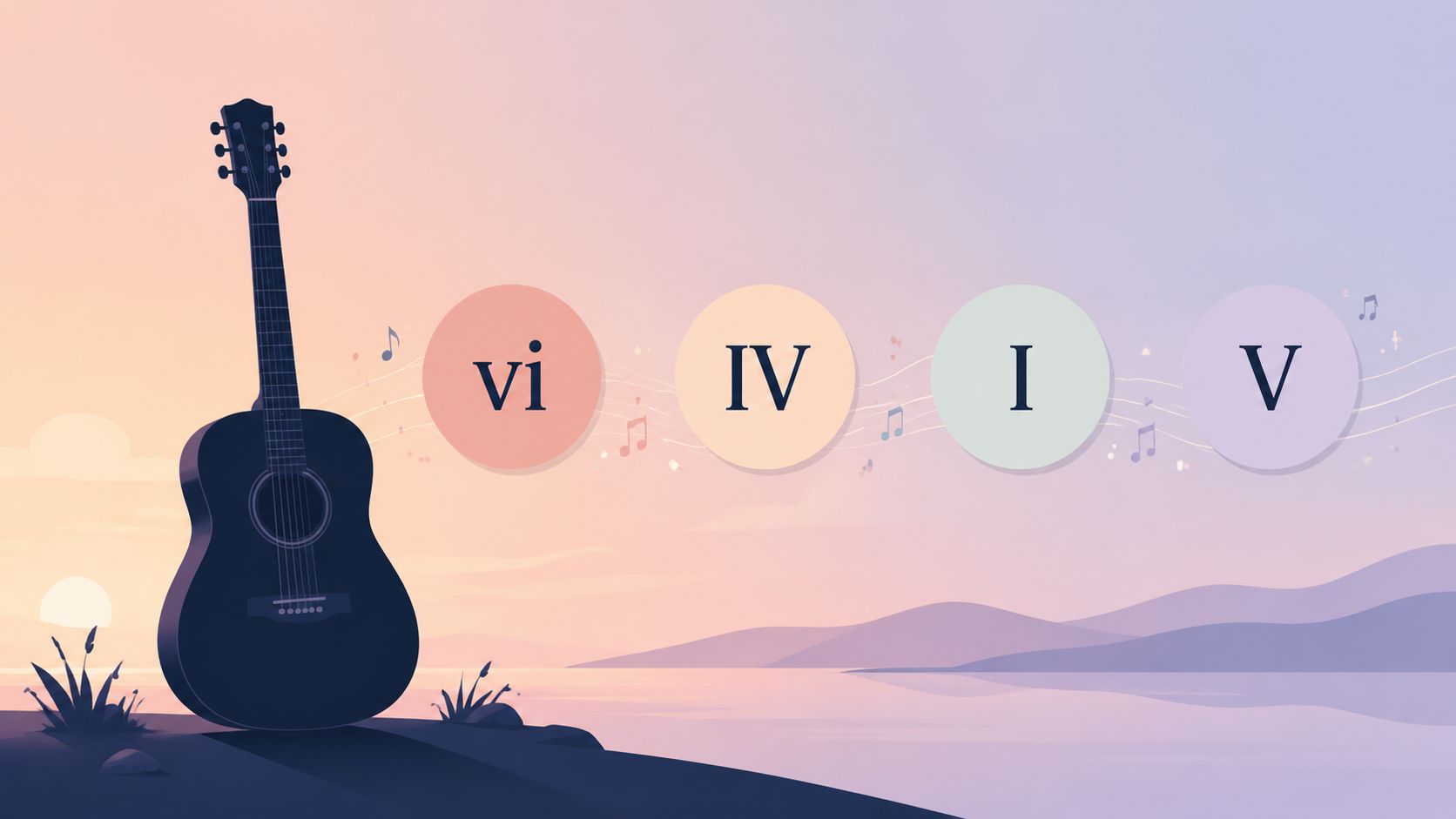
This one changes the mood right away because it starts on a minor chord. In C major, that’s Am-F-C-G. The chords are still familiar, but the emotional entry point is different. Instead of opening on “home,” the song begins with reflection.
That matters for country ballads. A lyric about regret, distance, memory, or longing often lands better when the progression opens on vi. Your ear hears the same chord family as a pop progression, but the order changes the story.
You’ll hear this kind of shape in modern singer-songwriter and country-adjacent writing. It works well for slower songs because the first chord immediately creates emotional color without becoming harmonically complicated.
Hear the minor opening
A lot of players can spot a major chord change before they can confidently identify a minor one. That’s normal. Ear training fixes that through repetition.
When this progression starts, don’t rush to name the exact chord. First ask, “Does this opening feel settled and bright, or softer and sadder?” That first emotional distinction is often enough to tell you you’re not on I.
A quick refresher on how chords are built in basic music theory can help you understand why vi feels related to I, but the important step is hearing the relationship.
Try this as a singing drill:
- Play vi and I back to back: In C, switch between Am and C until you can hear the contrast quickly.
- Sing one melody note over both: Notice how the same note feels more exposed over vi.
- Resolve by ear: After vi-IV-I, pause and sing where you expect the fourth chord to go.
This progression is great for building musical freedom because it teaches you that hearing “sad” doesn’t mean you’ve left the key. You’re still inside the same harmonic family. Your ear just needs to hear the family resemblance.
4. I-V-vi-IV The Modern Pop-Country Cycle
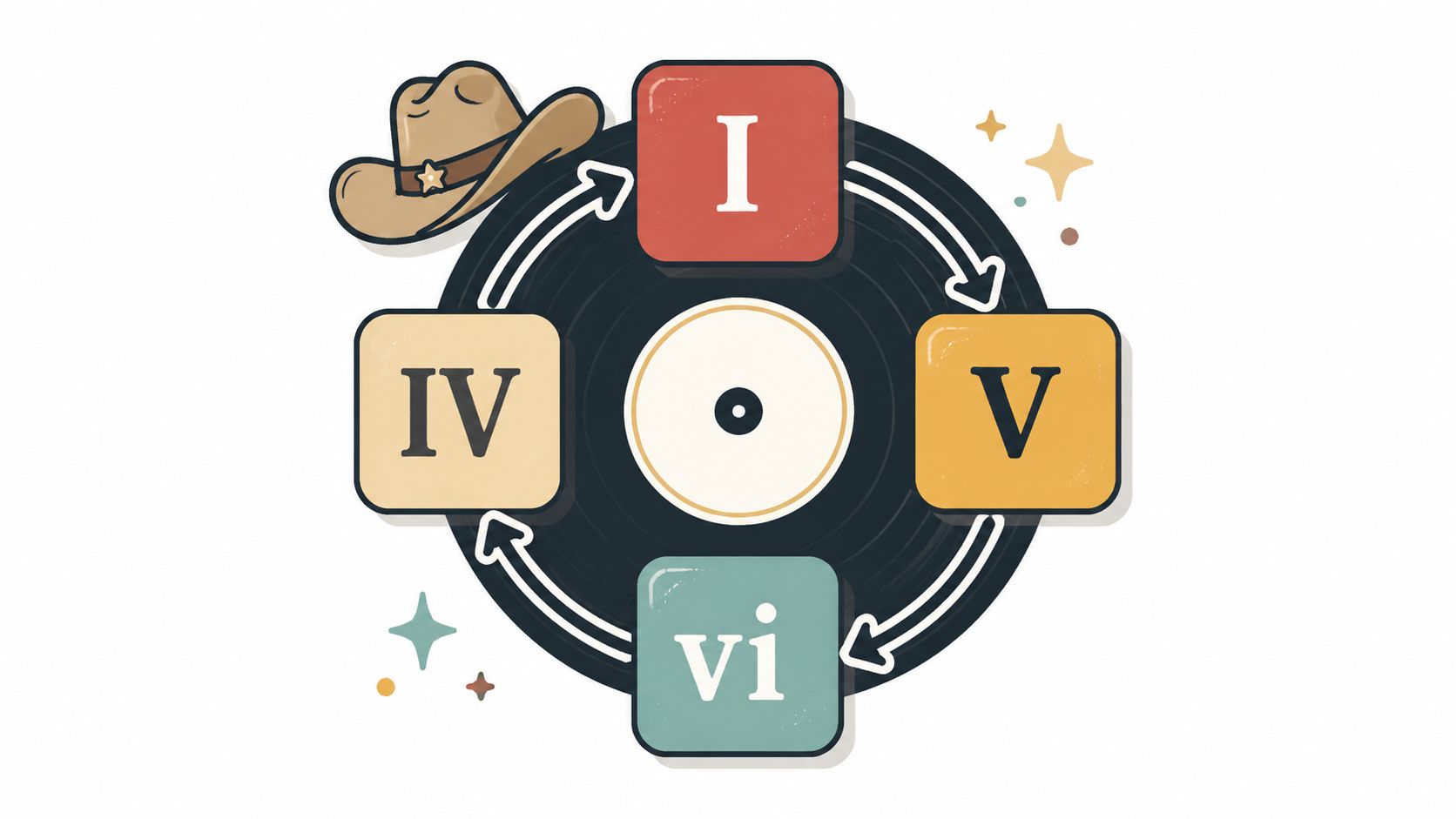
If you listen to contemporary country-pop, this progression is hard to miss. In C, it’s C-G-Am-F. It sounds open, catchy, and ready for a big chorus. It supports confident melodies and easy singalongs, which is part of why so many writers return to it.
One lesson on country songwriting highlights the related I-IV-V-vi family with C-F-G-Am and describes it as appearing in hundreds of country songs. The same lesson also notes that this four-chord family shows up in major-hit writing across genres, which is exactly why it’s such a useful benchmark for ear training and transposition practice (country-pop progression lesson video).
That crossover quality makes this progression valuable even if country isn’t the only style you play. Learn it once by ear, and you’ll start hearing relatives of it in pop, worship, singer-songwriter, and acoustic rock.
Why this one shows up everywhere
It starts strong on I, moves to V for lift, drops to vi for emotion, then lands on IV for a smooth reset. That sequence gives singers room to sound both upbeat and reflective.
If you’re training to play by ear, the most important moment is the shift from V to vi. That move keeps the progression from sounding too obvious. It brightens first, then softens.
Hear the third chord as the emotional turn. If the first two chords feel confident and the third suddenly feels more inward, you may be hearing vi.
A practical way to internalize it:
- Play one key for a full week: Stay in C or G until the sound becomes automatic.
- Improvise a melody with only three notes: This forces you to listen to the backing harmony instead of relying on finger habits.
- Transpose after singing it: Once you can sing the pattern, move it to D, A, or E.
This progression is one of the fastest ways to connect ear training with real songwriting. You don’t just recognize it. You start using it.
5. IV-I-V-I The Bluegrass and Traditional Country Pattern
This pattern starts away from home. That’s why it’s so useful.
In G, the progression is C-G-D-G. If you expect songs to start on the I chord, this one can throw you off at first. But once you learn to hear it, your sense of key gets stronger because you stop depending on the first chord to tell you everything.
That’s a real playing-by-ear skill. In jam situations, songs don’t always introduce the tonic right away. Sometimes the groove starts first, the melody hints at the center, and the progression circles into place.
Find the key even when the song starts away from home
The IV chord has an open, leaning quality. It doesn’t feel as tense as V, but it doesn’t feel fully settled either. When a song opens there, your ear has to stay curious instead of jumping to conclusions.
Bluegrass and traditional country often reward that kind of listening because the rhythm can be driving even when the harmony is simple. Bill Monroe, the Stanley Brothers, Dolly Parton, and Alison Krauss all point toward styles where your ear benefits from following function, not just start points.
Here’s a strong exercise for this pattern:
- Drone the tonic first: Before playing C-G-D-G in the key of G, hum a G note. Then hear how the opening C relates to that home pitch.
- Clap on each chord change: Physical timing helps you separate harmonic identity from groove.
- End on I and stop: Let the last chord ring and notice how much more settled it feels than the first chord.
This progression trains a deeper kind of chord recognition. You’re not asking, “What chord came first?” You’re asking, “Where is home, and how does each chord point toward it?” That shift is huge for improvisation and musical independence.
6. I-vi-IV-V The Emotional Country Story
This progression has an old, familiar warmth. In G, it’s G-Em-C-D. It starts grounded, then immediately darkens a little on vi before opening back up through IV and V. That shape works well for storytelling because the second chord feels like a turn in the plot.
A lot of country writing lives there emotionally. The song starts with certainty, then memory, regret, tenderness, or doubt enters almost right away. You can hear that change without knowing any formal theory.
Use the second chord as your emotional marker
The ear-training move here is to stop focusing only on the first chord. Plenty of players can hear I at the beginning. Fewer can hear what the second chord does to the emotional temperature of the phrase.
In this pattern, the second chord doesn’t push hard like V. It softens the scene. Then IV broadens it, and V prepares the return.
Try this listening routine for 10 minutes a day:
- Sing scale degree 1 over all four chords: Hear when it feels strong, unstable, or tender.
- Compare I-vi-IV-V with I-V-vi-IV: Same chord family, different emotional timing.
- Write one lyric line over each loop: Storytelling makes the harmonic motion easier to remember.
Ear training, in turn, starts helping songwriting too. Once you can hear where the emotional pivot happens, your melody choices improve. You stop placing notes randomly and start responding to what the chords are already saying.
7. I-IV-vi-IV The Soft Country Ballad Variation
This pattern feels gentle because it avoids the sharper push of the V chord. In D, it would be D-G-Bm-G. Without that classic dominant pull, the progression breathes more. It sounds reflective, intimate, and well suited to acoustic arrangements.
That softer cadence is useful for your ear because it teaches you not to depend on V every time you want to orient yourself. Plenty of learners identify progressions by waiting for the strongest tension chord. This one asks you to listen more carefully to color and repetition.
Hear the repeated IV chord doing two jobs
The first IV opens the space. The second IV helps stabilize the phrase after vi. Same chord, different role.
That’s a subtle but valuable lesson in playing by ear. Chords don’t only matter by name. They matter by placement.
A repeated chord can sound different when its job changes. Train your ear for function, not just shape.
Use these drills:
- Loop it: Soft strumming makes the emotional contour easier to hear than aggressive strumming.
- Name the mood at each chord: “Steady, open, inward, held.”
- Swap vi for V once: Compare D-G-A-G with D-G-Bm-G and listen to how the story changes.
For ballad playing, this progression builds control. You learn to hear smaller differences, which helps with chord recognition in stripped-down performances where there’s less rhythmic information to guide you.
8. I-ii-IV-V The Gospel and Traditional Country Progression
This one adds a chord that many beginners hear less clearly at first. In C, it’s C-Dm-F-G. The ii chord is minor, but unlike vi, it often feels more like a step forward than an emotional drop. That gives the progression a gospel and traditional-country flavor that can feel both warm and lifted.
If you’ve mostly practiced I, IV, V, and vi, the ii chord can seem slippery. That’s exactly why it deserves attention. Training your ear to hear ii makes you better at recognizing more than the usual major-chord backbone.
Train your ear for the ii chord
The ii chord often sounds like preparation. It doesn’t feel like home, and it doesn’t sound as final as V. It points ahead.
If that’s hard to hear, isolate it. Play C, then Dm, then back to C. After that, play Dm-F-G and notice how naturally ii leads into the rest of the phrase.
A short explainer on gospel chord progressions and their movement can help if you want more context for this sound in traditional styles.
Use these practice ideas:
- Drill ii alone first: In several keys, alternate I and ii until the color becomes familiar.
- Sing through the whole loop: Your voice helps lock in the shape faster than silent finger practice.
- Transpose every few days: Hearing ii in C, G, D, and A keeps you from tying the sound to one fretboard picture.
This progression is a strong next step for anyone who wants real musical freedom. Once your ear can hear ii, more songs open up, and your ability to improvise over traditional harmony gets stronger.
8 Country Chord Progressions Compared
| Progression | 🔄 Implementation complexity | ⚡ Resource requirements | 📊 Expected outcomes | 💡 Ideal use cases | ⭐ Key advantages |
|---|---|---|---|---|---|
| I‑IV‑V‑I (The Classic Country Foundation) | Very low, three chords, predictable flow | Low, solo guitar/vocals or basic band | Strong tonic recognition; foundational ear training | Beginners, traditional country, sing‑alongs | Timeless, highly singable, easy to learn |
| I‑IV‑I‑V (The Shuffle Variation - Country Swing) | Low–Moderate, rhythmic nuance required | Moderate, tight rhythm section or precise strumming | Energetic groove; recognizability in shuffle feel | Honky‑tonk, uptempo dance songs, shuffle practice | Creates forward drive and danceability |
| vi‑IV‑I‑V (The Emotional Country Ballad) | Moderate, minor start increases harmonic nuance | Moderate, benefit from piano/strings and strong vocal | Emotional depth; modern ballad tonality | Contemporary ballads, storytelling, radio ballads | Deeply resonant and modern‑sounding |
| I‑V‑vi‑IV (The Modern Pop‑Country Cycle) | Low, ubiquitous, loop‑friendly | Moderate, adaptable from solo to full production | Catchy, radio‑friendly hooks; cross‑genre appeal | Pop‑country hits, anthemic choruses, covers | Instantly recognizable and versatile |
| IV‑I‑V‑I (Bluegrass & Traditional Pattern) | Moderate, non‑tonic start needs context awareness | Moderate–High, fast instrumentation (fiddle/banjo) | Driving energy; traditional acoustic feel | Bluegrass, instrumental showcases, fast repertoire | Authentic traditional sound with rhythmic momentum |
| I‑vi‑IV‑V (The Emotional Country Story) | Moderate, needs smooth major↔minor transitions | Moderate, strong vocal focus, careful arrangement | Narrative harmonic arc; emotional storytelling | Lyrical country ballads and narrative songs | Balances sophistication with singability |
| I‑IV‑vi‑IV (The Soft Country Ballad Variation) | Low–Moderate, cyclic, intimate voicings | Low, solo/acoustic settings work best | Intimate, meditative mood; emotional nuance | Soft acoustic ballads, intimate performances | Gentle, emotionally nuanced and vulnerable |
| I‑ii‑IV‑V (Gospel & Traditional Country Progression) | Moderate–High, introduces ii function and voice‑leading | Moderate, benefit from vocal harmonies or organ | Sophisticated gospel‑tinged movement; climactic builds | Gospel‑influenced country, spiritual/reverent songs | Harmonic maturity and strong emotional climaxes |
Your Daily System for Playing by Ear
Learning country song chord progressions doesn’t come down to collecting more theory terms. It comes down to hearing the same few patterns so often, and so clearly, that your hands begin to trust your ear.
That’s why short daily practice works better than occasional long sessions. If you spend 10 minutes a day on ear training, you give your brain steady repetition. You hear the sound of I-IV-V. You learn the difference between vi and ii. You start noticing whether a phrase feels settled, open, or unresolved before you ever touch the instrument.
A simple order works well. Start with I-IV-V-I until the V-to-I return feels obvious. Then practice I-IV-I-V so you stop mistaking a temporary return for the ending. After that, move into the progressions with minor chords, especially vi-IV-I-V, I-V-vi-IV, and I-vi-IV-V. Finally, train non-tonic openings and ii chords so your ear gets flexible.
Keep the practice musical. Sing the roots. Hum over loops. Pause recordings and predict the next chord before checking. Transpose one pattern into a few keys instead of learning ten new shapes at once. If you do that consistently, chord recognition improves in a real-world way. You jam more easily, accompany singers with less hesitation, and start improvising with more confidence.
This is also where the perfect pitch question becomes less distracting. Most players don’t need perfect pitch to play by ear well. They need relative hearing. They need to recognize movement, function, and color. That skill is trainable, and country harmony is one of the best places to build it because the patterns repeat enough to become familiar without becoming meaningless.
If you want a practical system, use a daily tool that keeps the focus on listening, not guessing. Trill: Ear Training Daily is one option built around short practice sessions for recognizing chords, intervals, notes, and scales. Used consistently, that kind of routine can support the exact skills behind hearing country progressions in real songs.
The goal isn’t to become a theory machine. The goal is simpler. Hear a song, recognize the movement, and join in. That’s musical freedom, and it starts with a few chords you practice until they sound like old friends.
If you want to stop guessing and start hearing chord changes with more confidence, Trill: Ear Training Daily offers short daily practice built around chord recognition, interval training, and the listening skills that help you play by ear. Ten focused minutes a day can go a long way when you stay consistent.