How Do You Read Tenor Clef: The Ultimate Guide
You’re reading along just fine, then the clef changes and everything falls apart.
If you play cello, bassoon, trombone, or another lower instrument, you’ve probably hit that moment. The notes suddenly look familiar and unfamiliar at the same time. You know they’re on a staff. You know they’re real notes. But your brain says, “I have no idea what I’m looking at.”
That symbol is the tenor clef. It isn’t there to make your life harder. It’s there to make mid-to-high notes easier to read.
The good news is that learning how do you read tenor clef isn’t about having a special gift. It’s a trainable skill. And if you connect what you see to what you hear, you’ll learn it faster and keep it longer. That matters if you want stronger ear training, better sight-reading, more confidence in rehearsal, and eventually the freedom to play by ear instead of guessing.
Table of Contents
- Why That Weird Clef Suddenly Appeared in Your Music
- Decoding the Tenor Clef One Landmark Note at a Time
- Connecting Notes on the Page to Sounds You Can Hear
- Where You Will Meet the Tenor Clef in Real Music
- A Simple Framework for Fluent Tenor Clef Reading
- How to Fix Common Mistakes and Read with Confidence
Why That Weird Clef Suddenly Appeared in Your Music
Tenor clef usually shows up right when the music climbs out of the comfortable bass range.
Instead of piling on ledger lines, the composer changes clefs so the notes sit more neatly on the staff. That means less visual clutter and a better chance that you’ll read the phrase musically instead of decoding it one note at a time.
Historically, the tenor clef was introduced in the 16th century for vocal tenor parts, and it reduced ledger lines by up to 70% for notes in the upper-middle register compared with bass clef alone, according to Music Theory Academy’s tenor clef explanation. By the 18th century, it was standard in orchestral works by composers like J.S. Bach, as noted in that same source.
Practical rule: If your part starts living above the bass staff for a while, tenor clef is often the cleaner option.
That’s why it appears in music for instruments such as cello, bassoon, and trombone. It isn’t a different musical universe. It’s the same pitches, written in a way that helps players stay oriented.
A lot of students get stuck because they treat tenor clef like a code to crack. They stare at each note, translate it into another clef, then try to play it. That works for about five seconds.
Real fluency feels different. You see a shape, hear the contour in your head, and move. That’s why this skill connects so naturally with ear training, perfect pitch practice, interval recognition, and learning to play by ear. When your ear joins the process, tenor clef stops feeling like visual punishment and starts feeling like normal music reading.
Decoding the Tenor Clef One Landmark Note at a Time
The fastest way in is not to memorize everything at once.
The fastest way is to lock in one note so firmly that the rest of the staff can grow out of it.
Start with one note
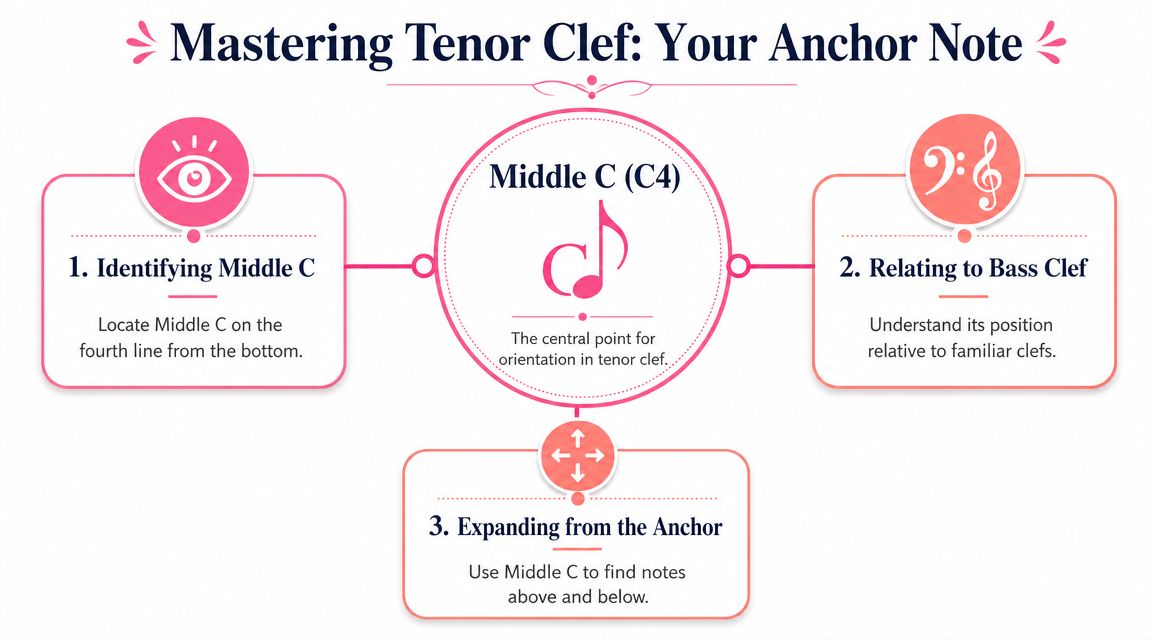
In tenor clef, middle C (C4) sits on the fourth line from the bottom. That is the anchor.
Once that note is solid, every other note becomes a short step away. One line down is A. One space below that is G. One line above middle C is E. You don’t need a hundred facts. You need one reliable landmark and the habit of moving by steps.
Here’s the basic layout many players memorize first:
- Lines: D, F, A, C, E
- Spaces: E, G, B, D
Some players use a mnemonic for the lines, such as Dogs Fight All Cats Eagerly. That can help at the start. But don’t stop there. Mnemonics are training wheels, not fluent reading.
Use a simple note map
This kind of table helps when you’re bridging from a clef you already know.
| Tenor Clef Note | Bass Clef Equivalent | Treble Clef Equivalent |
|---|---|---|
| Middle C on 4th line | Ledger line above the staff | Ledger line below the staff |
| Top line E | 2nd ledger line above bass staff | Bottom line E |
| Middle line A | Top space A | 2nd space A |
| Bottom line D | 4th line D | Space below bottom line D |
Don’t worry about making this instant on day one.
Find middle C first. Then read outward by step. That one habit prevents a lot of panic.
A useful way to practice is to point at random notes in a tenor clef line and ask two questions: “How far is this from middle C?” and “What would it sound like on my instrument?” That second question matters. If you only learn the visual label, you’ll stay slow. If you link the note to an expected sound, your reading gets much more stable.
Connecting Notes on the Page to Sounds You Can Hear
Most players try to solve tenor clef with their eyes alone. That’s why it often feels slow.
If you want real speed, train your ear to predict sound from shape.
Your ear is the shortcut
When you read well, you’re not identifying isolated notes like flashcards. You’re noticing movement. Up a step. Down a third. Leap up. Repeat. Sequence.
That’s where ear training changes everything. If your ear recognizes intervals, tenor clef becomes easier because you don’t need to rebuild every note from scratch. You anchor one pitch, then hear the rest relative to it.
Music cognition studies from Carnegie Mellon indicate that aural anchoring improves reading fluency 40% faster than visual drills alone, according to this summary of aural anchoring and fluency. In plain language, hearing a reference tone while you scan the page helps your brain connect notation to real sound more quickly.
That’s the same skill behind learning to play by ear. It’s also one path toward stronger pitch memory and more accurate interval recognition, which many people loosely connect with perfect pitch goals. You don’t need to guess. You can train yourself to hear what you see.
For a focused daily routine, try short exercises built around aural training practice so the staff becomes something you hear internally, not just something you decode visually.
A quick daily drill
Use this for 10 minutes a day:
- Pick one anchor pitch: Start with middle C in tenor clef.
- Sing before you play: Look at the next note and try to hear whether it moves by step or leap.
- Check on your instrument: Play it and compare what you expected with what came out.
- Name the interval: Second, third, fourth, fifth.
- Repeat with tiny phrases: Two to four notes is enough.
If you can hear the jump before you play it, you’re no longer guessing.
This short video gives you another way to think about hearing and reading together:

The point isn’t to become a theory robot. The point is to make the page sound alive in your head. Once that starts happening, clef changes stop breaking your concentration.
Where You Will Meet the Tenor Clef in Real Music
You are reading along in bass clef, everything feels familiar, and then a new clef appears right when the line starts to sing higher. That moment catches a lot of players. In real music, tenor clef usually shows up because the composer wants the part to stay readable in an upper register, not because anyone is trying to make the page harder.
Cello players meet it when the line rises
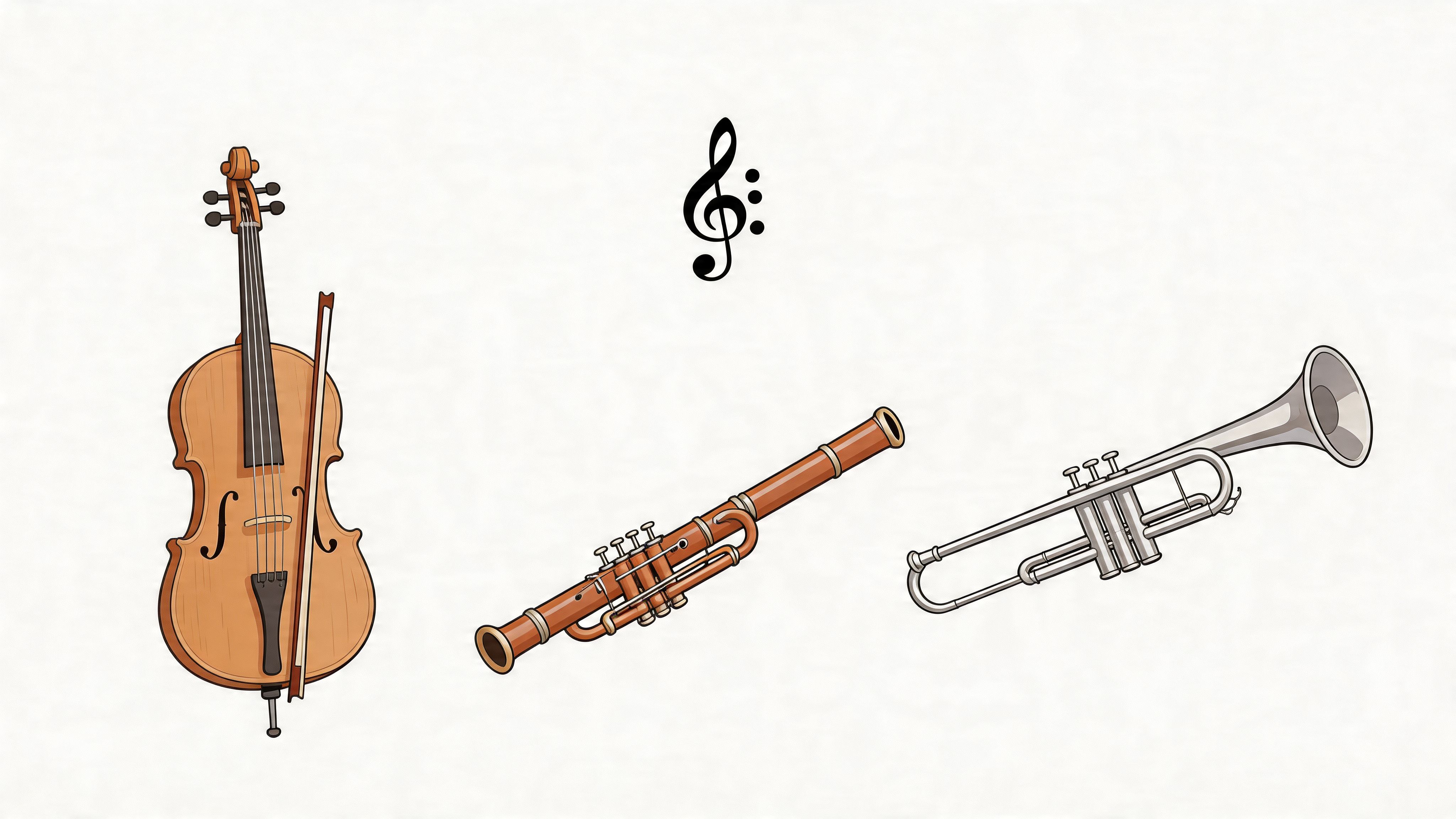
Cellists run into tenor clef in études, sonatas, concertos, and orchestral parts. Once the music climbs high enough, bass clef starts filling the staff with ledger lines. Tenor clef cleans that up so your eyes can follow the phrase shape, bow plan, and rhythmic flow.
That matters musically. A high lyrical passage is easier to phrase when you can see a contour instead of decoding one note at a time.
If you are practicing this switch, use short excerpts you already know by sound. A familiar melody teaches your eye and ear together, which is much closer to real playing than flash-card memorization. A music theory practice app for note and clef drills can help between practice sessions, but repertoire is where the clef starts to feel natural.
Bassoon, trombone, and other low instruments see it for the same reason
Bassoonists often read tenor clef in upper passages, especially in solo music and orchestral writing. Trombonists meet it when the part sits above bass clef for more than a brief moment. The goal is simple. Keep the notation readable enough that attention can stay on tone, intonation, articulation, and ensemble balance.
The useful question is not just, “What note is that?” Ask, “What does that line sound like?” In real repertoire, tenor clef often appears in patterns your ear can learn quickly: scales, arpeggios, stepwise singing lines, and repeated interval shapes.
Here is what players usually start noticing once they stop treating tenor clef as a separate code:
- In lyrical passages: the eye catches rise and fall before the brain names every note.
- In runs: the hand responds to familiar shapes and the ear predicts where the line is going.
- In ensemble parts: entrances feel steadier because you can hear the line internally while reading.
That is why real music is such a strong teacher. Tenor clef becomes easier once it is attached to sound, motion, and phrase direction instead of isolated note-name quizzes.
A Simple Framework for Fluent Tenor Clef Reading
Fluency comes from organized repetition, not random struggle.
Professional pedagogues recommend a Prepare-Write-Sightread-Practice framework, and musicians typically reach fluency after 40 to 60 hours of structured practice that integrates those components, according to this video explanation of the clef mastery framework.
Prepare and write
Prepare means scanning before you play. Find middle C. Notice the highest and lowest notes. Spot any repeated shapes or awkward leaps. This takes a few seconds, but it changes everything.
Then write. Copy a short melody into tenor clef by hand. Use something simple like “Mary Had a Little Lamb” or another tune you already know by ear. Writing slows you down in a good way. It forces the staff positions to stick.
A few useful writing habits:
- Mark landmark notes: Circle middle C and any other notes you recognize quickly.
- Say note names aloud: Your eyes, hand, and ear all stay involved.
- Sing the tune softly: If the melody is familiar, your ear can catch notation mistakes.
Sight-read and practice
Now switch modes. Read a short new passage every day without stopping every beat to analyze.
The goal isn’t perfection. The goal is continuity. Keep the pulse moving and train your brain to recover.
After that, use practice time to isolate what tripped you up:
- A slow clef switch from bass to tenor
- Large leaps
- Repeated misreading of one staff position
- A phrase you couldn’t hear internally before playing
Daily habit: Ten focused minutes beats occasional marathon sessions because it keeps note recognition and sound recognition close together in memory.
If you want one place to support those broader musicianship habits, explore a music theory app for daily musicianship practice. Keep the emphasis on consistency. That’s what turns slow decoding into fast reading.
A good week of work might look like this:
| Day | Main focus |
|---|---|
| Day 1 | Landmark notes and middle C drills |
| Day 2 | Handwritten melody in tenor clef |
| Day 3 | Short sight-reading excerpt |
| Day 4 | Interval singing from tenor clef |
| Day 5 | Clef switching between bass and tenor |
| Day 6 | Repertoire passage |
| Day 7 | Review and play through |
That’s simple, repeatable, and musical.
How to Fix Common Mistakes and Read with Confidence
Most tenor clef mistakes come from one of two problems. Either you don’t have a stable anchor note, or you’re reading with your eyes only.
Both problems are fixable.
When you keep mixing up bass and tenor clef
This is normal. Your brain wants to snap back to the older habit.
The fix is not to stare harder. The fix is to drill the anchor points until the switch becomes automatic. In bass clef, you probably already know your landmarks well. In tenor clef, keep returning to middle C on the fourth line from the bottom and building outward.
Try this:
- Flash switch drill: Look at one bar in bass clef, then one bar in tenor clef, and identify only the anchor notes.
- Same pitch, new clef: Find the same sounding note written in different clefs.
- Play and verify: Let your ear confirm whether the note you chose sounds right.
When your reading is too slow
Slow reading usually means you’re naming every note one by one.
That’s exhausting. Strong readers notice patterns. They read steps, skips, repeated notes, and interval shapes. If you also hear those shapes internally, your speed goes up and your confidence goes with it.
Use interval drills that connect notation to sound. This kind of interval ear training approach helps because it trains the exact skill that turns notation into expected sound.
Your ear can catch errors your eyes miss. If the note looked right but sounded wrong, that’s useful feedback, not failure.
You do not need mysterious talent to learn tenor clef. You need repetition, a clear anchor, and a habit of hearing what you read. That’s how the clef becomes playable. That’s also how music starts feeling freer, whether your goal is better auditions, stronger sight-reading, or the bigger prize of being able to play by ear with confidence.
If you want a daily system for building the listening skills behind fluent reading, Trill: Ear Training Daily helps you practice intervals, chords, notes, and pitch recognition in short sessions. It’s built for musicians who want real outcomes: stronger ear training, better chord recognition, more confidence to play by ear, and steady progress from just 10 minutes a day.