The Treble Clef Staff: From Sight to Sound by Ear
You sit down with your instrument, open a piece of music, and recognize the notes on the page. E, G, B, D, F. Maybe FACE too. But when someone plays a short melody and asks you to copy it by ear, everything falls apart.
That gap frustrates a lot of musicians.
They can read labels, but they can’t yet hear what those labels mean. The treble clef staff becomes a decoding exercise instead of a musical tool. And if reading never turns into hearing, note knowledge stays trapped on the page.
The good news is that ear training is trainable. You don’t need perfect pitch to make the treble clef staff useful. You need a better connection between what your eyes see, what your voice sings, and what your hands play. Once that connection starts to form, sight-reading gets easier, playing by ear gets less mysterious, and improvisation stops feeling like guessing.
Table of Contents
- Why Every Good Boy Can’t Help You Play by Ear
- Decoding the Notes on the Treble Clef Staff
- Exploring Notes Beyond the Basic Staff
- Connecting What You See to What You Hear
- Daily Drills to Build Your Musical Ear
- From Reading Notes to True Musical Freedom
Why Every Good Boy Can’t Help You Play by Ear
A lot of beginner teaching stops at mnemonics. You learn that the line notes are “Every Good Boy Does Fine” and the space notes are “FACE,” then you’re expected to feel like you’ve learned the treble clef staff. But naming notes isn’t the same as hearing music.
That teaching gap is common. Beginner treble-clef materials often focus on rote note naming and mnemonic phrases, while rarely connecting notation to ear training, melodic hearing, or transfer into playing by ear, as noted in this overview of treble clef note teaching patterns.
What memorizing gives you and what it doesn’t
Mnemonics do have a use. They help you get oriented. If you see a note on a line and remember the sentence, you can work out its name.
But a sentence in your head is slow. Music happens in sound, not in alphabet puzzles.
If a friend sings three notes and you can’t find them without hunting, the missing skill isn’t more memorization. It’s aural connection. You need the note on the page to trigger an expected sound in your mind.
Practical rule: If you can name a note but can’t sing it or find it by ear, you haven’t learned it deeply yet.
Why musicians get stuck
The treble clef staff is often taught as a test of visual recall. Students ask, “What line is that?” A more useful question is, “What does that note sound like, and how does it move?”
That’s the shift that leads to real musicianship. Instead of treating notation like a school worksheet, you start using it as a map for pitch direction, melodic shape, and interval distance.
A simple reset helps. When you see a note, don’t stop at the name. Ask yourself three things:
- Where does it sit on the staff, low, middle, or high?
- How would it sound if you sang it right now?
- Where would your hand go on your instrument to match that sound?
That habit is what starts turning reading into hearing. If you want to strengthen that bridge more directly, this guide on ear training and how to play by ear is a useful next step.
Decoding the Notes on the Treble Clef Staff
You sit at a piano, look at a note on the page, and press the right key. Good start. Then someone plays a short melody by ear, and suddenly the page feels less helpful. The missing piece is not more note-name trivia. It is a clearer link between the staff and the sound it represents.
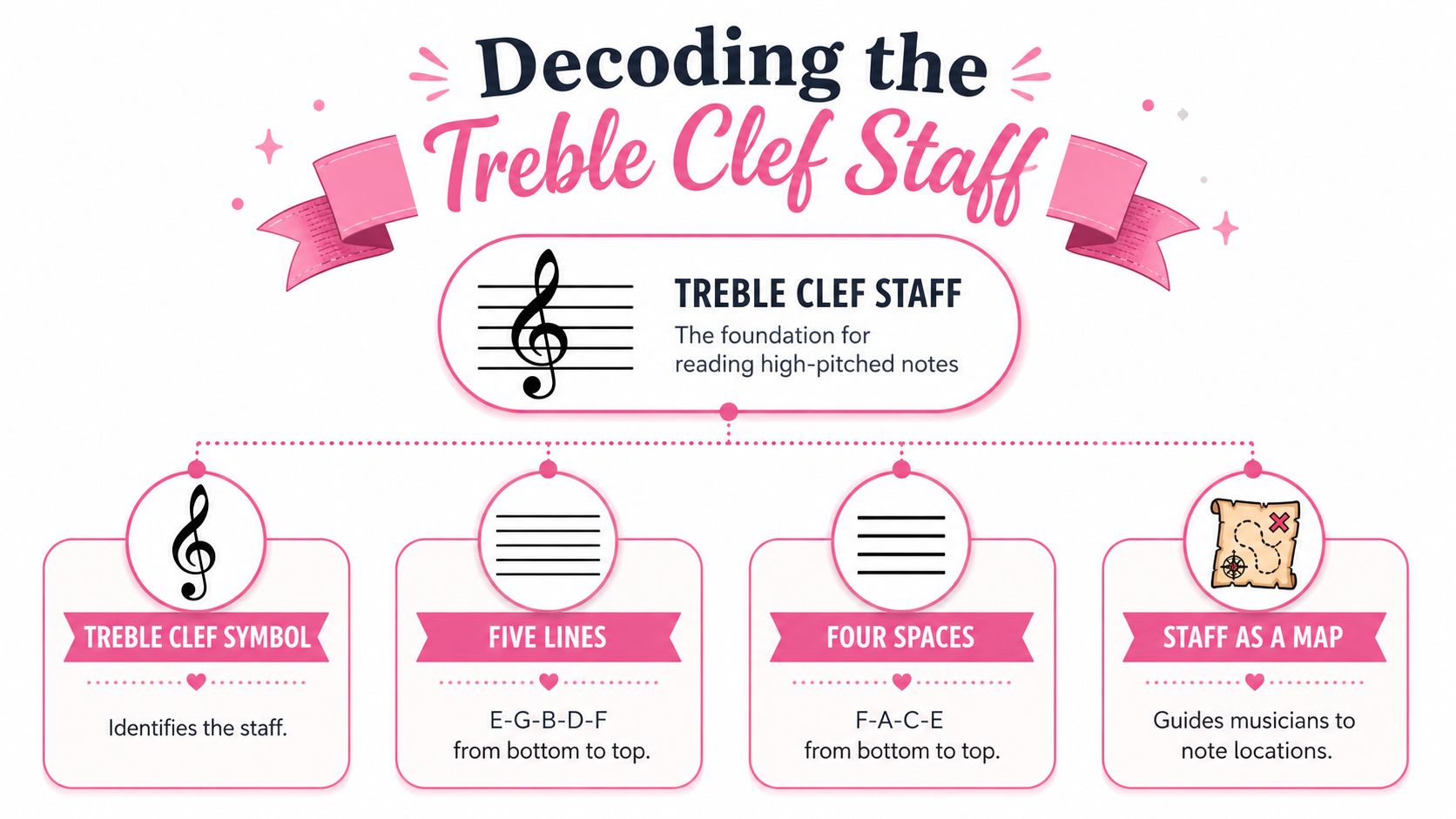
The treble clef staff gives you a pitch map for higher sounds. Five lines and four spaces show where notes live, and each step up the staff means the pitch moves up by one letter in the musical alphabet. Each step down does the same in reverse. If your ear follows that motion, the staff stops feeling like a decoding exercise and starts feeling like a picture of melody.
What the symbol is telling you
The treble clef is a G-clef. Its spiral wraps around the second line of the staff, which marks G above middle C. That one point gives you an anchor, like finding your location on a road map before tracing the rest of the route.
From there, notes follow a simple pattern. Move from a line to the next space, or from a space to the next line, and the letter name moves by one step.
| Part of staff | Notes from bottom to top |
|---|---|
| Lines | E, G, B, D, F |
| Spaces | F, A, C, E |
If that table feels abstract, turn it into sound right away. Play or sing the second-line G. Then move to the space above it, A. Then the next line, B. Your eye sees upward motion. Your ear should hear a rising line.
Where beginners often get confused
A common mistake is trying to identify every note as an isolated fact. That slows reading down and does little for your ear.
Landmarks work better. The spaces spell FACE, which gives many beginners a quick reference. The G line is another strong anchor because the clef points to it. Once you know one note, nearby notes become easier because you can hear and feel the distance from that anchor, not just name it.
That matters for playing by ear. If you see one note and the next note is one step higher, your first thought should become, “the melody rises,” not only, “the letter changed.”
Turning the map into sound
The staff is most useful when it predicts sound before you play. Reading a note should create an inner pitch expectation. Reading two notes should suggest motion by step, skip, or repeat.
Try this short drill:
- Choose one staff note such as the second space.
- Name it if you know it.
- Sing it or hum your best guess.
- Check it on your instrument.
- Move to a nearby note and describe the change out loud: same, higher by step, or lower by step.
That last habit builds real reading skill. You are training your ear to connect position with pitch direction, which is the skill behind sight-singing, picking out melodies, and improvising phrases that match what you hear in your head.
A staff note is not just a label. It is a sound with a place, a direction, and a relationship to the note before it. Once you start reading those relationships, the treble clef becomes much easier to hear.
Exploring Notes Beyond the Basic Staff
At some point, the music goes past the five lines and four spaces. That’s where beginners often panic.
You don’t need to.
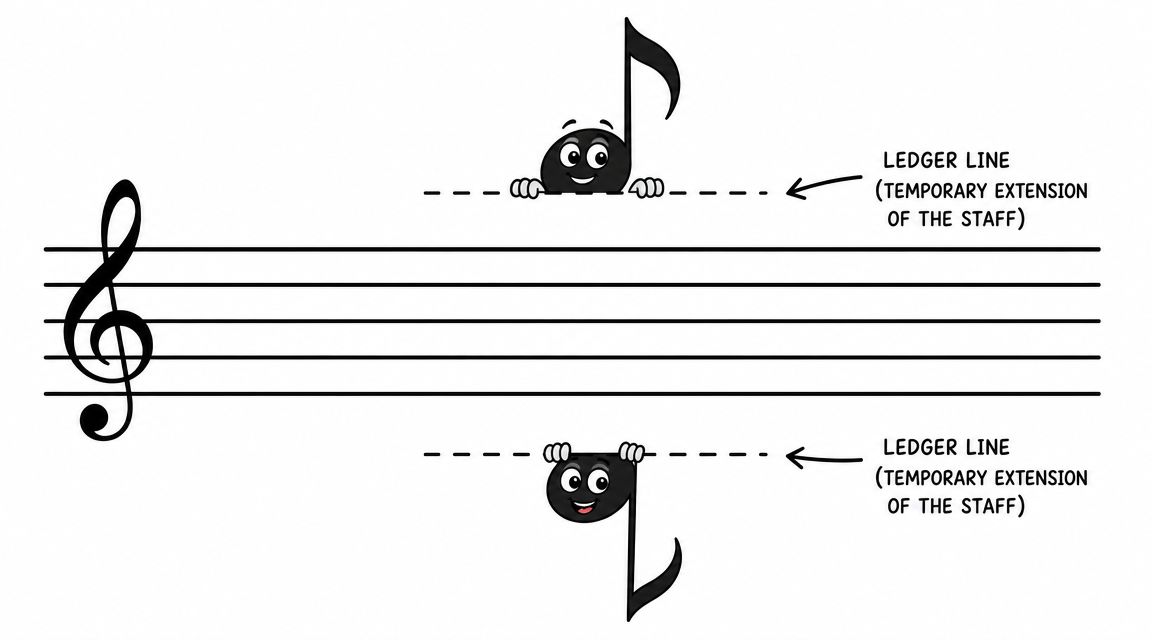
Ledger lines are just short extra lines that extend the staff. They aren’t a new system. They’re the same musical alphabet continuing beyond the frame you already know.
Read the direction before the exact name
When you see a note above the top line, your first job isn’t perfect identification. Your first job is to notice its register. It sits higher, so you should expect a higher sound.
When you see a note below the staff, expect the opposite. Lower placement should create a lower sound expectation in your ear.
That sounds basic, but it’s a major skill. Good readers don’t only decode exact notes. They also feel the contour immediately.
One pattern keeps repeating
Ledger lines follow the same letter sequence you’ve already been using. The staff doesn’t break when notes go outside it. The alphabet keeps moving.
A helpful way to practice is to think in two layers:
- Layer one: Is this note visually higher or lower than the previous one?
- Layer two: By a little, or by a lot?
That trains relative pitch, which is far more useful than trying to brute-force every ledger-line note in one sitting.
See the height first. Hear the height second. Name the note third.
A simple way to practice ledger lines
Take any short melody that includes notes above or below the staff.
- Trace the shape with your finger in the air.
- Hum the contour without worrying about exact pitch names.
- Play it on your instrument.
- Go back and identify the specific note names after your ear has engaged.
This keeps the treble clef staff from becoming a visual trap. The page should tell you what the melody is doing in sound. Ledger lines are part of that story, not an exception to it.
Connecting What You See to What You Hear
At this point, the treble clef staff becomes musical instead of academic.
When two notes appear on the page, they don’t just have names. They have a distance. That distance creates a sound relationship your ear can learn to recognize. In music, that relationship is called an interval.
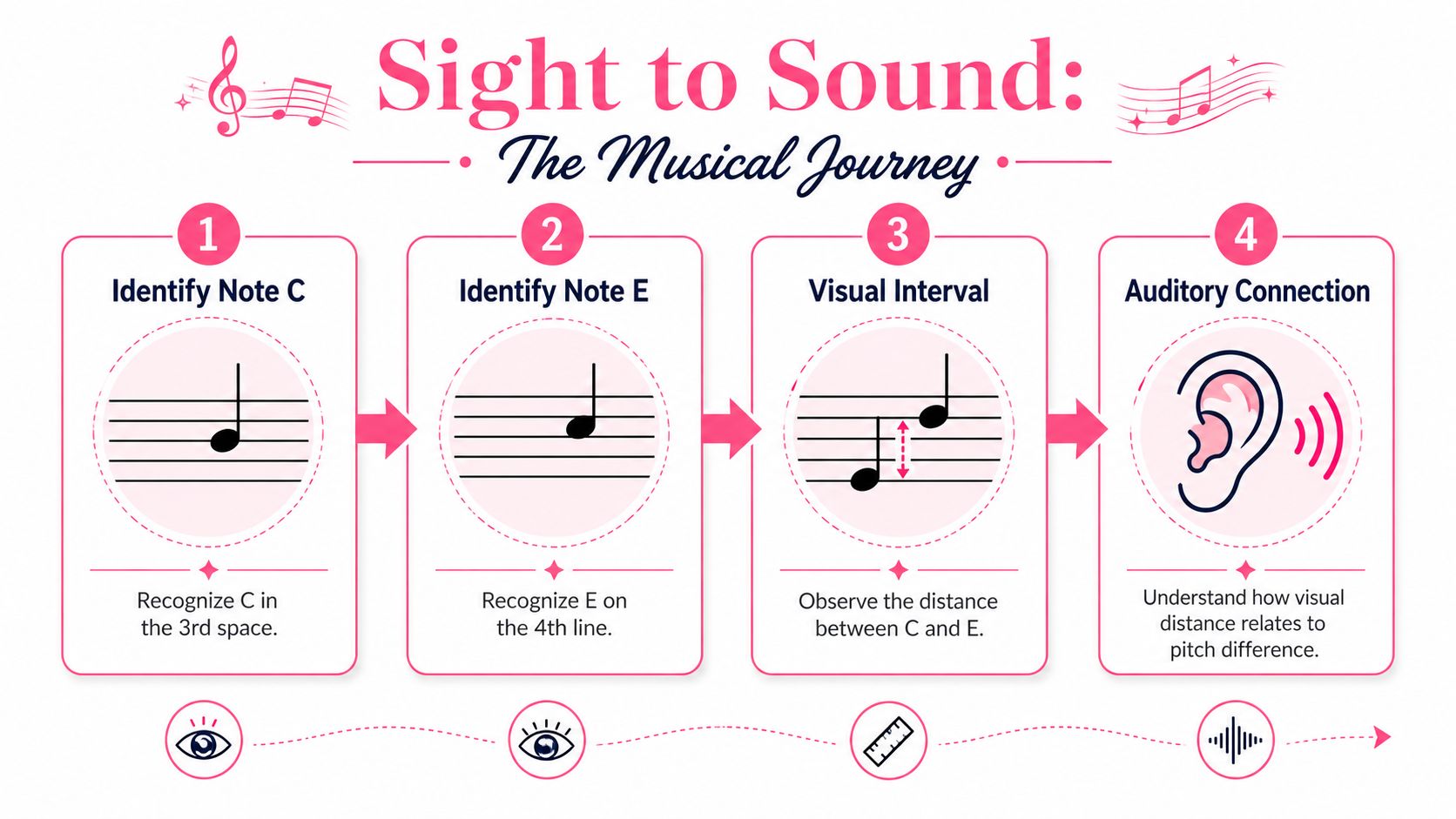
Take one example. If you look at C in a space and then E on the next line above, your eyes should notice that the notes skip over one letter in between. Your ear can learn that sound as a small upward leap. Over time, you stop reading each dot as an isolated fact. You start recognizing a pattern.
Melodies have shapes, not just note names
Most beginners read music one note at a time. That’s slow, and it doesn’t help much with ear training.
A better approach is to read motion.
If notes climb line-space-line-space in sequence, the melody often feels like a staircase. If one note suddenly jumps much higher, you’ll hear a leap. If several notes stay near each other, you’ll hear a tighter melodic area.
These visual shapes matter because songs aren’t random collections of pitches. They move in ways your ear can predict.
Here’s a simple comparison:
| What you see | What your ear should notice |
|---|---|
| Stepwise motion | Smooth movement, close notes |
| A skip or leap | A bigger pitch change |
| Repeated note position | Same pitch repeated |
| High placement on staff | Higher register |
| Low placement on staff | Lower register |
For a focused breakdown of these pitch distances, this guide to intervals in music helps connect the visual spacing to the sound you need to recognize.
A short demonstration can help anchor the idea:

The fastest bridge is your voice
Your voice is the best tool for linking notation to sound because it removes mechanical distractions. If you go straight from page to instrument, your fingers can fake understanding. If you sing first, your ear has to lead.
Try this loop:
- Look at two notes on the staff.
- Notice the direction. Up, down, or same.
- Sing them slowly.
- Check on your instrument.
- Adjust and repeat.
This is how musicians start to play by ear from notation, which sounds backwards until you try it. Reading becomes ear training because every written move creates an expected sound.
If you can’t sing the movement between notes, your hands will keep guessing.
What to listen for in real music
Pick a melody you already know well. Children’s songs are perfect because the melody is familiar enough that your ear won’t feel lost.
As you look at the treble clef staff, don’t ask only, “What note is this?” Ask better questions:
- Does the phrase rise or fall?
- Where is the biggest jump?
- Which notes feel like arrival points?
- Can I hear the next note before I play it?
That’s the core skill behind playing by ear, improvisation, and even strong sight-reading. You’re training prediction. The page gives you clues, and your ear learns to turn those clues into sound before your fingers touch the instrument.
Daily Drills to Build Your Musical Ear
Ear training doesn’t improve from occasional effort. It improves from repetition that is short enough to sustain and focused enough to matter.
A daily routine works because it keeps your ears engaged all the time. Even 10 minutes a day can create momentum when the work is deliberate and consistent.
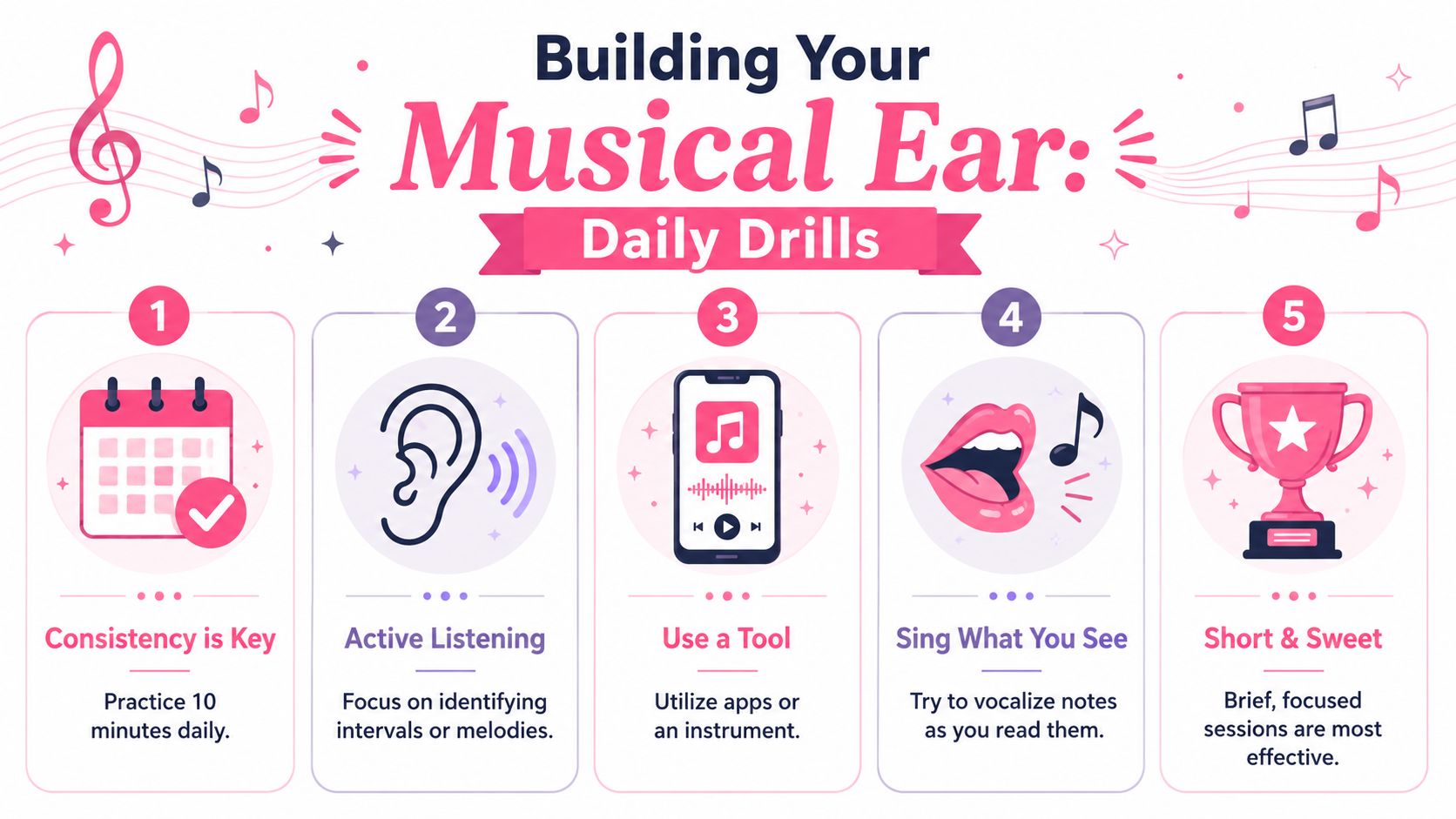
Four drills that connect the page to your ear
You don’t need a long theory session. You need repeatable actions.
-
Single-note singing: Write or point to one treble clef note. Sing it before touching your instrument. Then play it and compare. If you’re off, don’t judge it. Correct it and sing again.
-
Contour reading: Take a short written melody and ignore note names for the first pass. Just describe the shape. Up by step. Down by step. Leap up. Repeat. Then sing that contour.
-
Two-note interval checks: Pick any two written notes. Don’t calculate too much. Look at the visual distance, sing the leap, then confirm it on your instrument.
-
Silent audiation: Look at a bar of music and hear it internally without moving or playing. Then test whether your inner hearing matched reality.
A weekly practice grid you can reuse
If you like structure, rotate your focus instead of doing the same exact drill every day.
| Day | Main focus | Quick prompt |
|---|---|---|
| Day 1 | Single notes | Sing before you play |
| Day 2 | Up and down motion | Trace melodic contour |
| Day 3 | Intervals | Hear the gap between two notes |
| Day 4 | Ledger lines | Predict high or low first |
| Day 5 | Short melodies | Sing then play |
| Day 6 | Review | Revisit weak spots |
| Day 7 | Free play | Improvise using notes you can hear |
This kind of structure is why many musicians use a dedicated daily ear training routine instead of relying on motivation alone.
Keep the sessions small and honest
Long sessions often turn sloppy. Short sessions force attention.
A good daily session might look like this:
- Two minutes of singing single notes from the treble clef staff.
- Three minutes of interval recognition from written pairs.
- Three minutes of singing a simple melody before playing it.
- Two minutes of reflection on what kept fooling you.
Small habit, big payoff: Consistency trains faster than occasional marathon practice.
Where perfect pitch fits and where it doesn’t
A lot of players worry that they can’t improve because they don’t have perfect pitch. That’s the wrong target for many.
The practical skill is hearing relationships. Can you tell whether a melody went up or down? Can you hear whether the next note is close or far? Can you recognize a chord quality or match a pitch after hearing it? Those abilities support real playing far more directly than waiting to feel “gifted.”
That’s why daily ear training matters. It builds recognition through repetition. Not talent. Not luck. Practice.
From Reading Notes to True Musical Freedom
You sit at the piano, look at a note on the treble clef staff, and before your finger moves, you already hear it. Then you spot the next note and can tell whether the melody steps up gently or jumps farther. That is the point of learning the staff well. It turns written notes into expected sound.
The treble clef staff works like a map of musical distance. Notes stacked close together usually sound close together. Notes placed farther apart usually sound farther apart. Once your ear starts linking that visual spacing to real pitch movement, reading stops feeling like decoding symbols and starts feeling like following a musical path.
That change affects far more than sight-reading.
You learn tunes faster because your eyes and ears start working as one system. You catch mistakes sooner because a wrong note does not just look wrong. It sounds wrong before you finish playing it. Improvisation also gets easier, because you begin to choose notes you can already hear internally instead of reaching and hoping.
Playing by ear grows from this same habit. A melody on the page becomes something you can sing. A jump between notes becomes an interval you can recognize by sound and by sight. Over time, the staff stops being a memory test about line names and space names. It becomes a guide to hearing relationships, which is the skill behind transcribing, harmonizing, and making up your own melodic ideas.
Keep your practice small enough that you can stay honest. If you can look at one written note, sing it, check it, and adjust, you are building real musicianship. A few focused minutes of that kind of work each day will take you much farther than rushing through pages of notes you never hear.
If you want a simple way to keep that habit going, Trill: Ear Training Daily gives you a structured system for ear training, interval recognition, chord recognition, and the listening skills behind playing by ear and perfect pitch work. It is built for short daily sessions, so you can hear music more clearly and respond with confidence.