Master Inversion of Triads: Hear Chords Clearly
You sit down at the piano or guitar, play a chord you know well, and something sounds off. Not wrong. Just different.
Maybe it’s a C major chord. Same three notes you’ve always learned. But one version feels grounded, another feels smoother, and another feels like it wants to go somewhere. If you’ve ever noticed that and thought, “Why does this sound different if it’s still the same chord?” you’re already hearing the inversion of triads.
That moment matters for ear training. Musicians who play by ear don’t just recognize chord names. They hear what the bass is doing, how the chord sits, and why one voicing feels settled while another feels active. That’s a big part of chord recognition, improvisation, and musical freedom.
The good news is this isn’t some rare gift. A documented classroom-focused source reports that more than 96% of beginner pianists find inverted chords difficult to recognize, and it also notes that listeners hear root-position triads as more stable than inversions, which means your ear is already reacting to this difference even if you can’t label it yet. You can read that in this discussion of hearing first inversion triads.
Table of Contents
- Why Some Chords Sound Different Even When They Are the Same
- The Three Shapes of Every Triad
- How to Find and Label Inversions Instantly
- Stop Guessing and Start Hearing Inversions
- How Inversions Are Used in Your Favorite Songs
- Your 10-Minute Daily Inversion Practice Plan
Why Some Chords Sound Different Even When They Are the Same
A student once played C major three times in a row for me. First as C-E-G. Then E-G-C. Then G-C-E. After the third one, they stopped and said, “I know those are the same notes, but they don’t feel the same.”
That’s the exact door into the inversion of triads.
A chord isn’t only about which notes are present. It’s also about which note is lowest. Your ear grabs the bass first. That bottom note changes the weight, the color, and the direction of the chord, even when the chord’s identity stays the same.
If you’re new to harmony, it helps to first be clear on what a chord is. Once that clicks, inversions stop looking like extra theory and start sounding like real music.
The hidden reason a chord feels different
When the root is in the bass, the chord usually feels settled. When the third or fifth moves to the bottom, the sound shifts. Many players can hear that shift long before they can explain it.
Practical rule: If two chords contain the same notes but feel different, listen to the bass before you look at your fingers.
This is why playing by ear can feel frustrating at first. You may identify the chord quality correctly, major or minor, but still miss how it’s functioning because you’re not hearing the inversion.
This is a listening skill, not a talent test
Beginners often think they’re “bad at ear training” because inversion recognition feels slippery. It isn’t slippery because you lack talent. It’s slippery because your ear hasn’t learned what to listen for yet.
Train your ear to notice the bass note, and chords stop sounding like random stacks. They start sounding organized. You begin to hear why one version connects smoothly to the next chord and another feels clunky.
That’s one of the biggest shifts in learning to play by ear. You stop guessing chord names from the top down and start hearing harmony from the bottom up.
The Three Shapes of Every Triad
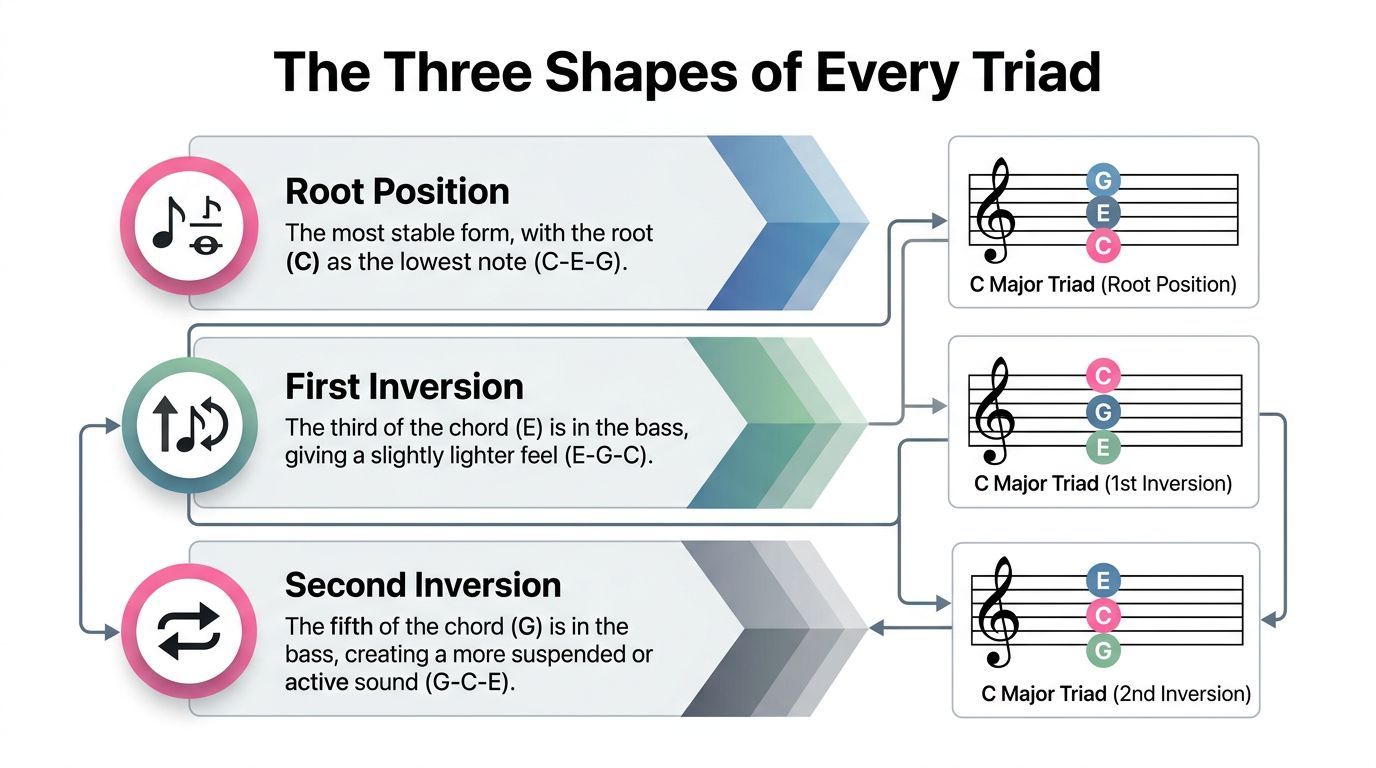
A triad has exactly three chord tones, so it has three possible positions: root position, first inversion, and second inversion. The inversion is determined by the lowest sounding pitch, not by the chord’s root, as explained in this triads and inversions tutorial.
Use C major as the cleanest example:
- C-E-G
- E-G-C
- G-C-E
All three are C major. The notes are the same. The bottom note changes.
The bass note changes everything
Think of a triad like three people standing in a stack. The same three people are there every time. But whoever stands on the bottom carries the weight.
In music, that “person on the bottom” is the bass note.
- Root position means the root is lowest. In C major, that’s C-E-G.
- First inversion means the third is lowest. In C major, that’s E-G-C.
- Second inversion means the fifth is lowest. In C major, that’s G-C-E.
On piano, this is easy to see because the leftmost note is the bass. On guitar, it’s less visual at first because the same chord can appear in different shapes and string sets. But the rule stays the same. Listen for the lowest sounding pitch, not the shape your hand makes.
Same chord name. Different bottom note. Different sound.
A simple cheat sheet
| Position | Bass Note | Example (C Major) |
|---|---|---|
| Root Position | C | C-E-G |
| First Inversion | E | E-G-C |
| Second Inversion | G | G-C-E |
If you’re a keyboard player, play those three versions slowly and hold each one. Don’t rush. Let your ear notice the personality of each sound.
If you play guitar, strum each voicing and mute everything for a moment after each one. That little pause helps your ear separate the sounds instead of blending them together.
Where readers usually get confused
The common mistake is thinking inversion changes the root. It doesn’t.
If the notes are C, E, and G, the chord is still C major. The root is still C. The inversion only tells you which chord tone is in the bass.
That’s why inversion is so useful. It explains how a chord can keep its identity while changing its feel. Once you hear that, music theory becomes much more practical.
How to Find and Label Inversions Instantly
When you see three notes on a page or hear them on an instrument, don’t start by naming the bottom note as the chord. Start by finding the note that makes the stack work as a triad.
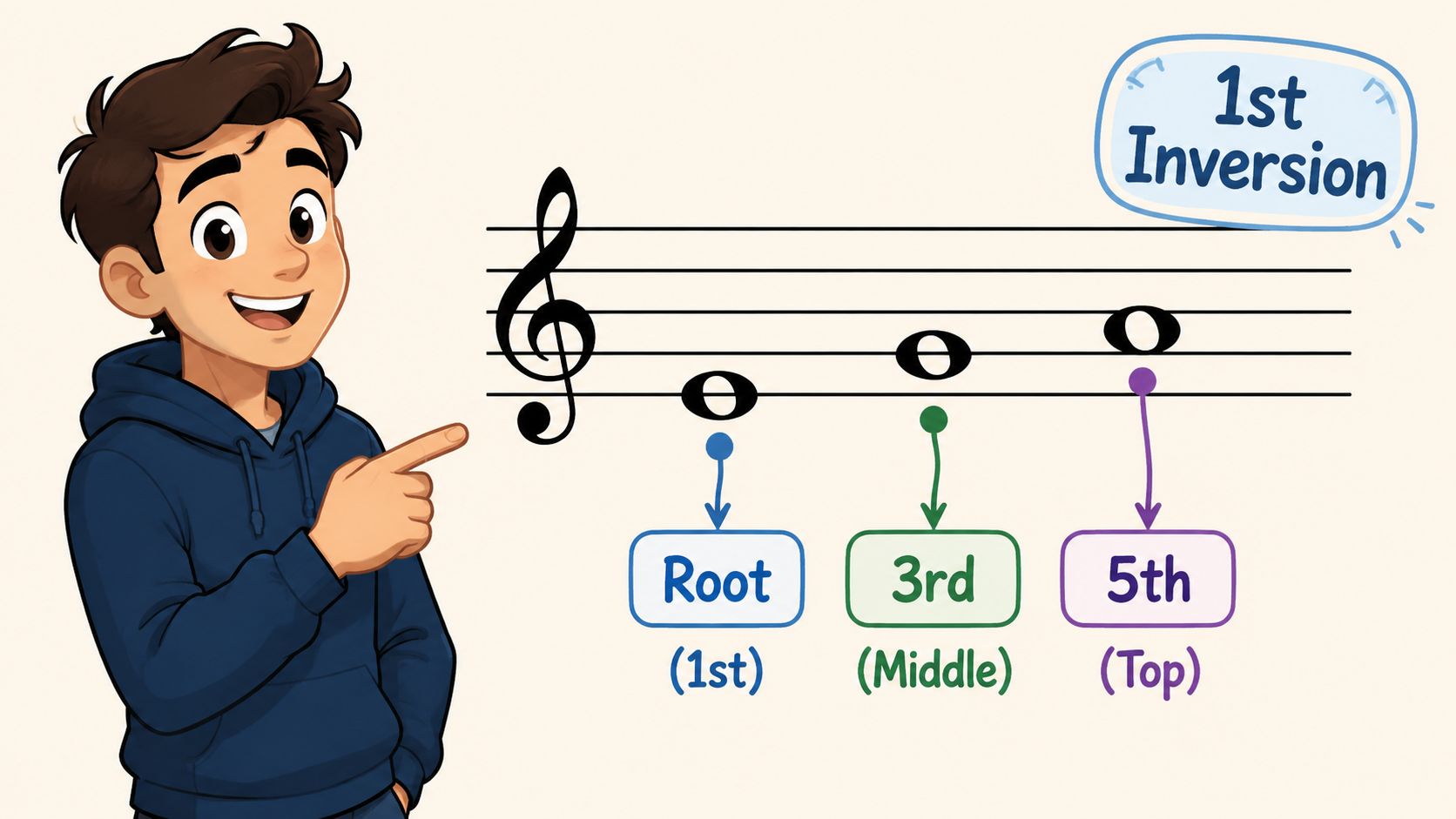
Use the stack test
Take the notes E-G-C.
If you reorder them as C-E-G, the triad becomes obvious. C is the root. E is the third. G is the fifth. Since E is the lowest sounding note in the original version, it’s C major in first inversion.
Try the same with G-C-E.
Reorder the notes into thirds and you get C-E-G again. That means it’s still C major. Since G is the bass, it’s second inversion.
Here’s the quick process:
- Look at the three notes
- Re-stack them in thirds in your head
- Find the root
- Check which note is lowest
- Label the inversion
If that process feels slow, that’s normal. Speed comes from repetition, not from reading about it once.
Why slash chords suddenly make sense
A lot of players see symbols like C/E or G/B and freeze. They assume it’s a strange advanced chord. Usually, it’s much simpler than that.
In figured-bass practice, a first-inversion triad is commonly labeled a “6” chord, and that same idea shows up in modern slash chords like C/E, where E is the bass note even though C remains the root, as shown in this guide to inverted triads and slash-chord thinking.
That means:
- C/E = C major with E in the bass
- C/G = C major with G in the bass
- G/B = G major with B in the bass
If slash chords confuse you, it helps to strengthen your hearing of note distance first. This guide to intervals in music pairs well with inversion practice because interval hearing makes it easier to recognize chord tones quickly.
Don’t read slash chords as “new chords.” Read them as “same chord, different bass.”
That one shift clears up a huge amount of chart reading.
Stop Guessing and Start Hearing Inversions
You play a chord from a song, and it sounds close, but not quite right. The notes belong to the chord you expected. The problem is the bottom note. Your ear is reacting to the inversion, even if you do not have that word ready yet.
That is why inversion practice matters so much for playing by ear. On paper, all three versions of a triad can look like a simple labeling exercise. In real music, they feel different because the bass changes the weight, direction, and mood of the chord.

What each inversion feels like
A useful first step is to stop asking, “What notes are in this chord?” and start asking, “What is the bass making me feel?”
The bass works like the floor under the chord. Change the floor, and the same three notes land differently in your ear.
Try listening for these traits:
- Root position often feels grounded and finished.
- First inversion often feels gentler, less heavy, and more connected to whatever comes before or after.
- Second inversion often feels less settled, as if the chord wants to keep moving.
One harmony text explains this well in its discussion of how inversions function musically. The big idea is simple. Inversions shape motion. Once you hear that, they stop being abstract theory terms and start sounding like practical choices.
Three ear training drills that work
Use just one triad at first. C major is plenty. You are training recognition, not trying to cover every key at once.
- Hold the root in your ear. Play a low C, then play C-E-G, E-G-C, and G-C-E above it. Keep noticing how each version sits against that sense of home.
- Spotlight the bass note. Play the three versions and sing only the lowest note each time: C, E, G. If you can hear and sing the bass, you are already identifying the inversion from the inside out.
- Test yourself without your eyes. Record the three versions in random order. Come back a few minutes later and name them by sound before you check.
Short drills work because they teach your ear one job at a time.
Here’s a quick listening example to pair with your own practice:

If you want to build on this skill, the next layer is hearing chord quality and function in context, not just hearing the bass by itself. This guide on how to recognize chords by ear gives you a broader listening framework that supports inversion work.
A better way to practice than guessing
Start with questions your ear can answer.
- What is the bass note?
- Does the chord feel stable or like it is leaning somewhere?
- Can I sing the bottom note before I touch the instrument?
- If I move this to another key, does it keep the same feeling?
Those questions build real musicianship. You stop hunting for the right label after the fact and start hearing why the chord sounds the way it does. That is the shift that helps you pick out songs faster, accompany more smoothly, and trust your ears more every time you play.
How Inversions Are Used in Your Favorite Songs
A lot of songs sound smooth not because the chords are complicated, but because the bass line moves well.
That’s where the inversion of triads becomes practical. Writers, arrangers, and accompanists use inversions to connect one chord to the next with less jumping and more flow.
Why arrangers love them
Inversions are tools that shape voice-leading, bass motion, and cadential emphasis. A first-inversion triad is heard through its bass relationship, which gives it a smoother and less stable sonority than a root-position chord. That’s why the bass matters so much when you’re listening to real harmony.
If you play every chord in root position, the progression can sound blocky. The harmony is correct, but the movement can feel stiff.
Use inversions and the same progression starts to sing.
Good voice-leading often sounds “professional” before a listener has any idea why.
A progression you can hear right away
Try this on piano or guitar.
First, play this progression in basic root position:
- C
- G
- Am
- F
Now try a more connected version:
- C
- G/B
- Am
- C/G
- F
The chord names are familiar, but the bass line becomes more melodic. Instead of big jumps, you hear a more deliberate line moving through the harmony.
That change affects real-world playing skills:
- Accompaniment gets smoother because your hand doesn’t leap as far.
- Songwriting gets stronger because the bass starts contributing to the melody.
- Improvisation gets easier because you can hear where the harmony wants to go.
- Playing by ear improves because you stop listening only for chord quality and start hearing bass movement too.
Try one more experiment. Play a simple cadence in your instrument’s most comfortable key. Keep one chord in root position, then test a first inversion in the next chord. Listen for the connection, not just the label.
That’s how inversions show up in actual music. They don’t announce themselves. They enhance the overall movement.
Your 10-Minute Daily Inversion Practice Plan
If you practice inversions once a week, you’ll understand them intellectually. If you practice them for 10 minutes a day, you’ll start hearing them automatically.
That’s the difference between knowing theory and being able to play by ear.
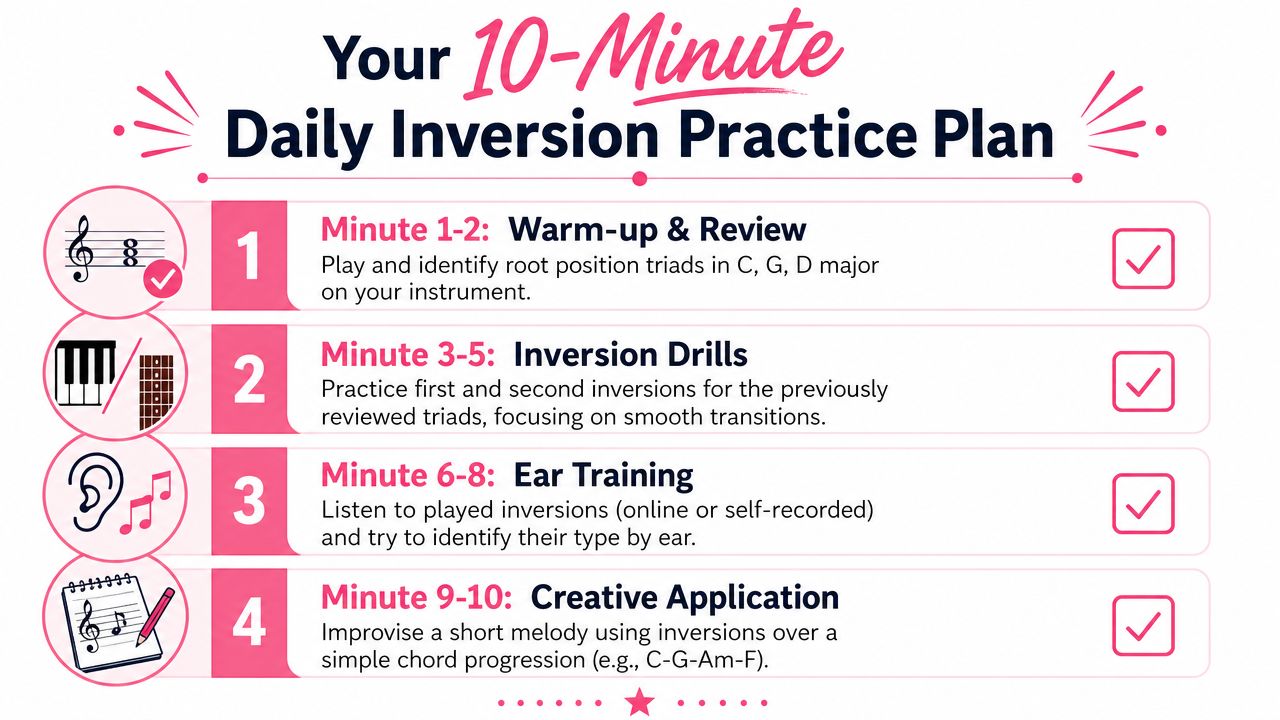
Use this routine:
- Minute 1 to 2. Warm up with root position. Play C, G, and D major triads in root position. Say the root out loud before you play.
- Minute 3 to 5. Drill the inversions. Move each triad into first inversion, then second inversion. Focus on the bass note each time.
- Minute 6 to 8. Do ear training only. Close your eyes. Play one inversion randomly or use a recording. Identify it by sound before checking.
- Minute 9 to 10. Apply it musically. Use inversions in a short progression like C, G, Am, F. Try to make the bass line as smooth as possible.
Keep it simple at first. One key is enough. One chord family is enough. Consistency builds recognition much faster than trying to master every key at once.
If you can hear the bass, you can hear the inversion. If you can hear the inversion, you can play with much more control.
If you want a structured daily routine for ear training, Trill: Ear Training Daily is built around short practice sessions that help musicians recognize chords, intervals, notes, and scales by sound. It’s a practical fit if your goal is to stop guessing, build chord recognition, strengthen perfect pitch skills over time, and play by ear with more confidence.